


Search for after school lesson plans and you mostly get activity lists. An activity is not a plan. A plan is what a part-time staff member can pick up at 3:10pm, with fourteen mixed-age children already in the room, and run without asking a question.
An after school lesson plan sets one goal, lists the materials, splits the session into blocks, gives step-by-step instructions anyone can follow, and leaves space for a two-line note on how it went.
What goes into an after school lesson plan
A usable plan answers seven questions. Any fewer and the person running it has to improvise.
- Session goal. One sentence, observable from across the room. "Every child builds a tower that stands on its own" beats "children explore structures."
- Age range and expected headcount. Write the range you can actually run, not a single number. A plan for 8 to 18 children survives a wet Tuesday.
- Materials, with a substitute. List what you need and what you will use instead when the glue sticks have dried out. Every recurring activity should have a named fallback.
- Time blocks with minutes. Not "activity" but "3:55 to 4:45, main activity." Minutes are what stop a session drifting.
- A step-by-step run sheet. Including how to explain the task in two sentences. If the explanation needs a paragraph, the activity is too complicated for 3:30pm.
- Adaptations: one scaffold, one stretch. A way in for the child who is stuck and a harder version for the child who finished in six minutes.
- A post-session note. Two lines, written before you leave: what to keep, what to cut.
The reason this list looks different from a classroom lesson plan is that after school is not school. Children arrive after six hours of instruction, hungry, socially spent and done with sitting still. Plans that work lean active, short on explanation and heavy on choice. Plans that fail are the ones that need constant resetting: complicated rules, fragile materials, or a task where one mistake means starting over.
Treat the plan as a document a stranger could run. The test is simple. If a relief staff member picked it up cold at 3:05pm, could they run the session without calling you?
The four-block afternoon
Most programs settle on the same shape, because it matches how children arrive. The structured part of the afternoon splits into four blocks.
| Block | Minutes | What it does |
|---|---|---|
| Arrival, snack, settle | 15-20 | Take attendance, food, decompress, tell them the plan for the day |
| Homework or quiet reading | 20-30 | Optional but expected, and the block parents value most |
| Main activity or rotation | 40-60 | The part the lesson plan is really about |
| Free choice and close | 15-20 | Child-led, cleanup, one-line reflection at the door |
That comes to roughly 90 to 130 minutes. A wraparound club running to 6:00pm covers the rest with the fourth block: free choice stretches until the last pickup, which is what staggered collection needs anyway.
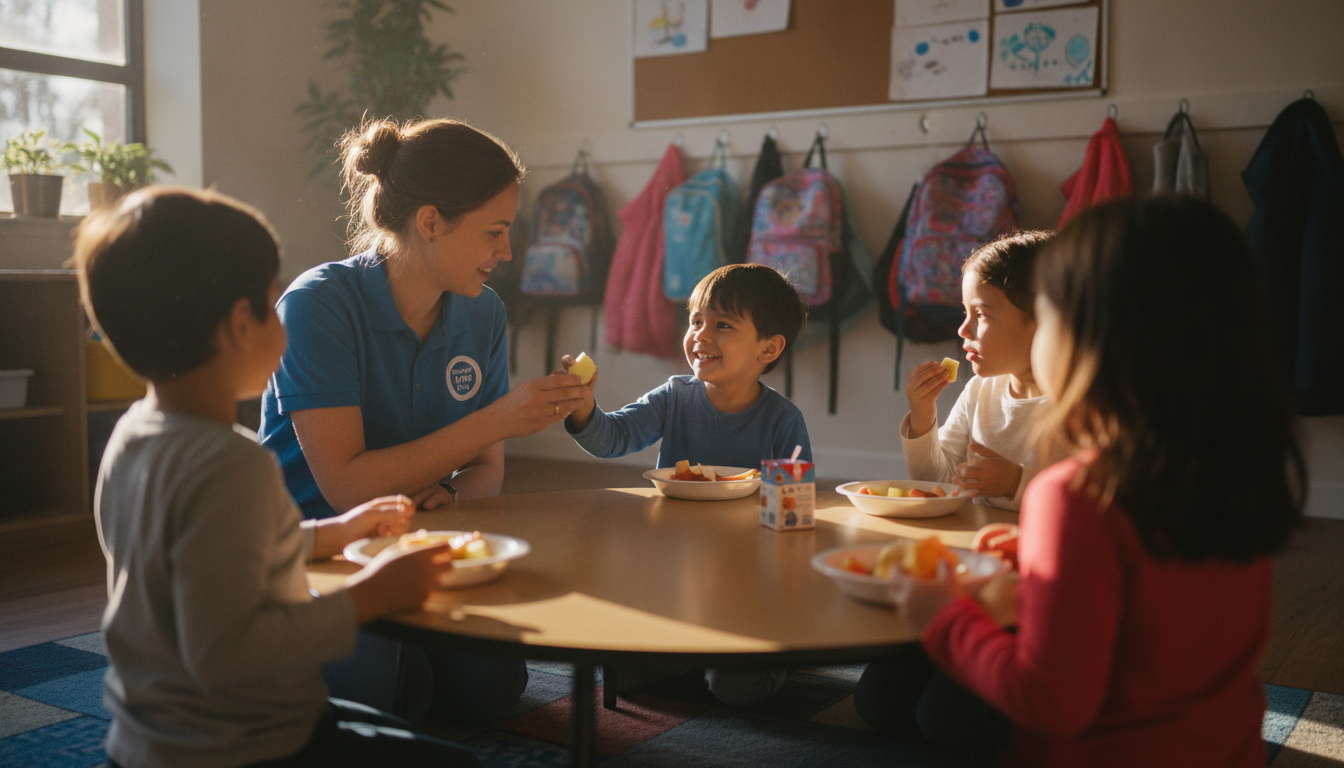
Attendance goes first, before coats are off, because it is the only moment when every child is in one place. Snack goes before anything cognitive, because a hungry seven-year-old cannot follow a three-step instruction and you will spend the main activity managing behavior that food would have fixed.
A 60-minute enrichment club compresses the same shape: 10 minutes arrival and settle, no homework block, 35 minutes on the main activity, 15 minutes for free choice and close. The blocks do not disappear, they shrink.
Transitions are where plans lose time. Use the same three-part move every day: a signal (a clap pattern, a bell, a count of five), a countdown ("two minutes left"), then one instruction at a time. Setting that routine in the first week of term is worth more than any single activity, which is why it belongs in the work of getting your club ready for the new school year rather than something you introduce in week four.
A reusable after school lesson plan template (free PDF)
This is the whole plan on one side of paper. It carries the seven fields above plus three operational lines, prep, Plan B and safety notes, that decide whether the session survives contact with a real Tuesday. Download it as a printable PDF to fill in by hand, or copy the text below into a doc. Fill one per session and keep the filled versions. Six weeks of these is a program; six weeks of activity ideas is a pile of paper.
AFTER SCHOOL LESSON PLAN Date and theme: ____________________ (example: Tue Oct 14, Build week) Ages and expected numbers: ____________________ (example: ages 5-11, 14 to 18 children, 2 staff) Session goal (one observable sentence): ____________________ (example: every child builds a free-standing tower that holds a tennis ball for 5 seconds) Materials, with substitute: ____________________ (example: 10 plastic cups and 20 craft sticks per pair, 1 roll of masking tape per pair. Substitute: newspaper rolls if cups run out) Prep before children arrive (target 10 minutes): ____________________ (example: pull the Build tub, set 8 tables with a tray each, tape a start line) 3:10 Arrival and snack (____ min): ____________________ 3:30 Homework or quiet reading (____ min): ____________________ 3:55 Main activity (____ min) Explain in two sentences: ____________________ Step 1: ____________________ Step 2: ____________________ Step 3: ____________________ Step 4: ____________________ Step 5: ____________________ 4:45 Free choice and close (____ min): ____________________ Scaffold (for the child who is stuck): ____________________ Stretch (for the child who finished early): ____________________ Plan B (if weather, materials or numbers change): ____________________ Safety, allergy and consent notes: ____________________ (example: no food in this activity. Photo consent checked before the display goes up) AFTER THE SESSION (two lines) Keep: ____________________ Cut: ____________________
Two fields carry most of the weight. The two-sentence explanation forces you to test whether the activity is simple enough, and the Plan B line means the decision to switch is made on Sunday rather than at 4pm with a room full of children.
Three sample plans you can run this week
Each of these is the template above, filled in, and each one downloads as a printable one-page PDF. They cover construction, arts and movement, and between them they handle the three constraints that break plans: cost, mixed ages, and zero prep time.
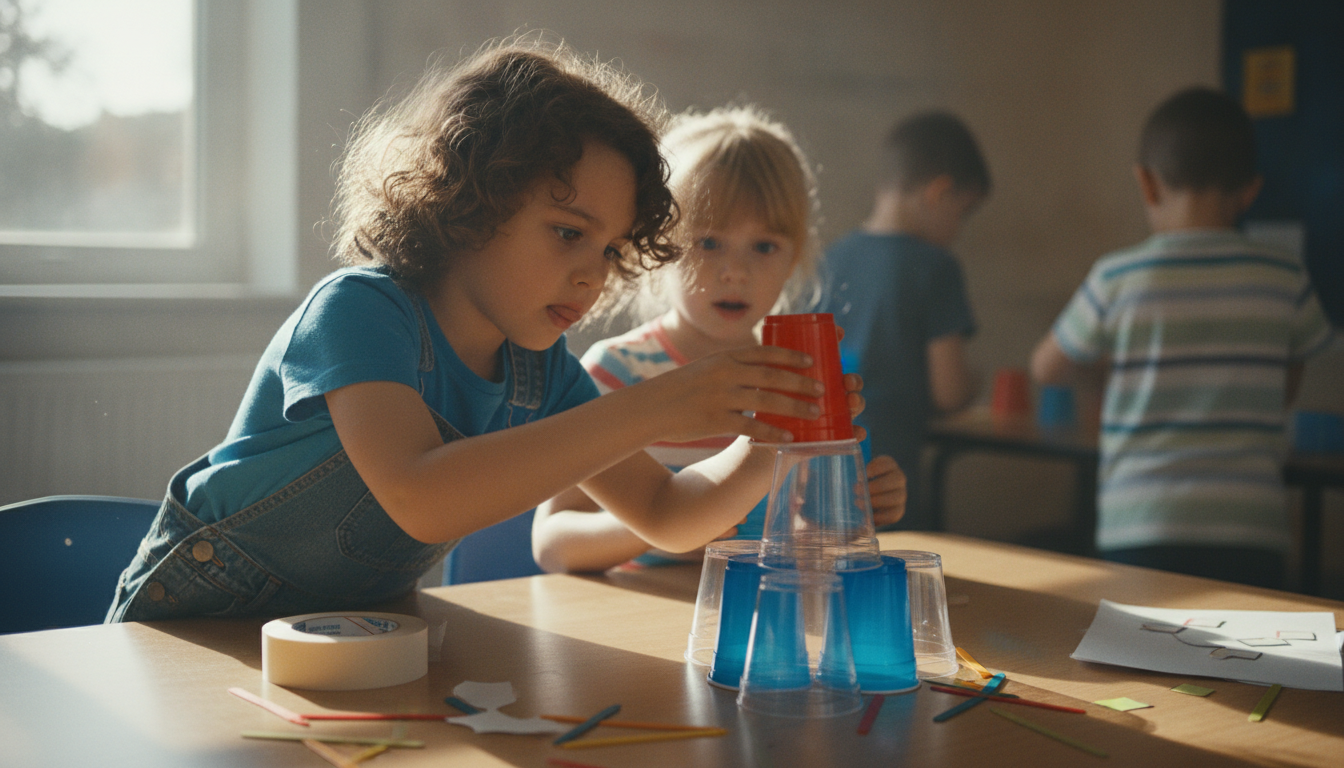
Sample plan 1: Tower challenge, ages 5-8, under $2 a pair
Goal: each pair builds a free-standing tower that holds a tennis ball for five seconds.
Materials: 10 plastic cups, 20 craft sticks and one roll of masking tape per pair. One tennis ball for testing. Substitute rolled newspaper for craft sticks.
Prep (10 min): pull the Build tub, set a tray per pair, tape a start line on each table.
Explain in two sentences: "You have 20 minutes and these materials to build the tallest tower you can. It has to stand on its own and hold this ball for five seconds."
Run sheet: 5 min demo one weak tower and ask why it fell. 20 min build. 5 min testing round, one pair at a time, everyone watching. 5 min cleanup and a show of hands for the tallest survivor.
Scaffold: pre-build a three-cup base so the child starts from something stable. Stretch: set a height target in cup-lengths, then test with a hand fan for wind resistance.
Assessment: the tower either holds the ball or it does not. No rubric needed.
Download the tower challenge plan as a printable PDF.
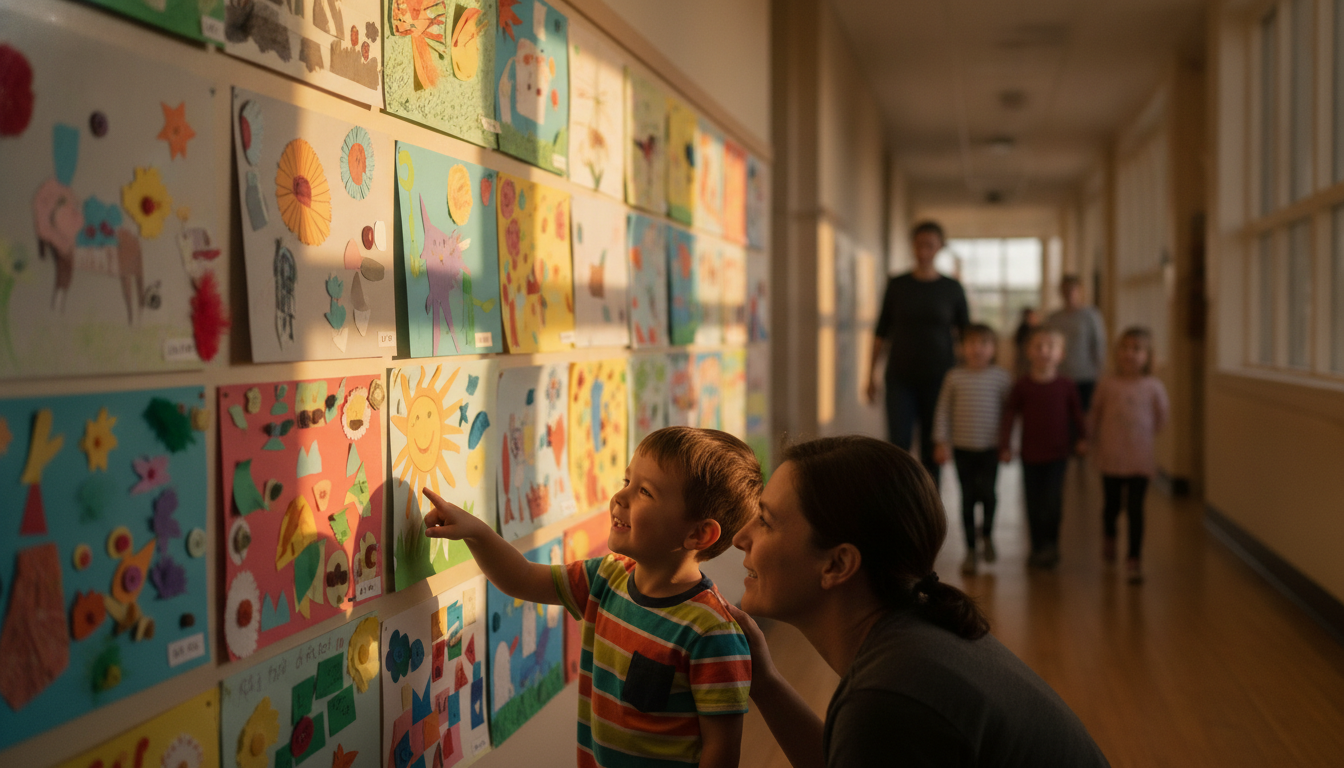
Sample plan 2: Gallery wall collage, mixed ages 5-11, arts
Goal: every child contributes one finished panel to a hallway display on the term's theme.
Materials: old magazines, scrap card cut to a fixed panel size, glue sticks, scissors, one roll of backing paper. Substitute painted paper if the magazines run out.
Prep (10 min): cut the card to size in advance, lay out glue and scissors, pin the backing paper up before children arrive.
Explain in two sentences: "Everyone makes one panel for the wall on our theme. Your panel has to fill the card and it has to still be readable from across the hallway."
Run sheet: 5 min show two finished panels, one simple and one detailed. 30 min make. 10 min mount panels together and stand back to look.
Scaffold: a pre-cut shape to build around, and an adult at the table for the youngest. Stretch: older children add a title strip or curate the layout of the whole wall.
Note before you run it: check photo consent before anything goes on a public display or a social post. Consent for a hallway wall is not the same as consent to post a photo online, and it is worth knowing which children are on which list before the wall goes up. If you need theme options, our list of after school club activity ideas is a good place to start.
Download the gallery wall plan as a printable PDF.
Sample plan 3: Movement games, any age, zero prep
Goal: 35 minutes of active play with nothing but cones, bags or coats as markers.
Materials: six cones or six school bags. That is the entire list.
Prep: none. This is the plan you run when the day falls apart.
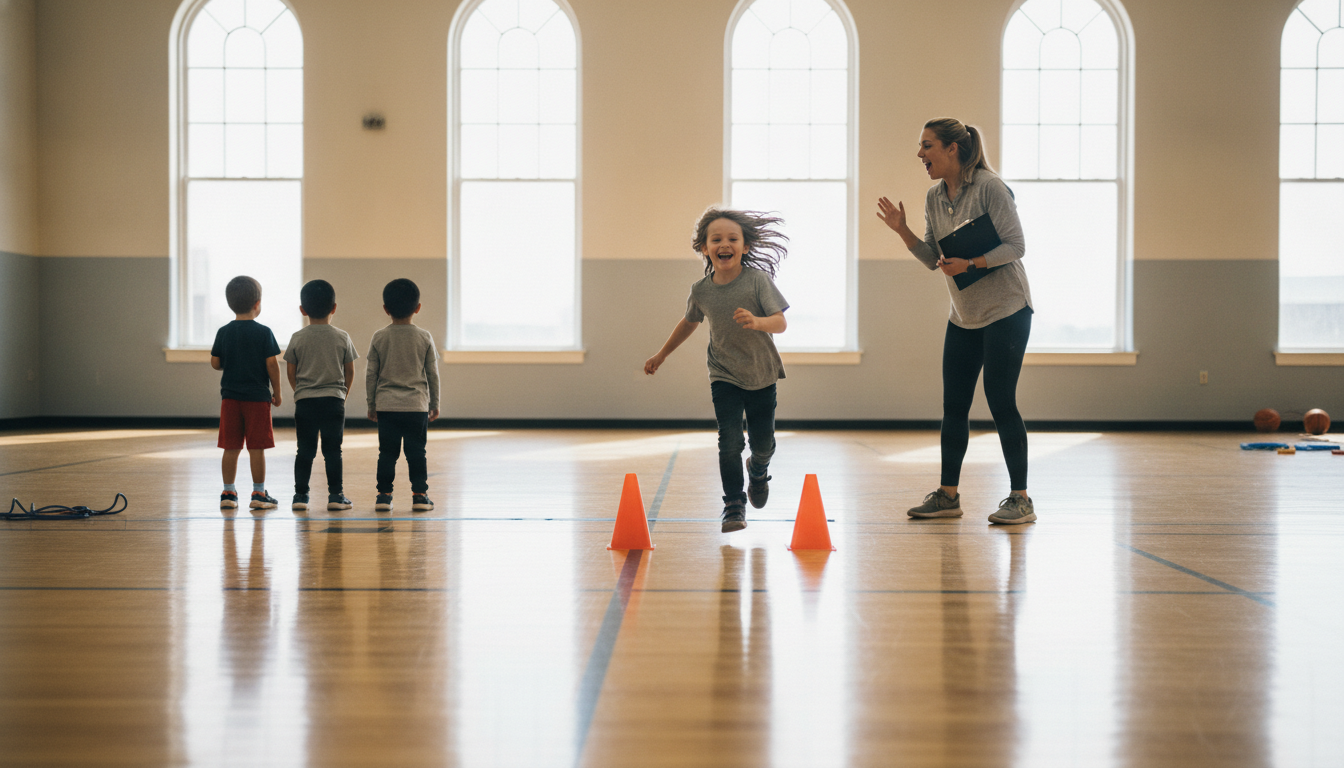
Run sheet: three games, roughly 10 minutes each, with a two-sentence explanation and a quick water break between.
- Corners. Number four corners of the room. Call a number, everyone runs to that corner, last one there swaps into the calling role.
- Cone tag. Two taggers, a safe zone at each cone, only three seconds allowed in a safe zone.
- Line relay. Split into teams behind a line, race to a cone and back, change the movement each round: hopping, sidestepping, crab walk.
Scaffold: shrink the space so slower children are never far behind. Stretch: older children referee a round, which stops them coasting and gives you a second pair of eyes.
This plan pairs with the Plan B section below. Download it as a printable PDF and keep a copy in the folder so nobody has to invent games under pressure. For more games that slot into the same 10-minute rotation, our bank of after school program activity ideas is organized by session slot.
A sample week you can rotate
Theme the week, not the day. The theme is the anchor, the days are interchangeable, and children arrive already knowing the shape of the afternoon.
| Day | Theme | Main activity | Prep |
|---|---|---|---|
| Monday | Build | Tower challenge | Pull the Build tub, tape start lines |
| Tuesday | Create | Gallery wall panel | Cut card, lay out glue, pin backing paper |
| Wednesday | Move | Games rotation | Cones out |
| Thursday | Explore | Scavenger hunt or nature walk | Print sheets, check the weather |
| Friday | Show | Showcase, team games, reflection circle | Put the wall display up |
Predictability lowers the explanation cost. When Wednesday is always Move, you spend 30 seconds on the transition instead of five minutes on the concept, and children who find change hard know what is coming before they walk in. Thursday is the day worth protecting outdoors: our guide to outdoor learning activities covers what to run when the field is available and what to do when it rains.
Here is the caveat that most weekly rotations quietly ignore. Your Tuesday children may never see Monday.
Planning for a roster that changes every day
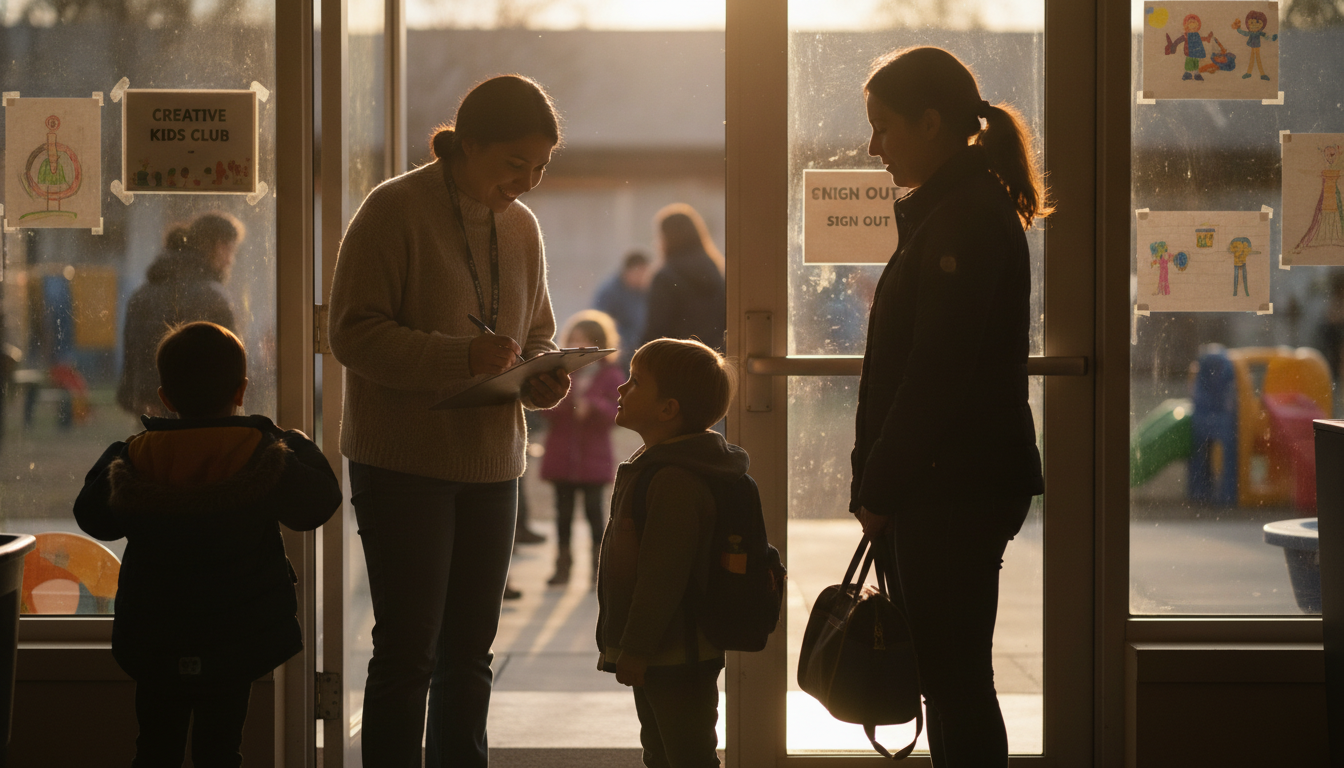
After school places are sold by the day. Families book Tuesday and Thursday, or Mondays only, or a one-off because a shift changed. That means the group in front of you is a different group every session, and a rotation built as if the same twenty children attend all five days will leave someone out four times a week.
Five rules make a plan survive that:
- Make every session self-contained. No cliffhangers, no "we will finish this tomorrow," unless the piece can be stored and picked up by whoever is there that day.
- Give multi-day projects a parallel entry point. A Thursday-only child should start a panel, not watch someone else finish one. Build the project out of repeatable units, not sequential steps.
- Write the plan for a range, not a number. State what the session looks like at 8 children and at 18, and name the headcount at which you split into two groups.
- Keep the same opening ritual every day. Same signal, same snack routine, same order. A newcomer learns the routine in one session instead of three.
- Check the headcount and ratios the morning of, not at 3pm. If Thursday is running at 22 children with two staff, you want to know at 9am while you can still call someone in.
That last point is the one that decides whether a plan is realistic. The plan and the roster need to agree, and they usually live in two different places.
Stretching one plan across ages 5 to 11
You do not need a different plan per age. You need one open-ended task and three rungs. Set the activity once, then change the demand for the child in front of you.
| Layer | Ages 5-7 | Ages 8-9 | Ages 10-11 |
|---|---|---|---|
| Task | Build a tower that stands | Build to a height target | Build to a height and load target |
| Support | Pre-made base, adult at the table | Written steps on the table | Design sketch before building starts |
| Role | Builder | Builder and tester | Team lead, briefs a younger pair |
The same three rungs work on the collage: fill the card, fill the card on theme, curate the wall. Three moves make the ladder run itself. Pair older children with younger ones and give the pairing a job title, because "you are the guide" gets a different response from "look after him." Group stations by what children can do rather than how old they are, since a capable six-year-old and a hesitant nine-year-old often want the same rung. And choose tasks that are naturally open-ended, so a single instruction covers the whole room and the differentiation happens in the doing.
What the research says about plans that work
Most planning advice is taste. There is one piece of evidence that is directly about the question, and it is worth knowing because it changes what you put in the plan.
Durlak, Weissberg and Pachan's meta-analysis of 68 studies of after school programs that set out to foster personal and social development split them by whether staff used four skill-training practices, abbreviated to SAFE: sequenced, active, focused and explicit. The 41 that used all four produced statistically significant gains on every outcome measured, with mean effect sizes of 0.37 for children's self-perceptions, 0.30 for reduced problem behaviors, 0.29 for positive social behavior, 0.25 for school bonding, 0.22 for school grades, 0.20 for achievement test scores, 0.16 for reduced drug use and 0.14 for school attendance. The 27 that did not use all four produced no statistically significant effect on any outcome at all, with mean effect sizes between 0.02 and 0.13.
That is the useful finding here: the difference between a program that changes something and a program that fills time is not the activity, it is how the activity is run. Translated into four things you can write into a plan:
- Sequenced: order your sessions so each one builds on the last. A six-week arc, not seven unrelated afternoons.
- Active: the child does the thing. Cut demonstrations to five minutes and hand over the materials.
- Focused: one skill per session, named in the goal field. Two skills means neither gets enough attempts.
- Explicit: say the skill out loud to the children. "Today we are practicing testing an idea and changing it" is the difference between a craft and a lesson.
The wider context is that the demand is there and the supply is not. Afterschool Alliance's America After 3PM survey of 30,515 parents found that parents of nearly 30 million children want an after school program, and 77% of those children cannot get into one, with cost cited by 56%, no safe way to travel by 49% and no program available locally by 42%. Among families who do have a place, 95% are satisfied and 85% rate the quality as excellent or very good. Your plan is a large part of what earns that rating. If you are still shaping what your program is for, our explainer on what enrichment means in school covers the ground above the session level.
Materials, prep time and a per-child budget
The activity a plan describes is only as good as the prep it demands. Three habits keep prep under 10 minutes.
Build tubs, not shopping lists. One labeled box per recurring activity type: Build, Create, Move, Explore, Show. Everything that activity needs lives in the box permanently and gets topped up on Friday. Prep becomes pulling a box off a shelf rather than remembering what a plan needs and finding it.
Separate buy-once from weekly. The buy-once list is cones, scissors, rulers, a set of laminated instruction cards, masking tape in bulk, a ball bag and a games kit. The weekly list is card, paper, glue sticks, and snack. Confusing the two is why clubs re-buy scissors every term and run out of glue every Wednesday.
Set a per-child materials allowance. Between $0.30 and $0.75 per child per session covers almost any activity if two of your five days are zero-cost movement or outdoor sessions. Work it through for a club of 20 across a six-week block: three materials days a week at $0.50 per child is $30 a week, or $180 for the block, and the Move and Explore days cost nothing but a print run. That number is small enough to sit in a term budget and specific enough to defend to whoever signs off on it. If materials money is the constraint, our guide to grants for afterschool programs covers funders that pay for exactly this kind of cost.
The rule of thumb worth stating plainly: if a plan needs more than 10 minutes of prep, either the tub is missing or the activity is too complicated for after school.
Plan B: rainy days and the 10-minute filler bank
Every written plan should carry a Plan B line, so the decision is made in advance rather than at 4pm. Switch when the weather closes the outdoor block, when materials did not arrive, when half the club is on a field trip, or when the group walks in wired and the room is clearly not going to sit down.
Six no-prep fillers, 10 minutes each, that work from ages 5 to 11:
- Category chain. Name a category, go round the circle, no repeats and no pauses longer than three seconds.
- Silent line-up. Line up in birthday order without speaking. Harder and funnier than it sounds.
- Drawing relay. Teams of four, one word whispered to the first child, each draws one element in turn, the last one guesses.
- Would you rather. Two options, children move to the side of the room that matches their answer, one child explains why each round.
- Paper airplane distance test. One sheet each, one fold-and-throw round, then one round where they are allowed to change the design.
- Story round-robin. One sentence each around the circle. A staff member starts and closes it.
Keep these printed on a single laminated card in the folder. The point of a filler bank is that nobody has to be creative at the worst possible moment.
From single sessions to a six-week arc
A club that runs seven unrelated afternoons is childcare. A club that runs seven sessions building toward something a parent can see at pickup is a program, and parents re-book programs.
The structure is straightforward across a six or seven session block. Session 1 introduces the theme and makes something small and finishable the same day. Sessions 2 to 5 build the parts, each self-contained, each producing a piece that stands alone if that child is not back for two weeks. Session 6 assembles. Session 7 shows: a display in the hallway, a mini tournament, a performance, or just a table of finished work at the door on Friday.
That last session is doing commercial work as well as educational work. A parent who sees a finished thing at pickup has a reason to sign up for next term, and a child who was part of it asks to come back. It is one of the cheapest retention levers a club has, which matters when the harder job is filling the club in the first place. The same thinking scales up: our guide to designing a summer camp curriculum applies it to a full camp program.
How to tell whether a plan worked
Skip the rubric. Three signals, checked in the last 10 minutes, tell you everything a written assessment would.
Completion. How many children finished, and did the ones who finished early have something to do? If a third of the room stalled, the task needed a scaffold. If half finished in ten minutes, it needed a stretch.
Attention. Count the number of times you had to reset the room. Once is normal. Four times means the explanation was too long, the materials were too fiddly, or the block ran past what the group could hold.
Demand. Did anyone ask to do it again? This is the only one children volunteer without being asked, and it is the most reliable of the three.
Then write the two lines: keep and cut. Do that for one term and the folder stops being a stack of plans and starts being a program that improves. At the door, ask "what would you change about today" rather than "did you enjoy it." The first gets you a usable answer; the second gets you a shrug.
Keep the plan and the roster in the same place
A plan needs facts that live in your booking system. Today's confirmed headcount, the ratio that headcount implies, allergy and medical flags before any food or cooking activity, and photo consent before anything goes on a display or a social post. If you are still choosing that system, our roundup of the best afterschool program management software compares five on enrollment, check-in and billing.
We built our afterschool program software so those sit against the booking rather than in a separate spreadsheet. Parents book specific days, so numbers are known in advance rather than counted at the door. Capacity limits per session mean Thursday cannot quietly become a 24-child afternoon with two staff. Attendance, allergy notes and consent flags are on the same list, so the person writing Monday's plan is working from what the person at the door will see.
Neither replaces the other. The plan decides what happens; the roster decides whether it can.
Key takeaways
- One goal per session, written as something you can see from across the room.
- Four blocks: arrival and snack, homework, main activity, free choice and close. Compress them for a 60-minute club, do not drop them.
- The plan should fit on one page and be runnable by someone who has never seen it.
- Make every session self-contained, because after school rosters change daily and a five-day arc leaves part-time children out.
- Differentiate with one open-ended task and three rungs rather than three separate plans.
- Sequenced, active, focused, explicit. Programs missing any of the four showed no statistically significant gains on any outcome.
- Budget $0.30 to $0.75 per child per session, keep an activity tub per theme, and cap prep at 10 minutes.
FAQs
What should an after school lesson plan include?
Seven things: one observable session goal, the age range and expected headcount, materials with a named substitute, time blocks with minutes, a step-by-step run sheet including a two-sentence explanation, one scaffold and one stretch, and a two-line note written after the session. It should fit on one side of paper.
How long should an after school session be?
A wraparound club typically runs 3:00 to 6:00pm, with about two hours of structured time in four blocks: 15-20 minutes arrival and snack, 20-30 minutes homework, 40-60 minutes main activity, and 15-20 minutes free choice and close, with free choice stretching until the last pickup. A 60-minute enrichment club uses the same shape compressed to roughly 10, 0, 35 and 15 minutes. The same block logic applies to a morning session, which is why [breakfast club ideas](/blog/breakfast-club-ideas) follow a similar structure.
How do you plan for mixed ages in one club?
Run one open-ended task with three rungs rather than three separate plans. Change the demand, not the activity: build a tower that stands, build to a height target, build to a height and load target. Pair older children with younger ones and give the pairing a named role, and group stations by ability rather than age.
Do after school programs need a curriculum?
Most settings do not require a formal curriculum, and a themed six-week arc does the same job with far less paperwork. Check your local licensing or registration requirements, since some states and local agencies set quality standards for programs receiving public funding. Plan a theme per block and let each week's plan sit inside it.
Where can I find free after school lesson plans?
The reusable template in this article is [free to download as a printable PDF](/downloads/after-school-lesson-plan-template.pdf), no email required. For fully written plans, the [Afterschool Lesson Plan Database](https://sedl.org/afterschool/lessonplans/) from the National Center for Quality Afterschool at the American Institutes for Research holds 103 free lesson plans, covering 29 math, 23 art, 21 literacy, 16 technology and 14 science, sorted by subject and grade span from kindergarten through grade 12. Some include a sample video of the activity being run.
How much homework time should an after school program include?
Twenty to thirty minutes is standard, offered rather than enforced. Always have an alternative ready for children who have no homework or finish early, usually quiet reading or a puzzle table, because the block only works if nobody is sitting with nothing to do. Parents consistently rate this block highly, so it is worth protecting.
How do you plan when attendance changes every day?
Write self-contained sessions with no cliffhangers, give multi-day projects a parallel entry point so a newcomer starts a piece rather than watching one finish, and write each plan for a range of children rather than a fixed number. Keep the opening ritual identical every day so a child attending once a week still knows the routine.
How far ahead should you plan?
Pick a theme per six-week block, write individual plans one week ahead, and order materials two weeks ahead. That spacing means a delivery delay never cancels a session, and it leaves room to react to what the previous week's notes told you. Reuse filled plans from last term rather than starting from a blank page.
What activities work best right after school?
Active, short to explain, and choice-led. Children have just finished six hours of instruction, so anything needing sustained concentration should sit in the second block after snack, not the first. Construction challenges, movement games, open-ended art and outdoor exploration all work; long written tasks and multi-rule board games do not.
How many activities should one session have?
One main activity, plus free choice. Two or three short rotations work for younger children with shorter attention spans, but the temptation to schedule four things back to back is what turns an afternoon into a series of transitions. One skill, enough attempts at it, then choice.
What is the difference between a lesson plan and an activity plan?
An activity plan describes what the children will do. A lesson plan adds why, for whom, in what order, with what adaptations, and how you will know it worked. Search results tend to give you the first, but it is the second that lets someone else run your session without asking a single question. If you are setting up from scratch, our guide on [how to start an after school program](/blog/how-to-start-an-after-school-program) covers the steps before the planning starts.