


A gymnastics gym is one of the most equipment-heavy kids-activity businesses you can open. A spring floor alone can run $30,000, and you need a building with 18 feet or more of clear ceiling and no columns in the training area. Get the concept, the building, or the numbers wrong before you sign a lease, and you are locked into a five-figure monthly mistake. This guide gives you the real costs, a sample budget, a facility checklist, the staffing and insurance reality, and a month-by-month timeline.
The short version: opening a gymnastics gym takes roughly 6 to 12 months and $150,000 to $500,000, and it breaks down into eleven steps: validating the idea, choosing your concept, business plan, funding, facility, equipment, insurance and legal setup, coaching, programs and pricing, day-one admin, and marketing. We will work through each one with numbers you can actually plan against.
What it costs to open a gymnastics gym
Plan for $150,000 to $500,000 to open a gymnastics gym. A small recreational or preschool-focused gym can open nearer $100,000 to $250,000. A full competition facility with bars, beams, vault, a spring floor, and an in-ground pit runs $300,000 to $500,000 and up.
The single biggest variable is equipment. The second is your building fit-out. Everything else, insurance, legal setup, software, and first months of rent, is smaller by comparison but still adds up fast. Here is how a typical startup budget splits out.
These are synthesized ranges, not a single quote, so treat them as planning brackets and tighten each line as you get real numbers from landlords, equipment suppliers, and insurers in your area. The full profit-and-loss view behind these figures, including a sample one-year P&L, is what your business plan pulls together (Step 3).
Step 1: Get clear on why, and get real gym experience
Before any capital moves, validate two things: your motive and your understanding of the operation. Owning a gym is mostly admin, payroll, retention, and risk management, with coaching squeezed in around the edges. Plenty of brilliant coaches open gyms and burn out on the business side.
The cheapest way to learn is from the inside. Coach, manage, or shadow at an existing gym for a season. Interview owners who are not your direct competitors and ask the questions that matter: what percentage of revenue goes to rent, what goes to payroll, what their student retention looks like month to month, and what they wish they had known before signing their lease.
Demand for gymnastics is real but intensely local. The Sports & Fitness Industry Association tracks gymnastics as a long-standing top youth participation activity, and US gymnastics class providers number in the thousands, which means most catchments already have competition. The market is there. Your job is to prove there is room for one more gym within a 15-minute drive of where families already live.
Step 2: Choose your gym type and niche
Your concept drives every later number, facility size, equipment list, coach hires, insurance band, and revenue mix. Decide it first.
The main models are:
- Recreational only - classes for hobby gymnasts, the lowest equipment load, the fastest path to open.
- Recreational plus competition team - the most common model; rec classes fund the building and feed a small team track.
- Competition-focused - the most capital- and coach-intensive, with full apparatus and an in-ground pit.
- Tumbling and trampoline - lighter on bars and beams, heavier on sprung strips and trampolines.
- Ninja or parkour crossover - obstacle-based, popular with older kids and a different equipment list again.
- Preschool and parent-and-tot heavy - soft-play shapes over competition apparatus, lower fit-out, daytime revenue.
Layer your age bands on top: parent-and-tot (18 months to 3 years), preschool (3 to 5), school age (6 to 12), teens, and an optional adult fitness-gymnastics track. Then pick a specialism. Artistic is the default; tumbling and trampoline, rhythmic, acro, and cheer-tumbling are all viable niches with their own equipment needs.
A 3,000 sq ft preschool-and-tumbling gym is a fundamentally different business from a 10,000 sq ft competition facility, and most families will travel less than 15 minutes to reach either one. Be honest about which one your market and your budget support. If you want the demand case for the underlying activity, our piece on the benefits of gymnastics for children lays out why families keep signing up.
Step 3: Write your business plan
Lenders do not fund ideas. They fund plans with numbers. Whether you approach a bank, the SBA, an equipment financier, or a parent willing to back the build, you need an executive summary, your concept, a local market analysis, your services and revenue mix, your facility and equipment requirements, a staffing plan, and financial projections.
Vague numbers mean no loan and no signed lease. The plan is also where the sample budget above turns into a real one: your specific rent, your specific equipment list, your specific class capacity and pricing.
Rather than duplicate the detail here, build it properly with our gymnastics business plan guide, which walks through every section with gymnastics-specific figures and a worked one-year profit and loss. Come back to this guide for the operational steps once your plan is firm.
Step 4: Sort out your funding
Most gyms are funded by a stack, not a single source. The common pieces are:
- Personal savings - almost always part of the mix; lenders want to see you have skin in the game.
- An SBA 7(a) loan - the SBA 7(a) program is the standard route for fit-out and working capital, with longer terms than a conventional bank loan.
- Equipment financing or leasing - spreads $50,000 or more of apparatus over a multi-year term and preserves cash for rent and payroll.
- Investors or partners - a co-owner who brings capital, coaching, or operational experience.
- Pre-sold founding memberships - collecting deposits or discounted memberships before you open, which both funds the build and proves demand.
- Grants - US clubs can look at local small-business and youth-sport grants; UK clubs have routes through British Gymnastics and Sport England.
We cover the grant side in more depth in our guide to funding for gymnastics clubs.
How to open a gymnastics gym with less capital
You do not have to open at full scale on day one. If $300,000 is out of reach, lower the entry cost:
- Rent hours in an existing facility - a rec center, a school gym, or a host club's off-peak slots let you run classes with almost no fit-out.
- Launch preschool and tumbling only - soft shapes, mats, and a single sprung strip cost a fraction of full artistic apparatus.
- Lease equipment instead of buying - higher lifetime cost, far lower upfront cost, and the apparatus is replaceable as you grow.
- Run mobile or pop-up classes first - build a waitlist and a brand before you commit to a lease, then convert that demand into your founding members.
Each of these trades some margin for a much smaller initial outlay, and several let you start earning while you raise the capital for a permanent space.
Step 5: Find the right facility
The building is the biggest bottleneck and the decision you can least afford to rush. Gymnastics needs space most retail or office units simply do not have, and the wrong building cannot be fixed with money. Tour every space against a fixed checklist so you can walk away from the ones that do not work.
| Facility spec | Why it matters | Typical requirement |
|---|---|---|
| Clear-span interior | Columns in the training area are dangerous and unusable | No poles or columns across the floor |
| Ceiling height | Bars, tumbling, and trampoline need vertical clearance | 18-20 ft minimum, more for trampoline |
| Square footage | Drives how many programs and students you can run | 2,500-3,000 sq ft small rec; 10,000-20,000 sq ft full competition |
| Floor and pit | An in-ground pit needs the right slab and excavation | Suitable slab, or budget for a foam/resi pit instead |
| Fire and access | Code compliance and parent expectations | Sprinklers, fire egress, ADA access, restrooms, viewing area |
| Parking | Drop-off and pickup flow shapes the parent experience | Roughly 25 spaces per 250 students |
| Zoning | Often the slowest approval in the whole project | Change-of-use permit for assembly or recreation |
| Location | Catchment and competition | 5+ miles from an established competitor where possible |
Two lines on that list quietly sink more projects than any other. The first is ceiling height: a 42-foot competitive spring floor and a full bar setting need real vertical clearance, and you cannot raise a roof. The second is zoning. Changing a unit's use to recreational assembly can take months of permits and inspections, so confirm the path with the local planning office before you sign anything.

Step 6: Buy your equipment
Once the building is secured, equipment is your largest single line. Buy safety-critical pieces new and consider used only for non-critical items. Core artistic apparatus and rough per-piece ranges look like this:
- Spring floor - around $30,000 for a full competition floor; sprung tumbling strips cost less.
- Uneven bars - a single setting plus matting.
- Balance beams - low training beams through to competition-height beams.
- Vault table and runway - the table plus a sprung or rolled runway.
- Mats - panel mats, landing mats, cheese wedges, and incline shapes, bought in volume.
- Pit foam or a resi pit - an in-ground foam pit, or a above-ground resi-pit alternative.
- Trampolines and tumbl-trak - for tumbling, trampoline, and skill progression.
- Preschool soft play - octagons, cylinders, mini-tramps, and soft shapes for the youngest classes.
All in, equipment runs from about $30,000 for a lean recreational setup to $250,000 and up for a full competition floor. For a complete itemized breakdown, use our gymnastics equipment list, and once it is installed, our gymnastics lesson plans and gymnastics games and warm-ups help you put it to work from week one.
Step 7: Get insured and handle the legal setup
Gymnastics is a contact-injury sport, which makes risk management non-optional. Get the legal and insurance scaffolding right before a single child sets foot on the floor.
On the legal side, form a legal entity (an LLC is the most common choice for US gyms), get an EIN, register for a business license and sales tax where it applies, and run background checks on every coach. On the insurance side, you typically need:
- General liability - roughly $300 to $5,000 a year depending on size and coverage.
- Accident-medical - covers injuries to participants during class.
- Property insurance - protects your equipment and leasehold improvements.
- Workers' compensation - required once you have employees in most states.
Budget $700 to $6,000 for first-year insurance overall, scaling with your size and program mix. Note that these figures and the legal structures are US-specific; UK clubs work through British Gymnastics membership and different insurance providers, so check the requirements for your country.
Step 8: Hire and certify your coaches
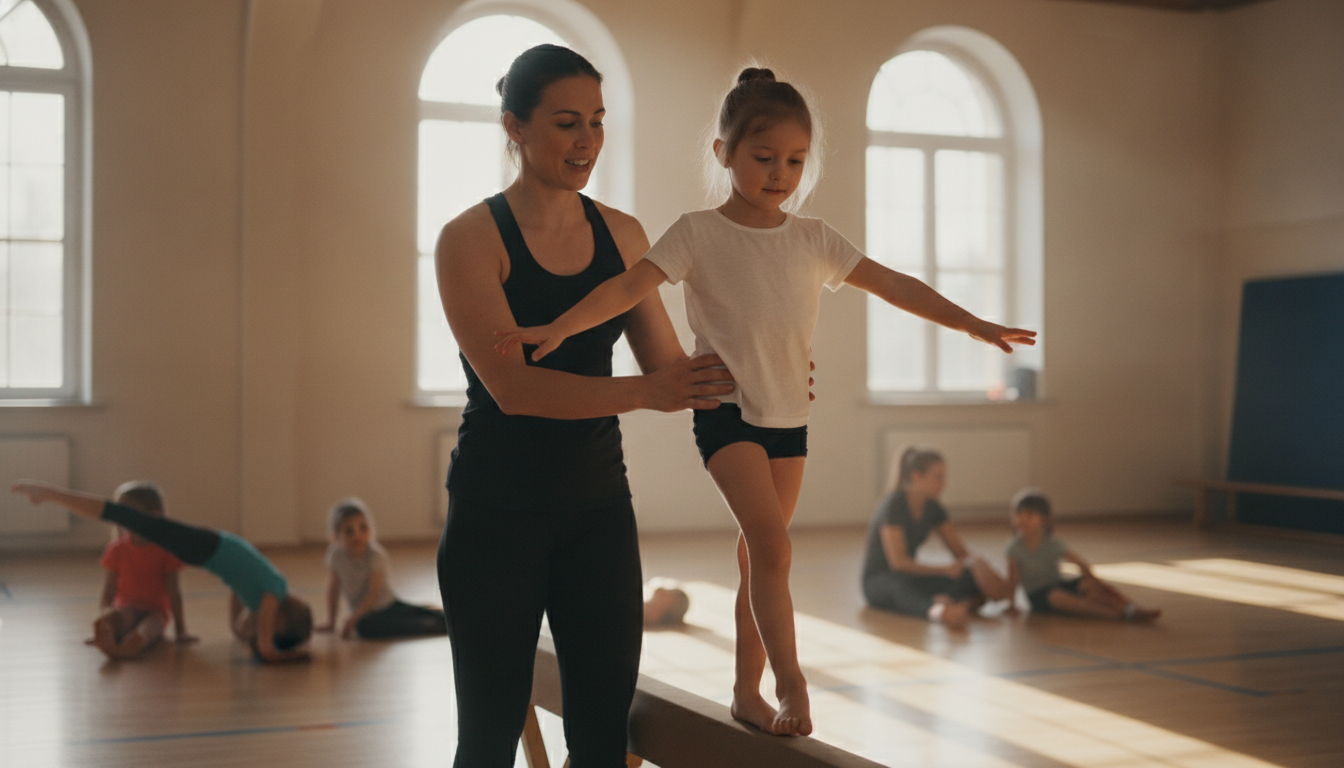
Your coaches are your product and your single biggest payroll line. Staff to safe ratios: roughly 1 coach to 6 gymnasts for recreational classes, and 1 to 4 for preschool, where attention spans are short and supervision matters most.
In the US, certification runs through two bodies. Coaches join USA Gymnastics as professional members, complete the U.S. Center for SafeSport abuse-prevention training, and hold a current USA Gymnastics safety certification, which is renewed on a roughly four-year cycle. Many clubs also designate a Safety Champion to keep certifications and policies current. Confirm the exact current membership and certification fees on usagym.org before you budget, since rates change year to year.
Hire flexibly. Bring in experienced team coaches for your upper competitive levels, and recruit trainable staff, former gymnasts, dancers, or preschool teachers, for entry-level and parent-and-tot classes, then certify them as they grow. For the full path your hires will follow, point them at our guide on how to become a gymnastics coach. In the UK, the equivalent path runs through British Gymnastics coaching qualifications and DBS checks.
Step 9: Set up programs, pricing, and the schedule
This is the math most guides skip: what you charge, and what you actually earn. Typical US pricing looks like this:
| Program | Typical price |
|---|---|
| Recreational class tuition | ~$150 / month (or $15-20 per drop-in) |
| Developmental / competition team | ~$250 / month |
| Adult fitness-gymnastics track | ~$90 / month |
| Add-ons | Birthday parties, holiday camps, pro-shop, private lessons |
Blend those and a typical gym lands around $180 in average revenue per student per month. At roughly 10 months of average tenure, that is about $1,800 in lifetime value per student, before add-ons.
On margins, a healthy gym runs a gross margin of 50 to 60% and a net margin of 10 to 20% once rent (usually 15 to 25% of revenue) and payroll (25 to 40%) are paid. To find your break-even, add your fixed monthly costs (rent plus base payroll), then divide by your contribution per student. If your fixed costs are $20,000 a month and each student nets you $130 after direct costs, you need roughly 154 active students to break even.
Build a weekly schedule that follows demand: after-school and weekend slots are your peak rec hours, while weekday mornings are prime time for preschool and parent-and-tot classes that would otherwise sit empty. Strong session planning keeps retention high, so stock your coaches with a deep bank of gymnastics drills for kids before you open.
Step 10: Handle the day-one admin
From the moment you open, you are running an operation: online enrollment, recurring or term-based tuition billing, class registers and attendance, digital medical and photo-consent forms, family accounts, and parent communication across dozens and then hundreds of families. This is the load most opening guides ignore, and it is the one that breaks first.
A spreadsheet and a card reader hold up for a handful of families. By your third term, with siblings on different plans, mid-month joiners, failed payments, and waitlists, manual admin starts eating the evenings you should be coaching or marketing. Chasing tuition by hand is the fastest way to leak both revenue and goodwill.
This is exactly where we built Pembee to help. One place handles enrollment, recurring billing, attendance, and family records, so your front desk is not stitching together three tools and a notebook. Our piece on why class payment and attendance software pays off makes the case in detail, and our roundup of the best gymnastics management software for 2026 shows how the options compare.
Step 11: Market the gym and fill your classes
Empty mats do not pay rent, so marketing starts before you open, not after. Build a pre-launch waitlist and offer founding-member pricing to the families who join it. Those early sign-ups give you cash flow on day one and a base of word-of-mouth.
Local search is your highest-return channel. Claim and fill out your Google Business Profile, gather reviews early, and partner with nearby schools, preschools, and community groups who already reach your families. Run a grand-opening event with free trial classes, and lean on referral and family discounts to turn each enrolled family into two.
Make signing up effortless. If a parent finds you on a Saturday morning and cannot enroll on their phone in two minutes, you have lost them, which ties straight back to the booking setup in Step 10. For the full playbook, work through our gymnastics marketing guide and our list of gymnastics marketing ideas.
A realistic timeline: decision to opening day
Most owners underestimate how long the lease, zoning, and equipment steps take. From firm decision to first class, plan for 6 to 12 months. Here is a workable sequence.
The two steps that blow timelines are zoning approval and equipment lead times. A custom spring floor or in-ground pit can take months to fabricate and install, so order early, and never assume a change-of-use permit is a formality.
Key takeaways
- Plan for $150,000 to $500,000 and 6 to 12 months to open a gymnastics gym; a small rec gym can open nearer $100,000 to $250,000.
- Concept comes first. A preschool-tumbling gym and a full competition facility are different businesses with different budgets, buildings, and equipment.
- The building is the bottleneck. Tour every space against a fixed checklist: clear-span, 18-20 ft ceilings, the right square footage, parking, and a workable zoning path.
- Equipment is your biggest line. Buy safety-critical apparatus new; lean or lease to open with less capital.
- Know your numbers. Around $180 average revenue per student, 50-60% gross margin, and a break-even of fixed costs divided by per-student contribution.
- Set up enrollment, billing, and attendance before day one, not after, and market a waitlist before you open.
FAQs
How much does it cost to open a gymnastics gym?
Plan for $150,000 to $500,000 in total. A small recreational or preschool-focused gym can open for around $100,000 to $250,000, while a full competition facility with a spring floor, in-ground pit, and complete apparatus runs $300,000 to $500,000 and up. Equipment and building fit-out are the two largest lines by a wide margin.
How much space do you need for a gymnastics gym?
A small preschool or recreational gym can work in 2,500 to 3,000 sq ft, while a full competition facility needs 10,000 to 20,000 sq ft. Beyond floor area, you need 18 to 20 feet of clear ceiling height and a clear-span interior with no columns in the training area, which rules out most standard retail and office units.
How long does it take to open a gymnastics gym?
Plan for 6 to 12 months from firm decision to opening day. The steps that most often cause delays are zoning and change-of-use approval, which can take months, and equipment lead times, since a custom spring floor or in-ground pit can take weeks to fabricate and install. Order equipment and start the permit process as early as possible.
Is a gymnastics gym profitable?
Yes, a well-run gym is profitable, typically at a gross margin of 50 to 60% and a net margin of 10 to 20%. The two levers that decide profitability are rent, usually 15 to 25% of revenue, and payroll, usually 25 to 40%. Keep both in range, hold retention up, and add high-margin revenue like camps, parties, and private lessons.
How do you open a gymnastics gym with little money?
Lower the entry cost rather than skipping steps. Rent off-peak hours in an existing rec center or host club, launch a preschool-and-tumbling concept that needs far less equipment, lease apparatus instead of buying it, and run mobile or pop-up classes to build a paying waitlist before you sign a lease. Each path trades some margin for a much smaller upfront outlay.
Do I need USA Gymnastics affiliation to open a gym?
You do not strictly need USA Gymnastics affiliation to open, but it is expected if you want SafeSport training, safety certification, and the ability to enter sanctioned competitions. Most credible clubs affiliate. In the UK, the equivalent is British Gymnastics membership. Confirm current fees and requirements directly with the governing body before you budget.
What qualifications do gymnastics coaches need?
In the US, coaches typically hold USA Gymnastics professional membership, complete U.S. Center for SafeSport abuse-prevention training, and maintain a current USA Gymnastics safety certification, renewed roughly every four years, plus CPR and First Aid. UK coaches work through British Gymnastics qualifications and DBS checks. See Step 8 above for the full path your hires will follow.
How many students do you need to break even?
It depends on your fixed costs and your per-student contribution. Add your monthly rent and base payroll to get fixed costs, then divide by what each student nets you after direct costs. A gym with $20,000 in monthly fixed costs and a $130 net contribution per student needs roughly 154 active students to break even.
What insurance does a gymnastics gym need?
At minimum, general liability, accident-medical cover for participants, property insurance for your equipment and improvements, and workers' compensation once you have employees. First-year insurance typically runs $700 to $6,000 depending on your size and program mix. Because gymnastics is a contact-injury sport, treat insurance and documented safety procedures as non-negotiable.
What software do you need to run a gymnastics gym?
You need a system that handles online enrollment, recurring or term-based tuition billing, attendance registers, digital medical and consent forms, and family accounts in one place. Running this on spreadsheets and a card reader breaks down once you pass a few dozen families. We built Pembee to handle exactly this load in one place, and Step 10 above links a full comparison of the options if you want to weigh them up.
Should I open a recreational or competition gym first?
For most first-time owners, recreational classes are the foundation, with a small competition team added later. Recreational programs carry a lighter equipment load, fill faster, and generate the steady cash flow that funds a team track. A recreational-plus-team model is the most common structure for exactly this reason. Decide based on your local demand, your budget, and your coaching depth.