


Kids walk in at 3:10 having sat still since 8:30. They are hungry, loud, and the group runs from kindergarten to fifth grade in one borrowed room with two staff. Somebody has to have a plan, and it usually gets made at 2:40pm.
So here are 50 after school program activity ideas grouped by where they fit in the session rather than by subject, because that is how an afternoon is actually planned. Every one carries an age band, a group size range, a prep time, a materials list and the space it needs. The best after-school activities are matched to the slot they run in: high-energy movement early, hands-on making in the middle, quiet wind-down before pickup.
Below the list sits a sample week you can copy, a costed starter kit, and the mixed-age tactics that keep a K-5 room together. Demand is not the problem: the Afterschool Alliance found that parents of nearly 30 million children want a program and more than 3 in 4 of those kids are not in one. Delivering a good session every day is.
Why after-school activities need their own playbook
After-school is not a second school day and it is not camp. Kids arrive depleted rather than fresh, the group spans six years of development, the room often belongs to someone else, and the budget is whatever was left after payroll.
That changes what a good activity looks like. Sequence matters more than the activity itself. Movement comes before focus, food comes before instruction, and wind-down comes before pickup, or you hand a parent an over-stimulated child at 5:50pm and they remember that instead of the craft.
Movement earns a protected slot for two reasons. The CDC recommends 60 minutes or more of moderate-to-vigorous activity a day for ages 6 to 17, and just 24% of that age group get it every day. The after-school window is where that shortfall gets closed. It also makes the rest of the session work: the Institute of Medicine's review of the evidence found that a single bout of moderate activity improved children's attention on a focus task, where an equal period of quiet rest did not. Run the tag game before the homework block, not after it.
Parents notice the design rather than the activity names. Nine in ten say programs encourage fun and learning and cut screen time, which is a verdict on the shape of your afternoon rather than on any one activity. It is worth turning each slot into a written plan so any staff member can run it when the regular lead is out.
How to read the activity specs
Every idea below ends with a one-line spec in this shape:
Ages 5-8 · 4-30 kids · 5 min prep · Paper, markers, tape · Tables
- Ages is developmental fit, not a rule. Most activities stretch either way with the tweaks in the mixed-age section.
- Group size is the range where it holds together. Below the floor it falls flat, above the ceiling it turns into crowd control.
- Prep is staff minutes before kids arrive, not total run time.
- Materials is what you need on hand. Anything not listed you already have.
- Space is the honest minimum: tables, clear floor, gym, corridor or outdoor.
Arrival and decompression activities (ideas 1-7)
The first 15 to 20 minutes. Kids trickle in over that whole window, so everything here has to be joinable halfway through and has to absorb energy rather than demand attention.
1. Choice-board check-in. Post three or four stations on a whiteboard and let kids pick one as they arrive; the board doubles as your attendance sheet when they move a name card across. Ages 5-11 · 10-40 kids · 5 min prep · Whiteboard, name cards or magnets · Any room
2. Question of the day wall. One low-stakes question, one sticky note per kid, stuck to a wall you keep all term. Best food you ate this week. A superpower you would return. Ages 5-11 · 5-40 kids · 5 min prep · Sticky notes, pens, wall space · Any room
3. Wiggle-out warm-up circle. Ninety seconds of shake-outs, animal walks and big stretches to reset bodies that have been in a chair since lunch. Ages 5-11 · 6-40 kids · No prep · None · Clear floor
4. Silent ball. Kids pass a soft ball around a circle without speaking, and anyone who talks or drops it sits. The quiet is the game, which is why it works on the loudest arrivals. Ages 7-11 · 6-20 kids · No prep · One soft ball · Clear floor
5. Build-a-story cube. Roll a story die or pull a prompt slip, and each kid adds one sentence as they join the circle. Ages 6-11 · 4-15 kids · 5 min prep · Story dice or prompt slips · Tables or carpet
6. Mystery box guessing. One hidden object, five yes or no questions per table, one guess each. Ages 5-10 · 4-25 kids · 5 min prep · A box and one object · Any room
7. Free-draw table with a weekly prompt. The default for kids who need ten minutes of nothing before they can talk to anyone. Change the prompt card each Monday. Ages 5-11 · 1-12 kids · 2 min prep · Paper, markers, prompt card · Tables
Do not open the day with instructions. Two minutes of movement first, then the briefing, and you will say it once instead of four times. If you are starting a new term or a new cohort, borrow from these name games and first-week openers, which scale down from camp to a 20-minute arrival window.
Snack-time activities that earn their 20 minutes (ideas 8-12)
Snack is the slot most programs waste. Kids are sitting and eating anyway, so run something conversational that costs nothing to set up.
8. Two truths and a wish. A kinder variant of two truths and a lie: two true things about your day, one thing you wish had happened. Works down to age five. Ages 5-11 · 4-30 kids · No prep · None · Tables
9. Table talk cards. A jar of 40 conversation prompts, one card per table per day. Write them once and reuse them for years. Ages 6-11 · 4-40 kids · 20 min once · Index cards, jar · Tables
10. Rose, thorn, bud. Best thing today, hard thing today, thing you are looking forward to. It is a soft behavior check-in disguised as a game, and staff learn more here than anywhere else in the session. Ages 5-11 · 4-30 kids · No prep · None · Tables
11. Guess my snack. Describe what you are eating without naming it. Sneaks descriptive vocabulary into a slot with zero academic pressure. Ages 5-9 · 4-25 kids · No prep · Whatever is on the table · Tables
12. Snack-builder challenge. Kids assemble a no-cook snack from a set of components: yogurt parfait, ants on a log, fruit kebab. Ages 5-11 · 6-30 kids · 15 min prep · Yogurt, fruit, cereal, celery, cups, spoons · Tables near a sink
Keep a printed allergy list at the snack table and check every ingredient panel against it before serving, including the ones you have served before, since manufacturers change formulations. Run food activities nut-free and dairy-free by default so no child sits out, and follow whatever food handling rules your license or host site sets. Our food planning notes for camps cover portioning and shopping for a group if you are catering more than a snack.
Get-moving activities (ideas 13-22)
The biggest section, and the one that protects the 60-minute target. Some of these need a gym, several need nothing but a cleared floor, and the spec line tells you which.
13. Sharks and minnows. One shark in the middle, everyone else runs from wall to wall, tagged players become sharks. Scales to 40 kids with zero equipment. Ages 5-11 · 10-40 kids · No prep · Cones for the boundary · Gym or outdoor
14. Rob the nest. Four teams, four hoops, a pile of beanbags in the middle, one runner at a time. Ruthless, fast, and over in twelve minutes. Ages 6-11 · 8-32 kids · 5 min prep · 30 beanbags, 4 hoops · Gym or outdoor
15. Obstacle course relay. Cones to weave, chairs to crawl under, a pool noodle to jump. Let the fourth and fifth graders design Thursday's course and you buy back your own prep time. Ages 5-11 · 8-30 kids · 10 min prep · Cones, chairs, pool noodles, hoops · Gym or hall
16. Freeze dance with a twist. Freeze in the shape called out: a letter, an animal, the number four. The shape-calling is what makes it last past round three. Ages 5-9 · 6-40 kids · 2 min prep · Speaker and a playlist · Any clear floor
17. Everybody's it tag. Everyone is the tagger, tagged players crouch until the person who tagged them gets tagged. High activity, tiny footprint, no waiting. Ages 6-11 · 8-30 kids · No prep · Cones for the boundary · Small hall or outdoor
18. Parachute games. Mushroom, cat and mouse, popcorn with soft balls on top. The single best purchase for a mixed-age group, because a five-year-old and an eleven-year-old can play the same game without either being bored. Ages 5-10 · 8-25 kids · 2 min prep · 12 ft parachute, soft balls · Gym or hall
19. Category scavenger hunt. Not a list of objects, a list of categories: something rough, something that starts with M, something older than you are. Ages 5-11 · 6-30 kids · 10 min prep · Printed lists, clipboards, pencils · Indoor or outdoor
20. Capture the flag. The anchor outdoor game. Run the simplified 20-minute version with two flags, a center line and a five-count jail break, and it fits an actual after-school slot. Ages 8-11 · 12-40 kids · 5 min prep · 2 flags, cones, pinnies · Large outdoor space
21. Recycled-bottle bowling. Ten rinsed bottles, a taped foul line, one ball, and a corridor. For the afternoon the gym gets booked out from under you. Ages 5-9 · 2-12 kids · 10 min prep · 10 bottles, 1 ball, tape · Corridor or classroom
22. Cooperative hoop pass. The whole group holds hands in a circle and moves a hula hoop all the way around without letting go. Add a second hoop going the other way once they beat their time. Ages 5-11 · 8-30 kids · No prep · 1-2 hula hoops · Any clear floor
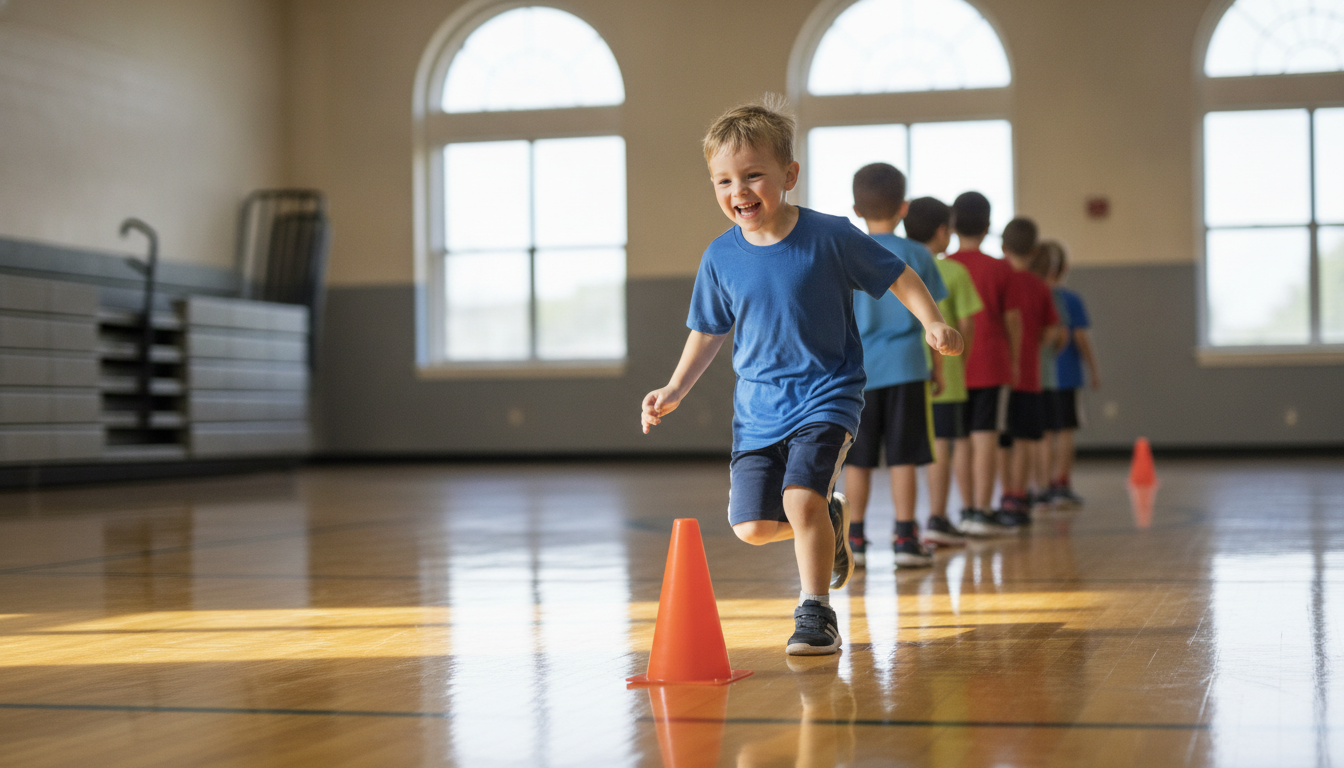
Running these in a shared cafeteria takes three adjustments: pick the small-footprint games (17, 21, 22), set the boundary with cones before kids come through the door, and use a raised hand as your stop signal instead of a whistle so the sound does not bounce off every hard surface. For more large-group options that survive a mixed-age crowd, our camp games for kids list runs deeper on team formats, the gymnastics warm-up games work as five-minute openers, and the soccer drills for kids give you something structured when a sport-specific block appears on the schedule.
Make-something activities: art, craft and cooking (ideas 23-32)
The slot kids remember and the one parents see, because something comes home. Priority goes to activities that produce a finished object and clean up in under five minutes, since most programs are handing the room back.
23. Painted rock characters. Collect smooth rocks once, paint faces and creatures on them all year. Close to free and endlessly repeatable. Ages 5-11 · 4-24 kids · 10 min prep · Smooth rocks, acrylic paint, brushes, sealer · Covered tables
24. Friendship bracelets. The highest-retention craft in this bank. Teach one knot, hand out floss, and it runs itself for six weeks while kids talk to each other. Ages 7-11 · 4-20 kids · 5 min prep · Embroidery floss, tape or clipboards, scissors · Tables
25. Recycled-material sculpture challenge. Cardboard, tape, bottle caps, tubes, a theme and 30 minutes. Announce the theme late so nobody plans it in advance. Ages 6-11 · 6-30 kids · 10 min prep · Cardboard, tape, caps, tubes, string · Tables and floor
26. Cardboard arcade. A multi-week build where each kid makes one working game, ending in an arcade afternoon families are invited to. Staff do all the cutting. Ages 8-11 · 6-24 kids · 15 min per week · Cardboard, box cutters for staff, tape, marbles · Tables and storage
27. Six-panel comic strip. Fold a sheet into six, give one prompt, no drawing skill required. The quietest 25 minutes you will get. Ages 7-11 · 1-30 kids · 2 min prep · Paper, pencils, fine markers · Tables
28. Paper-plate loom weaving. Quiet, repetitive and genuinely calming. This is the one for the child who needs to opt out of the loud thing without sitting alone. Ages 6-11 · 2-16 kids · 15 min prep · Paper plates, yarn, hole punch, scissors · Tables or floor cushions
29. Air-dry clay creatures. Sensory, low-instruction, and forgiving. Kids who freeze at a blank sheet of paper never freeze at a lump of clay. Ages 5-11 · 4-24 kids · 5 min prep · Air-dry clay, plastic tools, boards · Covered tables
30. No-bake energy bites. Mix oats, seed butter and honey, roll into balls, eat. The only cooking most programs have the facilities for. Ages 6-11 · 6-20 kids · 15 min prep · Oats, sunflower seed butter, honey, bowls, gloves · Tables near a sink
31. Tortilla pizzas. If you have a toaster oven, this is the one that makes your program famous. Everyone builds their own on a tortilla base. Ages 6-11 · 6-20 kids · 20 min prep · Tortillas, sauce, cheese, toppings, toaster oven · Kitchen access
32. Fabric-marker T-shirt day. The end-of-term event craft. Cardboard inside the shirt, fabric markers on top, everyone wears theirs on the last day. Ages 5-11 · 10-40 kids · 20 min prep · Plain tees, fabric markers, cardboard inserts · Covered tables
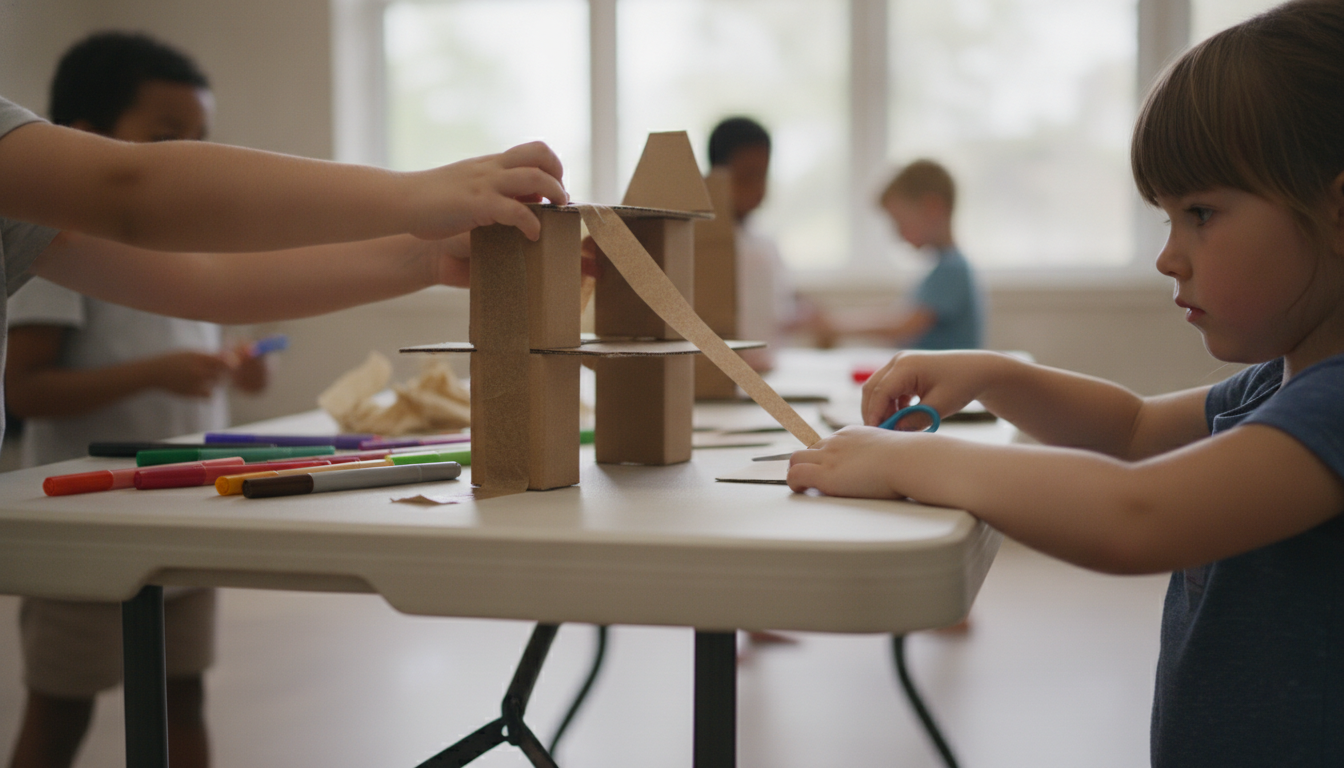
Cost control here is a storage problem more than a buying problem. Order consumables in bulk once a term, sort everything into labeled tubs by activity, and rotate a kit of the week so setting up means carrying one tub. The wider case for arts and crafts is worth having in your back pocket when a board asks why you spend money on paint, and our cooking class lesson plan has the structure if you want to run food as a proper weekly block.
Build-and-tinker activities: STEM without a curriculum budget (ideas 33-40)
You do not need a subscription kit. Everything here runs on materials under $20 or free browser software, and it all produces something measurable, which is what makes kids argue about it afterwards.
33. Spaghetti and marshmallow tower. Twenty minutes, 20 sticks of dry spaghetti, one marshmallow on top, tallest freestanding structure wins. Brutal and brilliant. Ages 8-11 · 4-32 kids · 5 min prep · Dry spaghetti, marshmallows, tape measure · Tables
34. Paper airplane distance lab. Three designs, three throws each, results on a chart. It turns a paper plane into data without anyone noticing. Ages 7-11 · 4-30 kids · 5 min prep · Paper, tape measure, chart paper · Long corridor or hall
35. LEGO build challenge with a constraint. The constraint is the whole activity: build a bridge that holds a book using only 40 bricks, or a tower that survives a table shake. Ages 5-11 · 2-20 kids · 5 min prep · Mixed brick bin, a book to test with · Tables or carpet
36. Baking soda reaction stations. Run it as a variables test rather than a demo: more soda against more vinegar, warm water against cold, and kids predict before they pour. Ages 5-10 · 4-24 kids · 15 min prep · Baking soda, vinegar, trays, cups, food coloring · Covered tables
37. Egg drop challenge. Build a carrier, drop it from a stairwell landing, iterate next week. The best multi-week engineering arc for older kids. Ages 8-11 · 6-30 kids · 10 min prep · Eggs, straws, tape, cotton, a stairwell · Indoor plus a drop point
38. Human robot. One kid gives step-by-step commands, another executes them literally, including the wrong ones. Teaches sequencing and debugging with zero devices. Ages 6-10 · 4-24 kids · No prep · Masking tape for a floor grid · Any clear floor
39. Block-based coding club. Free browser tools, a six-week arc from moving a sprite to a playable game, showcased on the last day. Ages 8-11 · 4-15 kids · 20 min first week · Laptops or tablets, free browser tools · Room with devices
40. Take-apart table. A donated toaster, keyboard or printer, screwdrivers, and permission to destroy it. Consistently the highest-engagement activity in this bank for ages 9 and up. Ages 9-11 · 2-8 kids · 20 min prep · Donated electronics, screwdrivers, safety glasses, tubs · One dedicated table
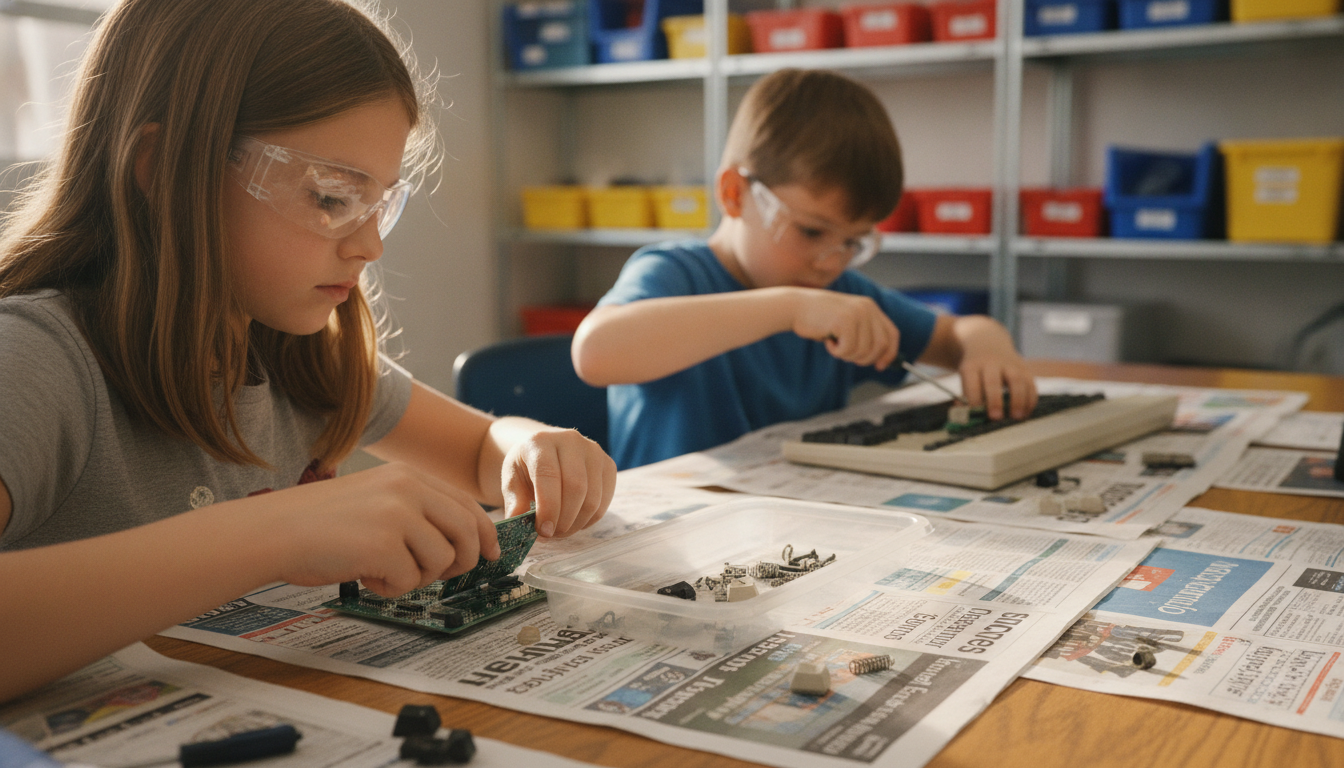
Safety rules for the take-apart table are short and non-negotiable: appliances arrive unplugged with the cord cut off, no CRT screens or anything with a tube, no batteries, no microwaves, safety glasses on before the first screw comes out, and small parts go straight into a tray. If a parent or funder asks how this differs from tutoring, our explainer on what enrichment means in school draws the line clearly.
Homework help and literacy that does not feel like more school (ideas 41-45)
The hardest slot to make popular, because the kids have already done school today. The design job is to make the academic block feel unlike the classroom it just followed.
41. Homework café. Lamps instead of overheads, quiet music, a snack still on the table, and a sign-up sheet for anyone who wants help. The setting does most of the work. Ages 6-11 · 5-25 kids · 10 min prep · Lamps, quiet playlist, sign-up sheet · Tables in a quieter corner
42. Math fact scavenger hunt. Find three objects in the room that add up to 17. Find something that is half the length of your arm. Math facts with legs attached. Ages 6-10 · 4-24 kids · 10 min prep · Number cards, timer · Any room
43. Read-aloud with jobs. One kid reads, the others hold roles: sound effects, question asker, illustrator, predictor. Nobody is passively listening, which is why it holds. Ages 5-10 · 4-20 kids · 5 min prep · One chapter book, role cards · Carpet or cushions
44. Book club with choice. Kids vote on the book, then six weeks of one chapter and a discussion. Discussion, not comprehension questions. Ages 8-11 · 4-12 kids · 15 min per week · Multiple copies, discussion cards · Tables
45. Prompt jar for journaling and drawing. Five minutes, pull a slip, write or draw. No marking, no spelling correction, no sharing unless the kid offers. Ages 6-11 · 1-30 kids · 15 min once · Notebooks, prompt slips, jar · Tables
Cap the homework block at 30 to 45 minutes and never let it eat the movement slot. When we hear from programs that stretched the academic block, attendance is what slips first, and the link between after-school clubs and academic performance does not depend on grinding through worksheets until 5:45.
Wind-down activities for the pickup window (ideas 46-50)
The most neglected 30 minutes in most programs. Pickup is staggered across 45 minutes, the group shrinks unevenly, and the goal is to hand every parent a calm child.
46. Kids' yoga flow. Five poses, ten minutes, no mats needed. Tree, cat and cow, downward dog, child's pose, and a 30-second lie down at the end. Ages 4-11 · 4-25 kids · 2 min prep · None, mats optional · Clear floor
47. Box and starfish breathing. Trace a square in the air, four counts a side. Or spread a hand and breathe up and down each finger. Ninety seconds, works from age four. Ages 4-11 · 1-40 kids · No prep · None · Anywhere
48. Story circle with the lights low. One staff member reading, floor cushions, half the overheads off. The most reliable way to drop the volume in a room. Ages 4-10 · 4-20 kids · 2 min prep · A read-aloud book, cushions · Carpet corner
49. Quiet puzzle and drawing tables. Two tables, jigsaws on one and paper on the other, for the last dozen kids waiting on a parent stuck in traffic. Ages 5-11 · 1-15 kids · 5 min prep · Jigsaws, paper, colored pencils · Two tables
50. Highlight round before dismissal. One sentence each on the best thing today, then coats on. It gives kids the answer when a parent asks what they did. Ages 5-11 · 4-30 kids · No prep · None · Anywhere
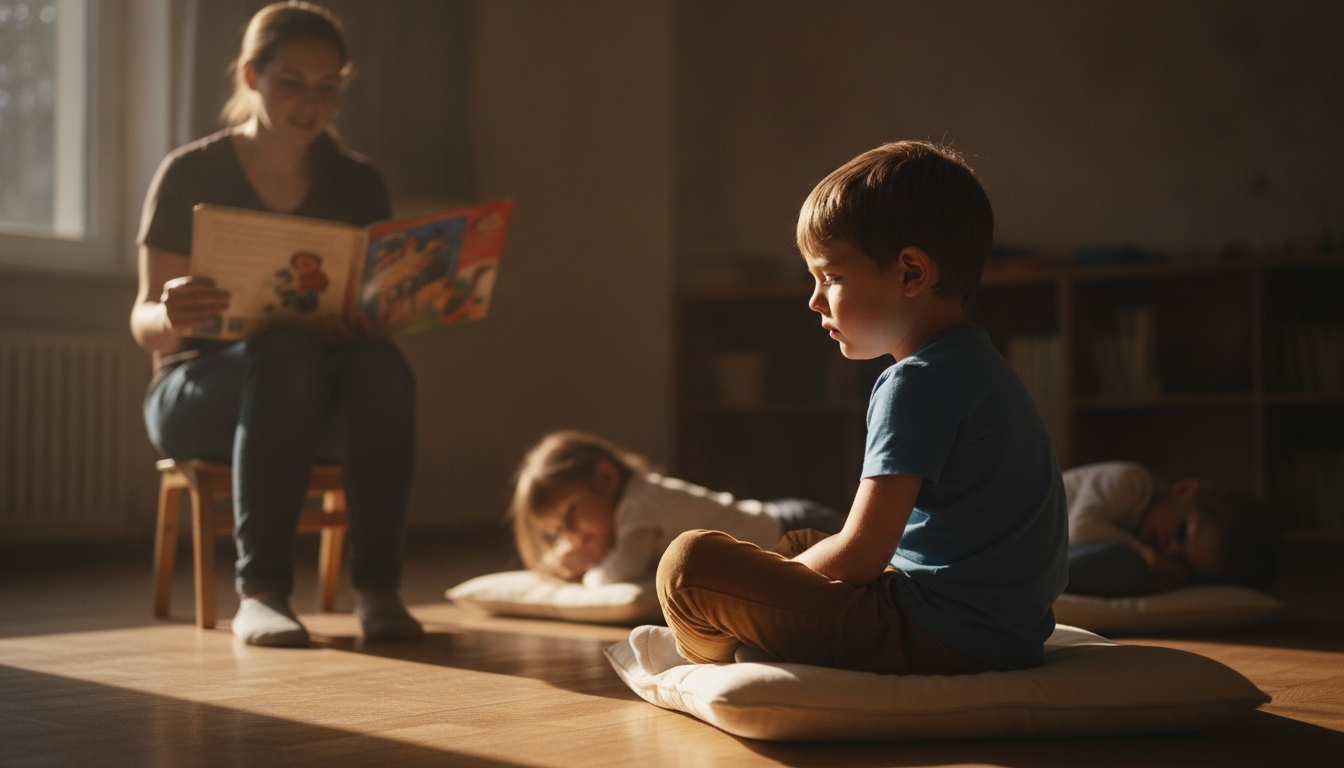
Spend 15 seconds per parent at the door telling them exactly what their child made or won today. It costs nothing, it is the only evidence most parents get that the fee is working, and it does more for re-enrollment than any newsletter. Our kids yoga lesson plan has full sequences if you want to build the wind-down into something more structured.
A sample week you can copy
The grid below uses activity numbers from the list above so you can see the sequencing logic rather than just the activities.
| Slot | Mon | Tue | Wed | Thu | Fri |
|---|---|---|---|---|---|
| 3:10 Arrival (20 min) | 1 Choice board | 3 Wiggle-out | 2 Question wall | 5 Story cube | 7 Free draw |
| 3:30 Snack (20 min) | 10 Rose, thorn, bud | 9 Table talk cards | 8 Two truths, a wish | 12 Snack builder | 11 Guess my snack |
| 3:50 Move (40 min) | 16 Freeze dance | 15 Obstacle relay | 18 Parachute | 19 Scavenger hunt | 13 Sharks and minnows |
| 4:30 Make or build (45 min) | 23 Painted rocks | 33 Spaghetti tower | 26 Cardboard arcade | 24 Friendship bracelets | 35 LEGO challenge |
| 5:15 Homework (30 min) | 41 Homework café | 41 Homework café | 41 Homework café | 44 Book club | 45 Prompt jar |
| 5:45 Wind-down | 46 Yoga flow | 49 Quiet tables | 48 Story circle | 47 Breathing | 50 Highlight round |
Three rules hold that grid together. The shape of the day never changes, only the content, so kids know what happens next and staff stop re-explaining the routine. One multi-week build sits on a fixed day, Wednesday here, so children can count on it and absent kids know exactly what they missed. And Friday is deliberately the lowest-prep day of the week, because by Friday your staff have nothing left.
Zoom out to the term and you want four to six week arcs running alongside the one-off days: the cardboard arcade, the book club, the coding club, the egg drop. Kids finish something, which one-off activities never give them. It is worth setting those arcs before September, when you are getting the program ready for the new school year, because retrofitting a six-week build into week nine rarely works. And if the program itself is still on the drawing board, our guide to starting an after school program covers everything that comes before the first activity plan.
The starter kit: what to buy and what it costs
Most of the 50 need nothing you do not already own. The rest come from this list, which is the whole equipment budget for a program running five days a week.
| Item | Approx. cost | Activities it unlocks |
|---|---|---|
| Parachute, 12 ft | $45-60 | 18 |
| Beanbags and 4 hoops | $30 | 14, 22 |
| Cones, set of 20 | $15 | 13, 15, 17, 20 |
| Embroidery floss, bulk pack | $15 | 24 |
| Acrylic paint, brushes, sealer | $25 | 23 |
| Air-dry clay, 5 lb | $20 | 29 |
| Masking tape and cardboard | $8 | 25, 26, 37, 38 |
| Dry spaghetti and marshmallows | $10 | 33 |
| Baking soda, vinegar, trays | $12 | 36 |
| Screwdriver set and safety glasses | $25 | 40 |
| Storage tubs, 6 labeled | $40 | All of them |
That is roughly $245 to $260 for the full kit, or $130 to $145 for the first five rows if you would rather add the rest a term at a time. On a $50 opening budget, buy cones, tape and a screwdriver set with safety glasses, then ask families and local businesses for cardboard, bottles, jars and dead electronics. Prices are approximate US retail and move around, so treat them as a planning figure rather than a quote.
Keeping per-child activity spend low is not a nice-to-have. Cost is the barrier parents name most often, cited by 56% of families who wanted a program and could not use one, ahead of unsafe transportation at 49% and inconvenient locations at 48%. Every dollar you do not spend on kits is a dollar that does not have to come out of fees. If you are chasing external money instead, our afterschool program grant proposal template covers how to frame the ask.
Running these with a mixed-age group
Real programs run kindergarten through fifth grade in one room with two staff. Four tactics cover almost every case.
Change the constraint, not the activity. Everyone builds the spaghetti tower, but K-2 build for height alone and grades 3-5 build for height while supporting a marshmallow and a spare weight. Same materials, same table, same 20 minutes, two levels of difficulty.
Pair up rather than split up. Assign an older child to a younger one for setup and cleanup. It fixes behavior and staffing at the same time, and fifth graders who are bored by an activity are rarely bored by being trusted with a job.
Run parallel difficulty at one table. Put out two versions of the craft template and let kids choose. They pick accurately, and nobody has been publicly sorted by ability.
Split only for the loud thing. Age gaps hurt most in movement games, where a size difference is a safety issue. Split there, stay together everywhere else, and you keep the group feeling like one program.
Be honest about the exceptions. The take-apart table wants ages 9 and up and the egg drop ages 8 and up, and no amount of adaptation makes six-year-olds safe with screwdrivers and a stairwell. The parachute, painted rocks, freeze dance and story circle work for the whole span with no adjustment at all.
Picking activities for the space you actually have
Most programs run in a borrowed room. Here is the same 50 re-cut by what your building actually gives you.
- One classroom with fixed tables: 2, 5, 6, 7, 9, 10, 11, 21, 27, 28, 29, 33, 35, 38, 42, 45, 47, 49, 50
- Shared hall or cafeteria, cleared by 6pm: 1, 3, 4, 8, 12, 16, 17, 22, 25, 32, 34, 36, 46, 48
- Gym access: 13, 14, 15, 18, 19, 20, plus anything from the classroom list on a rainy day
- Outdoor space: 13, 14, 17, 19, 20, 22, 23, and every category scavenger hunt variant you can invent
Keep three no-materials activities memorized for the afternoon your room falls through, which it will. Numbers 3, 47 and 50 need nothing but a space and a voice. If your outdoor space is better than your indoor one, our outdoor learning activities list is built for exactly that constraint.
Let kids pick some of it
Attendance in an optional program is a vote, and kids vote hardest for the afternoons they helped design. Choice needs a mechanism though, not a principle, and three are worth running.
The interest survey. Run it in week one and again at mid-term, and keep the questions concrete. Which of these three would you sign up for? What did you do here that you would do again? What is something you want to learn that we have never done? Which day of the week is your favorite and why? If you ran the program for one day, what would we do?
The choice board. Post three or four options before arrival with a cap on each, written as a number of name-card slots. When a slot is full it is full, kids pick something else, and it repeats next week. The cap is what stops the board turning into a stampede toward whichever option involves glue.
A student-led slot. One Friday a month, a pair of kids runs an activity they proposed on a one-page form: what it is, what you need, how long it takes, how many can play. Staff vet it and stand back. The proposal form teaches more than the activity does.
How to tell whether an activity worked
You do not need a survey. Three observable signals cover it.
Time to first question. If staff are still explaining after four minutes, the activity is too complex for the slot, no matter how good it is on paper.
Voluntary cleanup. Kids who hang around to help pack up enjoyed themselves. Kids who vanish at the first sign of a broom did not.
Does it come back? Ask on Monday whether anyone wants Friday's activity again. If three kids ask before you do, it stays in the rotation. That is the whole evaluation.
When something flops, change one variable before dropping it: group size, time of day, or difficulty. Most failures are placement failures rather than activity failures. A craft that dies at 3:15 with hungry kids often works perfectly at 4:30 once they have eaten and run around, and you will have written off a good activity for no reason.
Key takeaways
- Group activities by the slot they run in rather than by subject. Arrival, snack, movement, making, homework and wind-down each need a different kind of activity.
- Protect the movement slot and put it before the focused work. Just 24% of children aged 6 to 17 get their recommended 60 minutes, and moving first makes the homework block work better.
- Keep the shape of the day fixed and change only the content, so kids stop asking what happens next and staff stop re-explaining it.
- Run one multi-week build on a fixed day each week so children finish something, and make Friday the lowest-prep day.
- The full equipment kit for all 50 activities costs roughly $250, and about half the list needs nothing you do not already have.
- Give kids a real mechanism for choice, an interest survey and a capped choice board, not just the principle.
Build your own rotation
Match the activity to the slot and most engagement problems solve themselves. The craft that failed at 3:15 was never a bad craft, it was a bad time.
Start narrow. Pick six activities from this list, one for each slot, run them for two weeks, and swap out the two that die. Do that three times and you have an 18-activity rotation your staff know cold, built out of things your kids have already voted for with their attention. Then write the ones that stick into proper session plans so they survive staff turnover. And if the admin around the rotation is what eats the afternoon, our roundup of the best afterschool program management software compares five tools on enrollment, check-in and billing.
FAQs
What activities should an after school program do every day?
Four things, every day, in this order: movement, a snack with conversation, one hands-on making or building block, and a wind-down before pickup. The content changes daily but the shape does not, which is what lets children settle and staff plan quickly. Homework support fits between the making block and the wind-down.
What are good after school activities for elementary students?
For K-5 specifically, the reliable ones are parachute games (ages 5-10), painted rock characters (5-11), freeze dance with called shapes (5-9), category scavenger hunts (5-11), air-dry clay creatures (5-11) and a story circle to close the session (4-10). All six work across a wide age span with no adaptation, which matters when your group spans six grades.
How long should each after school activity last?
Fifteen to 20 minutes for arrival and wind-down, 30 to 45 minutes for movement and making, and a hard cap of 45 minutes on homework. Attention drops off sharply once children have already spent six hours in school, so a 45-minute block usually means 30 minutes of work and a natural pause. It is better to end an activity while kids still want more.
What are cheap after school program activities?
The genuinely free ones use only what a program already owns: wiggle-out warm-ups (3), silent ball (4), two truths and a wish (8), rose, thorn, bud (10), sharks and minnows (13), everybody's it tag (17), cooperative hoop pass (22), human robot (38), breathing exercises (47) and the highlight round (50). Under $5 gets you recycled-bottle bowling, paper airplane labs and a six-panel comic strip.
How do you keep older kids engaged in an after school program?
Give them roles, longer arcs and real choice. Fourth and fifth graders will design the obstacle course, run the take-apart table and lead a student-proposed Friday if you let them, and they lose interest fastest when treated like the youngest kids in the room. The demand is there: [nearly 6.7 million middle schoolers have parents who want a program](https://www.afterschoolalliance.org/afterschoolsnack/America-After-3PM-finds-that-unmet-demand-for-afterschool_12-16-2025.cfm), 5.2 million are not in one, and 49% would enroll if a program existed.
What STEM activities work in an after school program without a curriculum budget?
Spaghetti and marshmallow towers, paper airplane distance labs, constrained LEGO builds, baking soda variable tests, egg drop challenges, unplugged coding as a human robot, block-based coding on free browser tools, and a take-apart table built from donated electronics. Every one of those costs under $20 or nothing at all, and each produces a measurable result kids will argue about.
What do you do when you lose the gym at short notice?
Switch to the small-footprint games. Everybody's it tag, cooperative hoop pass, recycled-bottle bowling in a corridor and freeze dance all work in a cleared classroom or a hallway. Keep three no-materials activities memorized so a room change never costs you planning time, and set the boundary with cones or tape before children come in.
How do you run activities with a mixed-age group of 5 to 11 year olds?
Change the constraint rather than the activity: the same build, with a harder target for the older kids. Pair older children with younger ones for setup and cleanup, offer two difficulty levels at the same table so kids self-select, and split by age only for movement games where size differences become a safety issue. A handful of activities genuinely do not stretch down, including the take-apart table and the egg drop.
How do you plan an after school program schedule?
Fix the slots first and fill them second. Decide the times for arrival, snack, movement, making, homework and wind-down, then slot activities in by matching each one's energy level to its position in the afternoon. Put the multi-week build on a fixed day, keep Friday low-prep, and write the plan down so any staff member can run the session.