


Momence and Mindbody will both run your timetable, take your payments and chase your no-shows. They come at the job from opposite ends: the 1998 incumbent with a consumer marketplace attached, the 2020 challenger built to feel newer than what it replaces.
We compared them on scheduling, ease of use, client discovery, marketing, payment fees and total cost, using current pricing and what their own users say in reviews.
Below is a straight answer on Momence vs Mindbody, plus a third option if neither quite matches how your business runs.
The quick verdict
- Choose Momence if you want a modern interface with email, SMS and automations built in at a published price, and your bookings come from people who already know you.
- Choose Mindbody if you need the consumer app to find new clients, you sell courses or semesters, parents manage several children from one account, or you run more than one site and can absorb per-location billing.
- Consider a third option if you sell terms, seasons or camps rather than memberships and drop-ins. Neither tool treats enrollment, family accounts or sibling pricing as the default.
The rest of this post shows the evidence behind each call.
Momence vs Mindbody at a glance
| Software |
Momence
★★★★☆ 3.9 (76)
|
Mindbody
★★★★☆ 4.0 (2,993)
|
Pembee
Best for activity providers
★★★★★ 4.9 (23)
|
|---|---|---|---|
| Best for | Single-site boutique studios selling drop-ins, class packs and memberships to adults | Established and multi-location wellness businesses that want marketplace discovery | Activity providers running recurring classes, terms and camps |
| Starting price | $0/moBasic; $199 for staff and reporting | $79/moper location | $45/moflat, up to 5 admin users |
| Free trial | Free tierno time-boxed trial | ✗ Nodemo only | 30-day trial |
| Payment processing | 3.9% + $0.30US online card | Not publishedquoted per account | 0.59%plus Stripe fees |
| Platform fee on bookings | 2.5%-5%0% on the $199 tier | ✓ Noneon direct bookings | ✓ None |
| Contract | Not published | Set per plan | ✓ None |
| Term and course enrollment | Partialbuilt from recurring classes | ✓ Yescourse bundles | ✓ Yes |
| Family accounts for children | Partialadmin toggle, off by default | ✓ YesFamily Accounts | ✓ Yes |
| Sibling and family discounts | ✗ Notag-based price rules | ✗ Nono documented feature | ✓ Yes |
| Consumer marketplace | ✗ Nobranded app only | ✓ Yesplus ClassPass | ✗ No |
| Marketing automation included | ✓ Yesemail, SMS and inbox | Partialtop Ultimate tier only | Partialemail automations on Premium |
Ratings from Capterra, checked August 2026. Pricing from each vendor's official US pricing page, checked August 10, 2026. Partial means the capability exists but is limited or needs a workaround: Momence has no term-enrollment product and hides child booking behind an admin setting, Mindbody's marketing automation sits on its unpriced top tier, and our own automations are limited to email on the Premium plan.
What is Momence?
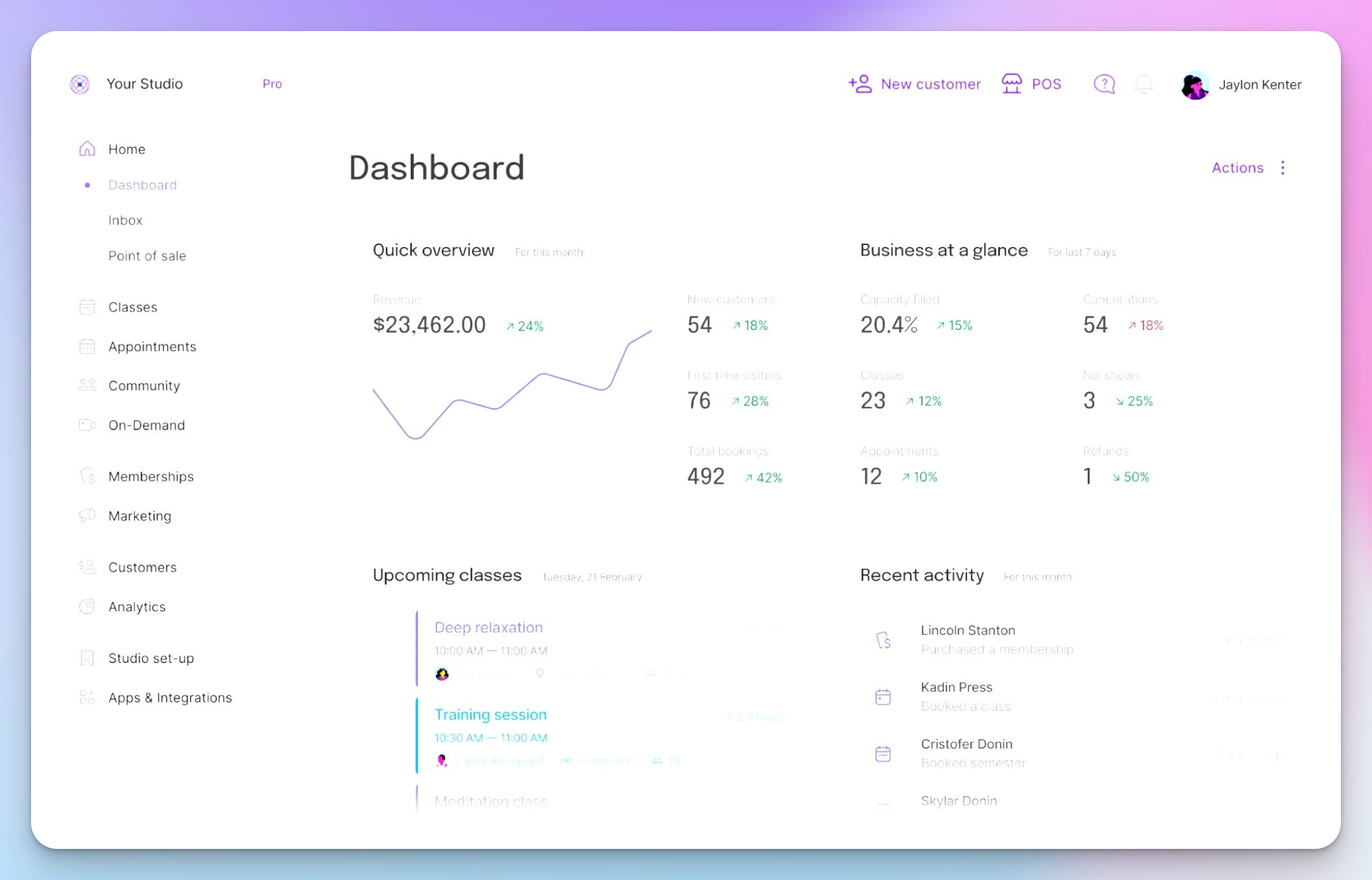
Momence is all-in-one studio management software for boutique fitness and wellness: yoga, pilates, barre, dance, gyms and spas. Founded in 2020, it is the modern-stack challenger in a category the incumbent has held for two decades, and its pitch is exactly that: the same jobs, in one place, with an interface built this decade.
It is no longer independent. Momence was acquired by Clubessential Holdings in January 2025, bringing around 4,500 business customers with it, and Clubessential merged with Xplor Technologies in a deal that closed on March 30, 2026. If you are buying today, you are buying from a large payments and software group, not a startup.
Where Momence is strong:
- The interface. This is the most consistent theme across 4 and 5 star Capterra reviews and the single most common reason people give for leaving an older system. One owner, Jennifer W., writes that "Momence offers everything we need in a simple and fluid format. It is easy for our staff to use as well as our clients."
- Consolidation. Reviewers repeatedly describe collapsing several subscriptions into one. Jena M., a CEO reviewing in March 2025, says "My front desk team loves its ability to have anyone on my team communicate with clients and we can all see the history."
- Native on-demand video and course content, so a studio selling recorded classes or a paid content library does not need a second platform for it.
- Marketing and comms in the base product: email and SMS campaigns, automations and a shared inbox, plus an optional AI Agent add-on that handles bookings, freezes and cancellations across email, SMS and in-app.
- A consumer-facing member app that reviewers and app store ratings treat well, which matters because it is the app your existing clients will actually book in.
Where users struggle:
- Support after the sale. This is the dominant one-star theme on Capterra and it shows in the sub-scores: customer service is 3.7, the lowest of Momence's four. Brian B. in operations writes "The lack of support. They send you token emails saying they will support you for fixes and don't. They over promise and under deliver." An owner, Simone P., puts it more bluntly: "The support is close to useless. They promised the world."
- Onboarding that does not match what sales described. The second most common one-star theme. Rachel W., an owner and director reviewing in March 2026, describes a "terrible onboarding experience. Onboarder launched me before everything was set up. Product was not easy to use. Client support was days away." Lindsey W. reports wasting "weeks setting up only to learn the platform couldn't deliver" the integrations she was sold.
- Billing and payout disputes. A recurring complaint across review sites: charges continuing after cancellation, payouts not arriving, refunds slow. Andrea D., a CEO, writes "They are not paying me my money which I have 5 months of proof of and suddenly nobody is available to speak with."
- Cost creep past the headline price. Add-ons, extra locations and staff seats push real spend well above the published tier. Simone P.'s review puts her actual monthly cost at around $2,000.
- Limited customization in the CRM, messaging fields and reporting. Lower frequency than the above, but it comes up often enough in the cons text to expect it.
The rating profile is polarized rather than average. Of 76 Capterra reviews, 45 are five star and 11 are one star, so roughly 14% of all reviewers rate it the lowest possible score. Read that as a product that works well until something goes wrong, and then depends on a support function reviewers do not rate.
Pricing: Basic is $0 per month with a 5% Momence platform fee charged to the business. Pro is $60 per month and drops the platform fee to 2.5%. Custom is $199 per month with no platform fee, unlimited add-ons and dedicated support. The catch sits in the exclusions: Basic and Pro both leave out staff members, multiple locations, reporting and insights, the inbox, retail products, a phone number and add-ons, so any business with more than one instructor is effectively on the $199 tier. Card processing is charged on top of the platform fee, at a published 3.9% plus $0.30 for US online cards, 3.7% plus $0.05 in person and 1.8% for ACH. The AI Agent add-on is $399 per month. There is a free Basic tier rather than a time-boxed trial, and subscription term and cancellation terms are not published. Pricing checked August 2026.
If Momence is one name on a longer list rather than a two-horse race, our Momence alternatives guide covers the wider field.
What is Mindbody?
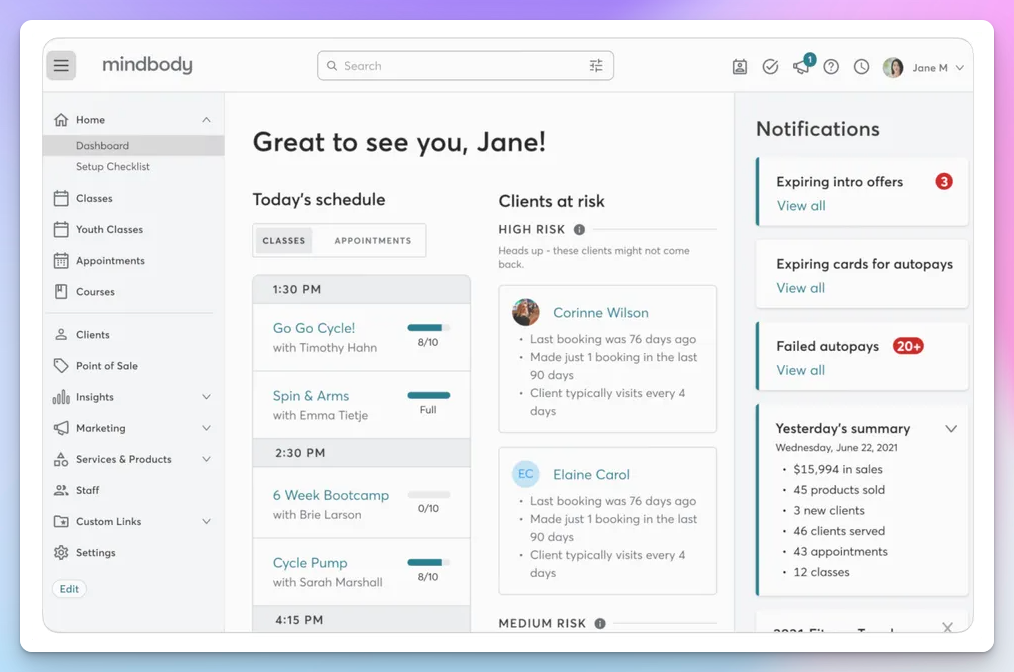
Mindbody is the category incumbent for fitness and wellness business management, and it is also a consumer marketplace. It started in 1998, went public in 2015, was taken private by Vista Equity Partners in a $1.9bn deal that closed in December 2018, and acquired ClassPass in October 2021. Scheduling, point of sale, payments, client management, reporting and marketing all sit in one system, with a listing in the Mindbody consumer app on top.
That last part is the pitch. You are not only buying software, you are buying a place in front of people who have never heard of your studio, and no direct competitor in this comparison has an equivalent.
Where Mindbody is strong:
- The consumer marketplace and app. Real demand, real new clients, and the listing is included in the plan rather than sold as an add-on. Nothing on Momence's side is comparable.
- Feature depth in one system. Features is Mindbody's highest Capterra sub-score at 4.0. Nick A., a founder reviewing in October 2025, writes "You can manage your staff and clients, collect member data, sell packages, track metrics, and even take payment in one tab."
- Reporting and customization. Nicole S., reviewing in January 2026, singles out being able to customize the reports.
- Support is better than its reputation suggests. Capterra's customer service sub-score is 3.8, a shade above Momence's 3.7, and positive support reviews are common. DeAnn L., a business owner reviewing in September 2025, writes "They have very great customer service, always helpful when I call and they go the extra mile to make sure my issue is resolved."
- ClassPass ownership and genuine multi-location scale, tested by chains far larger than a single studio.
Where users struggle:
- Cost escalation over time. This is the dominant one and two star theme, and it lines up with value for money at 3.6, the lowest number on Mindbody's profile. Paul W., a founder and owner reviewing in August 2025, writes "My subscription has climbed to over $1,000 CAD/month. It's almost impossible to real help. Instead, you get AI or emails replies or fix it yourself articles."
- Support quality at the low end. The same review describes AI deflection in place of a person. Jonathon S., an owner and teacher reviewing in January 2026, says "Customer service is painfully slow."
- A gap between the sales conversation and the product. Jonathon S. also writes: "The salesman who sold me my subscription wasn't honest and straightforward with me." Worth noting: this complaint appears on both tools, not just this one.
- Contract length and exit friction. Terms are set per plan and in the contract rather than published on the pricing page, and Mindbody's own answer to the cancellation question is that it depends on your plan and billing terms. It also publishes a dedicated page on contracts and cancellation, which tells you how often the question gets asked.
- Interface age. Reviewers commonly describe it as dated and heavy. In fairness to Mindbody, the numbers do not back a hard claim here: Capterra rates ease of use at 3.9 for Mindbody and 3.9 for Momence.
The distribution is similar in shape to Momence's, at far greater volume: of 2,993 Capterra reviews, 1,435 are five star and 248 are one star.
Pricing: Starter is from $79 per month per location in the US, and includes scheduling, online booking, integrated payments, staff management, basic reporting, the Mindbody app listing, branded booking widgets and unlimited users. Accelerate adds advanced analytics, room and resource management, client Pick-a-Spot and promo codes; Ultimate adds automated email and text campaigns, dynamic marketing lists, a 24/7 AI front desk and sales pipeline management. Neither of those two tiers has a public price, so both need a sales call. Card processing rates are not published either; Mindbody Payments runs on Stripe and rates are quoted per account. Marketplace bookings carry a fee of 20% of the purchase price excluding tax, capped at $30, charged once per client on their first eligible purchase through the Mindbody consumer app, and it does not apply to your branded app, branded web tools or your own booking site. There is no advertised free trial, only a demo. Pricing checked August 2026.
If you are already on Mindbody and shopping the wider market, our Mindbody alternatives guide runs through the options beyond this matchup.
Momence vs Mindbody: feature by feature
Class, course and term scheduling
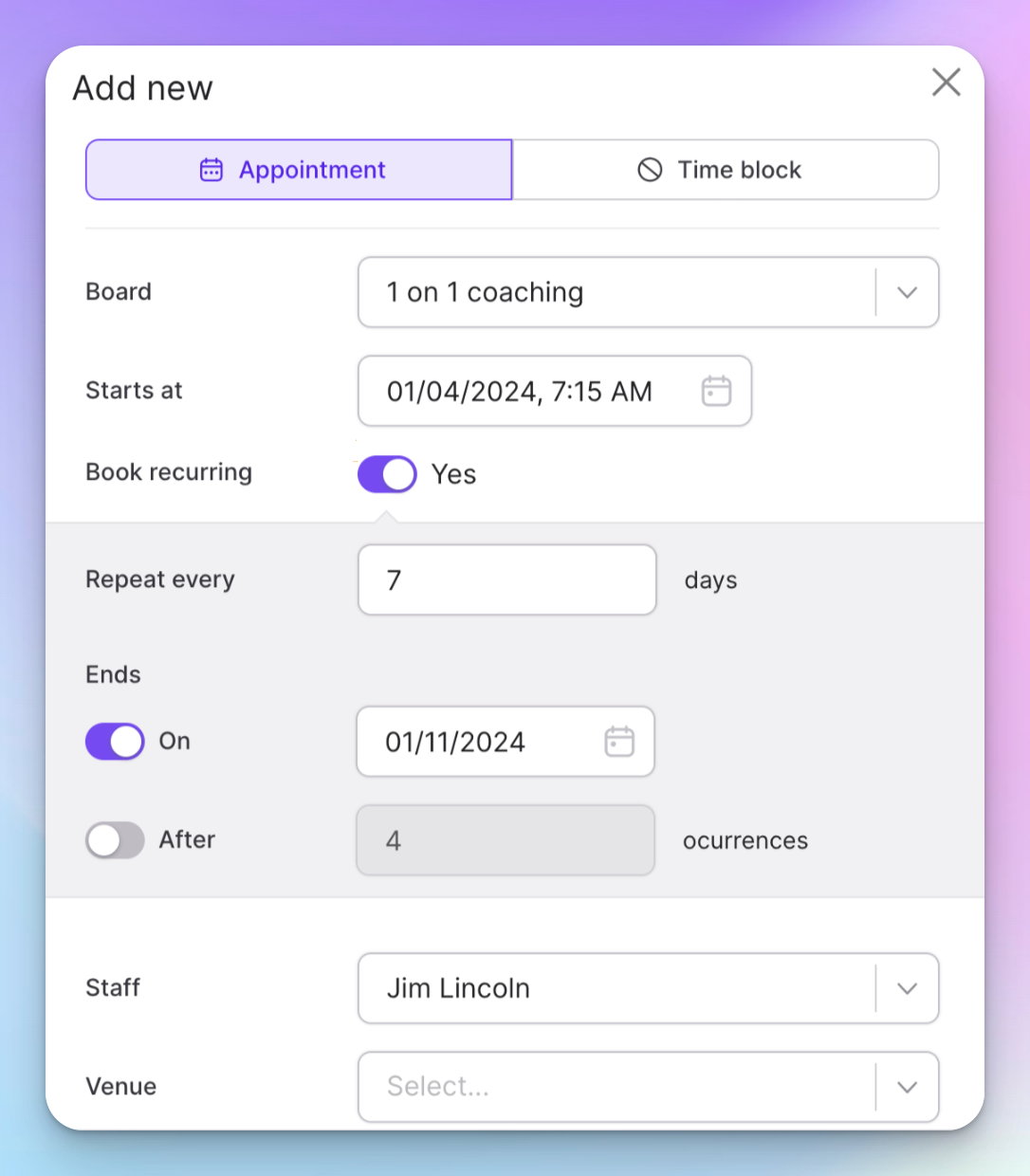
Momence covers the weekly essentials properly. Recurring classes repeat on a configurable frequency with a start and end date or run indefinitely, waitlists are automatic with an SMS to waitlisted clients when a spot frees up and the first responder taking it, check-in registers track attendance and no-shows, and intake forms capture waivers with a signature. What it does not have is a term or season product. Multi-week enrollment gets rebuilt out of recurring classes and subscriptions.
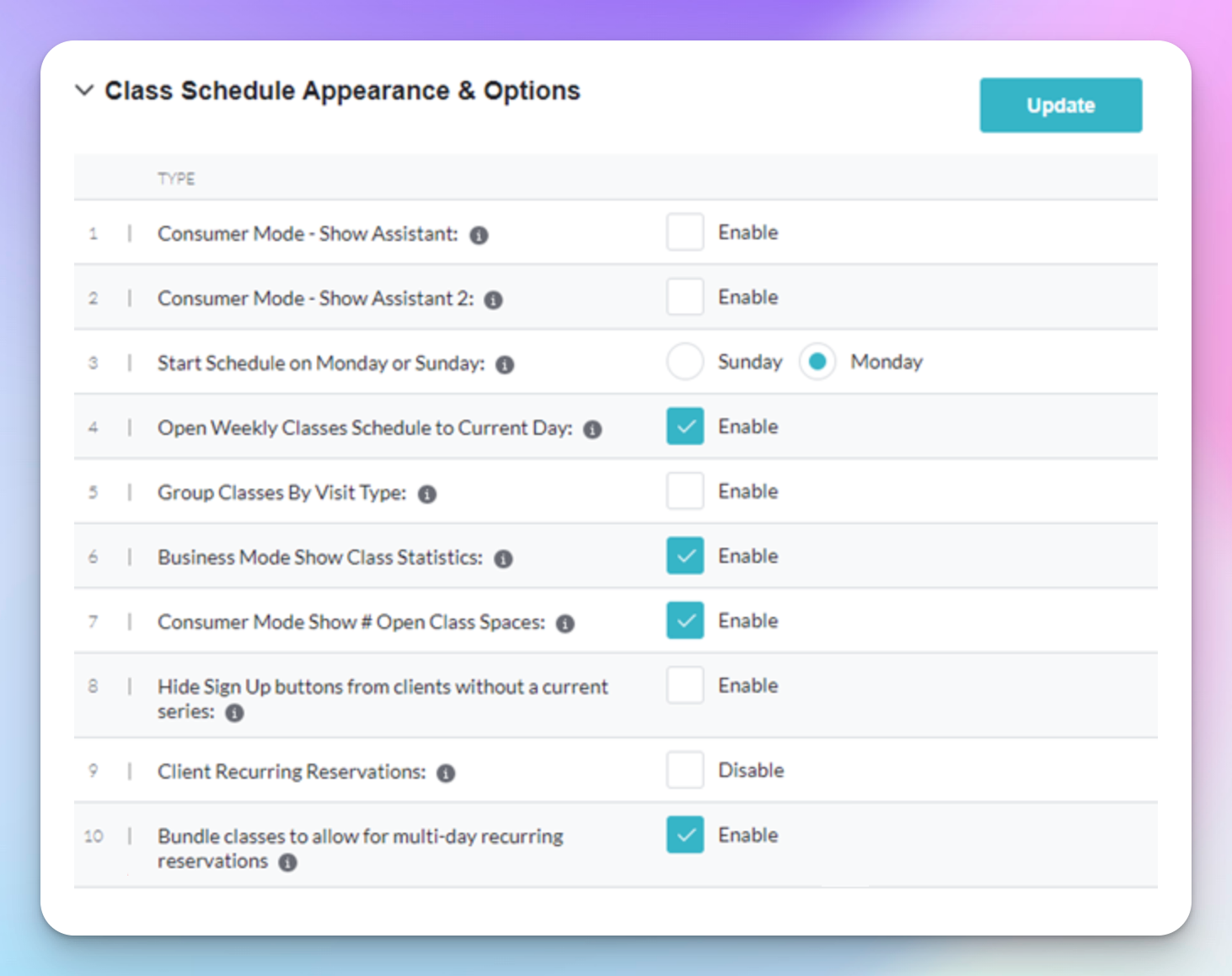
Mindbody goes further into group programming. Alongside recurring classes, recurring reservations and waitlist automation, it supports enrollments and course bundles so a block of multi-day recurring classes sells as one purchase, and semester passes are a documented use case. It also has a named Family Accounts feature, so a parent can book and manage several children from one login, with under-13s booked through the parent rather than holding their own account.
The split is clean. A Tuesday evening adult timetable runs fine on either. A twelve-week junior course that a parent books for two children is a job Mindbody has features for and Momence asks you to assemble. Mindbody's own documented limit is that flexible scheduling is not available for courses.
Edge: Mindbody for courses, terms and family bookings; Momence for a straightforward weekly drop-in schedule.
Ease of use and onboarding
Momence's interface is its strongest asset, and reviewers say so unprompted. The clean layout and the fact that front-desk staff pick it up without training are the two things 5 star reviews return to most, and they are the most common reason people give for switching to it.
Mindbody carries two decades of accumulated features, and reviewers describe the result as dated and heavy going for daily tasks. We should be careful with that claim though: Capterra scores ease of use at 3.9 for both tools. Whatever the difference feels like in a demo, the review data does not measure a gap.
Onboarding is where both tools get ugly, and it is worth reading the two complaint files side by side. Rachel W. says her Momence onboarder "launched me before everything was set up" and that client support was days away. Lindsey W. reports being sold integrations that did not exist. On the other side, Jonathon S. says the Mindbody salesman "wasn't honest and straightforward" with him. Neither vendor has earned the benefit of the doubt on the gap between the sales call and week one.
One practical difference: Momence's free Basic tier lets you open the product and look around before anyone calls you. Mindbody advertises no free trial, so your first real look at the software comes after a demo.
Edge: Momence on the day-to-day interface and on being able to try it first. Onboarding is a coin flip and we would not pick either with confidence.
Client discovery and the consumer app
This is the dimension Mindbody wins without argument. The Mindbody consumer app is a genuine acquisition channel: people who have never heard of your studio browse, find you and book, and the listing is included in every plan rather than sold separately. ClassPass, which Mindbody has owned since October 2021, sits alongside it.
The cost is honest and narrower than most write-ups suggest. Mindbody charges 20% of the purchase price excluding tax, capped at $30, once per client, on their first eligible purchase made through the consumer app. It does not apply to your branded app, your branded web tools, your own Mindbody booking site or any other direct channel. Framed properly, that is a capped customer acquisition cost, not a tax on your revenue.
Momence has a branded member app and booking pages, both well regarded by the people who use them. It has no consumer marketplace at all, so every booking has to come from somebody who already knows you exist.
Whether this decides your purchase depends entirely on where clients come from. If app discovery fills classes for you, Mindbody's fee is cheap acquisition. If your students arrive through schools, referrals and local word of mouth, you are paying for a shop window nobody walks past.
Edge: Mindbody, with no qualification.
Marketing and automation
Momence puts the marketing stack in the product rather than at the top of a price ladder. Email and SMS campaigns, automations and a shared inbox are part of the platform, alongside on-demand video and course content that gives you something to market. The optional AI Agent handles bookings, freezes and cancellations across email, SMS and in-app for a published $399 per month, which is expensive but at least it is a number you can read before you commit. The recurring complaint is customization: reviewers describe the CRM sequences and messaging fields as more rigid than they expected.
Mindbody has the same capabilities and better analytics behind them, but the good parts sit on Ultimate, its top tier, which has no published price. Automated email and text campaigns, dynamic marketing lists, the AI front desk and sales pipeline management are all up there. Starter gets basic reporting. So the honest comparison is not feature against feature but feature against ladder: on Mindbody, marketing automation costs whatever a salesperson quotes you.
For a small operator, that difference is the whole dimension. Comparable capability, much lower down the price ladder, with the price printed.
Edge: Momence.
Payments, fees and what you actually keep
Momence publishes everything, and the arithmetic is unkind. The platform fee is 5% on Basic, 2.5% on Pro and zero on the $199 Custom tier, and card processing sits on top of it at 3.9% plus $0.30 for US online cards. A Pro-tier studio taking an online card payment is therefore giving up roughly 6.4% plus $0.30 of the sale. On Basic it is closer to 8.9% plus $0.30. Only at $199 per month does the percentage skim disappear.
Mindbody does not publish processing rates at all. They are quoted per account through Mindbody Payments, which runs on Stripe, and the support articles say only that rates depend on your setup and merchant agreement. That opacity is a real strike against it. What Mindbody does not do is charge a platform percentage on top of processing for your direct bookings, and the marketplace fee only bites once per new client, capped at $30.
So the trade is transparency against take rate. Momence tells you exactly what it will cost and then takes a percentage of every sale unless you are on its top tier. Mindbody takes no percentage of your direct sales but will not tell you the processing rate until you are in a quote. For reference, our own payments run through Stripe with a 0.59% application fee on top of Stripe's rates.
Edge: Mindbody for a business whose bookings come from its own website and existing members, because there is no platform skim on every direct sale. Momence matches that only on the $199 Custom tier, and Momence is the more honest of the two about what you will actually pay.
Pricing, plans and contracts
Momence publishes all three tiers: $0, $60 and $199 per month. The number that matters is the third one. Basic and Pro both exclude staff members, multiple locations, reporting and insights, the inbox, retail and add-ons, so a studio with two instructors and a need to see its own numbers is on Custom at $199. Presenting Momence as a $60 product is the mistake to avoid. Subscription term and cancellation terms are not published anywhere we could find.
Mindbody publishes one tier: Starter from $79 per month per location in the US. Accelerate and Ultimate are quote only. Per-location billing is the structural point, because a provider running three sites pays three times for the same software. Cost escalation over time is its most common one and two star theme and value for money is its weakest sub-score at 3.6. Contract terms are set per plan, and Mindbody's own position is that it depends on your plan and billing terms.
For a single site with one instructor, Momence at $60 undercuts Mindbody at $79 and tells you the whole price. For a staffed studio, the comparison is $199 against $79 plus whatever the tier you need actually costs, which nobody outside Mindbody's sales team can tell you.
Edge: Momence for published, predictable pricing. Mindbody only if you are single-site, want the marketplace and can hold the Starter tier.
The verdict
Three dimensions each, and the split is real rather than engineered. Momence takes the interface, marketing and pricing transparency. Mindbody takes courses and family bookings, client discovery and the economics of direct sales.
Choose Momence if your clients already know you, you want marketing and automations in the base product, and you want to read the price before you speak to anyone. Choose Mindbody if the consumer app is a live acquisition channel for you, if you sell courses or semesters, if parents need one account for several children, or if you run more than one location and the per-location meter is worth what it buys.
One thing neither tool wins: support. Capterra scores customer service at 3.7 for Momence and 3.8 for Mindbody, and the same two complaints top both files, which are support that degrades after the sale and a sales process that promises more than onboarding delivers. Do not switch expecting relief on that axis.
Switching is not symmetrical. Moving from Mindbody to Momence means checking your contract terms first, since they are set per plan rather than published, then exporting clients, memberships and purchase history, rebuilding the schedule, and re-onboarding anyone who currently books you through the Mindbody app, because that discovery channel does not come with you. Going the other way costs you the interface your staff have learned and adds a sales call to reach any tier above Starter, but you gain the marketplace and proper course tools. In both directions, if the tool you have is working, price alone rarely justifies the migration.
If you read both columns thinking neither of these matches how your business runs, the next section is for you.
The third option: what if neither fits?
Both tools are built around the same customer: one adult, booking for themselves, paying by membership, class pack or per-visit credit. That assumption holds up in a pilates studio. It breaks the moment a parent enrolls two children for a whole autumn term.
It breaks in four specific places, all of them visible in the dimensions above. Term and season enrollment is a workaround on both, better on Mindbody with course bundles but still without pro-rata joining in week four. Family accounts are a real feature on Mindbody and an admin toggle that is off by default on Momence, where children are picked from a dropdown at checkout. Sibling and family discounts do not exist natively on either, and Momence's own documented answer is tag-based price rules applied by hand. And the pricing model charges you for machinery a Tuesday evening gymnastics term will never use, whether that is a 2.5% platform fee on every sale or a per-location meter.
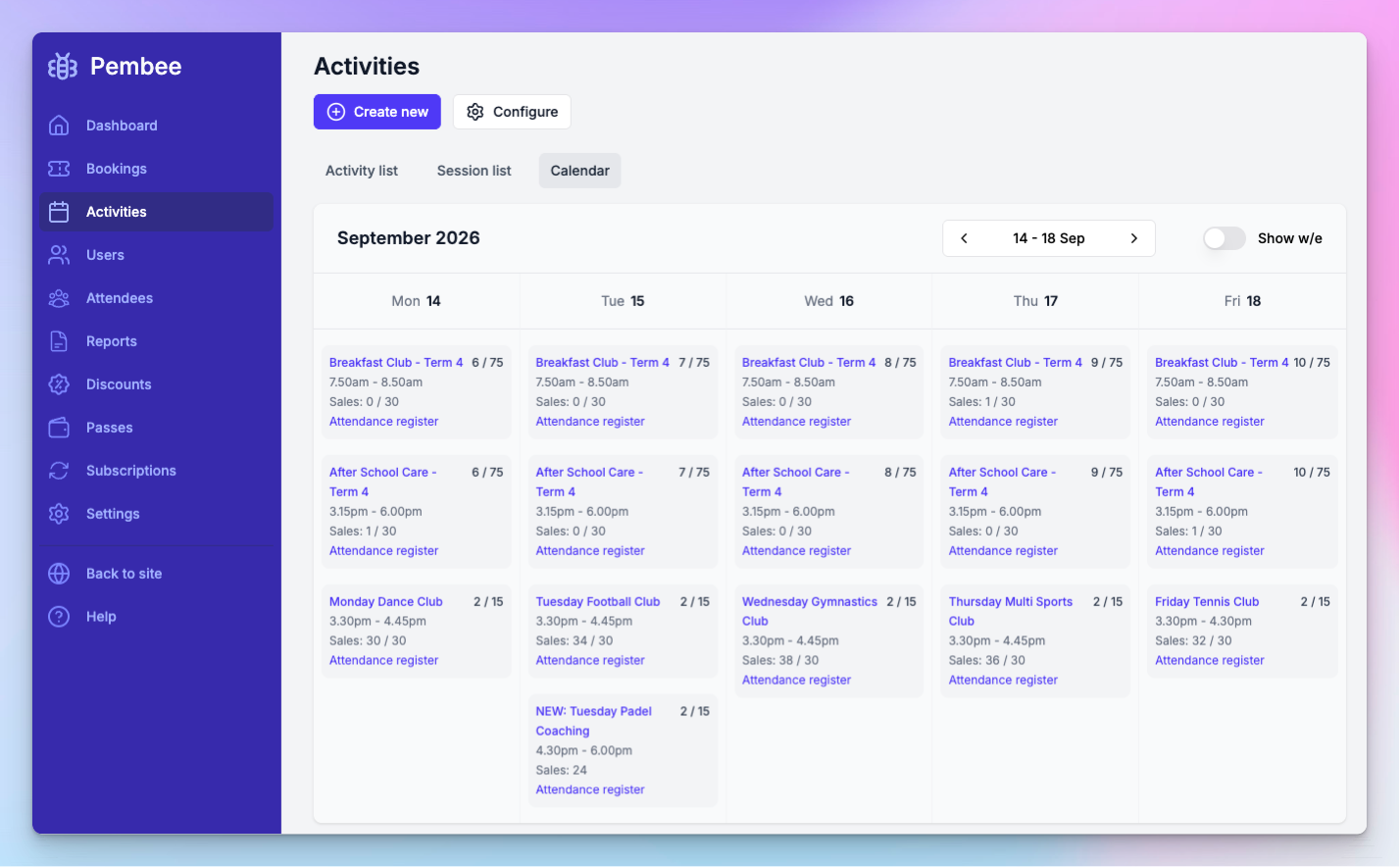
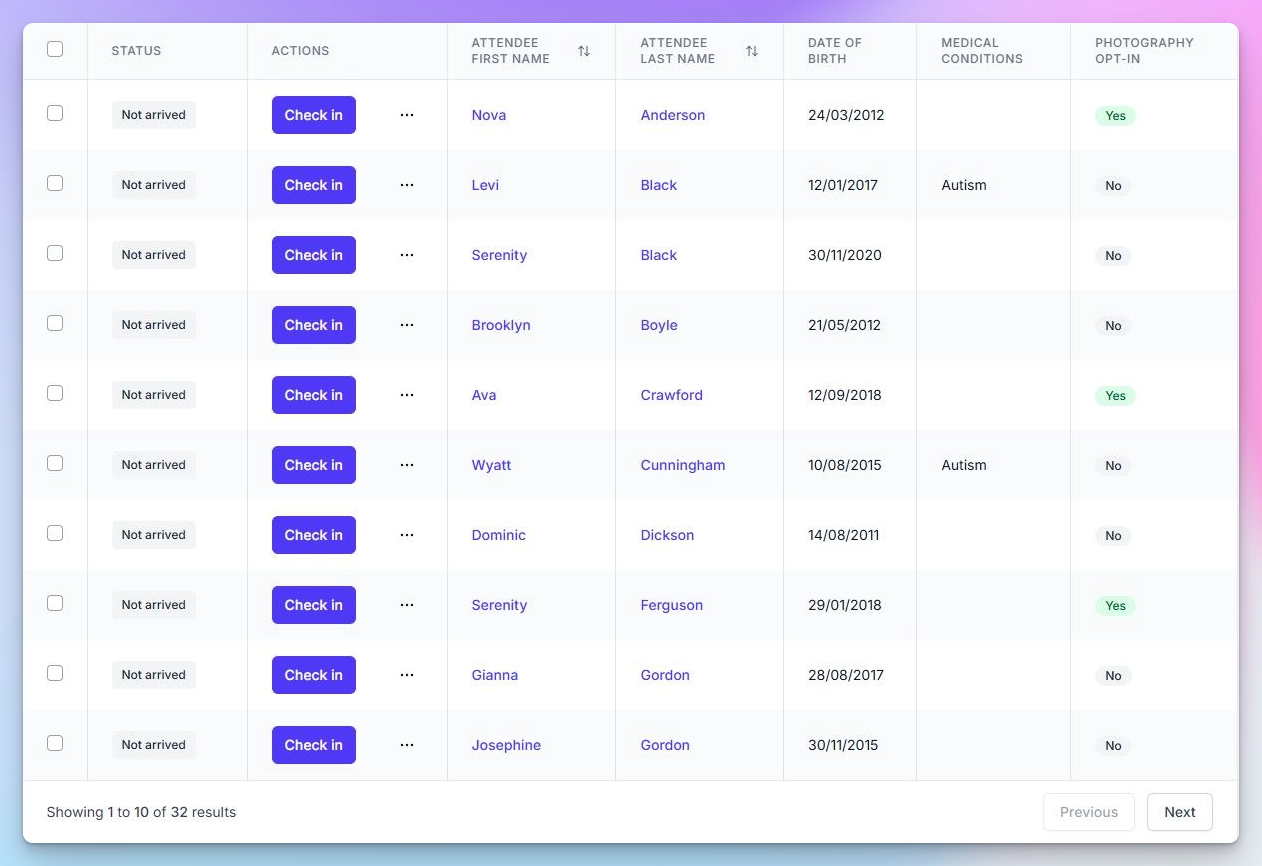
We built our platform for that shape of business, whether that is a dance studio, a gymnastics club, a school-holiday camp provider or a multi-week course. Term and course bookings are the default object rather than something you assemble from recurring classes. Parents hold one account with a record per child, so medical details, consent and emergency contacts sit on the booking instead of in a folder. Sibling, multi-purchase and code-based discounts are separate stackable rules, so a sibling saver can run alongside an early-bird code. Registers work on a phone at the venue. Waivers, waitlists, payments and customer comms are in the same place, and there is no platform percentage on top of processing.
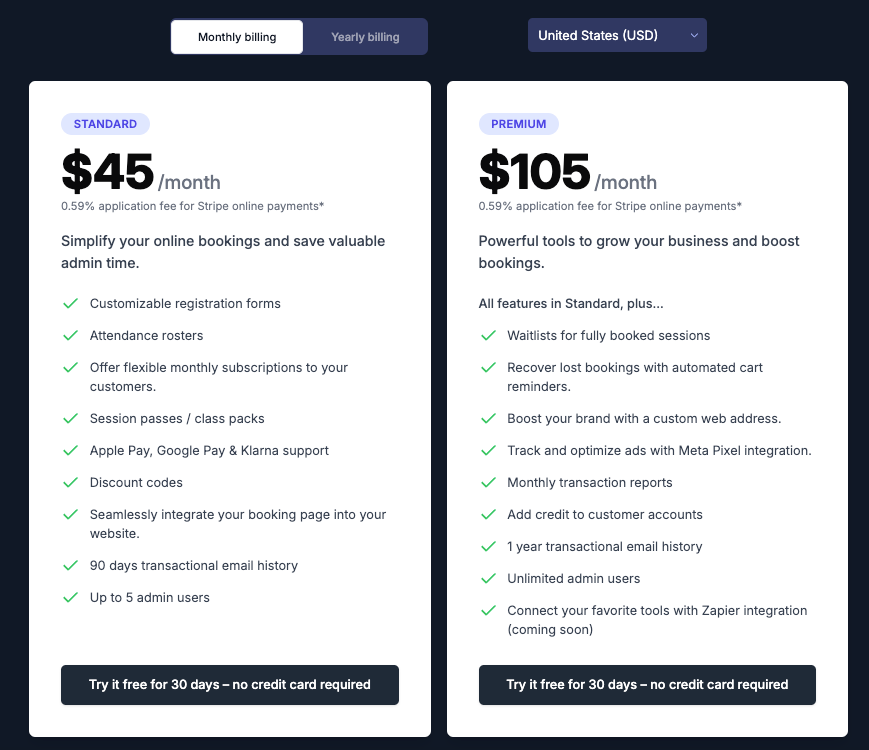
Pricing: Standard is $45 per month including up to 5 admin users. Premium is $105 per month and adds waitlists, automated recovery emails, a custom domain, monthly reports and unlimited admin users. Adding coaches or admins does not raise the price. Card payments run through Stripe with a 0.59% application fee on top of Stripe's own rates. The 30-day free trial needs no card, there is no contract, and annual billing includes two months free. Full details are on our pricing page. Pricing checked August 2026.
Where Momence or Mindbody still beats us:
- No consumer marketplace. Mindbody's app puts you in front of people who have never heard of you, and we have nothing like it. We run the business you already have; we do not send you clients.
- No on-demand video library or LMS. If selling recorded classes and course content is part of your revenue, Momence has that built in and we do not.
- Less depth for a large multi-site wellness operation: no room and resource management, no reserved spots in class, and a smaller integrations catalog than Mindbody's.
Switching: Most providers move at a term boundary, exporting clients from their current tool and setting up the next term's classes fresh rather than migrating years of history. Setup is self-serve inside the 30-day trial, and we help with the import.
What users say: We hold 4.9 out of 5 from 23 reviews on Capterra, with 5.0 for customer service and 5.0 for value for money. Courtney O., a founder, writes "Whenever I have a question, their team is quick to respond (I'm talking like same day response)!" and Julie H., an operations director, says "We have been very impressed with how easy Pembee is to use compared to our previous booking system." That is a far smaller review base than Momence's 76 or Mindbody's 2,993, so read it as fit with a specific audience rather than proof of scale.
Which one should you pick?
If your bookings come from people who already know you and you want a modern interface with marketing built in at a price you can read, Momence is the call, with the $199 tier as your realistic budget rather than the $60 one. If you need the consumer app to find new clients, sell courses or semesters, or run several locations, Mindbody earns its sales call and its per-location meter.
The third case is the one neither was designed for: terms, seasons and camps, where a parent enrolls children, sibling pricing matters and the register is the daily tool. That is the business we built for, and it costs nothing to find out whether it is yours.
FAQs
Is Momence better than Mindbody?
It depends on where your bookings come from. Momence is better if your clients already know you and you want a modern interface with email, SMS and automations in the base product at a published price. Mindbody is better if you need its consumer app to bring you new clients, you sell courses or semesters, parents manage several children from one account, or you run more than one location. Neither is the safe choice on support: Capterra rates customer service 3.7 for Momence and 3.8 for Mindbody.
How much does Momence cost per month?
Momence publishes three tiers as of August 2026: Basic at $0 per month with a 5% platform fee charged to the business, Pro at $60 per month with a 2.5% platform fee, and Custom at $199 per month with no platform fee. Basic and Pro exclude staff members, multiple locations, reporting, the inbox, retail and add-ons, so most staffed studios land on Custom. Card processing is charged on top at a published 3.9% plus $0.30 for US online cards, and the AI Agent add-on is $399 per month.
How much does Mindbody cost per month?
Mindbody's Starter plan is from $79 per month per location in the US as of August 2026, with unlimited users included. The Accelerate and Ultimate tiers, which add advanced analytics, room and resource management, reserved spots and marketing automation, are quote only and need a sales call. Card processing rates are not published. Marketplace bookings carry a fee of 20% of the first eligible purchase excluding tax, capped at $30 and charged once per client, and it does not apply to bookings made through your own site or branded app.
Can you switch from Mindbody to Momence?
Yes, but check your Mindbody contract first, because terms are set per plan rather than published and Mindbody's own answer on cancellation is that it depends on your plan and billing terms. After that, expect to export clients, memberships and purchase history, rebuild your schedule and pricing in Momence, and re-onboard anyone who books through the Mindbody consumer app, since that discovery channel does not transfer. Momence's free Basic tier lets you build and test the setup before you commit to a paid plan.
Does Momence or Mindbody handle kids' classes and family bookings?
Mindbody handles them better. It has a named Family Accounts feature so a parent can book and manage several children from one login, plus course bundles for multi-week programs. On Momence, booking for a child is an admin setting that is off until you turn it on, and children are then chosen from a dropdown at checkout. Neither has a native sibling or family discount: Momence's documented approach is tag-based price rules applied manually.
What is the best alternative to Momence and Mindbody?
It depends on the shape of your business. Boutique adult studios that want a modern interface usually stay with Momence, and multi-site wellness businesses that rely on marketplace discovery usually stay with Mindbody. For providers running recurring group programs, terms and camps, especially where a parent books for a child, we built our platform for exactly that: term enrollments, one account per family with per-child records, stackable sibling discounts, registers, waivers and payments in one place, priced flat per business rather than per location. If your classes are adult fitness instead, our [fitness class booking software](/solutions/fitness-class-booking-software) page covers how the same model works for yoga, pilates and HIIT timetables.