


From the outside, Forest School looks like children in waterproofs poking a log with a stick. What has been measured is more specific than that. The benefits of Forest School cluster into six outcomes that UK research keeps finding: confidence, social skills, language and communication, motivation and concentration, physical skills, and knowledge and understanding of the natural world.
Those six came out of an evaluation by Forest Research and the New Economics Foundation that tracked 24 children across seven schools in Shropshire, Worcestershire and Oxfordshire over eight months. Later work has put numbers on several of them. Below is what the UK evidence actually shows, how long it takes before anything changes, who benefits most, what a place costs, and how to tell a genuine programme from an afternoon in the woods.
What Forest School actually is (and what it is not)
Forest School is a long-term process, not a location. The Forest School Association defines it as a series of regular sessions in a woodland or natural setting, led by a qualified practitioner, where the learners decide a great deal of what happens. The approach has Scandinavian roots, arrived in the UK in 1993, and got its professional body when the FSA launched in July 2012.
Six guiding principles hold the whole thing together:
- A long-term process of regular sessions, linked by a cycle of planning, observation, adaptation and review
- A woodland or natural setting, so the learner builds a lifelong relationship with the natural world
- Learner-centred processes that create a community for being, development and learning
- All-round development of everyone involved, fostering resilient, confident, independent and creative learners
- Supported risk-taking, appropriate to the environment and to the learner
- Qualified practitioners who keep developing their own practice
Every benefit further down this page was measured in settings that worked this way. That matters, because the label gets used loosely.
The 24-week rule
The FSA sets a minimum before a programme can call itself Forest School. Sessions run with the same core group for at least 24 consecutive weeks in one year, the equivalent of two full school terms, covering two seasons. The alternative is 12 consecutive weeks a year across two years, again covering two seasons, or fortnightly sessions across a whole academic year for classes of more than 15. Each session lasts a minimum of two hours, except where participants have severe or complex needs, and the practitioner holds at least an accredited Level 3 Forest School qualification. All of this sits in the FSA's principles and criteria for good practice.
The length is not bureaucracy. It is the condition the research findings were produced under. A single trip to the woods is a good day out, and the evidence below does not transfer to it. If you are thinking about running sessions yourself, the 24 weeks is the first thing to design around.
Physical benefits
Woodland does something a playground cannot: it is uneven. Children clamber over roots, carry logs that are slightly too heavy, balance on a fallen trunk and adjust to ground that changes with the weather. That constant correction trains balance and body awareness alongside gross motor strength. Forest Research recorded exactly this, describing physical stamina and the gross motor skills and coordination that let a child move freely around the site, alongside the fine motor skills behind using tools and making structures and objects.
Set that against how much children in England currently move. Sport England's Active Lives Children and Young People Survey for the 2024/25 academic year found 49.1 per cent of children and young people in England, about 3.6 million, average 60 minutes or more of activity a day, the level the Chief Medical Officers recommend. At the other end, 28.4 per cent, roughly 2.1 million, do less than 30 minutes a day. Against that backdrop, two hours of unstructured outdoor movement a week is not a rounding error.
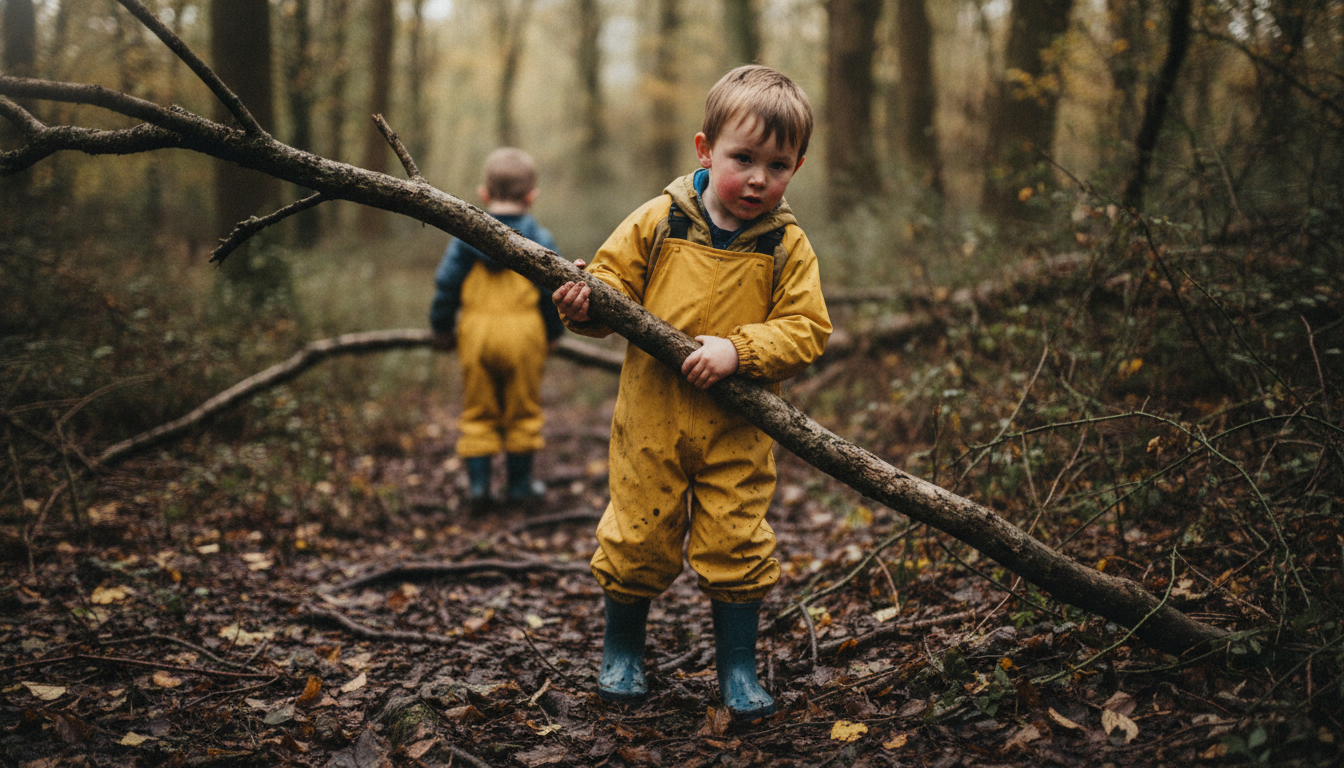
The fine motor side is easy to underrate. Whittling a point, tying a clove hitch, striking a fire steel and threading cord through a tarpaulin eyelet all demand precise grip and bilateral coordination, and practitioners find children repeat them far longer than they would repeat a handwriting exercise. Our list of Forest School activity ideas covers most of the standard repertoire.
Daylight, and what it does for eyesight
One physical benefit almost never gets mentioned, and it has harder evidence behind it than several that do. Time spent outdoors in daylight is one of the better-evidenced protective factors against childhood short-sightedness, and the protection appears to come from light intensity rather than from the exercise.
The clearest population example is Yilan County in Taiwan, where kindergartens introduced two hours of outdoor time every weekday from August 2014. Across seven school-year cohorts of children aged five and six, myopia prevalence fell from 15.5 per cent in 2014 to 8.4 per cent in 2016 and stayed between 8.5 and 10.3 per cent in the cohorts that followed. An overview of seven systematic reviews, covering 47 primary studies and 63,920 participants between them, reported an overall 2 to 5 per cent reduction in the odds of developing myopia for every additional hour spent outdoors per week. It was published in the College of Optometrists' journal.
Three honest caveats. The Yilan figures come from surveying successive cohorts across a whole county, not from a controlled trial, so they show an association rather than proof that outdoor time alone did it, and the review authors describe the overall link as a weak association. This is evidence about daylight exposure, not about Forest School as a method. And one weekly session is nowhere near two hours a day, so treat it as one contribution to a total rather than a claim about the programme.
Cognitive and academic benefits
The largest piece of UK evidence in this area is not a Forest School study as such, but it is the closest thing we have to scale. The Natural Connections Demonstration Project ran from 2012 to 2016 across the South West, funded by Defra, Natural England and Historic England and delivered by the University of Plymouth. It worked with 125 schools, with a combined roll of 40,434 pupils and more than 2,500 teachers, and Defra described it as England's largest outdoor learning project.
In the final report to Natural England, 95 per cent of the schools surveyed said learning outside the classroom had a positive impact on pupils' enjoyment of lessons, 92 per cent said the same for engagement with learning, 85 per cent reported a positive impact on behaviour and 79 per cent said it had a positive impact on teaching practice. Among pupils, 92 per cent agreed they enjoyed lessons outside and 89 per cent felt happy and healthy in them. Worth saying plainly: these are self-reported perceptions from a survey of 87 schools and 448 primary pupils, not test scores from all 40,000.
For attainment there is a narrower finding, and it needs handling carefully. University of Derby researchers surveyed 775 Year 6 pupils across 15 East Midlands primary schools for the RSPB. Children who scored above a threshold level of nature connection were around half a grade point ahead in English. The useful part is the researchers' own framing: nature connection mattered to English achievement on a similar scale to established factors such as life satisfaction and school attendance. The caveats matter just as much. The same gap did not show up in maths, the effect was small, and the design was correlational, so nobody has shown that nature connection causes the difference.
Language is the third strand, and it is one of the original six outcomes. Forest Research described children developing more sophisticated spoken and written language, prompted by visual and sensory experience. A wood generates vocabulary a classroom cannot conjure, because the child needs words for things actually in front of them: brittle, sodden, hollow, the difference between a beech and a hornbeam.
Motivation and concentration works by a mechanism most articles skip. Attention in a classroom is largely enforced. Attention at Forest School is held by the task, because the child chose it, which is why practitioners see children stay with one activity for a stretch that would be unusual indoors.
Emotional wellbeing and mental health
The most useful single study on this page is small, recent and British. Hepworth, Haddad and Edmonds at the University of East London recruited 179 schoolchildren aged seven and eight from four primary schools in Essex, with a final sample of 151 split between a Forest School group and a classroom group that was offered sessions the following term. Both were assessed at baseline and again after 12 weekly sessions.
Children who attended Forest School rated themselves as less tired, less bored, calmer and happier than the classroom group, and showed greater improvements in cooperation. The null results are just as informative: there was no overall difference in self-esteem, only some initial evidence of better competence-related self-esteem, and performance on a spatial cognition task was unchanged. A study that reports what did not move is a study worth trusting on what did.
One qualification on how far to push it. Children were not randomly allocated to the two groups, so this is a controlled comparison rather than a randomised trial, and the sample is one county.
Context helps explain why schools are looking. NHS England's survey of the mental health of children and young people in England found 20.3 per cent of 8 to 16 year-olds had a probable mental disorder in 2023, a rate that has held stable since 2022 rather than climbing further.
UCL Institute of Education researchers surveyed 451 children, mostly aged eight and nine, across 12 areas of England before and after outdoor activities for The Wildlife Trusts. Personal wellbeing and nature connection both rose. Ninety per cent of children felt they had learned something new about the natural world, 84 per cent felt capable of doing new things when they tried, and 79 per cent reported feeling more confident in themselves.
One finding deserves more attention than it gets. Separate Derby research covering almost 4,000 adults and children found a sharp dip in nature connectedness from around age 11, with a slow recovery only by about 30. Almost every Forest School article stops at early years. The evidence points the other way: upper primary and early secondary is precisely when the connection is being lost, and when a weekly session has the most to hold on to.
Social skills and supported risk-taking
Cooperation is the outcome the UEL study actually measured, and it is the one most visible to a parent at pick-up. The reason is structural. A den needs four hands. A log needs two children who agree on which way it is going. A fire circle has rules that only work if everyone keeps them. Social skill is not so much taught at Forest School as required by the tasks, and Forest Research recorded exactly that: a growing awareness of the consequences of your actions on other people, and a better ability to work co-operatively.
Why the risk is the point
One of the FSA's six principles is supported risk-taking. This is the part parents ask about most, and the most authoritative answer in Britain comes from the Health and Safety Executive, which is not the source people expect. In a joint statement with the Play Safety Forum, HSE states that the goal is not to eliminate risk but to weigh up the risks and benefits, adding that no child will learn about risk if they are wrapped in cotton wool. HSE explicitly backs risk-benefit assessment, where both sides are considered together.
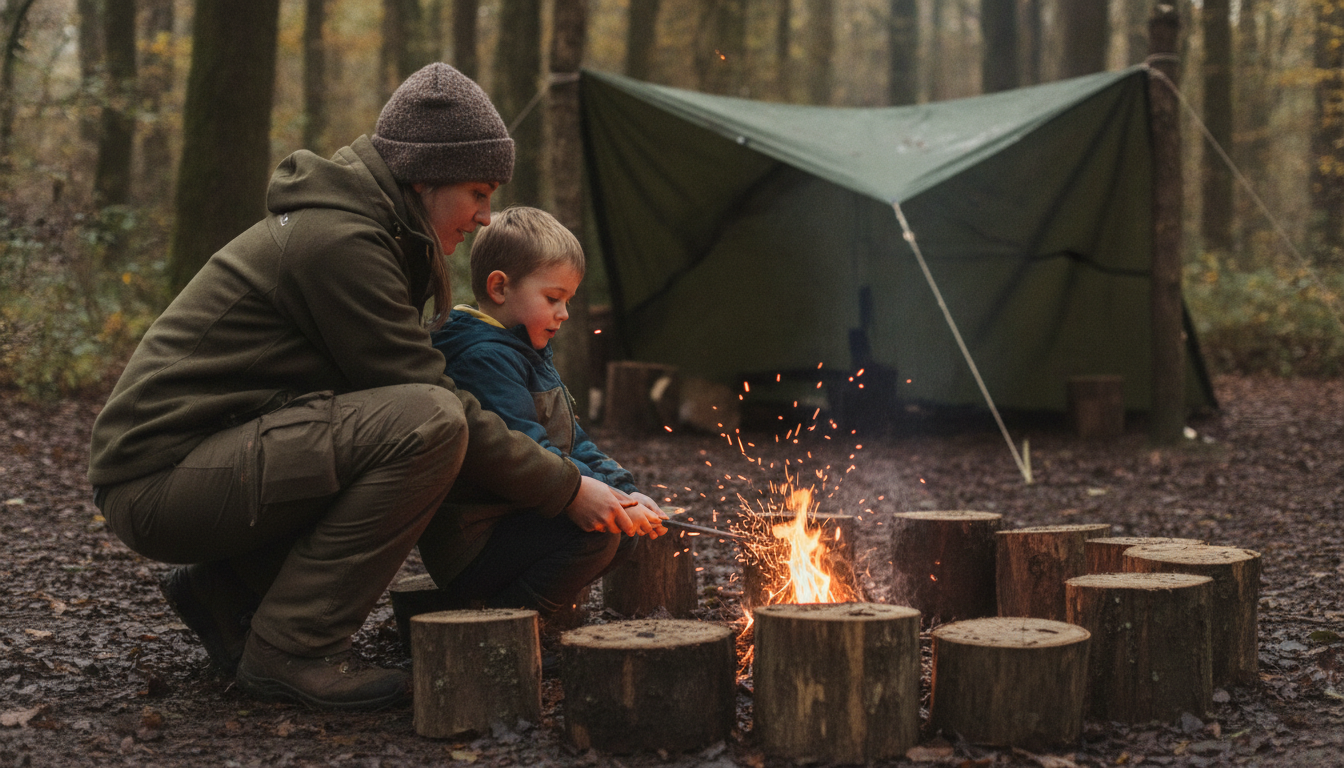
In practice that looks specific rather than daring. A fire circle with a marked boundary children step over one at a time. A knife introduced with a taught grip and a blood bubble, the arm's-length safe zone nobody else steps into, with one child cutting at a time. Tree climbing where the child decides the height and the practitioner never lifts them into a position they could not reach alone. The child assesses, the adult supervises, and the risk that remains is doing a job. If you are writing your own paperwork, our guide to designing a Forest School curriculum covers how risk-benefit assessment sits inside the planning cycle.
What changes, and when
This is the question parents ask after paying for a block, and the question schools ask before giving up curriculum time. The honest answer is that different things arrive at different points, and almost nothing arrives in the first month.
| Stage | What tends to happen | What the evidence says |
|---|---|---|
| Sessions 1 to 4 | Settling in. Children learn the site and test the boundaries, and some stay close to adults the whole time | Nothing measurable yet. This is the observation half of the FSA's planning, observation, adaptation and review cycle. Do not judge a programme here |
| Sessions 5 to 12 | The group starts working rather than orbiting. Children initiate activities and return to unfinished projects | The measurable window. By week 12 the UEL study found children calmer, happier, less bored and less tired than classroom peers, with greater gains in cooperation. Self-esteem had not shifted |
| Sessions 13 to 24 | The same site in two seasons. Children notice change, predict it, and start naming what lives there | The FSA minimum for a full programme. Returning to a known place in a changed state is where the knowledge and understanding outcome comes from |
| Beyond 24 sessions | Habits travel home and into the classroom. Parents report different play, different questions, different confidence | The deeper confidence and self-esteem findings, and the ripple effects on families that Forest Research recorded as a separate theme |
The practical implication is blunt. A four or six-week taster block will not produce what the research describes, and a provider selling one should tell you that rather than let you conclude the benefits were overstated.
Forest School for children with SEND, anxiety or school avoidance
Ask practitioners which children change most and a lot of them will name the ones school finds hardest. The mechanism is not mysterious.
- Higher adult ratios. The FSA does not publish a fixed number. It says ratios are high and are "decided upon through a risk assessment approach", weighing the participants' needs and abilities, the site and the activities, plus an additional adult on top. The practical effect is that a group with higher needs gets more adults, and that tools and fire are supervised more tightly still.
- Social contact through a task. Building something side by side is far less demanding than a face-to-face conversation, so children who freeze in a classroom group will talk over a fire they are both tending.
- A sensory environment that regulates rather than overloads. Wind, birdsong and leaf litter are varied but low-intensity, which is a different proposition from a corridor at changeover.
- No single right answer and no visible ranking. A child who is behind in class is not behind in a wood, because there is no page to be on.
- Movement is the default. In most classrooms getting up is a behaviour issue. Outdoors it is just how the session works.
Be careful about the strength of this evidence. A systematic review of Forest School literature in England found that every piece of primary research it examined used qualitative methods at least in part, and that only three of the 25 studies reviewed had more than 100 participants. The FINCH study is the first serious attempt to change that: a feasibility cluster randomised trial sponsored by Humber Teaching NHS Foundation Trust and run with the University of York's trials unit, targeting 200 Key Stage 2 children across eight primary schools in Hull, East Yorkshire and North Yorkshire. Its protocol was published in 2025 and it has not yet reported. Being a feasibility study, its job is to establish whether a full trial is workable rather than to prove that Forest School works.
On school attendance and emotionally based school avoidance specifically, there is no UK study of Forest School to point at. What exists is practitioner experience and the plausible mechanism that attending somewhere which does not look or feel like school can restart the habit of attending at all. Treat that as promising, not proven.
On funding, one point is worth knowing. There is no national list of approved interventions for an Education, Health and Care Plan. Section F of an EHC plan must set out the special educational provision required for each need identified, and the SEND Code of Practice says that provision must be detailed and specific, and should normally be quantified by type, hours and frequency. Where there is evidence that Forest School sessions meet an identified special educational need and are additional to or different from what other children of the same age get, they can be written into Section F, and once they are the local authority has a legal duty under section 42 of the Children and Families Act 2014 to secure them. It is decided case by case on the evidence, not by any national policy about Forest School. The SEND system is being reformed following the February 2026 schools white paper, but the 2015 Code and that duty still apply.
What Forest School costs in the UK
Prices vary more than almost any other children's activity, because "Forest School" covers everything from a free grant-funded community session to registered full-day childcare. The figures below come from the published price lists of UK providers across England, Scotland, Wales and Northern Ireland, checked in August 2026. Where providers quote privately rather than publishing, we have said so rather than guess.
| Format | Typical UK price |
|---|---|
| Community or grant-funded weekly session | Free to about £15, commonly £6 to £12 |
| After-school or weekend club, about 2 hours | £8 to £22 per child |
| Forest School nursery or kindergarten, half day | £25 to £40 |
| Forest School nursery, full day | £36 to £72, or £70 to £112 in London |
| Holiday club, single day of 5 to 6 hours | £30 to £45, or about £65 to £70 in London |
| Holiday club, full week | £180 to £225, or £325 to £350 in London |
| School-commissioned half-day session for a class | £85 a session on a block booking, up to about £400 for a small group at a high ratio |
| Bespoke 1:1 provision, full day | Rarely published. One provider quotes from £375 a day |
Two things drive the spread more than geography does. The first is what is bundled: a London forest nursery charging about £112 a day is usually running 8am to 6pm with meals included, against a six-hour day elsewhere, so the headline gap overstates the real one. The second, for school bookings, is group size and how many practitioners turn up. A half day can be £130 with one leader taking a whole class, or close to £400 where two leaders work with a small group, which is why per-session quotes are so hard to compare.
Wales is where subsidy shows up most clearly. Welsh Government and National Forest of Wales funding puts some community sessions in Swansea and Neath Port Talbot at £2 or free outright. The bigger obstacle for parents everywhere is that a large share of providers publish no prices at all and quote on request, which is why any national average for this sector deserves suspicion.
Staffing is why it costs what it costs. The ratios are deliberately high, the leader holds a Level 3 qualification, and the session runs whatever the weather, which means kit and maintenance on top.
Four funding routes are worth checking before you pay full price:
- Tax-Free Childcare adds £2 for every £8 you pay in, up to £500 a quarter or £2,000 a year per child, and £4,000 a year for a disabled child. The provider has to be registered and signed up. Providers can read our guide to accepting Tax-Free Childcare payments.
- Funded early years hours cover up to 30 hours a week for 38 weeks a year for working parents in England, now from nine months old, at registered settings. Many settings let you stretch the hours over more weeks.
- Pupil premium, worth £1,550 per eligible primary pupil in 2026 to 2027, where a school commissions the provision rather than parents paying.
- Grants for providers, including National Lottery Awards for All England at £300 to £20,000, and the Ernest Cook Trust, which funds outdoor learning specifically and runs grants from £500 to £20,000 depending on the programme.
Six questions to ask before you book
Most disappointment with Forest School comes from booking something that was never Forest School. These six questions sort it out in one phone call.
- How many weeks does the programme run, and does it cross two seasons? You are listening for 24 consecutive weeks, or 12 a year across two years. A four-week block is a taster, which is fine if it is sold as one.
- Is the leader a qualified Level 3 Forest School practitioner? Ask for the qualification by name and level, and check it was gained face to face, which the FSA criteria require. Level 1 is an introduction and Level 2 qualifies an assistant, so neither is enough to lead. Our guide to forest school training covers what each level involves and costs.
- What is the adult-to-child ratio, and how does it change for tools and fire? There is no national standard, so a good provider will explain how they arrived at their number rather than quote one.
- Who decides what happens in a session? Learner-led means children choose within boundaries the practitioner sets. A fixed timetable of adult-run activities is outdoor teaching. That has real value, but it is not Forest School and it is not what the research measured.
- How do you handle risk? A strong answer describes risk-benefit assessment and names the benefits being protected. An answer that is only about eliminating hazards is out of step with HSE's own position.
- How will I know what my child did and how they are getting on? Observation and review is built into the FSA's principles, so a provider should have a ready answer.
For providers: turning these benefits into something you can show
That last question is the one providers most often fumble, and it costs them renewals. Every outcome on this page is real, and almost all of it is invisible to the person paying. A parent who sees no evidence of progress assumes there was none, and does not rebook.
The fix is small and habitual rather than a reporting project:
- Short observation notes against the six outcomes, a line or two per child per session, not an essay
- A handful of photos each week, with consent collected at booking rather than chased in week six. Our photo consent form guidance covers what to ask for
- Attendance and retention across a block, which is itself evidence of engagement and the easiest number to show a school or funder
- One parent-facing update per half term, not a single report at the end
Time it against the evidence. If the change shows up between weeks five and 12, the update that matters commercially is the one that lands before the renewal decision, not after it. Providers who show progress at week eight sell the second block. If you are still setting the operation up, our forest school business plan guide covers the business side, from startup budget to break-even.

Key takeaways
- The benefits group into six outcomes UK research keeps finding: confidence, social skills, language and communication, motivation and concentration, physical skills, and knowledge of the natural world.
- A UK study of 151 children aged seven and eight found that after 12 weekly sessions they were calmer, happier and more cooperative than a classroom group, with no shift in self-esteem.
- Length is the condition. The FSA minimum is 24 consecutive weeks across two seasons, and taster blocks do not deliver it.
- Nature connectedness dips sharply from around age 11, making upper primary a stronger case than the usual early years framing.
- The format suits many children with SEND or anxiety, though the evidence is small-scale and no randomised trial has reported.
- Prices run from free community sessions to about £112 a day in London, and Tax-Free Childcare, funded hours and pupil premium can all apply.
FAQs
What are the six principles of Forest School?
They are: a long-term process of regular sessions linked by planning, observation, adaptation and review; a woodland or natural setting; learner-centred processes that build a community; development of the whole child; supported risk-taking; and delivery by qualified practitioners who keep developing their practice. All six are set by the Forest School Association, and a programme has to meet all of them.
How long does it take to see the benefits of Forest School?
Expect the first four sessions to be settling in. A UK study with a classroom comparison group measured clear differences in mood and cooperation by week 12, and the FSA's own minimum for a full programme is 24 consecutive weeks across two seasons. Deeper confidence changes and knock-on effects at home tend to come after that.
What do children actually learn at Forest School?
Two things at once. The six research-backed outcomes, from confidence to language, and a set of concrete skills: fire lighting, safe tool use, knots, shelter building, cooking outdoors and identifying plants, trees and wildlife. The skills are the vehicle, and the outcomes are what the skills produce.
Is Forest School suitable for children with additional needs?
Often it suits them better than a classroom does. Higher adult ratios, movement as the default, no visible ranking and social contact mediated through a shared task all lower the demand on a child who finds school hard. The evidence is mostly small-scale and qualitative so far, and the first randomised trial is a feasibility study that has not yet reported.
Is Forest School only for young children?
No. Programmes run from early years through secondary, and adult Forest School and outdoor learning sessions exist too. Research from the University of Derby found that connection to nature dips sharply from around age 11 and does not recover until roughly age 30, which is an argument for keeping it going well past infants.
What is the difference between Forest School and outdoor learning?
Outdoor learning is any teaching that happens outside, including a one-off woodland trip or a maths lesson on the field. Forest School is a specific long-term process with six defined principles, a minimum run of 24 weeks, two-hour sessions and a Level 3 qualified leader. Both are worthwhile, but only one is what the research measured.
How much does Forest School cost in the UK?
Community sessions run from free to about £15, after-school clubs £8 to £22 for around two hours, and holiday club days £30 to £45 outside London. Full-day Forest School nursery places range from about £36 to £72, rising to roughly £70 to £112 in London. Tax-Free Childcare, funded early years hours and pupil premium can all reduce what a family or school actually pays.
Is Forest School safe with fires and knives?
Yes, when it is run properly, and the tools are part of why it works. HSE and the Play Safety Forum are explicit that the aim is to weigh risks against benefits rather than eliminate risk. Practitioners use risk-benefit assessment, introduce tools one at a time with a taught grip, and keep tool and fire ratios far tighter than the general session ratio.
Does Forest School run in winter and in the rain?
Almost always, and the seasonal range is part of the design. The FSA criteria require a programme to cover two seasons precisely because returning to the same site as it changes is where the knowledge and understanding outcome comes from. Providers will give you a clothing list, and warm layers plus waterproofs and wellies cover most British weather.
Can Forest School be funded through an EHCP?
It can be, but there is no automatic route. Section F of an Education, Health and Care Plan must specify the special educational provision needed for each identified need, and provision written into Section F must be secured by the local authority. Whether Forest School goes in depends on evidence that it meets a specific need, decided case by case. The benefits of Forest School are real, they are more specific than most benefit lists suggest, and they depend almost entirely on the programme being long enough to count. Ask about the number of weeks before you ask about anything else. And if reading this has you thinking about running sessions rather than booking them, our guide to [starting a Forest School](/blog/how-to-start-a-forest-school) is the place to begin.