
Dance Studio Advertising: Budgets, Ad Copy and When to Run


Most dance studio ads fail for boring reasons. They run in September, after families have already filled their week. They send parents to a homepage instead of a booking page. And nobody can tell which ad brought in which student, so next year's budget is a guess.
Dance studio advertising works best when you run one clear offer, usually a free or low-cost trial class, to parents within a 10-15 minute drive, mainly on Facebook, Instagram and Google search, starting in late July for fall enrollment. Most small studios can start with $300-$600 a month in peak season and judge every channel by one number: cost per enrolled student.
Below you'll find how to set a budget from the students you need, how each channel compares, ready-to-adapt ad copy, a month-by-month advertising calendar and a simple way to track results. This guide covers paid and printed advertising. For the wider mix of organic social, email, SEO and referrals, see our dance studio marketing strategies.
Before you spend a dollar: pick one offer and one audience
The ad that says "We offer ballet, jazz, tap, contemporary and hip hop for all ages" is the one that gets scrolled past. It asks the parent to do the work of figuring out whether anything fits their child. One ad should speak to one audience about one class with one offer.
Choose the audience
Most studios have four distinct audiences, and each needs its own ad:
- Preschool parents (ages 3-5): buying a first activity, worried about separation and whether their child is "ready."
- School-age parents (ages 6-11): fitting dance around school, soccer and homework, comparing days and times.
- Teens: interested in hip hop, contemporary or a competition team, with a parent who still pays and drives.
- Adult beginners: the dancer is the buyer, and the worry is looking silly in a room of experienced dancers.
For anyone under 13, the parent is the buyer. Write to them, show their child having fun, and answer the practical questions (day, time, price, what to wear) before they have to ask.
Choose the offer
The offer is what you're advertising, not the studio. Good dance studio offers include:
- A free trial class or a $10-$20 paid trial (paid trials tend to get better show-up rates)
- A free first week of a new term
- An open house with mini classes and a registration discount
- An early-bird rate for summer camp or a summer intensive
- "New beginner class starting [date]"
A specific start date beats an evergreen pitch. "Tuesday Pre-Ballet starts September 8, six spots left" gives a parent a reason to act now. "Classes for all ages" gives them a reason to bookmark you and forget.
How much to spend on dance studio advertising
A common rule of thumb in the studio industry is to spend 5-8% of gross revenue on marketing, rising to 10-12% for a new studio that's still building its roster. It's a useful sanity check, but it doesn't tell you how many students that money will bring in or where to put it. A better approach is to start from the number of students you need and work backward.
Work backward from the students you need
Say you want 20 new students for fall. Your ads will bring in trial bookings, not enrollments, so you need to account for two drop-off points: families who book a trial but don't show, and families who try a class but don't enroll.
| Step | Assumption | Result |
|---|---|---|
| New students needed | Your goal for fall | 20 students |
| Trial attendees needed | 40% of trial families enroll | 20 ÷ 0.40 = 50 attendees |
| Trial bookings needed | 70% of bookings show up | 50 ÷ 0.70 = about 72 bookings |
| Ad budget | About $25 per booking (lead) on Facebook and Instagram | 72 × $25 = $1,800 |
| Monthly spend | Spread over late July to September | About $600 a month |
| Cost per enrolled student | $1,800 ÷ 20 | $90 per student |
The $25 cost per lead sits a little under the Education and Instruction average of $28.22 in WordStream's 2025 Facebook ads benchmarks, which makes sense for a local, visual offer like a kids' dance class. Treat every rate in the table as a starting assumption and replace it with your own numbers after your first campaign.
Now compare that $90 with what a student is worth. If your tuition is $85 a month and a typical student stays for a 10-month season, one new student brings in $850 in their first year alone. Spending $90 to win $850 is a good trade, and most students stay longer than one season. For the tuition side of this math, see our guide to how much to charge for dance classes.
Starting budgets by studio size
If you don't have any data yet, these ranges are a reasonable place to start during peak enrollment months:
| Studio | Peak-month ad budget | Where it goes |
|---|---|---|
| New or one-room studio | $300-$500 a month | Facebook and Instagram, plus one postcard drop before your open house |
| Established studio (150-300 students) | $500-$1,500 a month | Meta ads, Google search ads and retargeting |
| Multi-location studio | $1,500+ a month | Separate campaigns per location, each with its own radius and budget |
Spend heaviest in the peak windows covered in the calendar below, then drop to a small retargeting budget or pause in quieter months. If you're still building your financial model, our dance studio business plan guide shows where marketing fits alongside rent, payroll and costumes.
The best advertising channels for dance studios, compared
Each channel reaches a different family at a different moment. Here's how they compare on cost, reach and speed:
| Channel | Typical cost | Who it reaches | Best for | Time to results |
|---|---|---|---|---|
| Facebook and Instagram ads | About $28-$53 per lead (education and fitness averages) | Local parents scrolling their feed; adults by interest | Trial classes, camps, new class launches | 1-2 weeks |
| Google search ads | About $5-$6 per click, $63-$90 per lead (category averages) | People already searching for dance classes nearby | High-intent searches in August and January | Days |
| EDDM postcards | $0.26 postage plus printing per home | Every household on the mail routes you choose | New studios, open houses, a new location | 2-4 weeks |
| Flyers, posters and school folders | Printing only | Families at schools, libraries, cafes and pediatricians | Community awareness, events | Slow, builds over time |
| Local sponsorships and print | $100-$1,000+ | Local families at school and community events | Familiarity that makes other ads work harder | Slow |
| Retargeting ads | A small share of your Meta or Google budget | People who visited your website but didn't book | Turning lookers into bookings | Ongoing |
The paid social figures come from WordStream's 2025 Facebook ads benchmarks (Education and Instruction $28.22 per lead, Health and Fitness $52.98). The search figures come from WordStream's 2025 Google Ads benchmarks, which put Education and Instruction at $6.23 per click and $90.02 per lead, and Health and Fitness at $5.00 per click and $62.80 per lead. Neither is dance-specific, so read them as ballpark figures rather than targets.
If you're starting from scratch, run Facebook and Instagram plus a small Google search campaign. Add postcards if you're new to the area or opening a second location, and use flyers and sponsorships to support everything else.
Facebook and Instagram ads for dance studios
For kids' classes, Meta's platforms are usually the first place to spend. Parents are on them daily, video shows the movement and joy that a still photo can't, and leads tend to cost less than on search.
What a good dance studio Facebook ad looks like
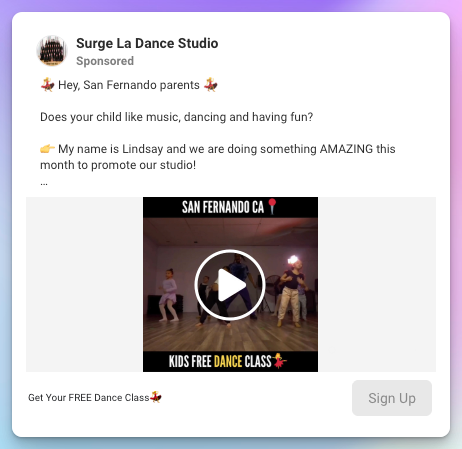
This ad from a Los Angeles studio gets most of it right. It opens by naming the reader ("Hey, San Fernando parents"), asks one question a parent will answer yes to, and makes one offer: a free kids' class. The creative is real class video with the city and the offer written on the thumbnail, so it works with the sound off, and the button says "Sign Up" rather than "Learn more." The only thing missing is the day, time and age range, which would save the parent a click.
Targeting that works
Set a radius of 5-15 miles around your studio, or think of it as a 10-15 minute drive. In a city, that might be 3 miles; in a rural area, 20. Parents rarely drive past two or three other studios to reach yours.
For kids' classes, target parents, not dance fans. Meta doesn't allow interest-based targeting of people under 18, and interests like "ballet" mostly reach adults who follow dance. A broad audience of adults aged roughly 25-45 within your radius, with parent-related options where Meta offers them, will usually outperform a narrow interest stack. Once your Meta Pixel has collected booking data, Meta's broad or Advantage+ audiences can find more families like the ones who already booked.
Adult classes are the exception. Style interests such as ballet, salsa, ballroom or K-pop are a fair way to reach adult beginners.
Creative
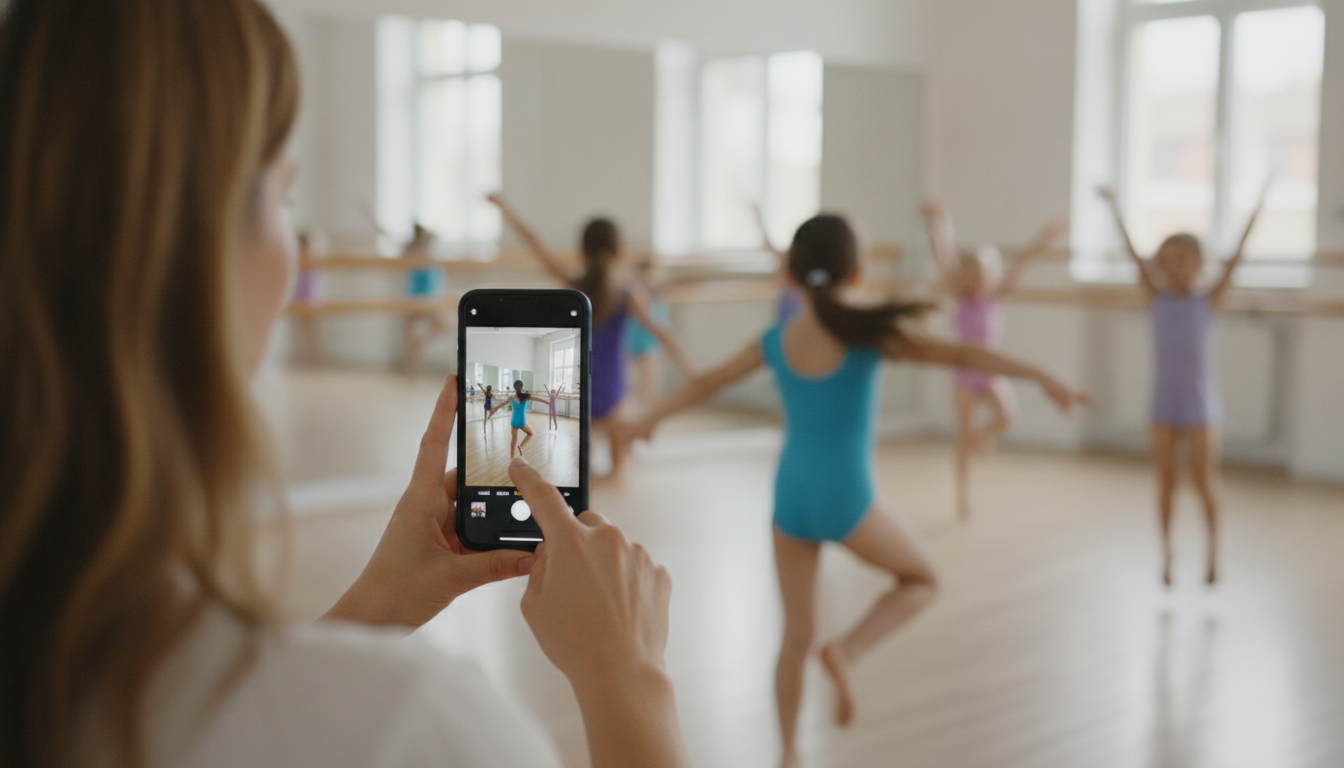
Use vertical video (9:16) between 15 and 30 seconds long, shot on a phone in a real class. The first three seconds decide whether anyone keeps watching, so open with movement: a line of preschoolers leaping, a teacher's high five, a teen landing a combination. Add captions, since many people watch with the sound off.
Show real students, your teachers and your space. Stock photos and empty studio shots look like every other ad in the feed. A parent's-eye view from the lobby window works well because it's exactly what the viewer imagines doing. Get written photo and video consent from families before you use anyone's child in an ad; a consent checkbox on your registration form makes this simple.
Campaign setup
Choose the Leads or Sales (conversions) objective and send people straight to a booking page for the class you're advertising. Start at $15-$25 a day per campaign. Meta's delivery needs time to settle, so give a new campaign 7-10 days before you judge it.
When something works, raise the budget by 10-20% at a time rather than doubling it overnight. Keep an eye on frequency: when the same people have seen your ad five or more times, results usually slip, and it's time for fresh video.
Retargeting
Put a small slice of your budget toward people who visited your timetable or class pages but didn't book. These ads can be blunter, because the viewer already knows who you are: "Fall classes start September 8. Four spots left in Tuesday Pre-Ballet." For the unpaid side of these platforms, see our guide to social media marketing for activity providers.
Google ads for dance studios
Facebook and Instagram interrupt people. Google search ads catch them while they're already looking. Someone typing "toddler dance classes near me" or "adult ballet classes [city]" has a need right now, which is why clicks cost more and convert better.
Keywords and structure
Build one ad group per class type or age group, such as toddler dance, kids' hip hop, ballet for kids and adult beginner classes. That way the ad and landing page can match what the person searched for. Keep location targeting tight to your catchment area.
Add negative keywords from day one so you don't pay for the wrong searches:
- jobs, hiring, teacher, instructor
- online, videos, tutorial, YouTube
- costume, shoes, wear
- rental, for rent (unless you rent out your space)
- free (unless your offer is free)
Check the search terms report every week for the first month and keep adding to the list.
Writing the ad
Google's responsive search ads allow headlines of up to 30 characters and descriptions of up to 90. Get the age group, the dance style, the offer and the location into those few words. Add sitelinks to your individual class pages and a location asset so your address shows up.
$10-$20 a day is usually enough to cover the search volume in a small studio's area during peak months. You'll often find you can't spend more than that, because only so many local people search for dance classes each day.
Your free Google Business Profile matters as much as the ads. It's what shows up in the map results for "dance studio near me," and reviews there make your paid ads more believable. Our guide to SEO for activity providers covers how to set it up.
If your studio is a registered 501(c)(3) nonprofit, Google Ad Grants offers up to $10,000 a month in free search advertising. For-profit studios aren't eligible.
Print advertising: postcards, flyers and local media
Print still works for dance studios because it reaches the parent who isn't on Instagram and sticks around on a fridge long after a feed ad has scrolled away.
EDDM postcards
USPS Every Door Direct Mail lets you mail a postcard to every household on the carrier routes you pick from an online map. You don't need a mailing list, and retail postage is $0.26 a piece from July 2026.
A drop to 2,000 homes costs about $520 in postage plus roughly $100-$400 for printing, depending on postcard size and quantity, so budget about $600-$900 all in. Get a quote from a printer before you commit. Time the drop to land one to two weeks before your open house or registration deadline.
Your postcard needs:
- One offer and a start date on the front
- Day, time and age details on the back
- A QR code that goes straight to the booking page
- A unique discount code, so you can count the bookings it brings in

Flyers and school folders
Many school districts run a flyer program for community activities, often distributed digitally to parents, with a small fee or approval process. Ask your local elementary schools how theirs works. Beyond schools, good spots for flyers include libraries, pediatricians' offices, coffee shops, children's clothing stores, dancewear shops and community centers.
Skip tear-off tabs. A QR code to a booking page does the same job and lets you track it.
Local sponsorships and print
Ads in school play programs, banners at youth sports fields and listings in local family magazines and directories build name recognition. They rarely bring in many direct bookings, but they make a parent more likely to click when your Facebook ad shows up later. Treat them as support for your main channels, not a replacement.
Dance studio ad copy examples you can adapt
Good dance ads follow a simple pattern: a hook that names the reader's situation, a specific class with age and day, the offer, and a single call to action. Sell the result (confidence, friends, a Saturday morning they look forward to) rather than a list of styles. Swap in your own details below.
Preschool parents (Facebook and Instagram)
Looking for your little one's first class? Our Tiny Dancers class for ages 3-5 mixes ballet basics, music and pretend play in a calm, friendly room. Parents can watch from the lobby window. Saturdays at 9:30am, starting [date]. Your first class is free. Book in under a minute. [Book a free class]
School-age parents, fall enrollment (Facebook and Instagram)
Fall schedules fill up fast. Save their spot now. Ballet, jazz and hip hop for ages 6-11, right after school on weekdays. Small classes, caring teachers and a show at the end of the season. Try a class free before you enroll. Classes start [date]. [Pick a day and book]
Teens and competition team auditions
Ready to dance with a team? Auditions for our [year] competition team are open to dancers ages 12-17. Hip hop, contemporary and jazz, with coaches who've taken teams to regionals. Audition workshop: [date] at [time]. Spots are limited. [Reserve your audition spot]
Adult beginners (January)
Always wanted to dance? Start here. Our 6-week Adult Beginner Ballet course starts [date]. No experience needed, no mirrors full of experts, just a friendly group learning from scratch. Thursdays at 7:30pm. Come for the workout, stay for the people. [Join the course]
Google search ad
Each headline below is under 30 characters and each description under 90. Google mixes and matches them, so every line has to make sense on its own.
Headline 1: Kids Dance Classes Near You Headline 2: Free Trial Class This Week Headline 3: Ballet, Tap & Hip Hop Ages 3+ Headline 4: Fall Classes Start Sept 8 Headline 5: Book Online in 60 Seconds Description 1: Small classes, caring teachers and a free first class. Pick a day and book online. Description 2: After-school and Saturday classes for ages 3-12. Fall spots are limited.
Postcard
FRONT Your child's first dance class is on us Fall classes for ages 3-12 start [date] BACK Ballet, tap, jazz and hip hop at [Studio Name], [street], [town] Weekdays after school and Saturday mornings Small classes with trained teachers, and a show every spring Scan to book your free trial class Use code FALLCARD at checkout for $20 off registration Offer ends [date]
Summer camp or intensive early-bird (Facebook and Instagram)
One week of dance, friends and a showcase on Friday. Summer Dance Camp for ages 5-12, [dates]. Mornings or full days, with a performance for families at the end of the week. Early-bird pricing saves $40 per week until [date]. [Save your camp spot]
When to advertise: a dance studio advertising calendar
Timing matters as much as the ad. The same $600 can fill a class in August and barely register in October.
| Months | What to advertise | What to run |
|---|---|---|
| Late July to September | Fall enrollment, your biggest push of the year | Meta and Google ads from late July, postcards landing early August, open house mid-August, retargeting through September |
| October and November | Filling classes that are under minimum size | Small Meta campaigns for specific classes, holiday show awareness |
| December and January | New Year starts, adult classes, mid-year openings, gift vouchers | Adult-focused Meta and Google ads, gift voucher promotions in December |
| February to April | Summer camp and intensive early-bird pricing | Meta ads to past and new families, school flyers |
| May and June | Recital season, final camp push, early fall registration for returning families | Recital-themed social ads ("join us next year"), camp retargeting |
August matters most because that's when families set their weekly schedule for the school year. Once Tuesday afternoon goes to soccer or piano lessons, it's usually gone until next summer. That's why studio owners start advertising in late July rather than waiting for the first week of school, when competition for the same families is highest.
Recitals are your best free advertising moment of the year, so plan your spring ads around them. Our dance recital ideas cover the show itself, and if you run summer programs, our camp registration software handles early-bird pricing and weekly sign-ups.
Make sure the ad leads to a booking, not an inbox
You can write the perfect ad and still waste the money if the click lands on your homepage or an "email us for more information" form. Every extra step loses parents, especially on a phone between school pickup and dinner.
Send each ad to a page for that specific class or trial. A parent should be able to see the day, time, age range and price, then book the trial in under a minute. Then keep the momentum going:
- Confirm instantly with an email that includes the address, parking and what to wear.
- Send a reminder the day before the trial. This is the simplest way to lift your show-up rate.
- Follow up within 24-48 hours after the trial with an enrollment link and a time-limited offer, such as waiving the registration fee for a week.
- Use a waitlist when a class fills up. A class waitlist keeps those families instead of turning them away and fills spots automatically when someone drops out.
This is where we can help. With our dance studio software, families can book a taster class or enroll for the full term straight from your ad, with discount codes and early-bird pricing built in. If you collect registration details at the same time, our dance registration form template shows what to ask for.
How to track which dance studio ads bring in students
Clicks, likes and views won't tell you whether an ad paid for itself. The one number to judge every channel by is cost per enrolled student: what you spent on a channel divided by the new paying students it brought in.
You don't need an agency to track it. Three simple tools cover most small studios:
- Tagged links. Add UTM tags to every ad link and postcard QR code (for example,
utm_source=postcard&utm_campaign=fall) so your analytics shows where each booking came from. - One discount code per channel. Use FALLCARD on postcards, FALLFLYER on flyers and FALLFB in Meta ads. Each redemption tells you which piece of advertising did the work.
- A "How did you hear about us?" field. Make it required on your booking form. It catches word of mouth and offline channels that links can't.
Install the Meta Pixel and Google Analytics conversion tracking on your booking page too. We integrate with both, so Meta and Google can optimize toward actual bookings instead of clicks.
Review results once a month. Cut or rework any channel that costs more per enrolled student than a new student's first term of tuition. When the numbers look off, the pattern usually points to the fix:
- Lots of clicks, few bookings: the landing page is the problem. Check that it loads fast on a phone and shows the day, time and price.
- Lots of bookings, few show-ups: add or improve your reminders.
- Good trial turnout, few enrollments: look at the trial class itself and your follow-up.
For a fuller framework, see our guide to measuring marketing campaign effectiveness.
Advertising adult dance classes
Adult classes need a different playbook. The dancer is the buyer, so you can target them directly, and style interests like salsa, ballroom, heels or adult ballet are fair game on Meta. Instagram and Google search ("adult ballet classes near me," "beginner salsa classes [city]") tend to do more of the work than postcards.
The main barrier for adults is nerves, not logistics. Lead with reassurance: no experience needed, a beginners-only group, no audience, and the social and fitness side of class. "Come on your own, leave with a group of friends" speaks to a real reason adults sign up.
Two formats convert best:
- A beginner course with a fixed start date, such as six weeks of adult tap starting the second week of January. Everyone starts together, which takes the pressure off.
- Drop-in classes or class packs for adults who can't commit to a weekly slot.
Time adult campaigns for January, September and early spring. If your adult program is growing into its own business, our course booking system handles fixed-length courses and drop-ins side by side.
Common dance studio advertising mistakes
- Advertising every class at once. One ad, one audience, one offer.
- Starting in September. By then most families have already committed their week.
- Sending traffic to the homepage. Link to the booking page for the class in the ad.
- Using stock photos. Real students and teachers usually beat generic images in a local feed.
- Judging a campaign after three days. Give Meta campaigns 7-10 days.
- No follow-up after the trial. A family that loved the class still needs a nudge to enroll.
- Not tracking by channel. Without codes and tagged links, you can't tell what worked.
- Using photos without consent. Get written permission before any child appears in an ad.
Paid advertising works best alongside the free channels that keep families coming back. Our email marketing guide covers how to turn trial families into enrolled students and enrolled students into returning ones.
Dance studio advertising checklist
- Run one offer to one audience per ad, ideally a trial class with a specific start date.
- Set your budget by working backward from the students you need, using show rates and trial-to-enrollment rates.
- Start with Facebook and Instagram plus a small Google search campaign; add EDDM postcards if you're new or opening a location.
- Target parents within a 10-15 minute drive for kids' classes; save style interests for adult classes.
- Start your fall push in late July, not September.
- Send every ad to a booking page, send reminders and follow up within 48 hours of the trial.
- Judge every channel by cost per enrolled student, tracked with tagged links, a code per channel and a "How did you hear about us?" field.
FAQs
How much should a dance studio spend on advertising?
Most small studios can start with $300-$600 a month during peak enrollment months, and established studios often spend $500-$1,500. A common guideline is 5-8% of gross revenue on marketing, or 10-12% for a new studio. The more reliable method is to work backward from the number of students you need, using your cost per lead, show rate and trial-to-enrollment rate.
What is the best way to advertise dance classes?
For most studios, Facebook and Instagram ads offering a free or low-cost trial class, shown to parents within a short drive, bring in the most bookings for the money. Google search ads catch families who are already looking. Add postcards or school flyers to reach parents who aren't active on social media.
Do Facebook ads work for dance studios?
Yes, especially for kids' classes, because parents use Facebook and Instagram daily and short video shows what a class feels like. WordStream's 2025 benchmarks put the average cost per lead for education businesses at about $28. Results depend on a clear offer, real class video and a booking page that's easy to use on a phone.
When should a dance studio start advertising for fall?
Start in late July. Families set their weekly activity schedule in August, before school begins, and once a weekday slot goes to another activity it's often gone for the year. Plan your postcards to land in early August and your open house for mid-August.
How do I advertise dance classes for free?
Set up and fill out your Google Business Profile, post class videos on your social accounts, ask local schools about their flyer programs and put flyers in libraries and pediatricians' offices. Referral rewards for current families also work well. The dance studio marketing strategies guide linked above covers the free channels in detail.
Are Google Ads worth it for a small dance studio?
Usually, yes, at a modest budget. Search ads reach people actively looking for dance classes near them, so they convert well, but clicks average around $5-$6 for education and fitness businesses. A tightly targeted campaign at $10-$20 a day with good negative keywords is enough for most single-location studios.
Should I offer a free trial class or a paid one?
Both work. A free trial gets more bookings, while a small paid trial ($10-$20) usually gets better attendance because families have committed money. If your show-up rate is low, try switching to a paid trial and see whether your cost per enrolled student improves.
How far around my studio should I target ads?
A radius of 5-15 miles, or roughly a 10-15 minute drive, works for most studios. Go tighter in dense cities where families have several studios nearby, and wider in rural areas. Check where your current students live and set the radius to cover most of them.
Do dance studio postcards still work?
They can, particularly for new studios and open houses. USPS Every Door Direct Mail lets you reach every home on chosen mail routes for $0.26 a piece in postage plus printing. Include one offer, a QR code to your booking page and a unique code so you can count the results.
How do I know which dance ads are working?
Track cost per enrolled student for each channel. Give each channel its own discount code and tagged link, and add a required "How did you hear about us?" question to your booking form. Review the numbers monthly and move budget toward the channels that bring in students for the least money.