
Gymnastics Lesson Plans: Free Printable Templates by Age


Every coach knows the lesson that dies three minutes in. The preschoolers have rolled off the mat, the eight-year-olds are asking what's next, and you are improvising. A real plan stops that from happening. Good gymnastics lesson plans give the class a shape, a goal, and enough structure that every child is working no matter their level.
A gymnastics lesson plan has four blocks: warm-up, skill development, apply or play, and cool-down. The class should focus on one or two skills per session, taught at stations that are scaled so every ability level has something to do. Below you get the framework, a copy-paste template, three complete sample plans by age, and the part nobody else covers: how a single lesson fits into a whole term. The template and all three sample plans are also free one-page PDFs you can print and take onto the floor.
What goes into a gymnastics lesson plan
Most rec classes run 45 to 60 minutes, and the strongest plans split that time into four blocks. The split matters: too long on warm-up and you lose skill time, too long on a single skill and the kids switch off. Here is how that time divides across the two common class lengths.
Each block has a job. The warm-up raises the heart rate, mobilizes the joints, and primes the specific shapes the lesson will lean on, such as the hollow and arch positions behind almost every skill. Skill development is the heart of the class: one or two target skills taught at stations, scaled so every ability level has something to work on. The apply or play block puts those skills under a little pressure in an obstacle course or game, which is where they start to stick. And the cool-down closes with a gentle stretch and a quick reflection, recapping what they learned so the next class is faster to start.
The number that surprises new coaches is the skill count. One or two skills per session, not five. Young gymnasts learn motor patterns through repetition, and a child needs many reps of a forward roll before it sticks. Spreading a 45-minute class across five skills gives each one a handful of attempts and no real progress. Pick one or two, then build every station around them.
The warm-up is where most plans leak time. Keep it to a pulse-raiser game plus a dynamic stretch, and lean on a fixed routine so you are not inventing it each week. If you want a ready library to pull from, our gymnastics games and warm-ups post has a 10-minute opening sequence built for exactly this slot.
A reusable gymnastics lesson plan template (free PDF)
Here is a clean fill-in template you can copy straight into a doc or your planning software and reuse every week. It captures everything a coach needs and nothing they don't. Download it as a printable PDF to fill in by hand at the gym, or copy the text below.
GYMNASTICS LESSON PLAN Class / age group: ____________ Date: ____________ Coaches: ____________ Lesson objective (1-2 skills): ________________________________ Equipment & setup: ________________________________________ Warm-up (____ min): Pulse-raiser game: ____________________________________ Dynamic stretch / shapes: ______________________________ Stations (____ min total, ____ min each): 1. Skill: ____________ Differentiation: ____________________ 2. Skill: ____________ Differentiation: ____________________ 3. Skill: ____________ Differentiation: ____________________ 4. Skill: ____________ Differentiation: ____________________ Apply / play (____ min): ________________________________ Cool-down (____ min): ___________________________________ Assessment / notes (who got it, who needs more reps):
The assessment line is the one most coaches skip and the one that pays off most. A quick note on who landed the skill and who needs another week tells you exactly where to start next class. Store the filled-in version rather than rewriting it from scratch each term, and your planning time drops to a few minutes a week.
Sample plan 1: Preschool gymnastics (ages 2-5)
Preschool classes live or die on engagement, so this plan wraps the skills in a theme. The theme is "jungle adventure," but the structure underneath is fixed warm-up, four stations, an obstacle course, and a cool-down. Class length: 45 minutes.
Warm-up (8 min): animal walks around the floor (bear walk, crab walk, frog jumps), then a "wake up the jungle" dynamic stretch where the kids reach tall like trees and curl small like seeds.
Stations (20 min, about 5 minutes each):
- Log rolls down a wedge mat ("roll like a snake"), arms stretched overhead.
- Tightrope beam walk on a low beam or a line taped on the floor, arms out wide.
- Tuck holds on a mat ("curl up like a sleeping monkey," hold 5 to 10 seconds).
- Jumps off a low block onto a soft mat, landing on two feet.
Apply (8 min): a jungle obstacle course that links all four skills into one path, with the coach calling the story as they go.
Cool-down (4 min): "the animals go to sleep" stretch on the mat, then a quick recap asking which animal each skill was.
For ages 2 to 3, shorten the rolls and let them step along the floor line rather than the beam. For ages 4 to 5, raise the beam slightly and ask for a held shape at the top of each jump. Equipment: wedge mat, low beam or floor tape, four to six mats, a low block, and a few soft props if you have them.
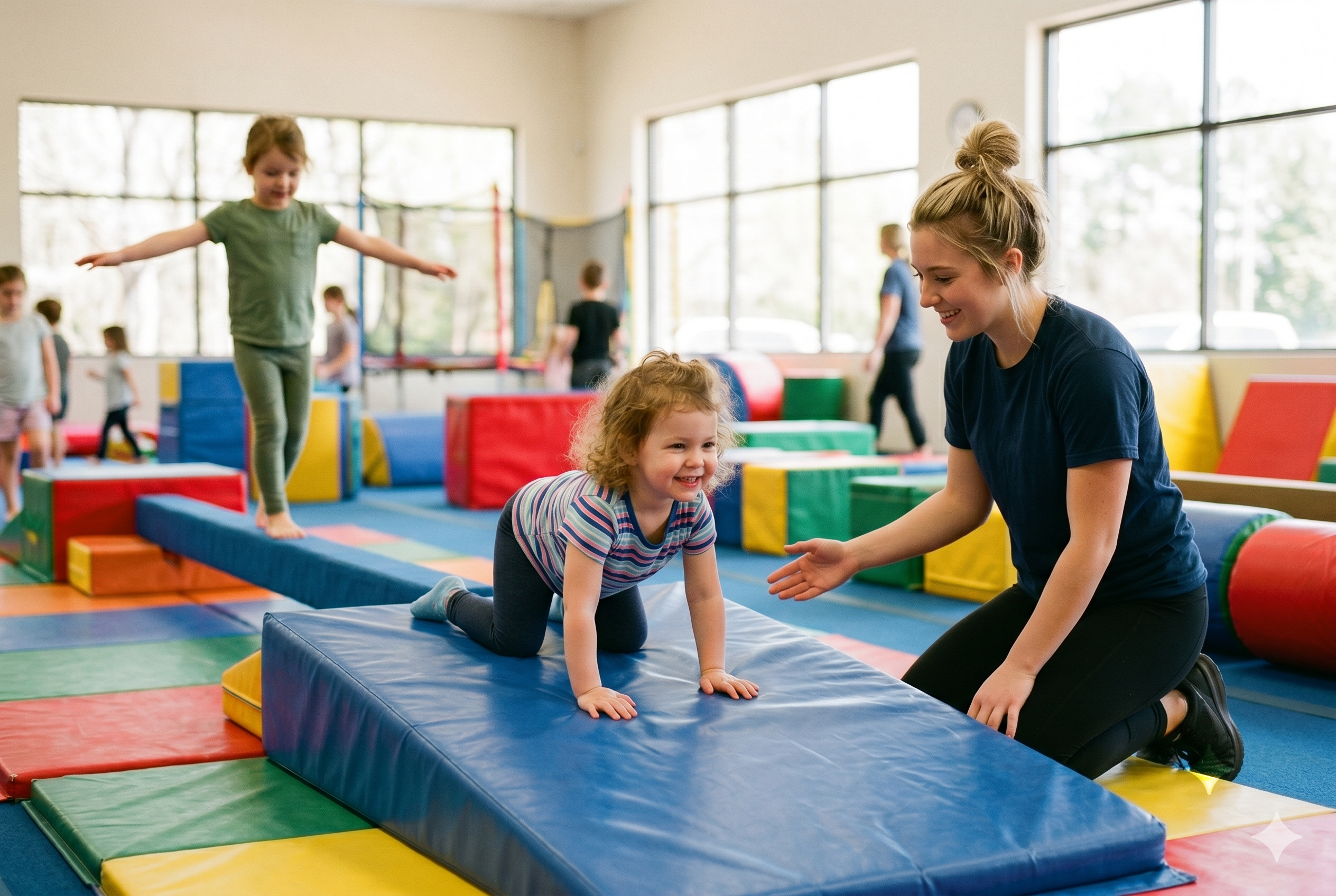
Download the preschool plan as a printable PDF.
Sample plan 2: School-age recreational beginners (ages 6-9)
This is the bread-and-butter rec class. No theme needed, just clean stations and clear form cues. Class length: 60 minutes.
Warm-up (10 min): a tag game to raise the heart rate, then dynamic stretches and hollow and arch shape holds on the floor (these shapes underpin almost every skill that follows).
Stations (24 min, four stations of 6 minutes):
- Forward roll with a wedge for downhill help. Cue: chin to chest, push through the hands, stand up without hands.
- Cartwheel along a floor line or against a wall. Cue: strong arms, kick the legs over one at a time.
- Straight jump with a 180-degree turn, sticking the landing on two feet.
- Beam tip-toe walk with arms held in a T, eyes forward, one foot in front of the other.
Apply (8 min): a relay or side-by-side obstacle course that strings the four skills together so the kids perform them under a little pressure.
Cool-down (5 min): pike and straddle stretches on the floor, then a recap of the one cue you want them to remember for next week.
Hold the foundational shapes for 5 to 10 seconds at this level, building toward longer holds as the gymnasts get stronger. The NSCA's position on youth resistance training is the standard reference for how to progress conditioning safely with this age group. The forward roll and cartwheel will take several weeks to clean up, which is the point of planning a term rather than a one-off class.
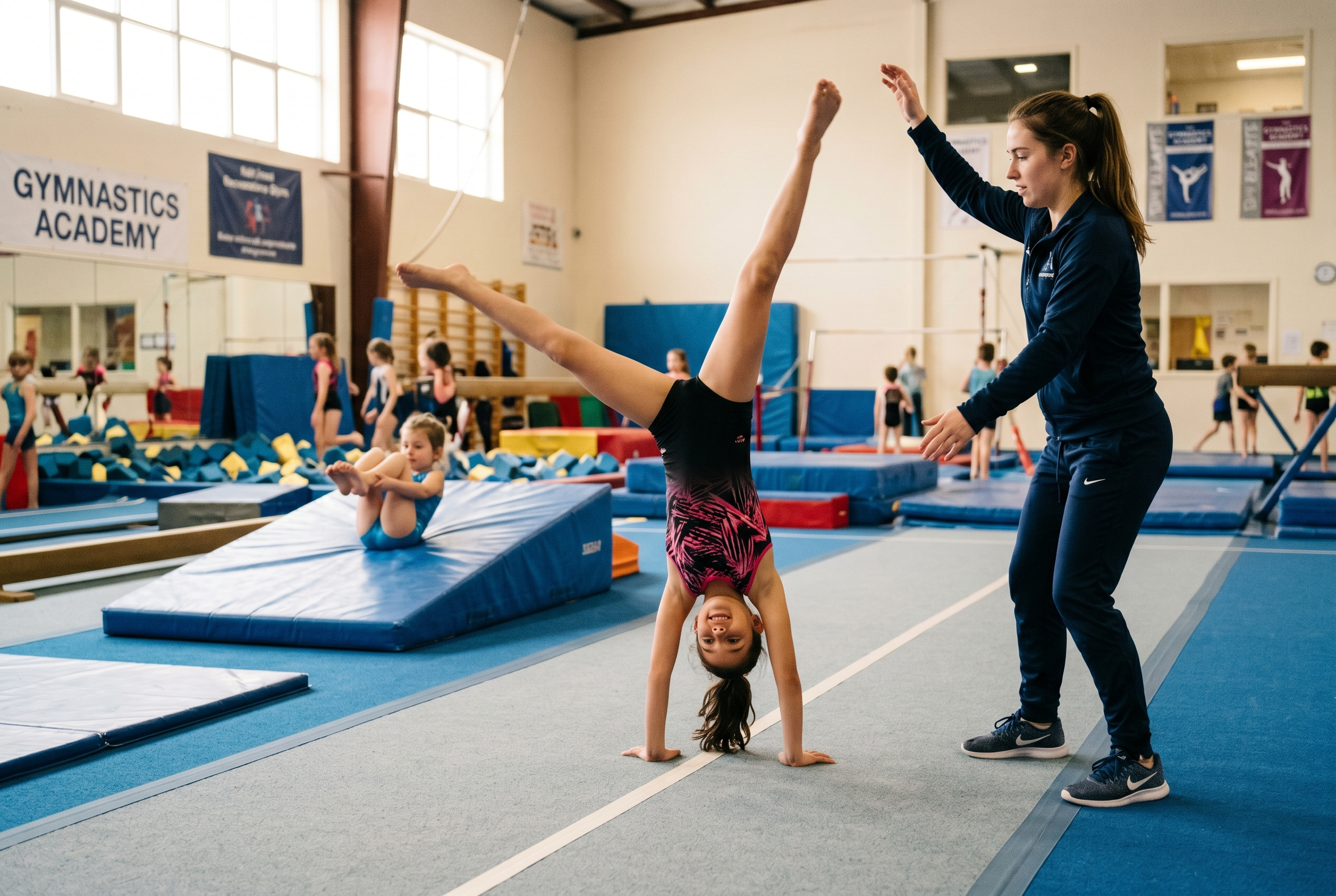
Download the rec beginners plan as a printable PDF. For more station ideas at this level, our roundup of gymnastics drills for kids gives you plenty to swap in.
Sample plan 3: Advancing beginners and pre-team
For kids who have the basics and want more, the plan adds conditioning and skills that need a spotter. Class length: 60 minutes.
Warm-up (10 min): dynamic mobility plus a short conditioning block: hollow holds and arch holds, three rounds of 10 to 30 seconds each.
Stations (24 min):
- Handstand against a wall: kick up and hold, working toward a straight, tight shape.
- Bridge and bridge kickover, assisted by the coach until the push is there.
- Round-off entry over a line, focusing on the hurdle and hand placement.
- Conditioning circuit: chin-up negatives, V-sits, and hollow holds, 10 to 30 seconds per exercise.
Apply (8 min): a short skill sequence or mini-routine that links two of the day's skills into one performance.
Cool-down (5 min): flexibility focus, with a splits progression and a pike stretch.
Spot the bridge kickover at the lower back and shoulders, and stay close on the handstand kick-up until the gymnast can hold the shape on their own. These are the skills where a coach's hands and eyes matter most, so position yourself at the highest-risk one.
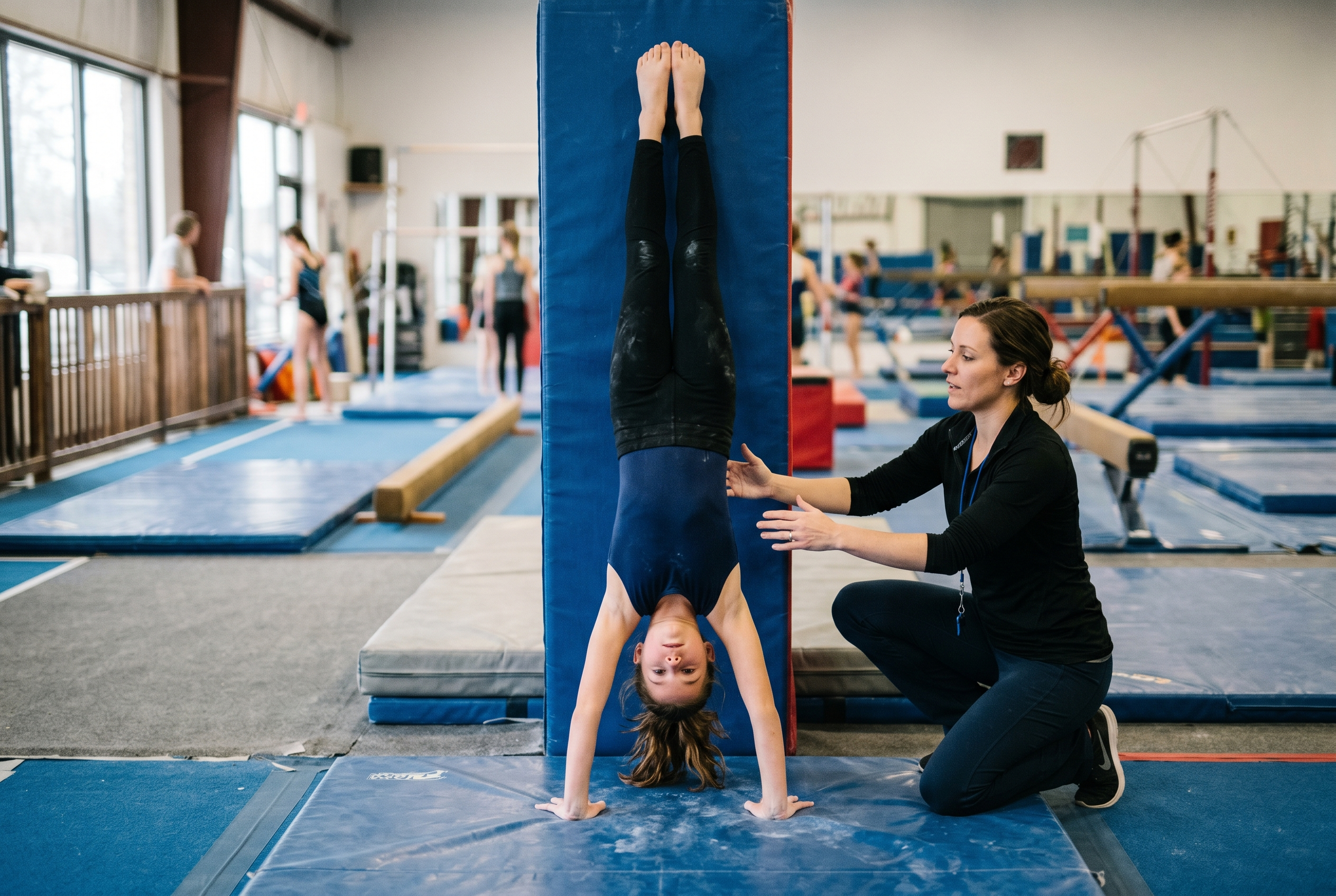
Download the pre-team plan as a printable PDF.
How to scale one plan across mixed-ability groups
The reason the station format works is that you do not need a different plan for each child. You run the same station and change the rep for the gymnast in front of you. Here is how three core skills scale across ability groups.
| Skill | Group 1 (beginner) | Group 2 (intermediate) | Group 3 (advanced) |
|---|---|---|---|
| Forward roll | Assisted, downhill on a wedge | Flat floor, unassisted | Dive roll |
| Cartwheel | Wall or handstand assist | Along a floor line | On a low beam |
| Bridge | Elevated or assisted | Flat bridge hold | Bridge kickover |
The coaching move is to set the station once, then meet each child where they are. A six-year-old rolls down the wedge while the eight-year-old next to them works a dive roll, same station, same equipment, different rep. That is what keeps a mixed class moving instead of stalling at the pace of the least or most advanced gymnast.
From one lesson to a term plan
This is the piece almost every plan skips. A single lesson is one step inside a 6 to 12 week block that drives toward a named skill. Plan the term first, then each weekly lesson writes itself.
Take the forward roll as a target. Here is an eight-week block that gets a beginner from a tuck shape to a dive roll.
| Week | Focus | Station progression |
|---|---|---|
| 1 | Tuck shape | Tuck holds and rocking on the back |
| 2-3 | Rock to stand | Rock and roll up to a stand, no hands |
| 4-5 | Assisted roll | Forward roll down a wedge with a spot |
| 6-7 | Unassisted roll | Forward roll on flat floor |
| 8 | Dive roll intro | Low dive roll over a soft barrier |
A second example is the cartwheel pathway: build the shapes first (straight and dish), then bunny hops over a line, then a wall handstand for the inverted position, then the cartwheel itself along a line. Each week is one rung on that ladder.
To plan your own term, pick the skill you want the class to own by the end, then reverse-engineer the weeks backward from it. Reuse the same lesson template every week and swap only the station progression. The warm-up, the format, and most of the equipment stay the same, which is what makes weekly planning fast once the term is mapped.
Keeping a plan fresh with themes
Repetition is how skills stick, but repetition is also how kids get bored. Themes solve that without touching the progression. The skills and the structure stay fixed; only the language and the obstacle course change.
Here are three themes mapped onto the same skill block:
- Space: straight jumps become "rocket launches," tuck holds become "floating in zero gravity," and the obstacle course is a mission to the moon.
- Safari: the jungle adventure plan above, with animal walks and a "find the watering hole" course.
- Ninjas: the balance beam becomes a "tightrope mission," forward rolls become "stealth rolls," and the course is a quiet escape.
The rule is simple: theme the words and the play, never the progression. The forward roll is still a forward roll with the same cues whether the child is a ninja or an astronaut. A strong theme buys weeks of repetition the kids never notice. For more activity ideas to fold into a theme, the warm-up library linked above is the place to start.
Running the plan: stations, rotations, and ratios
A plan only works if it survives contact with twelve real children. The logistics below are what hold it together.
Coach-to-student ratios run tighter for younger ages. A common working guide is around 1:6 to 1:8 for preschool and 1:8 to 1:10 for school-age rec, but ratios are set by your insurer and national body, so check your figure against USA Gymnastics in the US or British Gymnastics in the UK rather than treating any number as fixed.
For the four-station rotation, give each station an equal block (6 minutes in the 60-minute plan) and signal the change with a single consistent cue: a whistle, a clap pattern, or a call the kids know. Keep groups small enough that nobody is standing in a line waiting for a turn, because a waiting line is where behavior unravels.
Transitions are their own skill. A "first one to the next mat sitting criss-cross wins" reset gets the group moving and settled in one move. And build one spotting reminder into the plan for each high-risk skill: stay close on the cartwheel, the bridge kickover, and the handstand kick-up.
Safety checks built into every plan
Run the same checks before every class so they become automatic. Mats should be flush and secured with no gaps a foot can catch in, the beam stable, and the landing zones clear of bags and water bottles. Every tumbling station needs a soft surface under it.
Match the skill to the child's readiness rather than the calendar: a gymnast moves up a progression when they have earned it, not because it is week six. Keep your spotting positions set for the named skills above, and when in doubt, drop the child back a rung. The governing bodies publish the spotting and supervision standards your club should follow, with the FIG setting the standards used internationally.
Turn your plans into a system you can reuse
A good plan is step one. The system is reusing it. Storing your filled-in templates means next term starts from a library, not a blank page, and the assessment notes on each plan tell you exactly where the class left off.
That is where booking and club software earns its place. Tracking attendance and which students have hit which skill means the next plan starts from where the class actually is, which ties straight back to the term progression above. Keeping rosters, registers, waivers, and parent messages in one place means coaches spend their time on the mat, not on admin. For a club running multiple weekly classes, that is hours back every week.
If you want to see how this works in practice, our gymnastics management software page walks through registers, skill tracking, and parent comms built for class-based programs. If you are earlier in the journey, our guide to opening a gymnastics gym covers the build and the gymnastics business plan template covers the numbers. When you are ready to compare tools, our roundup of the best gymnastics management software lays out the options.
Key takeaways
- A gymnastics lesson plan has four blocks: warm-up, skill development at stations, apply or play, and cool-down.
- Focus on one or two skills per session. Reps build motor patterns, so depth beats breadth.
- Run the same station for every ability and just change the rep, using a differentiation grid to scale up or down.
- Plan the term first, then reverse-engineer each weekly lesson from the skill you want the class to own by the end.
- Themes keep repetition fresh: change the language and the play, never the progression.
- Logistics carry the plan: tight ratios for young ages, equal station blocks, clear rotation cues, and a spotter on every high-risk skill.
- Store and reuse your plans so each term starts from a library and notes, not a blank page.
The framework, the template, and the three sample plans above are built to copy. Map your term once, reuse the plan each week, and you will spend your planning time where it counts: deciding which child is ready for the next rung.
FAQs
How long should a gymnastics lesson be?
For recreational classes, 45 to 60 minutes is typical. Preschool classes work better at 30 to 45 minutes because attention spans are shorter. Match the four-block structure to the length you have, trimming station time first.
How many skills should one lesson cover?
One or two. Young gymnasts learn through repetition, and a child needs many attempts at a skill before it sticks. Teach the one or two skills at multiple stations so everyone gets reps at their own level.
What should a beginner gymnastics lesson include?
A warm-up, one or two foundational skills taught at stations, an apply game or obstacle course that uses those skills, and a cool-down with a recap. Forward rolls, cartwheels, jumps, and beam balance are the standard beginner skills.
How do I plan for a mixed-ability class?
Run the same stations for everyone and scale the rep for each child. A beginner rolls down a wedge while an advanced gymnast at the same station works a dive roll. The differentiation grid above maps how the core skills scale across three groups.
What is the right warm-up for a gymnastics class?
Keep it to 8 to 10 minutes: a pulse-raiser game to lift the heart rate, then dynamic stretches and the shapes the lesson is built on, such as hollow and arch holds. Use a fixed routine so it runs the same every week.
How do I keep kids engaged through repetition?
Layer a theme over a fixed skill block. Change the language and the obstacle course (space, safari, ninjas) while keeping the same skills and progression. The repetition the skill needs stays hidden inside a story the kids enjoy.
How long should gymnasts hold a shape or balance?
Beginners hold for 5 to 10 seconds; as they progress, build toward 10 to 30 seconds, often in sets of three. Hollow and arch holds in the warm-up and conditioning block are the easiest place to build this.
How do I turn one lesson into a term plan?
Pick the skill you want the class to own by the end of the term, then work backward to set a weekly progression toward it. Reuse the same lesson template each week and change only the station progression. An eight-week forward-roll-to-dive-roll block is a good model.
What coach-to-student ratio should a gymnastics class have?
Younger ages need tighter ratios, often around 1:6 to 1:8 for preschool and 1:8 to 1:10 for school-age rec. These are guides, not rules. Confirm your figure with your insurer and national governing body before setting class sizes.
What safety checks should every plan include?
Check mats are flush and secured, the beam is stable, and landing zones are clear before class starts. Put a soft surface under every tumbling station, set spotting positions for high-risk skills, and only move a child up a progression when they are ready.