


Opening a gym without a business plan is like sending a gymnast to a meet with no routine written down. You might get through the day, but you are guessing at every skill. A gymnastics business plan turns the guesswork into numbers you can act on: pricing, enrollment targets, coach payroll, rent, and the exact number of students you need to keep the lights on.
It is also a funding document. If you approach a bank, the SBA, or an investor, this is what they read first.
This guide walks through how to write a gymnastics business plan section by section, with realistic gymnastics-specific numbers, a sample one-year revenue build, and break-even math. Use it as a working template: each section below maps to a section of your own document.
What is a gymnastics business plan (and who needs one)?
A gymnastics business plan is a written document that sets out what your gym teaches, who your athletes are, how you make money, and how you plan to grow. It covers your concept, market, programs, operations, and financial projections, and it doubles as a funding document for lenders or investors.
Two people use it. You use it as an internal roadmap, the thing that keeps pricing, staffing, and enrollment decisions honest. A lender or investor uses it to judge whether your numbers hold up before they hand over any money.
You need one if you are opening a new gym, coaching independently and going out on your own, or running a club that wants a commercial lease, a loan, or a grant. The opportunity is real: the US gymnastics industry is worth roughly $960 million a year across more than 11,000 businesses and has grown around 5% annually, according to IBISWorld's gymnastics industry research. It is also highly fragmented, with no single operator holding more than a few percent of the market. That means room for a well-run local gym, but it is a capital-heavy business, which is exactly why the plan matters.
Before you start: clarify your concept
Before you open a blank document, get specific about the gym you are actually building. A plan for a preschool-heavy recreational gym reads nothing like a plan for a competitive team program. The decisions below shape every number that follows.
- Recreational only, or recreational plus competitive team? Team adds revenue and prestige but also coach hours, travel, and meet logistics.
- Which ages? Parent-and-tot (walking to age 3), preschool (3 to 5), school-age (6 to 12), teens, or adults. Most rec gyms center on 3- to 12-year-olds.
- Lease or buy your building? Nearly all first gyms lease. Buying is a much larger capital decision.
- How big? A rec gym typically needs 6,000 to 12,000-plus square feet with high ceilings. Floor space and ceiling height drive your facility search from day one.
- One location, or a plan to expand later? Even if you open with one, note the ambition so your financials leave room for it.
Get clear on these five answers first. Every section downstream, from pricing to staffing to your break-even number, flows from them.
1. Executive summary
The executive summary is a one-page overview of the whole plan. It appears first but is easier to write last, once every other number exists.
Include your concept and location, your target market, the programs you will run, your funding ask if you have one, and the headline financial goal, such as your break-even month or target enrollment. If someone reads only this page, they should understand the gym and why it will work.
Here is a sample for a hypothetical gym we will use throughout this guide:
GymWorks is a 10,000 sq ft recreational gymnastics gym opening in a mid-size US suburb. We serve families with children ages 2 to 12 across parent-and-tot, preschool, and recreational classes, with a developmental pre-team track. We are raising $180,000 to cover equipment, fit-out, and six months of working capital. We aim to reach 290 active students and break even by month 10, with a target 15% net margin by end of year two.

2. Company overview
Zoom in on the gym itself: how it is structured, what it stands for, and where it sits.
Business structure and ownership
Should a gymnastics gym be an LLC? For most single-location gyms, yes. An LLC separates the business from your personal assets, which matters in a sport where injuries and liability claims are a genuine risk. A sole proprietorship is cheaper and simpler to set up but gives you no protection: one serious injury claim can reach your personal savings. An S-corp is worth looking at once the gym is profitable and paying you a salary. Run the decision past an accountant, or start with the SBA guide to choosing a business structure.
In this section, also state who owns the business and in what shares, who sits on the management team, and any advisors or mentors involved.
Mission and vision
Write one sentence on why your gym exists, then one on what success looks like in five years.
- Mission example: "To give every child in our town a safe, joyful place to build strength, confidence, and a lifelong love of movement."
- Vision example: "To be the most trusted gym in the region, known for careful coaching, strong fundamentals, and athletes who keep tumbling for years."
Location and facility
Facility is where gymnastics plans differ most from generic ones, so be specific:
- Square footage. A recreational gym typically needs 6,000 to 12,000-plus sq ft to lay out floor, bars, beam, and vault without crowding.
- Ceiling height. This is the constraint most new owners miss. You want roughly 16 to 20 feet of clear height for high bar, rope or rod work, and tumbling. A low ceiling rules a building out no matter how good the floor space is.
- Parking and a viewing area so parents can watch and wait comfortably.
- Zoning and lease terms for commercial recreational use.
Get quotes and confirm ceiling height before you fall in love with a space. The facility search is the point where many gym dreams stall, so treat it as a gating decision, not a detail to sort out later.
3. Market analysis
This section shows you understand where your gym sits in its local market.
Industry and demand
Summarize the national picture, then bring it local. The US gymnastics industry runs at roughly $960 million a year across more than 11,000 businesses, growing about 5% annually and highly fragmented, per IBISWorld. The number of USA Gymnastics-affiliated clubs has grown from around 3,200 to more than 3,700 over the past five years, according to USA Gymnastics. Demand is driven by parents' focus on childhood fitness, school and community camps, and the interest spike around each Olympic cycle. Parents enroll because gymnastics builds strength, coordination, and confidence, a case we make in full in our guide to the benefits of gymnastics for children.
Local demand and target customers
National figures set the scene, but a lender wants your local math. Size your catchment by drive-time radius (most families will travel 15 to 20 minutes), count the school-age children in that area using US Census data, and count competing gyms within 5 to 10 miles.
Then define your customers. Your primary customer is a parent of a 3- to 12-year-old. Your secondary customers are competitive team families, teens, adults, and homeschool day classes that fill your quiet daytime hours.
Competitor analysis
List every nearby gym and adjacent program (rec centers, cheer gyms, ninja gyms). For each, note their programs and age ranges, pricing, capacity, and whether they run a waitlist. A gym with a long waitlist is telling you the market is underserved.
Then find your gap. Maybe no one runs a strong preschool program, a boys' team, an adult or open-gym offering, or a ninja and tumbling track. A simple positioning table, listing each competitor against price, programs, and gaps, makes this concrete for a reader.
4. Programs, services and pricing
Spell out what you are selling and how each piece makes money.
Program menu
Outline every program you plan to run:
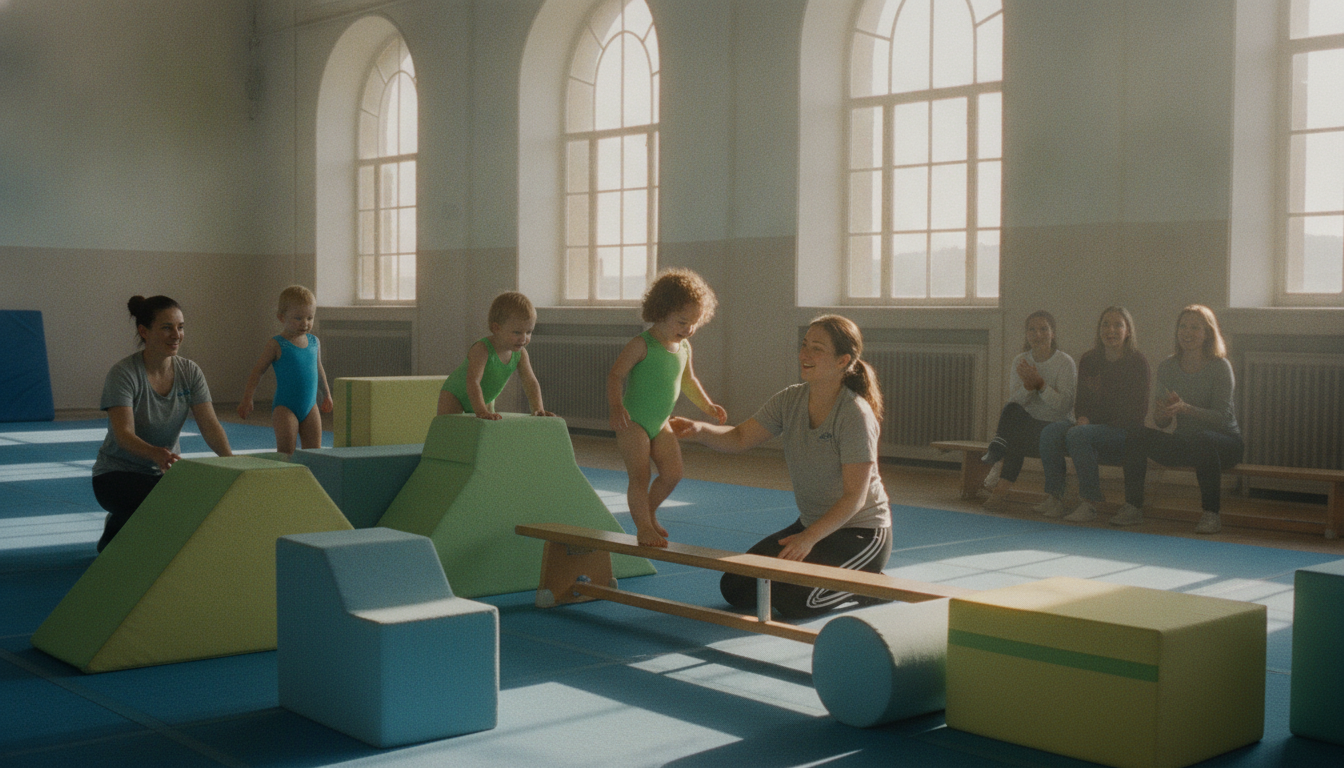
- Parent-and-tot (walking to age 3) and preschool (3 to 5), your entry point and highest-margin classes
- Recreational classes by age and level, the core of the business
- Developmental / pre-team, the bridge into competitive gymnastics
- Competitive team, typically 6 to 20-plus training hours a week depending on level
- Tumbling, cheer, and ninja classes to widen your reach
- Adult and homeschool day classes that use daytime hours
For each, note class length, level progression, and a safe student-to-coach ratio. If you need a starting structure for what these classes actually contain, our gymnastics lesson plans are a useful reference.
Beyond tuition: the revenue mix
The gyms that stay comfortable are the ones that do not live on class tuition alone. Layer in:
- Open gym sessions on evenings and weekends
- Holiday and summer camps, which also smooth the summer enrollment dip
- Birthday parties, often the single highest-margin thing a gym sells
- Private lessons and skill clinics
- A small pro shop for leotards, grips, and branded gear
Camps, parties, and open gym frequently carry stronger margins than regular classes because they use space and coaches you are already paying for. Do not treat them as afterthoughts in the plan.
Pricing
Prices vary by region, but realistic US ranges give you an anchor:
| Program | Typical US price |
|---|---|
| Recreational, one 45 to 60 min class/week | $60 – $120 / month |
| Multi-hour recreational | $150 – $250 / month |
| Competitive team (scales with hours) | $250 – $500 / month |
| Open gym / drop-in | $10 – $20 / session |
| Annual registration fee | $35 – $60 / year |
Use local competitor pricing to position yourself, then decide deliberately. If you price above the market, say why: smaller classes, more experienced coaches, a better facility. Recurring monthly billing is easier to forecast than per-term fees and keeps families enrolled between seasons, so build your plan around it.
5. Marketing and enrollment strategy
Keep this section tight. Summarize your channels and point to deeper resources rather than packing a full marketing plan in here.
Split it into two phases. Before you open, the goal is a founding wait list: early-bird or founding-member enrollment, partnerships with local schools and preschools, community events, and a simple landing page collecting names months ahead of opening. After you open, the goal is steady growth and retention: parent referrals, a claimed Google Business Profile with local SEO, social proof from meet results and class videos, and seasonal camp pushes.
Watch two numbers. Customer acquisition cost tells you what a new family costs to win. Retention tells you how long they stay, and keeping a family season to season is far cheaper than winning a new one, so budget for progress tracking and communication that makes families want to stay. Our gymnastics marketing guide covers the full playbook, and our list of gymnastics marketing ideas is a good source of specific campaigns. Most new gyms run a marketing budget of 5 to 10% of projected revenue and tighten it as word of mouth builds.

6. Operations plan
This is the section generic templates skip, and the one a lender reads closely. It covers how the gym actually runs week to week.
Staffing and coaching
Coaching is your product, and coach recruitment and retention is the single biggest operational constraint in gymnastics right now. Plan for it, do not assume it.
- Roles: owner or director, head coach, recreational coaches, front-desk staff, and part-time spotters for busy classes.
- Ratios: recreational classes commonly run 1:6 to 1:10, tightening for young children and team. Preschool often needs a coach plus an assistant.
- Wages: recreational gymnastics coaches typically earn around $15 to $26 an hour, with experienced and team coaches at the top of that range or above. The US Bureau of Labor Statistics tracks pay for coaches and scouts as a benchmark. Model rec coaches near the lower end and your experienced and team coaches higher.
Write your hiring plan into the operations section: how many coaches at launch, and when you add front desk or a second team coach. If you want to grow your own coaching pipeline, our guide on how to become a gymnastics coach is a useful thing to hand to promising teens on your team.
Facility and equipment
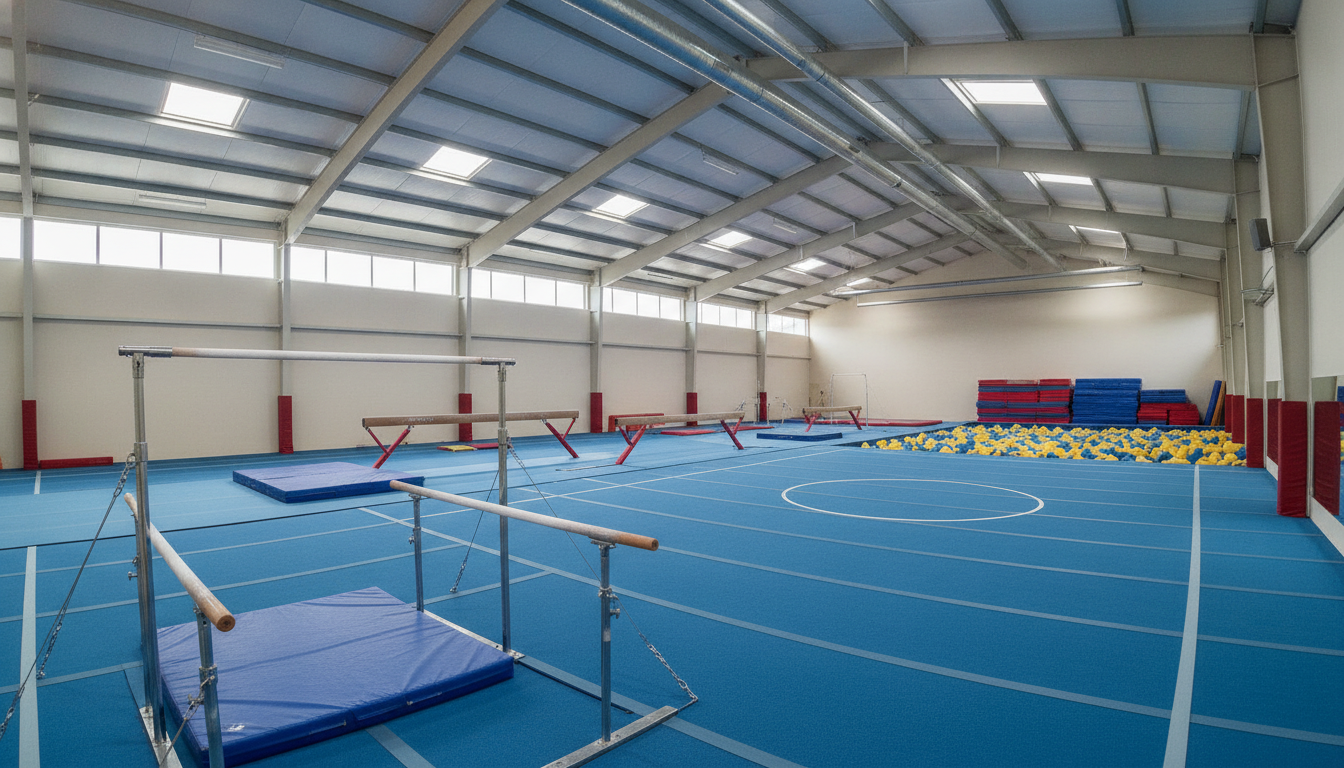
Gymnastics equipment is a major, gym-specific capital line. Your plan should list the real kit:
- Uneven and single bars
- Balance beams (low, medium, competition height)
- Vault table and runway
- Spring floor
- Tumble track or rod floor
- Foam pit, in-ground or above-ground
- Landing mats, wedges, and octagons
- Preschool soft-play shapes
Safety flooring is one of the largest line items and is not the place to cut corners. For a full checklist to cost against real suppliers, use our gymnastics equipment list.
Registration, billing and admin software
Spell out the systems that run enrollment and money. New gyms often start on spreadsheets, a card reader, and a group chat, and that stack breaks somewhere around 30 to 50 active students. Your plan should specify online enrollment, recurring or automatic billing, attendance registers, digital waivers, rosters, and multi-child family accounts.
This is where Pembee's gymnastics management software fits: online sign-up, recurring monthly tuition, registers, waivers, and family accounts in one place, built for exactly this kind of class-based, family-heavy operation. For a side-by-side of the main options, see our roundup of the best gymnastics management software. Pencil in $45 to $150 a month for software in your budget.
Safety, insurance and compliance
Lenders want to see you have thought about risk. Cover participant and general liability insurance, signed waivers for every athlete, coach background checks and SafeSport-style safeguarding, and USA Gymnastics club affiliation if you plan to enter athletes in sanctioned competition. None of this is optional in a sport where injury risk is real, and writing it down reassures anyone lending you money.
7. Financial projections
This is where a lender looks first. Build the numbers from the bottom up: how many students, at how much tuition, minus how much cost. Everything below is illustrative for our hypothetical GymWorks, a 10,000 sq ft rec gym in a mid-size US suburb. Plug in your own local quotes.
Startup costs
Startup costs for a modest single-location recreational gym typically land between $100,000 and $300,000, driven mostly by equipment and fit-out. Elite or competition-focused builds run higher. A sample breakdown for GymWorks:
| Line item | Budget |
|---|---|
| Equipment (bars, beam, vault, spring floor, mats, pit foam) | $40,000 – $120,000 |
| Leasehold improvements and fit-out (flooring, ceiling, HVAC, restrooms, viewing area) | $20,000 – $80,000 |
| Lease deposit + first and last month's rent | $10,000 – $25,000 |
| Insurance (first year) | $2,000 – $10,000 |
| Legal, LLC setup, permits | $2,000 – $5,000 |
| Branding, website, software setup | $2,000 – $6,000 |
| Opening marketing (launch push) | $3,000 – $8,000 |
| Working capital (3 to 6 months' reserve) | $20,000 – $50,000 |
Get real quotes from equipment suppliers and contractors before you commit. These ranges age quickly and vary a lot by region and by whether you buy new or used equipment.
Monthly operating costs
Once you are open, payroll is your largest cost, followed by rent. A sample monthly budget for GymWorks at roughly 250 to 300 students:
| Line item | Typical range |
|---|---|
| Rent (10,000 sq ft) | $7,000 – $10,000 |
| Payroll (coaches, front desk, owner) | $15,000 – $22,000 |
| Utilities and internet | $1,000 – $2,000 |
| Insurance | $300 – $800 |
| Equipment maintenance and replacement reserve | $300 – $800 |
| Booking and billing software | $45 – $150 |
| Marketing | $800 – $2,000 |
| Supplies (chalk, tape, first aid, cleaning) | $300 – $700 |
| Accounting and admin | $200 – $600 |
That puts GymWorks' fixed monthly costs at roughly $30,000 at the midpoint. Payroll moves with coach hours, so it rises and falls with enrollment: more students means more classes, which means more coaches on the floor.
Revenue projections: a sample one-year build
Build revenue bottom-up, from enrollment times price across every stream, and ramp it from a soft opening toward capacity. A realistic first year does not start full. GymWorks opens light and grows:
The ramp above is year one. Once enrollment settles near the break-even mark, roughly 260 active students across rec and team, a representative full year builds up like this with the full gymnastics mix layered on top of tuition:
That $488,500 rests on roughly 230 recreational students at $95 a month and about 35 team athletes at $310. Against roughly $415,000 in total operating expenses, it leaves about $73,500 in net operating profit before tax, a roughly 15% margin and a realistic year-two target for a disciplined single-location gym. These are illustrative numbers. Swap in your own local tuition, enrollment ramp, and real costs, and keep them consistent so the break-even below is honest.
Break-even: how many students do you need?
This is the number every founder and lender wants, and the calculation is simple: divide your fixed monthly costs by your average revenue per active student.
GymWorks break-even. Fixed monthly costs of about $30,000, divided by roughly $115 of average monthly revenue per active student (tuition plus a share of camps, parties, and open gym), works out to about 260 active students to break even. Below that number you are losing money each month; above it, every extra student is largely profit.
Run this math for your own gym before anything else, because it sets your enrollment target and tells you whether your facility is big enough to hold that many students across your schedule.
Funding and grants
If you need capital, explain how much you are raising, from whom, and what it pays for. Typical routes for a gym are owner savings, an SBA or bank loan, equipment financing (equipment makes good collateral), and outside investors. The SBA loan programs guide is the best starting point for US owners. Non-profit clubs also have grant options that for-profit gyms do not, which our guide to funding for gymnastics clubs covers in detail.
8. SWOT analysis
A one-page SWOT keeps you honest about where the gym stands. A gymnastics-specific version:
The two lines a lender will probe hardest are coach retention and seasonality. Have an answer ready for both: a coach pay and development plan, and a camp program that turns the quiet summer into income.
9. Milestones and implementation timeline
Close the plan with a realistic timeline from funding to your first full year. Present it as milestones with rough month markers so a reader can see you have sequenced it:
- Months 1 to 2: secure funding, finalize your LLC and insurance.
- Months 2 to 4: sign the lease and start fit-out. Ceiling, flooring, and HVAC are the long poles.
- Months 3 to 5: order and install equipment. Lead times on bars, beams, and custom flooring can run months, so order early.
- Months 4 to 6: hire and train coaches; set up software, waivers, and rosters.
- Months 5 to 6: run pre-enrollment marketing and build your founding wait list.
- Month 6: soft open with a limited schedule, then scale classes as enrollment grows.
- Months 7 to 12: grow toward your break-even enrollment and review the full plan at the twelve-month mark.
Equipment lead times and fit-out are what most often push an opening date back, so build slack into those months rather than assuming best case.
Use this as your gymnastics business plan template
Work through the nine sections above in order and you have a complete, fundable plan. The thing that separates a useful plan from a generic template is honest numbers: real quotes, a real enrollment ramp, and a break-even figure you have actually calculated. Treat it as a living document, not a file you write once, and revisit the numbers every quarter for the first two years.
When the plan is done, the work shifts to running the gym, and the admin load is what quietly overwhelms new owners first. Pembee handles enrollment, recurring tuition, registers, waivers, and family accounts from day one, so your opening months go into filling classes instead of chasing spreadsheets. Our companion guide on how to open a gymnastics gym picks up where the plan ends. If you run classes beyond gymnastics, the same structure works for a dance studio business plan too.
Key takeaways
- A gymnastics business plan is both an internal roadmap and a funding document. Nine sections cover it: executive summary, company overview, market analysis, programs and pricing, marketing, operations, financials, SWOT, and milestones.
- Facility is the gym-specific constraint. You need roughly 6,000 to 12,000-plus sq ft and 16 to 20 feet of ceiling height before a building is even worth viewing.
- Startup costs for a single-location rec gym typically run $100,000 to $300,000, driven by equipment and fit-out.
- Do not live on tuition alone. Camps, parties, and open gym carry strong margins and smooth the summer dip.
- Run your break-even math early: fixed monthly costs divided by average revenue per student gives the exact enrollment you need.
- Coach recruitment and retention is the biggest operational risk. Plan pay, ratios, and a development pipeline deliberately.
FAQs
How much does it cost to open a gymnastics gym?
A modest single-location recreational gym typically costs $100,000 to $300,000 to open. Equipment and leasehold fit-out are the two biggest lines, together often more than half the total. Elite or large competition-focused builds run higher. Buying used equipment and choosing a space that needs less build-out are the two fastest ways to bring the number down.
Is owning a gymnastics gym profitable?
Yes, once you are past break-even enrollment. A well-run single-location gym can reach a 10 to 20% net margin, but profitability is driven almost entirely by enrollment against fixed costs. Rent and coach payroll are the two costs that make or break margins, and ancillary revenue from camps, parties, and open gym is often what pushes a gym comfortably into profit.
How much do gymnastics gym owners make?
It varies widely with the size and maturity of the gym. In year one, expect to pay yourself last, since owner pay is a discretionary line and founders often run thin until enrollment stabilizes. A profitable single-location gym can support a modest owner salary, and owners of larger or multi-location gyms earn substantially more. Build an explicit owner-draw line into your projections so the plan is honest about it.
How many students does a gymnastics gym need to break even?
Divide your fixed monthly costs by your average revenue per active student. For our sample 10,000 sq ft gym, roughly $30,000 in monthly costs against about $115 average revenue per student works out to around 260 active students. Your number depends on your rent, coach costs, and pricing, so run the calculation with your own figures.
Should a gymnastics gym be an LLC?
For most single-location gyms, yes. An LLC separates the business from your personal assets, which matters given the injury and liability risk in gymnastics. A sole proprietorship is simpler but offers no protection, and an S-corp election often makes sense once the gym is profitable. This is general information, not legal advice, so confirm the structure with an accountant before filing.
How long should a gymnastics business plan be?
Typically 15 to 25 pages, enough to cover all nine sections with real numbers without becoming a document nobody finishes. Lenders and SBA-affiliated programs want enough detail to take the financials seriously, but they skim, reading the executive summary and financial projections most closely. Put long supporting material, such as detailed monthly projections and resumes, in an appendix.
Do I need USA Gymnastics affiliation?
Not to run recreational classes. You can open and operate a rec gym without any national affiliation. You typically do need USA Gymnastics club membership to enter athletes in sanctioned competitions, so it becomes relevant once you run a competitive team. Factor the membership and meet fees into your team program's budget.
What should a gymnastics business plan include?
A complete plan includes your concept, target market, market and competitor analysis, a full program and pricing menu, a marketing and enrollment strategy, an operations plan covering staffing and equipment, financial projections with startup costs and a monthly budget, a break-even analysis, a SWOT, and an implementation timeline. The gymnastics-specific details, such as ceiling height, foam pits, coach ratios, and the camps-and-parties revenue mix, are what separate a useful plan from a generic one.
How much do gymnastics coaches cost to employ?
Recreational gymnastics coaches typically earn around $15 to $26 an hour, with experienced and team coaches at the top of that range or above. Payroll is usually the largest single line in a gym's monthly budget, and it scales with enrollment because more classes need more coaches. Because coach shortages are the biggest operational risk in the sport, budget for competitive pay and retention rather than the bare minimum.
How far in advance should I start planning to open a gym?
Plan for 9 to 12 months from the day you commit to opening day. Equipment lead times and fit-out (ceiling, flooring, and HVAC work) are the long poles and routinely run several months. Starting your pre-enrollment marketing and founding wait list a few months before you open means you launch with classes already filling rather than empty.