


Gymnastics demand is strong, but classes do not fill themselves. Most clubs market by scattering tactics: a photo here, a boosted post there, a flyer when a term looks thin. Then they blame the season when enrollment dips. The clubs that stay full run marketing as a system. This gymnastics marketing guide gives you that system: a budget, a season calendar, the channels that actually work for gyms, and the retention math most clubs ignore.
If you want the one-line version of how to market a gymnastics gym: win local search, run a season-based calendar of trials and camps, convert those trials into members fast, and keep families re-enrolling. Everything below builds that out. This is the strategy guide. For a ready-to-use list of individual plays, pair it with our gymnastics marketing ideas.
Start with the enrollment funnel, not a list of tactics
Most marketing advice for gyms is a checklist of channels: do Instagram, do Google, do flyers. The problem is that a checklist has no shape. You can be busy on every channel and still watch enrollment slide, because a channel list tells you what to do but not why it fails.
The fix is to think in a funnel with four stages: attract, convert, retain, and measure. Attract is getting the right local families to notice you. Convert is turning that attention into a booked trial and then a paying member. Retain is keeping those families enrolled term after term. Measure is knowing which of the above is actually working so you spend on what pays.

Here is why the stages matter together. Say you pour money into ads and fill every trial slot, but half of last term's families quietly do not re-enroll. You are refilling a leaky bucket, paying acquisition prices to replace members you already had. A club with a smaller top of funnel and a tight retain stage grows faster and cheaper than a club that only markets to strangers. Keep the whole funnel in view, and the rest of this guide slots into place.
How much should you spend on gymnastics marketing?
Start with a percentage of gross revenue, then split that pot deliberately. Industry guidance for activity businesses puts an established gym at roughly 5 to 8 percent of gross revenue on marketing, and a new gym or one launching a fresh program at 10 to 12 percent, because you are buying awareness you do not yet have.
That headline number is where most advice stops, and it is not enough to act on. The useful question is how to divide the budget across channels. Here is a practical allocation for a typical club. Treat the shares as a starting point and shift them toward whatever your measurement stage proves is working.
Here is what each line buys. Local SEO and your Google Business Profile deliver steady inbound from ready-to-book parents for little more than time and small tool costs. Content and social show progress and build trust. Paid ads are the one real cash line, typically $150 to $600 a month, and are best for filling specific terms and camps fast. Events and open days run around $50 to $200 and buy cheap local reach and warm leads. Referral incentives cost nothing beyond the rewards and bring in the highest-trust new families you can get. And retention and re-enrollment, mostly software and small rewards, is the cheapest growth you have.
Two practical notes. First, most of your early spend should be time, not cash: filling out a profile, filming a reel, running an open day. Second, your website is a one-time build of around $1,000, not a $300-plus monthly lease. Paying a monthly fee for a simple club site drains budget that should go to filling classes.
Fit this into the bigger picture with our gymnastics business plan, which sets marketing against your wider revenue and cost model, and if cash is tight, look at funding for gymnastics clubs for where that budget can come from.
Build your marketing calendar around the season
This is the piece almost no gym does, and it is the biggest single upgrade to your marketing. Gymnastics enrollment runs on a season. If your campaigns ignore that season, you are always marketing at the wrong time, competing hardest when everyone else is and going quiet when families are actually deciding.
Map your year to the enrollment cycle instead. The fall term is your biggest enrollment window, so your loudest push runs in late summer. Spring is when you promote summer camps, well before competitors open registration. Summer camps are not just revenue; they are your top feeder into fall classes, so market them as a first step, not a one-off. Holiday camps fill the gaps, competition season gives you a stream of content and word of mouth, and every term break is a re-enrollment moment.
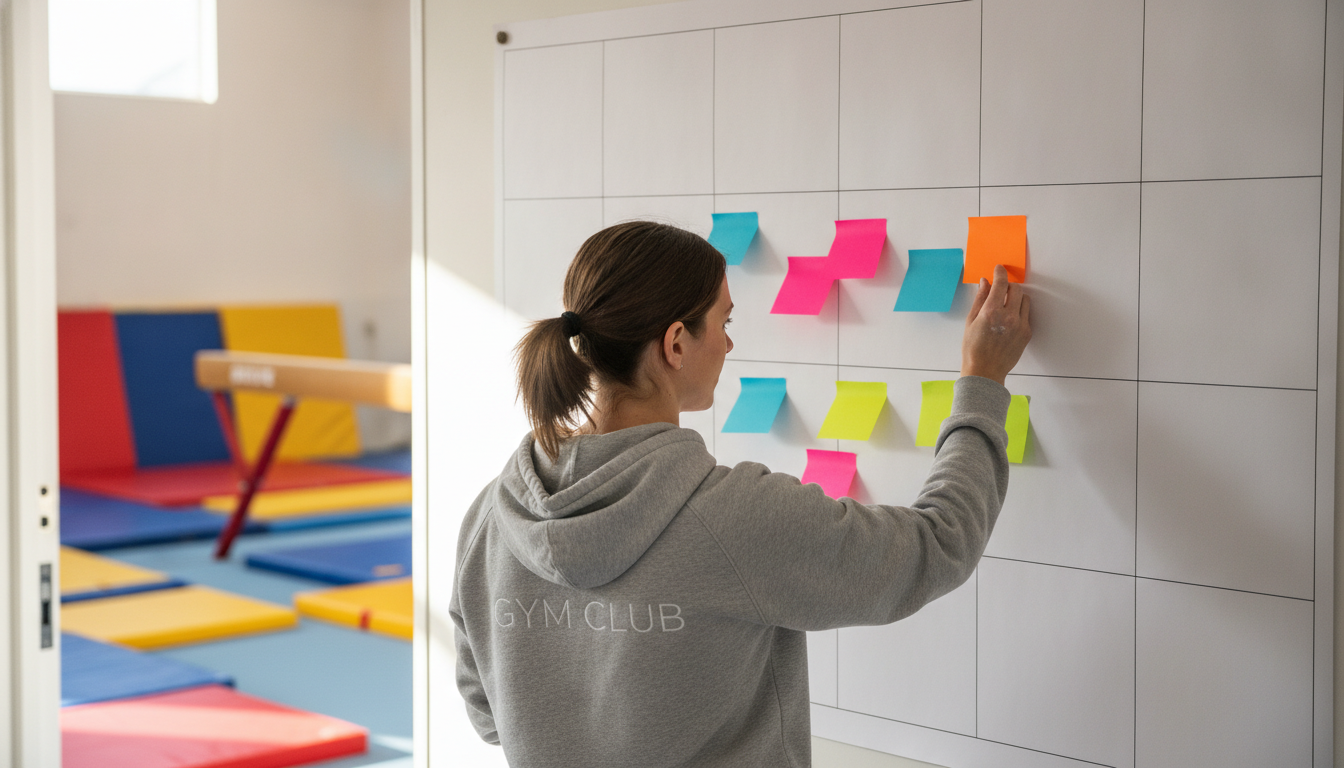
Here is a month-by-month skeleton you can adapt to your local school calendar.
| Month | Primary campaign | Channel focus | Goal |
|---|---|---|---|
| January | New-year rec push, adult classes | Paid ads, social | Fill winter/spring term |
| February | Spring camp early-bird opens | Email, waitlist forms | Capture camp demand early |
| March | Summer camp registration opens | Email, ads, GBP | Lock in summer before rivals |
| April | Summer camp reminders | SMS, retargeting | Convert warm leads |
| May | Camp fills, showcase content | Social, referral | Feed fall from camp families |
| June | End-of-year showcase, sibling offers | Events, email | Retain and cross-sell |
| July | Camps run, film progress content | Social | Build fall waitlist |
| August | Fall enrollment opens (biggest push) | Ads, email, GBP, events | Fill the year |
| September | Fall reminders, bring-a-friend days | Events, SMS | Top up classes |
| October | Holiday camp promotion | Email, social | Fill half-term/holiday camps |
| November | Competition-season content | Social, PR | Word of mouth, trust |
| December | Re-enrollment for spring | Email, SMS | Reduce term-to-term churn |
The point is timing. Open your registration and turn on reminder forms before competitors do, so you capture demand while families are still comparing options. To package terms and blocks so they are easy to buy, see how to sell more class packs.
Attract: the channels that fill gymnastics classes
These are the acquisition channels worth your time, ranked by return for most clubs. Do the first two well before you spend heavily on the rest.
Own local search
When a parent searches "gymnastics classes near me," you want to be the first result they can book. Start with a fully completed Google Business Profile: accurate hours, every program listed, real photos of your gym and classes, pricing where you can, and a weekly post. Then build a simple service page for each program (rec, competitive, preschool, camps) with your city and activity in the page titles, headings, and image alt text.
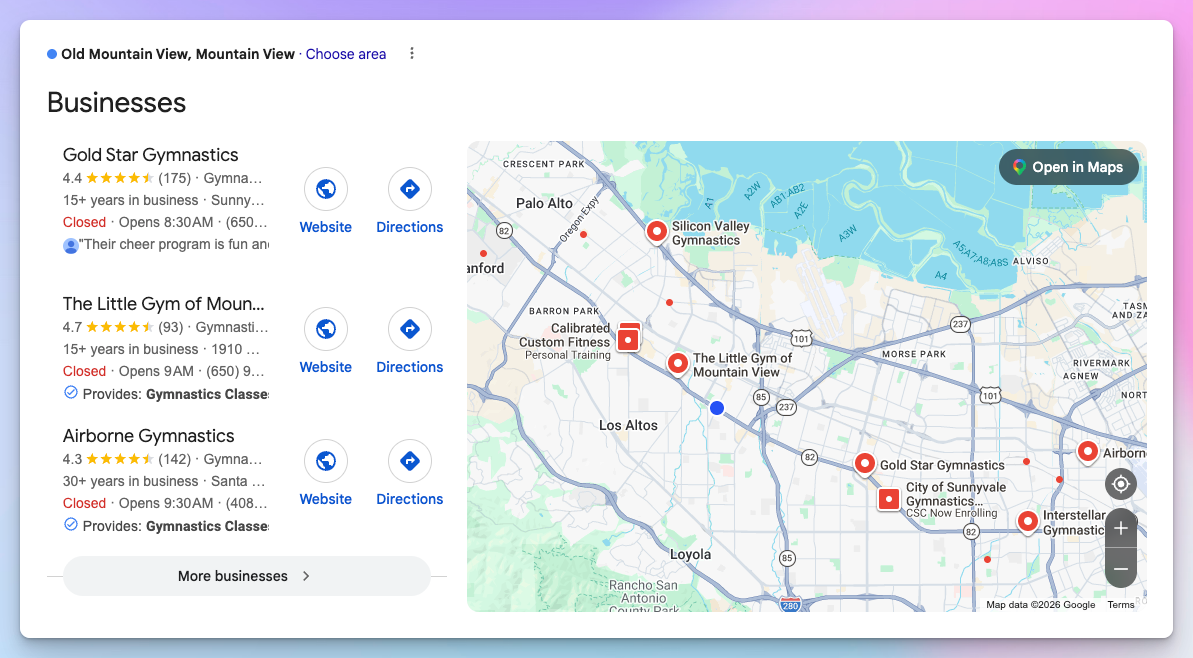
The prize is large. Industry data suggests roughly 46 percent of Google searches have local intent, the top few results take the large majority of clicks, and about three-quarters of searchers never move past page one. If you are not on that first page for your town plus "gymnastics," you are invisible to ready-to-book parents. For a full walkthrough, read our guide to SEO for group activity providers.
Post social media that shows progress
Parents buy visible progress. The content that converts is not polished ads; it is proof that kids improve at your gym. Film short skill-progression reels (week one versus week eight on a cartwheel or back handspring), coach spotlights, and honest behind-the-scenes clips. Aim for a mix that is mostly tips and tutorials, roughly 60 percent, with the rest promotion and personality.
Cadence matters more than production value. Posting three to four times a week plus a daily story keeps you in feeds without burning you out. Pull content ideas straight from the gym floor using our gymnastics games and warm-ups, and lift your reach with our guide to social media marketing for activity providers.
Run paid ads on a small budget
You do not need a big budget to test paid ads. Facebook and Instagram ads run from a few dollars a day, and the discipline is to test creatives against each other and keep the winner. Realistically, expect a cost of around $7 to $10 per registration in a short 7-day conversion window when you target local parents and retarget people who have already visited your website.
Point ads at a single clear action: book a free trial or register for a specific camp. A great ad sending traffic to a cluttered page wastes the spend, which is why the convert stage below matters as much as the ad itself.
Follow up leads with email and SMS
Attention is not enough; you have to follow up. Grow an email list from every touchpoint (trials, camps, showcases, the website) and segment it by enrollment status so you send fewer messages to enrolled families and more nudges to those who have not registered yet.
For speed, add SMS. Text messages see open rates near 98 percent and are usually read within a few minutes, against roughly 20 percent for email, which makes them ideal for time-sensitive nudges like "two spots left in Tuesday's class." Use email for the story and SMS for the deadline. Our guide to email marketing for activity providers covers list growth and segmentation in depth.
Host events, open days, and partnerships
The cheapest reach you have is your own community. Run bring-a-friend days where current gymnasts invite a mate, host a parents' night, and partner with local schools and nurseries for taster sessions. Set up a small display or demo at local competitions and fairs. These cost little, warm leads faster than any ad because they meet you in person, and they suit tight budgets.
Convert: turn trials and inquiries into members
Filling trial slots is only half the job. Conversion is where most clubs quietly lose money, so give it the same attention as attraction.
First, resolve the free-versus-paid-trial question, because competitors raise it and never answer it. A free trial lowers the barrier and lets a nervous child feel the space, which suits recreational volume where you want as many families through the door as possible. A small paid intro or evaluation session qualifies the lead and sets the parent's expectation on cost and commitment, which suits your competitive and team pipeline where you want committed families. Pick by goal: free for rec reach, paid for serious intent.

Second, follow up fast. Respond to inquiries in minutes, not hours. A parent who fills in a form is comparing three gyms that evening, and the one that replies first usually wins. Automated confirmation and reminder flows also make sure the trials you book actually show up, instead of quietly no-showing.
Third, treat your website as the conversion hub. Keep it simple with one clear call to action ("Book a free trial"), lots of real photos of your gym, visible safeguarding and safety information that reassures parents, and a mobile-first layout, since most parents book from a phone.
This is where your booking system does real marketing work. Our platform captures every inquiry, sends automated trial reminders, follows up on abandoned registrations, and asks "how did you hear about us?" on the form so every lead is tracked from the start. For a fuller picture of what to look for, see our roundup of the best gymnastics management software.
Retain: the growth most gyms leave on the table
Retention is the biggest gap in almost every gym's marketing, and it is the cheapest growth you have. Winning back an existing family costs a fraction of acquiring a new one, because they already know and trust you. Yet most clubs pour budget into strangers while last term's families drift away unnoticed. Retention is marketing; treat it as a stage, not an afterthought.
Picture the leaky bucket from the funnel. If 20 families leave every term and you spend to acquire 25 new ones, you grew by five but paid full acquisition price for the first 20 just to stand still. Plug the leak and every new family becomes real growth.

The levers are practical and mostly automatable. Send re-enrollment prompts before each term ends so families roll over before they forget. Run waitlists so a full class still captures demand instead of turning it away. Offer sibling and loyalty discounts that reward families for staying and bringing brothers and sisters. Send an end-of-session survey that links straight to next-term registration, so feedback and re-enrollment happen in one click. And add a referral program that rewards families who bring a friend.
In our system, re-enrollment reminders, waitlists, and family and sibling discounts run automatically, so retention happens without you chasing it by hand. That matters because the same tools that fill classes also track attendance and payments; see why software to track class payments and attendance pays for itself.
Match your marketing to your audience
One message does not fit every program. Split your marketing by who you are actually talking to.
Recreational classes are a volume play. Market fun, visible progress, convenience, and price to a broad local audience. This is where local search, social reels, and open days do the heavy lifting, because you want as many families as possible to notice you.
Competitive and team programs need a different pitch. Sell the pathway, your coaching credentials, and real results. Your best recruiting ground is your own rec base, so build an internal pipeline: identify promising rec gymnasts and invite their families to the next level. Credibility content helps here; a piece on how to become a gymnastics coach signals the depth of your program, and parent-facing proof like the benefits of gymnastics for children supports the case for committing.
Adult, open-gym, and homeschool sessions are an underserved audience most clubs ignore. Market fitness, flexibility, and the "always wanted to try it" angle, on separate channels and time slots from your kids' classes. Filling weekday daytime and late-evening gaps with adults and homeschoolers widens your market well beyond children and uses hours that would otherwise sit empty.
Measure: the two numbers that decide your budget
Every competitor says "track your marketing" and none say how. Here is the method. It rests on two numbers.
First, capture where every family came from. Put "how did you hear about us?" on every registration form, add UTM tags to your links, and use a unique promo code per campaign. Without source capture you are guessing.
Then calculate the two numbers that matter. Cost per acquisition (CPA) is the spend on a channel divided by the new members it brought in. Lifetime value (LTV) is the average monthly fee multiplied by the number of months a gymnast typically stays, which is often years, not months. Compare the two to decide what to scale.
Here is a worked example. Suppose a Facebook campaign costs $400 and brings in 8 new gymnasts. Your CPA is $50. If your average fee is $80 a month and gymnasts stay about 24 months, your LTV is $1,920. Paying $50 to earn $1,920 is a channel you scale hard. Run the same math on every channel and you stop guessing.
Review CPA against LTV every quarter and move budget from the losers to the winners. For the mechanics of tracking, see how to measure marketing effectiveness and how to analyze website performance with Google Analytics.
Your first 90 days
If this is a lot, do not try to run every channel at once. Here is a prioritized plan to build the system in three months.
Weeks 1 to 2: claim and fully complete your Google Business Profile, set up a trial-booking page with a single clear call to action, and add "how did you hear about us?" to your registration form so tracking starts on day one.
Weeks 3 to 6: start posting three to four times a week with progression reels, run a bring-a-friend day, and turn on automated re-enrollment and trial reminders so your retain stage is working before you scale acquisition.
Weeks 7 to 12: run a small paid ad test against a single campaign, add a referral incentive, then review CPA against LTV and reallocate your budget toward whatever is working. From here, the calendar above tells you what to run each month.
Key takeaways
- Run marketing as one system with four stages: attract, convert, retain, and measure. A full top of funnel still shrinks a club if retention leaks.
- Set a budget at roughly 5 to 8 percent of revenue (10 to 12 percent when new), then split it deliberately across channels instead of spending on a headline number.
- Build your calendar around the enrollment season: fall is the biggest push, spring sells summer camps, and every term break is a re-enrollment moment. Open registration before competitors.
- Win local search and post progress-led social first; add paid ads, email, SMS, and events once those two are solid.
- Convert with fast follow-up, a simple one-CTA website, and the right trial offer for the program (free for rec, paid for team).
- Treat retention as marketing: re-enrollment reminders, waitlists, sibling discounts, and referrals are your cheapest growth.
- Track source on every form and compare CPA against LTV each quarter to decide what to scale.
FAQs
How much should a gymnastics gym spend on marketing?
Established gyms typically spend around 5 to 8 percent of gross revenue on marketing, while new gyms or those launching a new program run closer to 10 to 12 percent. The bigger decision is how you split that budget across local search, content, ads, events, referrals, and retention. Let your measurement data move the money toward whatever is actually bringing in members.
What is the best way to market a gymnastics club?
Own local search so ready-to-book parents find you first, run a season-based calendar of trials and camps so you market at the right time, follow up on every trial fast, and keep families re-enrolling. No single channel wins on its own; the system does. Think attract, convert, retain, and measure, in that order.
Are free trials or paid trials better for a gymnastics gym?
It depends on the program. A free trial lowers the barrier and suits recreational classes where you want volume through the door. A small paid intro session qualifies the lead and sets expectations on cost and commitment, which suits your competitive and team pipeline. Match the trial type to whether you want reach or committed families.
When should I start marketing summer camps?
Start in spring, well before competitors open their registration. Opening early lets you capture demand while families are still deciding, and early-bird pricing can lock in a meaningful share of registrations before rivals even launch. Summer camps also feed your fall classes, so treat them as a first step into your program, not a one-off.
How do I know if my gymnastics marketing is working?
Capture where every family came from with a "how did you hear about us?" question, UTM links, and unique promo codes. Then compare cost per acquisition (channel spend divided by new members) against lifetime value (average fee times months enrolled). Scale the channels where the value far outweighs the cost, and cut or fix the ones that do not.
How often should I post on social media for my gym?
Aim for three to four posts a week plus a daily story. Consistency matters more than production quality, so short progression reels filmed on a phone beat occasional polished ads. Keep the mix roughly 60 percent tips and tutorials, with the rest promotion and behind-the-scenes personality.
Do I need to spend money on ads to grow a gymnastics gym?
Not to start. Your highest-return channels are usually free or time-based: a complete Google Business Profile, local SEO, progress-led social posts, referrals, and open days. Add paid ads once those foundations are solid, starting with a few dollars a day and scaling only the campaigns that prove out on CPA versus LTV.
How do I get more members from my existing families?
Focus on retention and referrals. Turn on automated re-enrollment reminders before each term ends, offer sibling and loyalty discounts, run waitlists so full classes still capture demand, and reward families who bring a friend. Winning back an existing family costs a fraction of acquiring a new one, so this is your cheapest growth.
How do I market adult gymnastics or open-gym sessions?
Treat adults as a separate audience with their own message and time slots. Market fitness, flexibility, and the "always wanted to try it" angle on channels aimed at grown-ups, and schedule sessions in weekday daytime or late-evening gaps. This fills hours your kids' classes cannot and widens your market beyond children.
What should my gym website include to convert visitors?
Keep it simple with one clear call to action such as "Book a free trial," plenty of real photos of your gym and classes, visible safeguarding and safety information, and a mobile-first layout since most parents book from a phone. Make sure booking a trial takes as few taps as possible. A cluttered site wastes every click you paid to send it.