


Most gymnastics gyms run the same two marketing moves: post a class photo and hope a parent shares it. When a term doesn't fill, they blame the season. The real problem is a thin playbook. Below are 25 gymnastics marketing ideas that fill recreational classes, camps, and adult sessions, sorted from free-this-week quick wins to season-long plays, so you can pick a few and start today.
If you want one connected system instead of a menu, read our gymnastics marketing guide next. This article is the idea bank you raid when you need something fresh to run this term.
How to pick which ideas to run first
You don't need all 25. You need three or four run consistently. A scattergun term of half-finished campaigns loses to two ideas executed well for twelve weeks.
A simple way to choose: pick two quick wins you can launch this week, one season-long play that compounds (referrals, reviews, re-enrollment), and one experiment you've never tried. Run them for a full term before you judge them.
On budget, plan for a single-digit percentage of revenue on marketing once you're established, and more (closer to 10-12%) when you're brand new or launching a new program. The ideas below are tagged so you can see at a glance which are free, which are quick wins, and which are season-long.
Do this first (about 30 minutes, all free):
- Fill in every field on your Google Business Profile and add five real gym photos.
- Create a one-tap review link and save it somewhere you can paste it fast.
- Open your booking page on your own phone and try to book a trial in two thumb-taps. Fix whatever slows you down.
Knock those three out in one sitting and you've covered the foundations the rest of this list builds on.
Get found by local parents
Most gymnastics searches start with a parent typing "gymnastics near me" into a phone. These four ideas make sure yours is the gym they find and trust first.
1. Optimize your Google Business Profile (free, quick win)
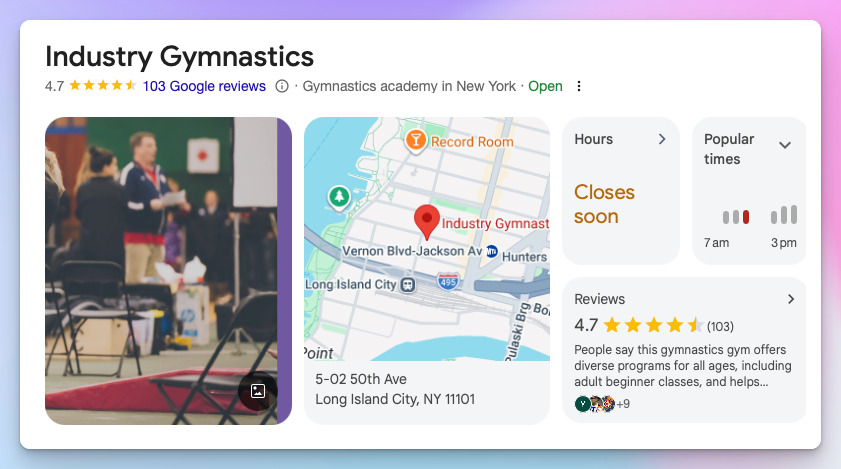
Your Google Business Profile is the storefront most parents see before your website. Fill in every field: hours, all programs (toddler, recreational, team, adult), real photos of your gym rather than stock images, and current pricing. Post one update a week (a class photo, an event, a new term opening) the way you'd post to social, because Google rewards active profiles in the local map pack. Search Engine Land's local SEO guide treats a complete Google Business Profile as the foundation of local visibility for a service business. It costs nothing and takes an afternoon.
2. Win local SEO with "near me" keywords (free, season-long)
Parents search by location, so your website should speak their language. Work your city and activity terms into page titles, headings, image alt text, and a short service page for each program ("toddler gymnastics in [city]," "recreational classes in [city]"). Keep pages fast and mobile-first. This is slow-burn work that pays off for years rather than weeks, so treat it as a season-long play. Our two-part walkthrough on local SEO basics covers the structure in detail.
3. Turn happy parents into a review engine (free, quick win)
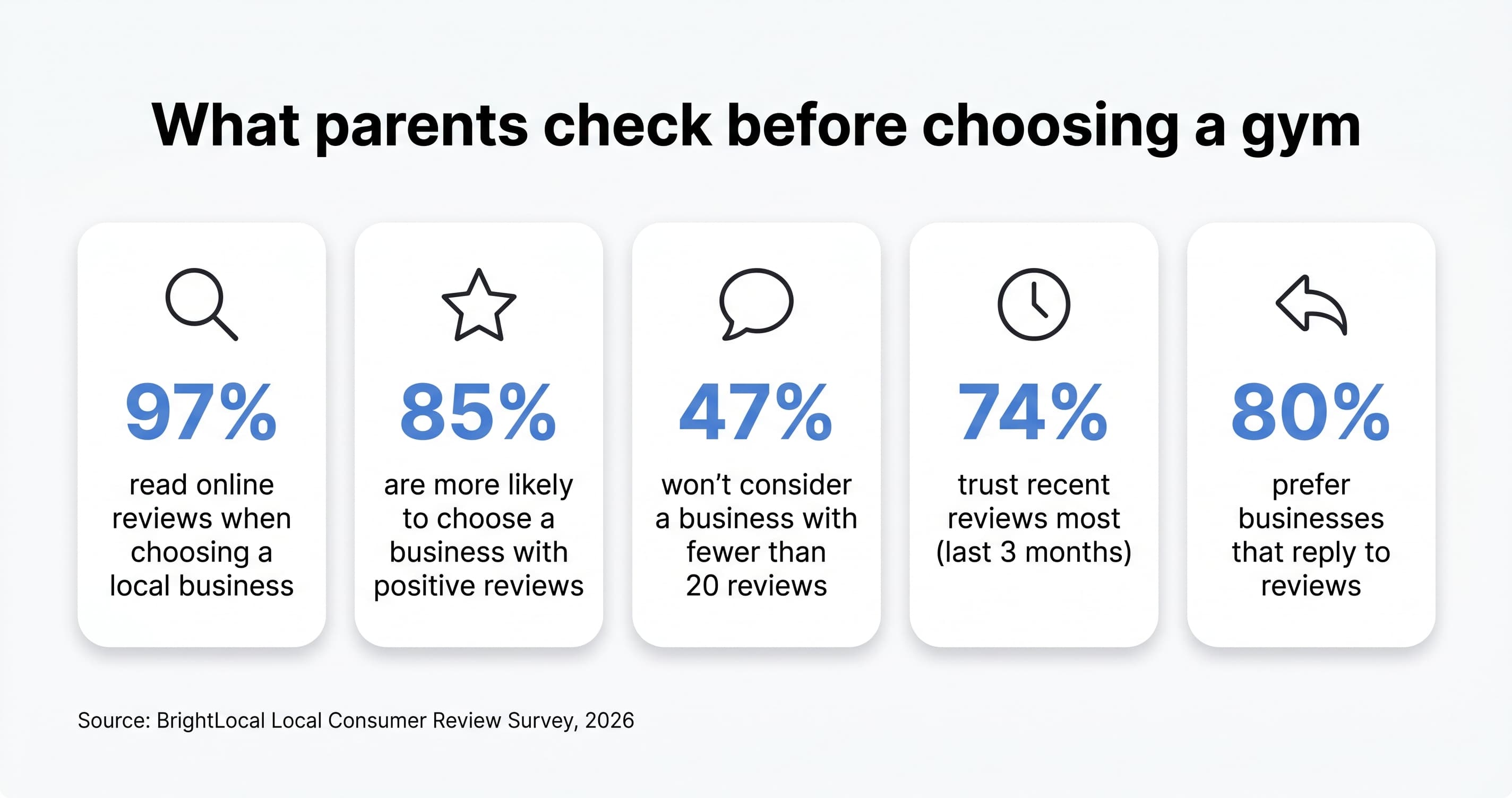
Reviews are the cheapest trust you can earn. In BrightLocal's 2026 Local Consumer Review Survey, 97% of consumers read reviews when choosing a local business, 85% become more likely to use a business after reading positive ones, and 47% won't consider a business with fewer than 20 reviews. The same survey found 74% care most about reviews posted in the last three months, so a steady trickle beats an old pile. Ask at peak emotional moments, right after a child nails a new skill or finishes a recital, and add a one-tap review link to your post-class email. Steal this text:
Hi [Name] — [Child] nailed their first cartwheel today and we're so proud! If you've got 20 seconds, a quick review really helps other local families find us: [link]
Reply to every review, since 80% of people prefer businesses that respond.
4. Fix the website basics that lose signups (quick win)
Paid traffic to a broken booking page is the most expensive mistake in this category. Across the bookings processed on Pembee, 85% are placed on mobile (source: Pembee analytics, 2026), so if a parent can't book a trial in two thumb-taps from their phone, half your effort leaks before it reaches your inbox. Put class times above the fold, make the "Book a Trial" button tappable, and cut the pop-ups. Online registration is built into Pembee's gymnastics management software if your current setup fights you on this.
Social content ideas parents reshare
Every competitor tells you to "post consistently" and stops there. The gyms that grow on social post specific things parents want to reshare. Here are six that work in gymnastics.
5. Post skill-progression reels (free, quick win)
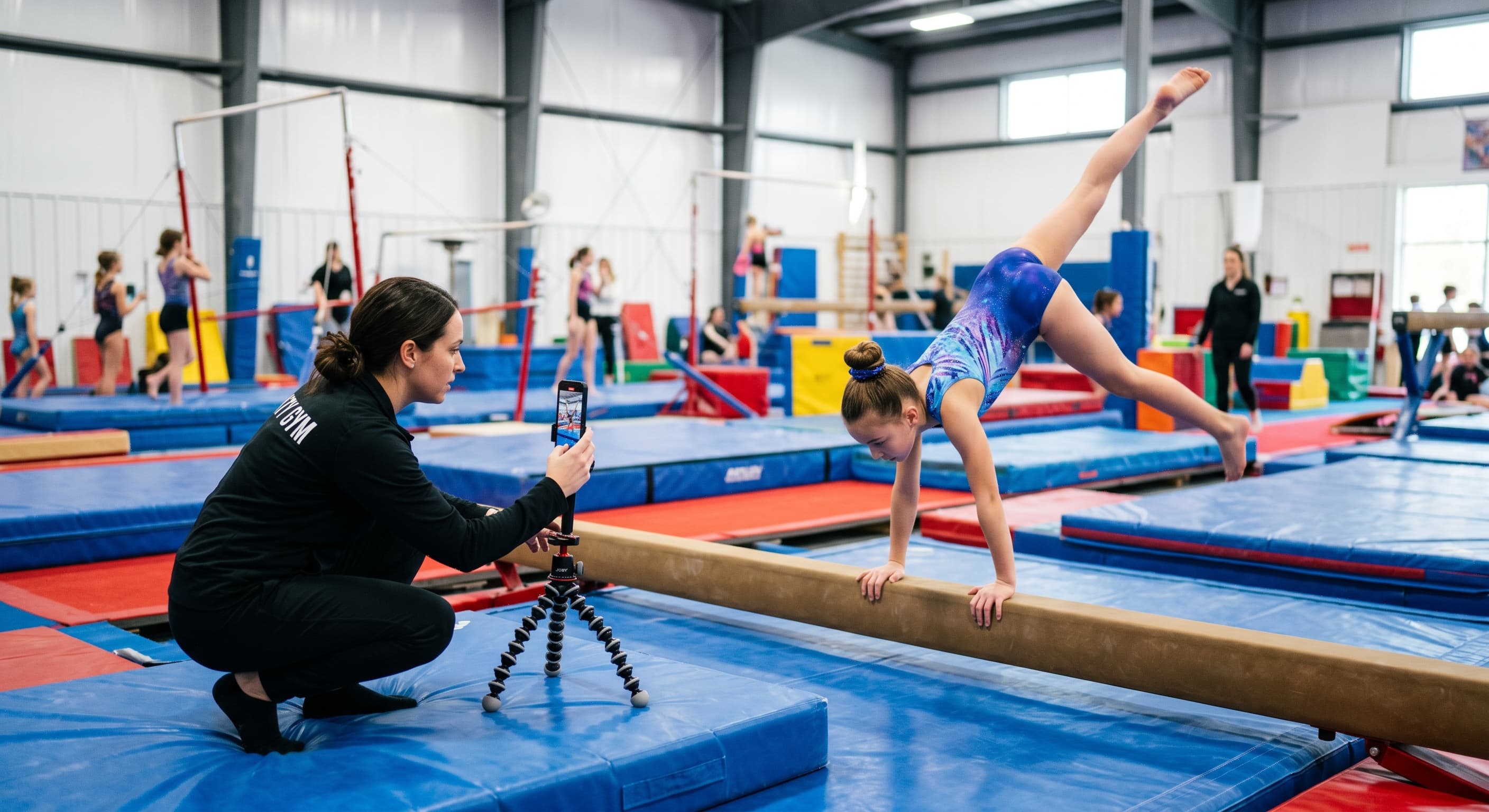
A "week 1 vs week 8" clip of a child landing their first cartwheel or back handspring is the most shareable content in gymnastics. It shows progress, which is exactly what a shopping parent is buying. Film vertical, keep it under 15 seconds, and let the before-and-after do the talking. Practical unlock: film a week-1 clip of every new starter now, even if you never post it, because you can't fake a before-and-after eight weeks later.
6. Run a "gymnast of the month" spotlight (free, quick win)
Spotlighting a gymnast boosts that child's confidence and earns you free reach when their family reshares it to grandparents, aunts, and uncles. Keep it simple: one photo, a sentence on a skill they've mastered, and a sentence on what they love about the gym.
7. Introduce your coaches (free)
Parents enroll with people, not facilities. A short post for each coach, a photo, their background, and one thing they love about teaching, lowers the "is this place right for my child?" barrier before a parent ever calls. New families remember a name far better than a logo.
8. Show the behind-the-scenes (free)
Practice bloopers, meet-day prep, the gym mascot, a coach setting up the floor at 6am. Behind-the-scenes content answers the quiet question every parent has: does this place feel warm and safe? It's also the easiest content to film, because it's just your normal day.
9. Host a challenge or contest (free, quick win)
Gymnasts are competitive, so give them something to compete in: longest handstand, most cartwheels in a minute, best bridge. Attach a hashtag, invite families to post their attempts, and feature the entries. A cartwheel-a-thon doubles as a fundraiser. Contests pull new attention to the gym and give current families a reason to tag their friends.
10. Repost parent-generated content (free)
Your families are already filming class. A short permission line at signup and a branded hashtag turn them into your content team. Reposting parent clips costs nothing, fills your feed, and signals to prospective families that real parents are happy here. Our social media guide has a full content-calendar template if you want to systemize this.
Convert interest into trials and signups
Visibility is wasted if nobody books. These four ideas turn an interested parent into a child on your register.
11. Offer a paid intro instead of a free trial (quick win)
Free trials fill your schedule with browsers. A low-cost paid intro or evaluation, somewhere around $15-25 and refundable on enrollment, filters for parents who are actually ready to commit, and it sets the expectation that gymnastics is a paid, ongoing program rather than a one-off freebie. If walk-in time-wasters aren't a problem for you, keep the free trial. If they are, a small fee qualifies the lead without scaring off serious families.
12. Run a "bring a friend" trial day (free, quick win)
Friends of current members convert far better than cold trials, because the trust transfer is already done. Pick a day, let every current gymnast bring a friend free, and offer both families a small perk if the friend signs up. Your existing parents do the recruiting for you, which is the cheapest acquisition there is.
13. Use waitlists and "almost full" urgency (quick win)
Scarcity moves parents off the fence. When a class is genuinely close to capacity, say so: "2 spots left in Tuesday 4pm." When it's full, collect a waitlist instead of losing the lead, then open the next class to that queue first. A waitlist turns over-demand into next term's revenue rather than a dead end.
14. Open registration early with an early-bird discount (season-long)
Gyms that open next term's registration 4-6 weeks before the current term ends, paired with a small early-bird discount, lock in a meaningful share of returning families before rivals have even posted their schedules. Early registration also gives you a real headcount, so you can open or close classes based on demand instead of guesswork.
Get parents recruiting for you
Word of mouth is still the strongest channel in gymnastics. These two ideas make it deliberate instead of accidental.
15. Launch a referral program with a real incentive (season-long)
A referred family enrolls more readily and churns less, and it costs nothing in ad spend. Make the reward worth talking about: a free month of tuition or account credit when a referred friend enrolls. Build it into your term rhythm rather than running it once and forgetting it. Give parents a line they can forward as-is:
Loving [Gym]? Refer a friend and you both get a free month when they enroll. Just have them mention your name at signup.
16. Add sibling and family discounts (quick win)
A sibling discount is a referral program inside the household. Families with two or three children are your highest-value accounts, and a 10-20% second-child discount nudges a parent to enroll the younger sibling too. Multi-child accounts compound over years, so the math works in your favor. Our piece on selling more class packs covers the multi-child mechanics.
Events and community partnerships
Some of the best gymnastics marketing happens off your screens and inside your community. These five ideas put non-members face to face with your gym.
17. Host an open house or free demo day (quick win)
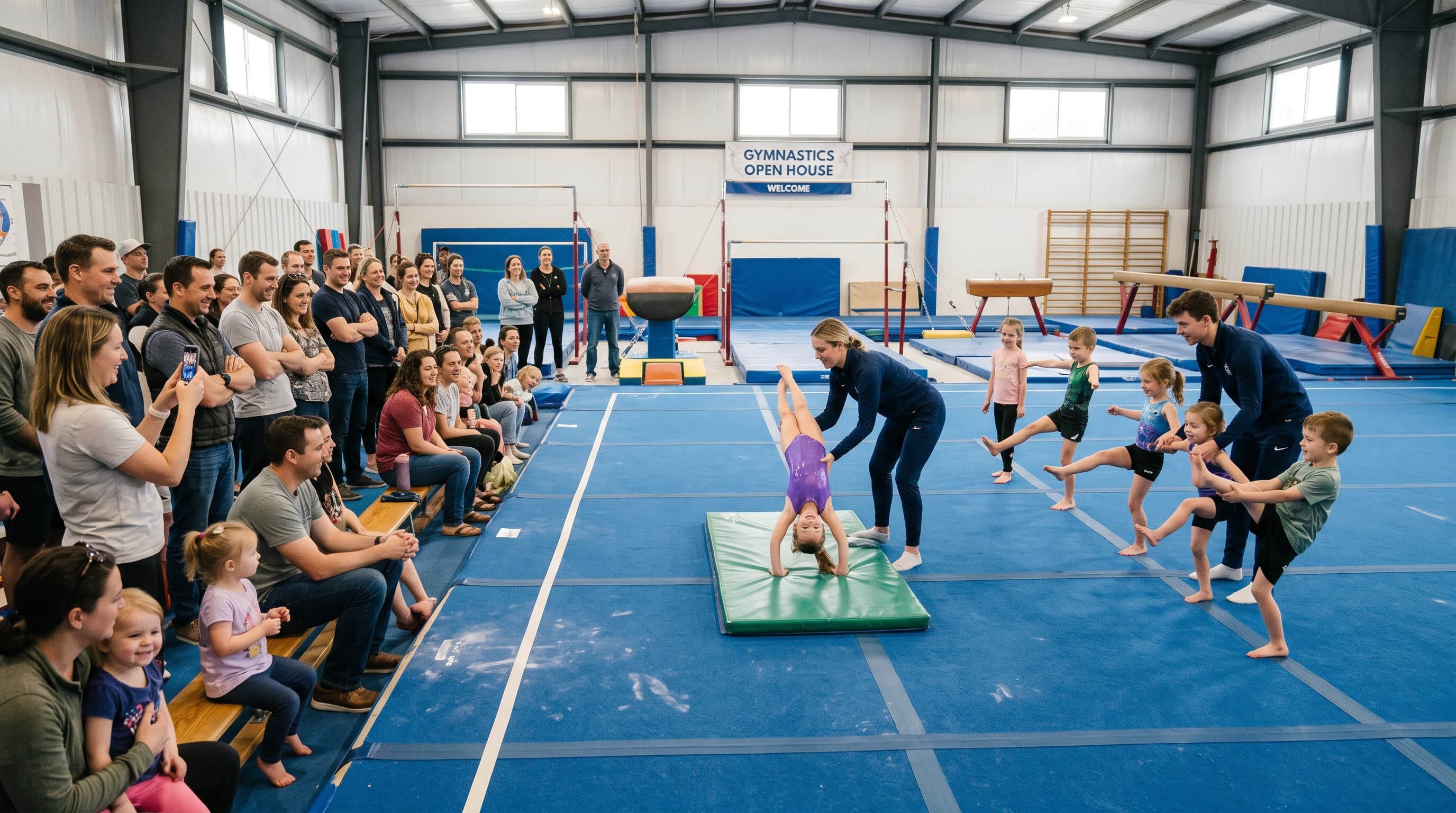
An open house lets families walk your floor, meet coaches, and watch a class with zero pressure. Run it before the back-to-school rush, promote it on your Google Business Profile and social, and have a simple way to book a trial on the spot. Keep the setup light: two open stations, coaches on the floor, and a QR code that goes straight to your trial booking page.
18. Run a "parents' night out" event (quick win)
Parents drop their children at the gym for a supervised evening of gymnastics and games while they get a few hours back. It earns revenue, it's a soft introduction for the children of friends who tag along, and it builds loyalty with the families you already have. Many gyms run these monthly.
19. Use birthday parties as an acquisition channel (season-long)
Every birthday party puts a room of non-member children inside your gym for an hour, and every guest is a warm lead. Drop a trial-class voucher with a one-week expiry into each goody bag. Some gyms run parties at slim margins purely because the follow-on enrollments make the math work.
20. Partner with schools, preschools, and daycares (season-long)
The cheapest qualified leads in gymnastics come from feeder schools. Offer a free 30-minute taster session, bring your own mats and a coach, and leave the school a discount code for families who want to follow up. A short email opens most doors:
Hi [Name], I run [Gym] here in [City]. We'd love to offer your students a free 30-minute gymnastics taster session this term, fully staffed and insured, with all equipment provided. Would a morning or afternoon slot suit you better? Many schools and daycares have budget for after-school activities or PE enrichment, so a single well-run visit can yield a cluster of new families.
21. Show up at local events with a booth (quick win)
Set up at a local fair, school fete, or community day with a mat, two simple stations, and stickers for every child who tries a forward roll. Let kids experience gymnastics on the spot, and have a QR code that links straight to your trial booking. It puts your name in front of hundreds of local families in an afternoon.
Email and SMS that bring families back
Your own list is the cheapest channel you have and the most under-used. Two ideas make it pull its weight.
22. Segment your list by enrollment status (quick win)
A prospect, a current family, and a lapsed family need different messages. Tag your contacts by status and send each group its own short note: prospects get the trial offer, current families get next-term news, lapsed families get a "we've missed you" credit. Segmenting cuts unsubscribes and lifts the response rate on every send. Our email marketing guide breaks down the segments in detail.
23. Send an end-of-session re-enrollment campaign (season-long)
The weeks before a term ends are your single biggest retention window. Send current families a short recap of what their child achieved and a one-click link to re-enroll for next term. Make re-booking take ten seconds, not ten minutes, and you'll keep families who would otherwise drift out over the break. A template that works:
Hi [Name], what a term — [Child] worked hard and nailed [skill]! Spots for next term are open now and filling fast. Re-enroll in one click here: [link]. Can't wait to see them back on the floor.
Two ideas most gyms overlook
Almost every gymnastics marketing list is acquisition-only. The two ideas below are where the quiet growth lives, and most gyms run neither.
24. Treat re-enrollment as your number one channel (season-long)
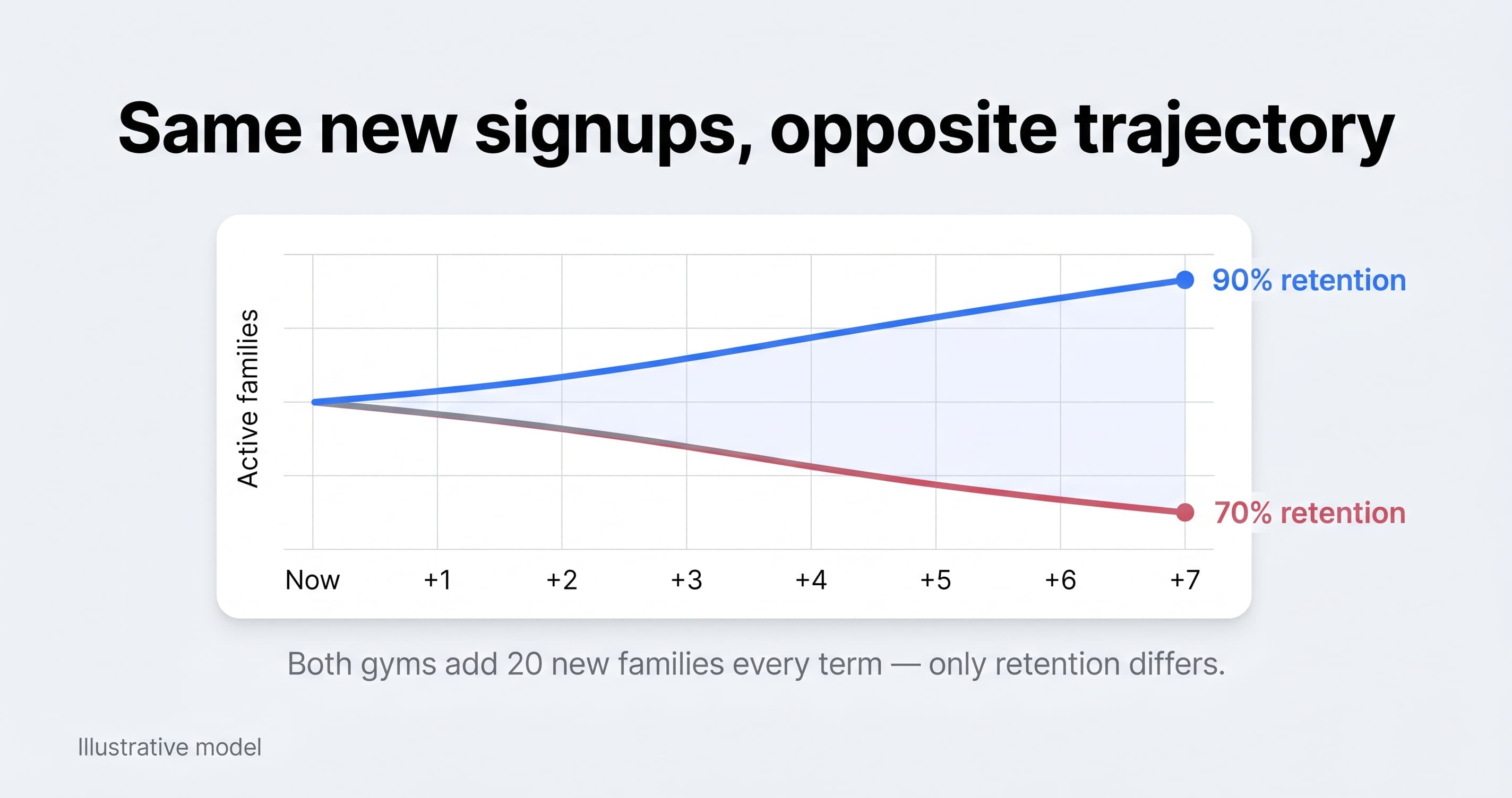
Keeping a family is far cheaper than winning a new one, yet most gyms pour their energy into the top of the funnel and let current families churn out the bottom. Run an end-of-term survey to catch problems early, celebrate milestones publicly, and make re-booking frictionless. If your current system makes parents re-enter everything each term, our comparison of the best gymnastics management software shows which tools handle re-enrollment properly. A gym that retains 90% of families each term grows on autopilot. A gym that retains 70% is running up a down escalator no matter how good its ads are.
25. Open up to new audiences (season-long)
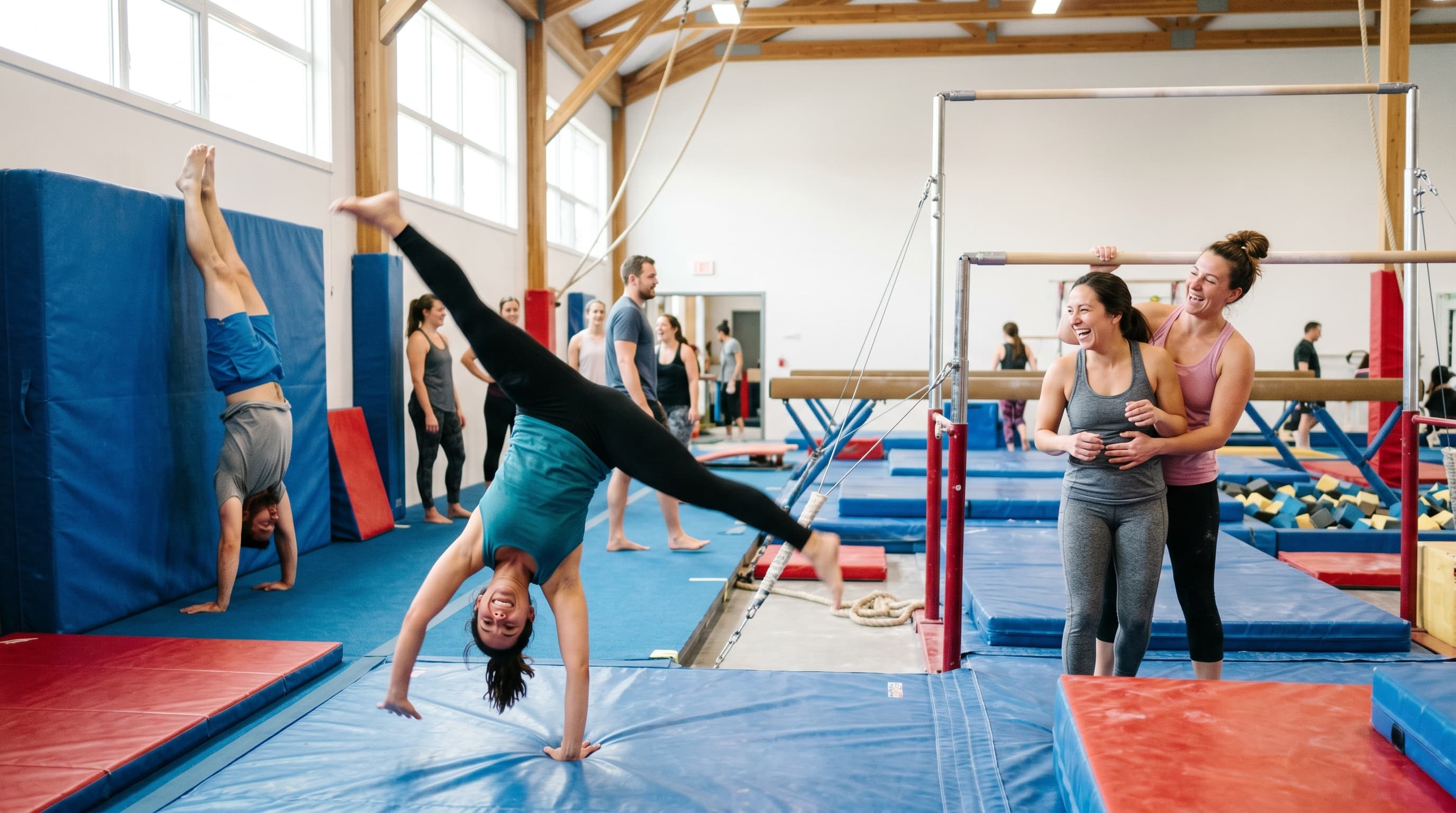
Gymnastics isn't only for young children. Adult gymnastics, ninja and parkour, open gym, homeschool PE sessions, and holiday camps all fill the off-peak hours your kids' classes leave empty, and they reach buyers your competitors ignore. Adults book and pay for themselves, which shortens the sales cycle. If you're weighing a new program, our guide on how to open a gymnastics gym covers the demand side.
How to tell which ideas are working
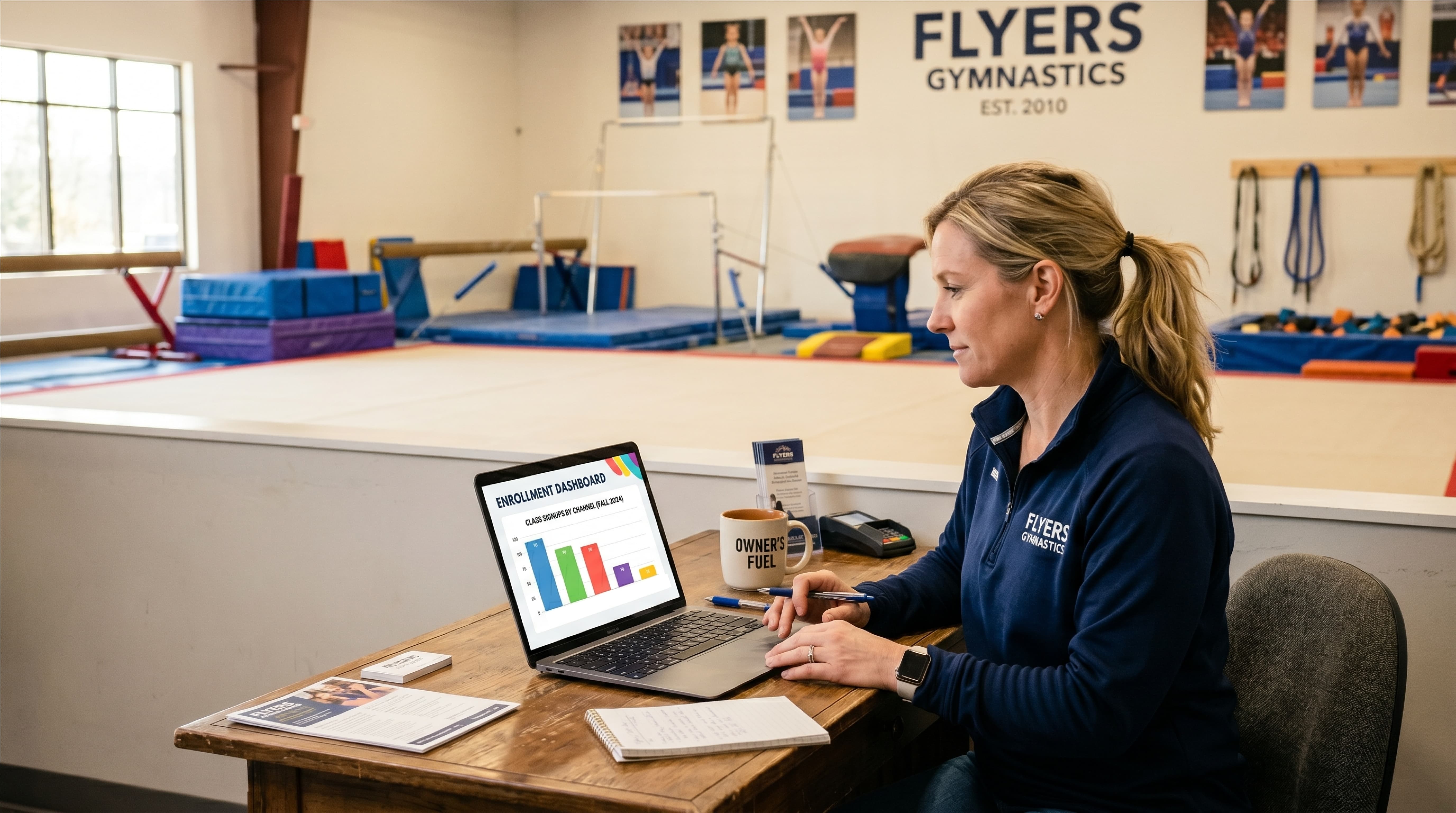
Running ideas without tracking them is how gyms waste money for years. The fix is simple: add a "How did you hear about us?" field to your registration form, then total enrollments by channel each term so you know what to repeat and what to cut.
For paid ideas, watch your cost per trial booked rather than likes or reach. Local search CPCs for service categories typically run a few dollars per click (WordStream's advertising benchmarks give category context), so a channel that brings trials in cheaply and converts them is worth scaling, while one that brings cheap clicks but no enrollments is not. Our walkthrough on measuring campaign effectiveness sets out the few metrics that actually matter.
Key takeaways
- Don't run all 25 ideas. Pick two quick wins, one compounding play, and one experiment, and run them for a full term before judging.
- The free foundations come first: a complete Google Business Profile, a fast mobile booking page, and a steady stream of recent reviews.
- Gymnastics-specific social content (skill-progression reels, gymnast spotlights, behind-the-scenes) gets shared in ways generic posts never do.
- Referrals, sibling discounts, and re-enrollment are the cheapest growth you have, yet most gyms treat marketing as acquisition only.
- Widen your audience with adult classes, ninja, open gym, and camps to fill the hours kids' classes leave empty.
- Track every enrollment by channel with a "How did you hear about us?" field, then do more of what works.
FAQs
What is the cheapest way to get more gymnastics students?
Referrals and re-enrollment cost almost nothing and convert better than any paid channel. A referral program with a real incentive turns your current parents into recruiters, and a strong end-of-term re-enrollment push keeps families you already have. Pair those two with a complete Google Business Profile and a steady flow of reviews, all free, before you spend a dollar on ads.
What are some creative gymnastics marketing ideas?
The most creative ideas in gymnastics are usually content and events, not ads. Skill-progression reels, a gymnast-of-the-month spotlight, a cartwheel-a-thon contest, and a parents' night out all generate attention and word of mouth at low cost. The advantage of creative ideas is that families share them, so your reach grows without extra spend.
What should a gymnastics gym post on social media?
Post things parents want to reshare: a child landing a new skill, a coach introduction, behind-the-scenes clips, and reposts of parent-filmed class moments. Keep videos vertical and short, and feature real children and coaches rather than stock images. Specific, human content outperforms polished generic posts every time.
How often should a gymnastics gym post on social media?
Consistency matters more than volume. Two to four posts a week that you can sustain beats a daily burst that fizzles out after a fortnight. Mix formats: a progression reel, a spotlight, a behind-the-scenes clip, and one event or offer post is a solid weekly rhythm.
Are free trial classes still worth it?
Free trials still fill schedules, but they attract browsers as well as serious families. If you get a lot of no-shows or time-wasters, switch to a low-cost paid intro that's refundable on enrollment, which qualifies the lead without scaring off committed parents. If your trials already convert well, keep them free.
How do I market gymnastics in the summer?
Summer camps are the most efficient way to convert non-members into term-time families, because a parent who books a week of camp has already cleared the time, location, and trust hurdles. Promote camps in spring with an early-bird discount, then follow up every camp family with a term-time class offer while the experience is fresh.
How can I market adult gymnastics classes?
Adults book and pay for themselves, so market to them directly rather than through a parent. Lead with the benefits they care about (fitness, flexibility, fun, a new challenge), use social proof from current adult members, and schedule classes in the evening and weekend slots adults can actually attend. Adult gymnastics, ninja, and open gym also fill the off-peak hours your children's classes leave empty.
How much should I spend on gymnastics marketing?
Plan for a single-digit percentage of revenue once you're established, and more (closer to 10-12%) when you're new or launching a program. Weight that spend toward your peak windows: back-to-school, New Year, and summer camp pre-sales. Spend nothing until your booking page converts, because paid traffic to a broken funnel is the most expensive mistake in the category.
How do I know which marketing ideas are working?
Add a "How did you hear about us?" field to your registration form and total enrollments by channel each term. For paid ideas, track cost per trial booked rather than likes or reach. The goal is to find the two or three channels that bring families in cheaply and do more of them.
How do I get more gymnastics students without spending on ads?
Stack the free ideas: complete your Google Business Profile, collect reviews after every recital, run a referral program, post shareable social content, and push re-enrollment hard at term end. Add a school taster session or community-event booth each term. Most gyms find that trials, referrals, and re-enrollment together fill more classes than any paid campaign. If you want these ideas wired into one system, Pembee's gymnastics management software handles trial bookings, waitlists, segmented email, and one-click re-enrollment, and you can [see the plans](/pricing) or start a free 30-day trial whenever you're ready.