


Most people who start a soccer club worry about coaching and drills. The club actually lives or dies on two things they underestimate: getting sanctioned and insured, and covering the cash it takes to run a season. Get those wrong and even a great coaching setup folds inside a year. This guide walks the whole build: club type, legal structure, sanctioning, a full year-one budget, break-even math, and how to take registrations online.
The short version: decide what club you are building, pick a legal structure, get sanctioned through a national body, lock fields and insurance, build a budget, find your break-even, recruit coaches and players, take signups online, then market locally. Here is each step with real numbers.
How to start a soccer club: the short version
- Decide what club you are building: recreational or competitive, and which age bands.
- Choose a legal structure: a 501(c)(3) nonprofit or an LLC.
- Get sanctioned by affiliating with US Youth Soccer, US Club Soccer, or AYSO.
- Lock your fields, insurance, and SafeSport background checks.
- Build a year-one budget and find your per-player break-even.
- Set registration fees with room to operate, not just to break even.
- Recruit and credential coaches, then register or try out players.
- Take signups and payment online, then market locally and land sponsors.

Step 1: Decide what club you are building
Before you file anything, decide whether you are starting a recreational club or a competitive one, because that single choice drives every cost, sanctioning body, and fee that follows. A rec club is about participation, low cost, and local play. A competitive or travel club is about development, tryouts, paid coaching, and league play that runs the family a lot more per season.
The two models sit far apart on price. A rec season commonly costs a family $75 to $400, while a competitive or travel season runs $800 to $2,500 once you add coaching, travel, and tournament fees. Treat those as planning ranges that vary by region, but the gap is the point: you are building two very different businesses, and you should pick one as your primary before you design anything else.
| Factor | Recreational club | Competitive / travel club |
|---|---|---|
| Family cost per season | $75 to $400 | $800 to $2,500 |
| Player commitment | One or two sessions a week, local games | Multiple sessions, travel, tournaments |
| Coaching | Mostly volunteer, parent coaches | Paid, licensed coaches |
| Typical sanctioning | AYSO or a US Youth Soccer rec league | US Club Soccer, ECNL, or MLS NEXT pathways |
| Age approach | Open registration, mixed ability | Tryouts, ability-graded teams |
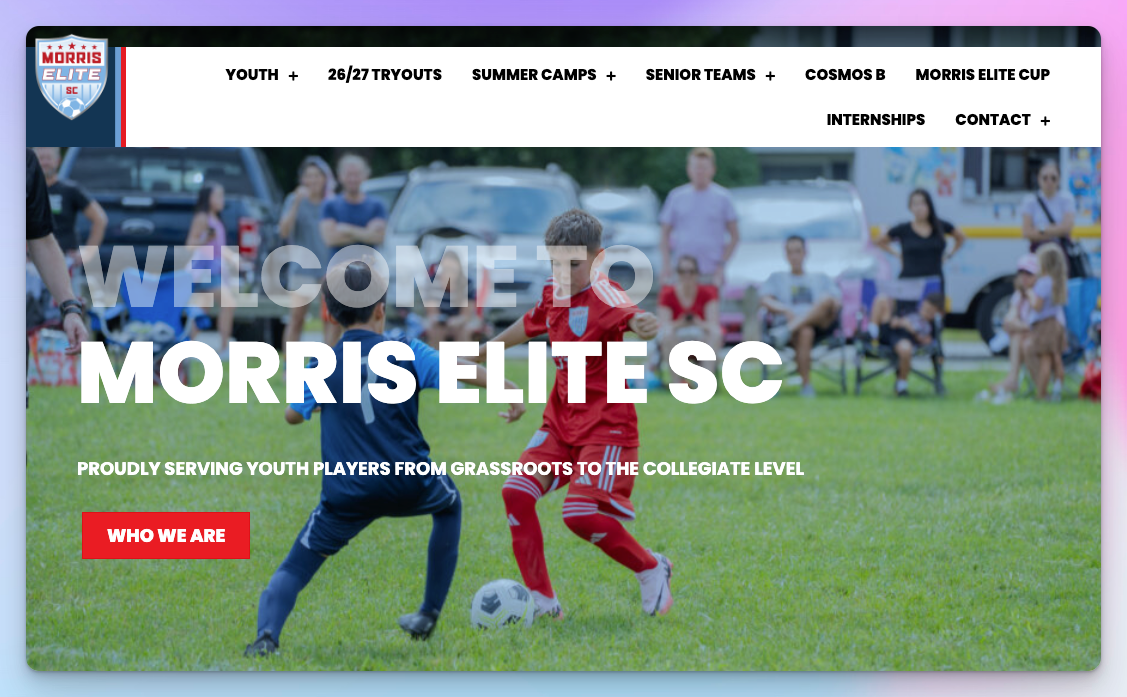
For a feel of what the competitive end looks like in practice, take Morris Elite SC, a competitive youth club in New Jersey. Its homepage navigation alone — tryouts, summer camps, senior teams, even its own cup — tells families what kind of club they are dealing with before they have read a word. That clarity is the payoff of deciding your model first.
Then set your age bands. US youth soccer is organized by birth year, and the practical bands are 5 to 8, 9 to 12, and 13 to 16 and up. Younger groups play small-sided formats rather than full 11-a-side, so your field needs and team counts change with the ages you take. Write a one-line mission that names your model, your ages, and your area, because it settles a dozen later arguments about direction.
If a full club feels like a lot to commit to cold, a camp is a lower-risk way to test demand and build a mailing list first. Our guide on how to run a soccer camp covers that as a front door before you commit to a season.
Step 2: Choose your legal structure
A soccer club needs a formal legal entity, both to protect you personally and because most sanctioning bodies expect to affiliate with an organization, not an individual. The two common choices are a nonprofit and an LLC, and they pull in different directions.
A 501(c)(3) nonprofit is the standard path for a community youth club. It exempts the club from federal income tax, lets families and sponsors give tax-deductible donations, and opens the door to grants that for-profit clubs cannot touch. The trade-off is structure: you need a board of directors, bylaws, and ongoing reporting, and the club's money belongs to the mission, not to you. To get the exemption you file IRS Form 1023, which carries a user fee of $600, or the streamlined Form 1023-EZ at $275 for smaller organizations, per the IRS. Many founders pay a filing service $1,500 to $2,000 to handle the paperwork, though it is doable yourself.
An LLC is faster to set up and keeps control with the owners, which suits a founder running the club as a small business. You lose the tax exemption, the grant eligibility, and the donation deductibility, and some rec leagues prefer to affiliate with nonprofits. Most competitive clubs still incorporate as nonprofits for the credibility and funding access, then run lean.
Either way, treat this as the point where you write down how the club is governed and how money is handled. If you want a formal plan with financial projections behind the structure, our soccer academy business plan guide walks through the document lenders, boards, and sponsors expect to see.
Step 3: Get sanctioned and affiliated
This is the step competitors gloss over, and it is the one that makes your games and players official. Sanctioning means affiliating with a national governing body so your club can register players, play sanctioned matches, enter tournaments, and access the insurance that comes with membership. Play unsanctioned and you are locked out of organized league play and carrying all the risk yourself.
In the US there are three main entry points. US Youth Soccer is the largest, working through state associations, and it is the common route for rec and competitive clubs alike. AYSO runs a national, volunteer-led recreational program and is a simpler on-ramp for a pure rec club. US Club Soccer is the other major body, popular with competitive and travel clubs for its flexible player registration. Higher up the competitive ladder sit pathways like ECNL and MLS NEXT, which you apply into once the club is established.
You affiliate by contacting your state association or chosen body and registering the club, then registering each player. Costs stack in layers: a state association affiliation often runs around $100 a year, per-club governing-body registration lands near $150 a year, and per-player fees are roughly $11 to $25 plus a $7 to $15 state fee. Entering a competitive league at the organization level is the big line: budget $3,000 to $10,000 a year, with ECNL near $3,000 to $5,000 and an independent MLS NEXT entry $5,000 to $10,000. Treat these as current planning ranges and confirm exact figures with your state association.
| Body | Best for | Rough cost |
|---|---|---|
| AYSO | Volunteer-run recreational clubs | Program and per-player fees, low |
| US Youth Soccer (via state association) | Rec and competitive clubs | ~$100/yr state affiliation + per-player fees |
| US Club Soccer | Competitive and travel clubs | Club registration + per-player fees |
| ECNL / MLS NEXT | Established competitive clubs | $3,000 to $10,000/yr at org level |
Step 4: Lock fields, insurance, and compliance
With a legal entity and a sanctioning path in place, secure the three things that gate your first season: somewhere to play, cover for when things go wrong, and clean background screening for everyone near the players.
Fields come first because they cap your dates and headcount. Start with public parks and recreation departments and local schools, which are the cheapest, then price private turf as a backup. Field rental commonly runs $75 to $150 an hour, and a club playing and training across a season should plan a $15,000 to $20,000 annual field budget. Book early, because good local fields get reserved months out, especially in the spring and fall.
Insurance is usually required to affiliate, and you want it regardless. Carry general liability, which runs roughly $2,000 to $5,000 a year for a club, and directors and officers (D&O) cover for your board at $500 to $1,500 a year. Your sanctioning body often bundles or requires a baseline policy, so confirm what membership already includes before you buy separately. For a broader primer on activity cover and what it protects, our summer camp insurance guide covers the same ground for seasonal programs.
Compliance is the piece first-timers miss. Under the federal SafeSport Act, background screening and abuse-prevention training are expected for anyone in regular contact with minor athletes, and that includes volunteers, not just paid staff, per the U.S. Center for SafeSport. Sanctioned clubs must run background checks and SafeSport certification on coaches and officials before they work with players. Build this into registration from day one rather than scrambling to verify people the week before your first session.

Step 5: Build your year-one budget
This is the section most club guides skip, and it is the one that decides whether the club survives its first year. Walk every cost line, then divide by your expected enrollment to see what each player has to cover. Here is a full sample year-one budget for a competitive club of about 100 players. Treat every figure as an illustrative planning range, not a quote, since costs swing hard by region and by public versus private fields.
| Cost line | Sample year-one range (USD) |
|---|---|
| Legal and formation (nonprofit filing, bylaws) | $600 to $2,500 |
| Field rental and training space | $15,000 to $20,000 |
| Insurance (general liability + D&O) | $2,500 to $6,500 |
| Coaching (paid, small competitive club) | $30,000 to $60,000 |
| League and affiliation fees | $3,000 to $10,000 |
| Equipment and uniforms | $5,000 to $12,000 |
| Registration software and website | $1,000 to $3,000 |
| Admin, marketing, and contingency | $5,000 to $10,000 |
| Year-one total | $62,000 to $124,000 |
The total looks daunting because a fully paid competitive club is a real business. A lean recreational club scales down sharply: lean on volunteer coaches, public fields, and simple uniforms, and a first-year rec club can run closer to $20,000 to $50,000. The difference is almost entirely coaching pay and league entry, the two lines you control most in year one.
Whatever model you pick, add a contingency line and expect the season to cost more than the spreadsheet says. The clubs that fold are usually the ones that priced against a best-case budget with no buffer.

Step 6: Set fees and find your break-even
Your budget gives you the floor. Break-even math turns that floor into a registration fee, and it is the calculation almost no club guide shows. The formula is simple:
Total annual costs divided by enrolled players equals your floor fee per player.
Run it on the sample budget. Take a midpoint around $90,000 in annual costs and 100 enrolled players, and your floor is $900 per player just to break even. That is the number before you add anything for a reserve, for scholarships, or for the surprise expense every season brings. So you never set the fee at the floor; you set it above.
Enrollment is the other lever. A club needs a minimum viable base of roughly 60 to 80 players to spread fixed costs like fields, insurance, and league entry across enough families to make the per-player fee bearable. Below that, the same fixed costs land on fewer players and the fee climbs out of reach.
| Enrolled players | Floor fee at ~$90,000 costs |
|---|---|
| 60 players | ~$1,500 per player |
| 80 players | ~$1,125 per player |
| 100 players | ~$900 per player |
| 120 players | ~$750 per player |
The table shows why growth matters: every extra family lowers the floor for everyone. Once you have a fee that clears break-even with margin, protect access with a sliding scale or a scholarship pool, commonly set around 10% of gross registration revenue, so cost never quietly filters out the players you want. Set the fee from this math first, then sanity-check it against what nearby clubs charge, not the other way around.
Step 7: Recruit coaches and players
With the numbers set, build the two things families actually judge you on: the coaching and the roster.
Recruit coaches for the mix of playing or coaching experience and the ability to hold a group's attention, then verify the non-negotiables before anyone runs a session. In US soccer, licenses run from Grassroots courses through the National C and B licenses, offered through the US Soccer Learning Center, and even an entry-level Grassroots badge shows a coach has been trained in age-appropriate methods. Pair every license check with a current background check and SafeSport certification, per Step 4. Paid coaching for a small competitive club runs $30,000 to $60,000 across the year, so decide early where you use paid staff and where a qualified volunteer works.
For players, the recruiting method follows your model. A rec club runs open registration: work with local schools, rec centers, and community groups, and take all-comers into age bands. A competitive club runs tryouts to grade players into teams, then registers the ones who make it. Either way, run a clean, dated registration window so families know exactly when to sign up and you can plan rosters and orders. Budget $500 to $1,000 to kit out each team with balls, cones, pinnies, and training gear on top of uniforms.

Step 8: Take registrations and payments online
This is the operational backbone of the club, and it is where most first-timers lose evenings they do not have. A club that runs signups through email threads and spreadsheets ends up re-keying player details, chasing unpaid balances, and hunting for the one waiver that never came back. Fix all of it with one online registration flow.
We built our booking software for exactly this. Families register and pay in one place, so enrollments, seasonal or recurring payments, digital waivers and medical forms, rosters, and confirmations live together instead of scattered across your inbox. You set a capacity cap per age group so you never oversell a team past a safe size, collect payment upfront so you are not chasing money mid-season, and send automatic confirmations and reminders without touching them.
Collecting card payment at the point of signup matters more than it sounds. Families who pay when they register show up at far higher rates than those carrying a balance, and upfront cash helps you cover field deposits and league fees before the season starts. Reusable waiver and consent forms mean a parent fills in medical details and photo consent once, and you have them on file for the whole season.
If you want to compare tools before you commit, we round up the best soccer club management software elsewhere on the blog.
Step 9: Market your club and land sponsors
A sanctioned, insured, well-run club still needs families to know it exists. You do not need a big budget, you need the right local channels and a reason to sign up now.
Go where the parents already are. Reach out to nearby schools and rec centers, post in community and neighborhood Facebook groups, ask local sports shops and cafes to display a flyer, and pitch the local paper a short story about a new club opening. Put a direct booking link in every post so an interested parent can register in the moment instead of emailing to ask. Referrals from current families are your cheapest signups, so make it easy for them to bring friends.
Sponsorship is a real second revenue stream, not an afterthought. Local businesses sponsor youth teams because it puts their name in front of engaged families every week, and youth sports carries strong sponsor recall with parents. Package it simply: a logo on the kit, a banner at home games, and a mention in your newsletter, priced in clear tiers a small business can say yes to. One or two sponsors can cover a meaningful slice of your uniform or field budget.
Your startup timeline
Knowing the steps is not the same as knowing the order. A first club takes 9 months at an aggressive pace and closer to 12 months realistically, so work backward from your target first game. Here is a workable sequence.
| Timeframe | Focus |
|---|---|
| Months 1 to 2 | Decide the model, file the legal entity, form a board or ownership |
| Months 3 to 4 | Affiliate with a sanctioning body, lock fields, buy insurance |
| Months 5 to 6 | Build the budget and fees, set up online registration, start outreach |
| Month 7 | Run tryouts or open registration, recruit and screen coaches |
| Month 8 | Order kit, finalize rosters, run preseason training |
| Month 9 | Season kicks off |
The order is not negotiable in the early months: the legal entity has to exist before you can affiliate, and affiliation and insurance have to be in place before you can register players or book sanctioned games. Front-load the paperwork so the back half is about soccer, not admin.

Key takeaways
- Decide recreational or competitive first, because it drives every cost, sanctioning choice, and fee. Family costs run $75 to $400 a season for rec and $800 to $2,500 for competitive.
- Sanctioning and insurance are non-negotiable. Affiliate with US Youth Soccer, US Club Soccer, or AYSO, carry general liability and D&O cover, and run SafeSport background checks on everyone near the players.
- Build a full year-one budget before you set fees. A paid competitive club runs about $62,000 to $124,000; a lean volunteer-run rec club, $20,000 to $50,000.
- Find your break-even with a simple formula: total costs divided by enrolled players equals your floor fee. Aim for a minimum viable base of 60 to 80 players, then price above the floor.
- Take registrations and payment online from day one, with upfront card payment and capacity caps, to kill the two biggest admin time sinks: chasing money and re-keying forms.
- Plan a 9 to 12 month runway and front-load legal setup and affiliation so player registration and preseason come last.
FAQs
How much does it cost to start a soccer club?
It depends heavily on the model. A lean recreational club built on volunteer coaches and public fields can start for roughly $20,000 to $50,000 in year one. A fully paid competitive or travel club, with paid coaching and league entry, runs closer to $62,000 to $124,000. The biggest lines are coaching pay, field rental, and league fees, so those are where the two models diverge most.
Do you need to be a nonprofit to start a soccer club?
No. You can run a club as an LLC, which is faster to set up and keeps control with the owners. Most community youth clubs still choose 501(c)(3) nonprofit status because it exempts them from federal income tax, allows tax-deductible donations, and opens up grants. The trade-off is that a nonprofit needs a board, bylaws, and ongoing reporting.
How do I get my soccer club sanctioned?
Affiliate with a national governing body: US Youth Soccer through your state association, US Club Soccer, or AYSO for a pure recreational club. You register the club, then register each player. Affiliation gives you access to sanctioned games, tournaments, a player registration system, and insurance. Contact your state association to start.
How many players do I need to start a soccer club?
Plan for a minimum viable base of about 60 to 80 players. Fixed costs like fields, insurance, and league entry do not shrink with a smaller roster, so below that range the per-player fee climbs out of reach for most families. More enrolled players spread those fixed costs and lower the fee for everyone.
What insurance does a soccer club need?
Carry general liability insurance, which runs roughly $2,000 to $5,000 a year, and directors and officers (D&O) cover for your board at $500 to $1,500 a year. Your sanctioning body usually requires a baseline policy to affiliate, and some may bundle it, so confirm what membership already includes before buying separately.
How long does it take to start a soccer club?
Give yourself 9 to 12 months from decision to first game. The early months go to legal setup and forming a board, then affiliation, fields, and insurance, then budgeting and registration. Player tryouts, coach recruitment, and preseason come last. The order matters, since you cannot register players until the entity exists and the club is affiliated and insured.
How much should I charge for soccer club registration?
Set the fee from your break-even first: total annual costs divided by enrolled players gives the floor, then price above it for a reserve and scholarships. As a benchmark, rec seasons commonly land at $75 to $400 and competitive or travel seasons at $800 to $2,500. Check your number against nearby clubs once the math clears.
What is the difference between a rec and a travel soccer club?
A recreational club is about participation: low cost, mostly volunteer coaches, local games, and open registration. A travel or competitive club is about development: paid licensed coaches, tryouts, travel, tournaments, and a higher season fee. They also tend to sanction differently, with rec clubs often through AYSO or a US Youth Soccer rec league and competitive clubs through US Club Soccer and pathways like ECNL or MLS NEXT.
Can I start a soccer club by myself?
You can be the founder and driver, but you cannot run it alone for long. A nonprofit legally needs a board of directors, and even an LLC needs credentialed coaches, screened volunteers, and someone handling registration and payments. Most successful clubs start with a small core team splitting coaching, admin, and finances rather than one person doing everything.
What legal structure is best for a youth soccer club?
For most community youth clubs, a 501(c)(3) nonprofit is the standard choice, because of the tax exemption, donation deductibility, and grant access. An LLC suits a founder running the club as a small business who wants to keep control and set up quickly. Weigh tax treatment, funding access, liability, and what your sanctioning body prefers before you file.