


ClassForKids and Pebble will both run a UK kids' club: bookings, registers, payments, parent comms, and a parent-facing marketplace attached to each. Where they split is what they charge you for it, and how they handle childcare funding.
We compared them on class and camp management, registers, payments, marketplace reach, support and real monthly cost, using current pricing and what their own users say on Trustpilot.
Below is a straight answer on ClassForKids vs Pebble, plus a third option if neither matches how your club actually fills its classes.
The quick verdict
- Choose ClassForKids if you run a term-based club and want free onboarding with a named account manager, documented waiting lists, and a listing on the larger of the two parent marketplaces here, on both companies' own claimed numbers. Its headline 2.5% transaction fee is an estimate that ClassForKids confirms per club, so get your actual rate in writing before you count on it being the cheaper bill. If you only trade in the holidays, its £120/year Camps Only plan has no equivalent here.
- Choose Pebble if a meaningful share of your parents pay with Tax-Free Childcare or childcare vouchers and you are Ofsted-registered, because Pebble handles both inside the checkout rather than as a manual workaround. WhatsApp comms at no extra cost, and the cheaper licence of the two if you commit to a full year (£300 against £349.90), are the other reasons to pick it.
- Consider a third option if your bookings already come from your own website, school partnerships and word of mouth. Both tools take a percentage of every payment you process, partly to fund a parent marketplace you may never need.
The rest of this post shows the evidence behind each call.
ClassForKids vs Pebble at a glance
| Software |
ClassForKids
★★★★☆ 4.5 (119)
|
Pebble
★★★★☆ 4.0 (81)
|
Pembee
Best for activity providers
★★★★★ 4.9 (23)
via Capterra
|
|---|---|---|---|
| Best for | Term-based UK kids' clubs that want marketplace reach and hands-on setup | Ofsted-registered camps and wraparound care taking Tax-Free Childcare | Providers who fill classes from their own website and want flat pricing |
| Starting price | £34.99/moYear-Round; £120/yr camps only | £35/moCore; £25 on a 1-year commitment | £30/moflat, up to 5 admin users |
| Free trial | ✓ Yeslength not published | ✓ 7 daysno card required | 30-day trialno card required |
| Booking fee | From 2.5%*estimate; clubs report 3.1% + Stripe | 2.5%-3%plus VAT, Stripe on top | 0.59%plus Stripe fees |
| Contract | Not publishedno minimum term advertised | Optional1-year term for the lower price | ✓ None |
| Tax-Free Childcare at checkout | Partialrecorded, reconciled outside | ✓ Yesvia PonchoPay, Ofsted only | ✓ Yesno extra transaction fee |
| Waiting lists | ✓ Yesdocumented on all plans | Not documented | PartialPremium plan |
| Parent marketplace | ✓ Yes1m+ parents claimed | ✓ Yes1,000+ providers claimed | ✗ Noyour own booking pages |
| Messaging included | Partialunlimited email, SMS 6p | ✓ Yesemail and WhatsApp | Partialemail, 90-day history |
ClassForKids and Pebble ratings from Trustpilot, our own from Capterra because our Trustpilot profile has no reviews on it. All ratings and pricing checked 17 September 2026 on each vendor's official UK pricing page. Starting prices are month-to-month rates, and all three are cheaper if you pay or commit annually. ClassForKids' 2.5% is marked as an estimate on its own pricing page, with the final rate set per club by an account manager; the rates clubs have disclosed are in the pricing section below. Partial means the capability exists but is limited or needs a workaround: ClassForKids records childcare vouchers but reconciles them outside the system, our waitlists sit on the Premium plan, and neither we nor ClassForKids document WhatsApp messaging. "Not documented" means we could not find published documentation for the feature, not that it definitely does not exist.
What is ClassForKids?
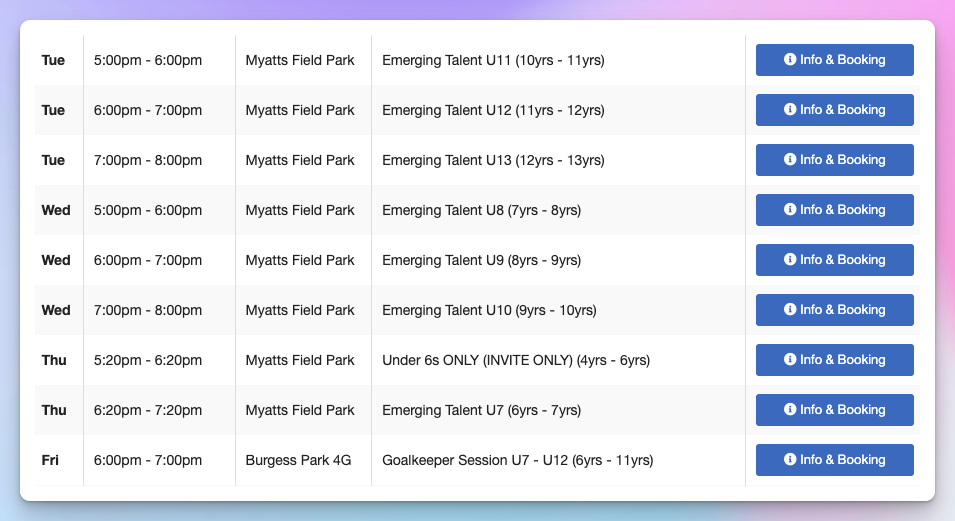
ClassForKids is a Glasgow-based booking and management platform for kids' clubs in the UK and Ireland. It sells a single licence that runs the whole club, from bookings and registers to payments and parent comms, with a free listing on its parent-facing Discovery Site attached. The company claims 4,500+ clubs on the platform and more than a million parents using Discovery.
It is no longer an independent company. The Access Group, one of the UK's largest business-software providers, acquired ClassForKids in February 2023 and placed it in its Non-Profit and Education division. That cuts both ways for a buyer: a large parent brings staying power and investment, and it also means product, pricing and support decisions now sit inside a much bigger organisation than the one many long-standing clubs signed up with.
Where ClassForKids is strong:
- Built around the kids'-club year rather than a generic calendar: term blocks, holiday camps, drop-ins, memberships and subscriptions, capacity limits, waiting lists, and sibling and early-bird discounts, with multi-venue and franchise support and staff permission levels.
- Payment recovery is part of the product. Automated reminders, automatic retries on failed payments, saved cards with Apple Pay, Google Pay and Link, and recurring subscriptions. One club case study on the company's own site claims a 90% cut in missed membership payments, worth £12k a year.
- Onboarding with a named human, included in the licence. This is overwhelmingly the dominant five-star theme on Trustpilot and reviewers name the person: "Jonny, the account manager that I dealt with was fantastic, he made the whole process feel easy" (Lorraine, September 2026), "Sophie was very helpful and walked us through every step" (Chris Hall, September 2026).
- A separate Camps Only plan at £120 a year, pay as you go, which is unusually well priced if you only trade in the school holidays.
- Reviewers credit it with removing spreadsheet admin outright: "It took away several hours of admin that my admin team previously spent using spreadsheets" (Pierre, performing arts, Capterra).
Where users struggle:
- Support going quiet after onboarding is the single most common one-star theme, and it comes from clubs rather than parents. "Very good system that we have been using for a few years now. But... they bill us monthly for a product that they don't support" (Vini Ganesh, June 2026), "No customer support for our customers, no reply when we as admin contact customer support" (SDA Admin, January 2026), "Difficult to contact when you have problems with the system" (Half Backs Rugby, September 2026).
- Parents cannot manage their own payment details, and the club absorbs the fallout. This is the most common parent-side one-star theme and it has recurred for years: "No way for me to remove my card details... it just says contact your club!!" (James, January 2026), "You cannot cancel the subscription & you cannot remove your card so it cannot be charged" (Mikaela Walker, September 2024). Every one of those tickets lands in a club's inbox.
- Fee perception is a live one-star theme, and the one detailed account puts the real rate well above the headline: "I wasn't explained about the additional 4.7% that was taken... I was told that other users were only on 2.7% and mine should be 3.7% but yet 4.7% was taken" (michelle hawkes, January 2026). The same reviewer says she lost over £600 in two months on top of the licence, and has since moved to Pebble.
- Older Capterra reviews, mostly from 2021 and 2022, flag functional gaps: no Zapier or third-party integrations, one main email contact per child, no way to invoice for non-class items such as uniform or show fees, and no notes on register pages. Treat these as dated, but worth asking about on a demo.
- The parent app is not the selling point it looks like. ClassForKids is the only one of the three tools here with a dedicated parent app, but it holds 1.9 stars from 44 ratings on the UK App Store, was last updated in November 2024, and nearly every review since early 2025 reports the same fault: "Can't log into app. Same email and password logs in fine on the website" (Oli2008, May 2025). When we looked for it on a current Android phone, Google Play said it "was made for an older version of Android" and would not install it.
- Childcare vouchers are recorded rather than processed. The company's own help centre states that "the actual processing and reconciliation of these payments must be managed outside of the system."
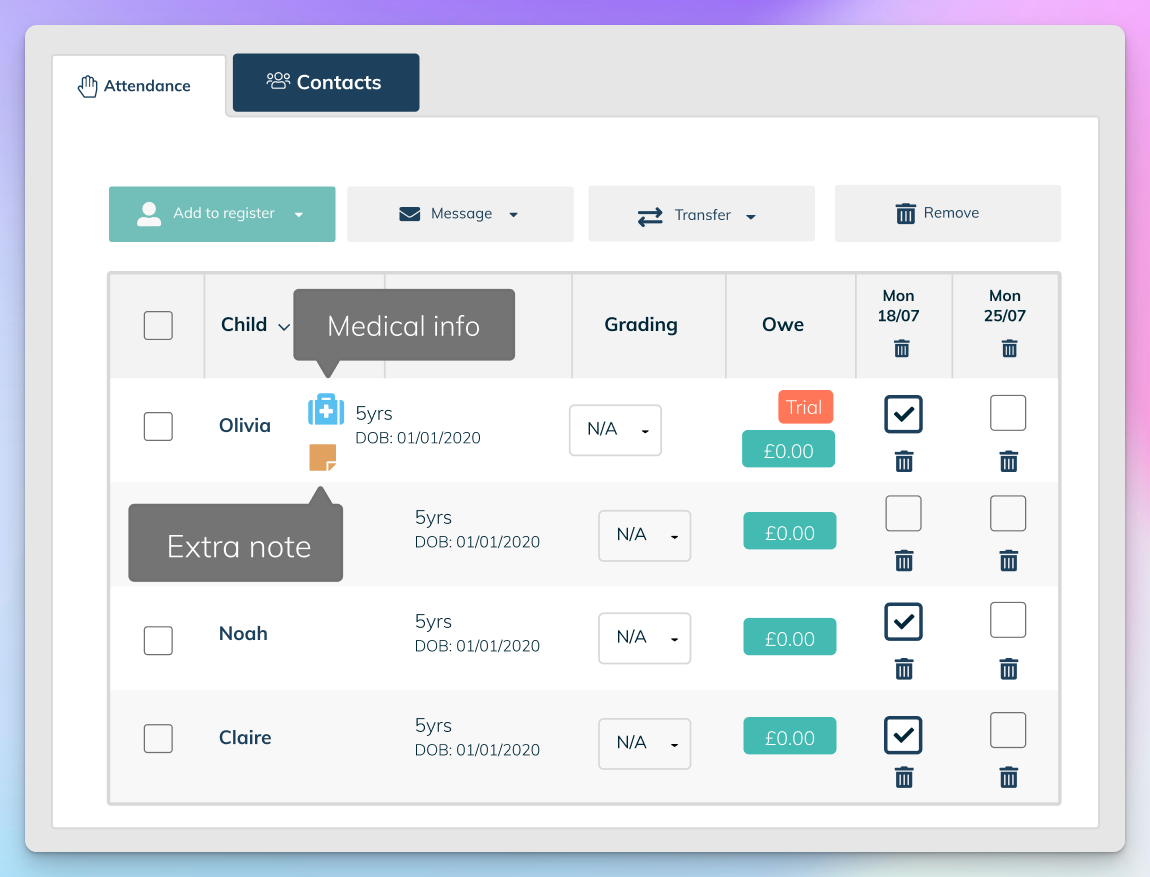
Pricing: Year-Round starts at £34.99 a month, with two months free if you pay annually, and includes unlimited users, parents, children and venues, unlimited emails, free onboarding and a free Discovery Site listing. The transaction fee is advertised as from 2.5% including Stripe, and from 1.5% on Enterprise and Franchise plans quoted on request, but the pricing page marks both figures as estimates: "Final fees are calculated based on your revenue and the volume of online payments processed through the platform and will be confirmed by your Account Manager." Until the 2026 pricing page, no percentage was published at all. The rates clubs have disclosed are higher. One football school's parent FAQ states that as of January 2024 "Class4Kids platform fees are 3.1%, and Stripe fees are 1.5% + 20p", and the Trustpilot reviewer above was told clubs sit on 2.7%, 3.7% or 4.7%. Camps Only is £120 a year, pay as you go. Paid SMS costs 6p a text, invoice texts are free, and payouts land three days after processing. Recurring subscriptions are reported to carry roughly 0.5% extra via Stripe Billing, which is not on the public pricing page. A free trial is offered but its length is not published, and no minimum term is advertised. Pricing checked September 2026. The company also describes itself as the only ISO-certified booking software designed for kids' clubs; we could not independently verify that, so treat it as their claim.
What is Pebble?
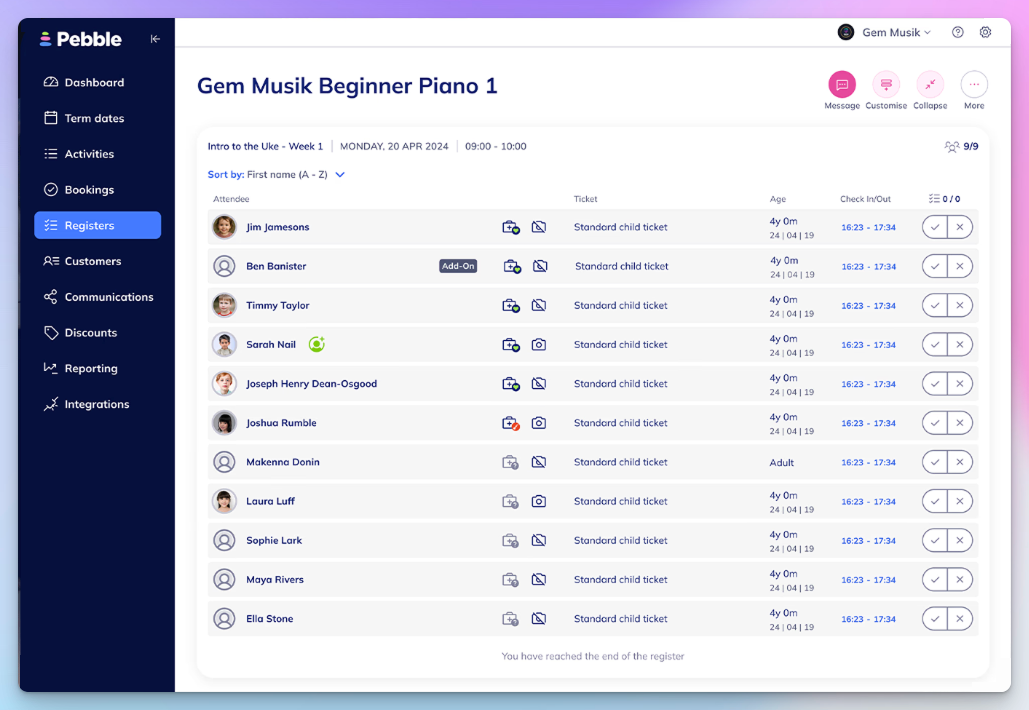
Pebble is a younger UK platform for children's activity providers, covering classes, camps, nurseries and franchises. It is two-sided by design: a parent marketplace where families find and book activities, with the provider software sitting behind it. The company claims 1,000+ activity providers and describes thousands of parents finding activities through it each week.
Where Pebble is strong:
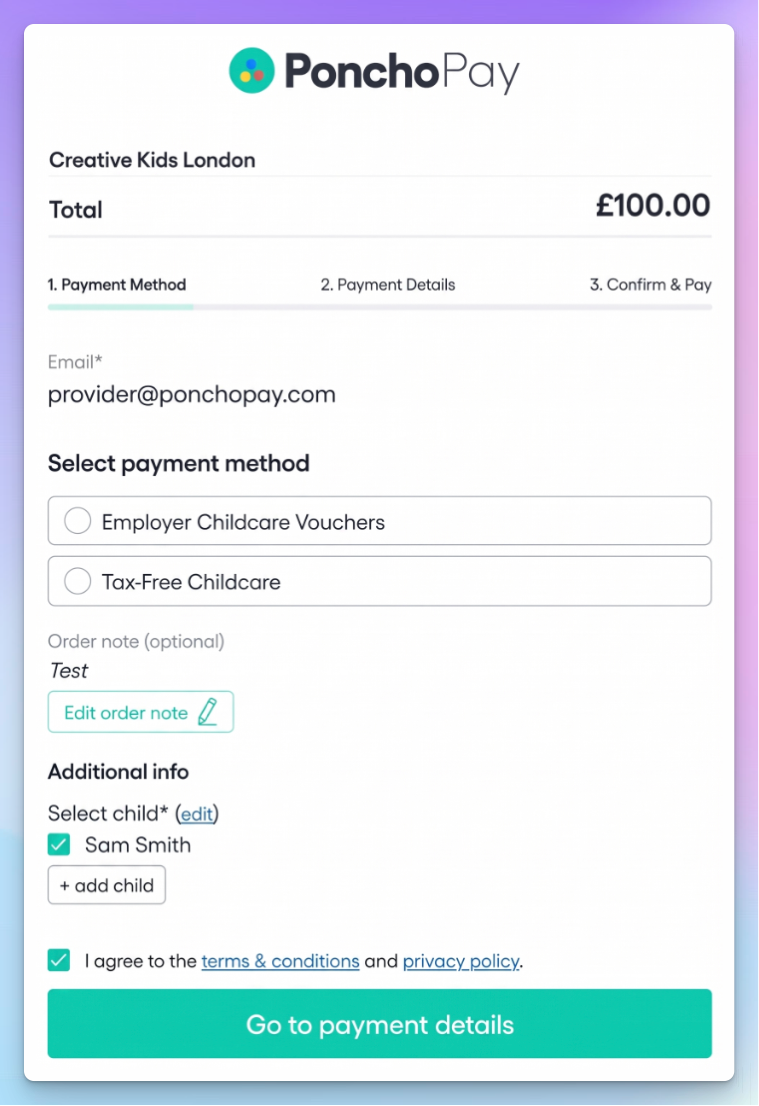
- Childcare funding is handled inside the checkout. Through its PonchoPay integration, parents pay with Tax-Free Childcare or childcare vouchers as a checkout option, and Tax-Free Childcare Express can settle instantly where the provider is already on the parent's TFC account with funds available. Setup takes about a week, voucher money typically lands in two to four working days, and it is restricted to Ofsted-registered providers.
- WhatsApp is included in provider comms alongside email, at no extra cost, with automated confirmations and reminders.
- Re-enrolment gets specific praise from providers, not just general approval: "The re-enrolment function is absolutely fantastic! There are a wealth of functions that really cut down on my admin time" (Amy Archer, April 2026), "Admin time has been cut down significantly and communication with parents has been very smooth" (Kyle Patrick Scanlon, July 2026).
- The team visibly ships what providers ask for. "The support from the team has been excellent. They have listened to our requests and already implemented changes" (Susie Everett, June 2025), "The Pebble team are proactive, forward-thinking, and genuinely committed to continuous improvement" (David Smith, Complete Cricket, November 2025).
- Franchise and multi-site reporting is called out by a franchisor: "Pebble also provides fantastic visibility across the network. It allows me to easily monitor how each site is performing" (Ole Spanish For Everyone, March 2026).
- Booking shapes cover online or in-person classes, single sessions, terms or blocks and subscriptions, with mobile-optimised digital registers, medical and photo consent capture, custom questions, sibling-discount ticket types and unlimited website integrations so you can sell from your own site. Holiday camps have a documented setup flow with cloning for repeat seasons.
Where users struggle:
- No self-service cancellation, and money continuing to move after cancellation, is the most serious one-star theme, and it hits providers as well as parents. "After cancelling my subscription, they continued to withdraw funds from my account without any explanation" (Hannah, a provider, February 2025), "There is also no mechanism to actually cancel a subscription" (Kieron Cooke, a parent, August 2026).
- Aftercare is inconsistent rather than uniformly bad, on a small sample: "The customer service is shocking! There is no aftercare and nothing is actioned" (Margaux Wild, March 2025) sits directly against the five-star support reviews above.
- The basket is click-heavy for parents booking several things at once: "The Pebble basket system doesn't work for multiple activities... requires me to check out 4 times, with a minimum of 31 clicks each time. That's 124 clicks" (Emma Scanlan, a parent, November 2025). That matters for camps and wraparound care, where a parent is often booking multiple sessions or siblings.
- There is effectively no software-review-site evidence to cross-check Trustpilot against. Pebble's Capterra and GetApp listings carry a single review, and that review is about PebblePad, an unrelated product. Trustpilot is the only real sample.
- We could not find published documentation for waiting lists on full sessions, a provider or parent mobile app, or a reporting suite beyond "clear reporting". That is an absence of documentation rather than proof of absence, so put it on your demo list.
Pricing: Core is £35 a month paid month to month, or £25 a month (£300 across the year) on the annual option, with a 3% per-booking fee plus VAT either way. It includes direct bookings via the Pebble marketplace, website booking processing, selected promo campaigns, four annual webinars and review access. Premium is £45 a month, or £35 on the annual option, with a 2.5% per-booking fee plus VAT, adding in-depth guided onboarding, preferential marketing support and custom branding. The pricing page opens on the annual view, so £25 and £35 are the numbers you see first, and they carry a "*Full year commitment" footnote that the monthly prices do not. Stripe card fees are charged separately, through your own connected Stripe account, so budget for Stripe's UK rates on top of the per-booking fee. Payouts reach your Stripe account on the day the parent pays and are available after three working days. The free trial is seven days with no card required, bookended by a set-up call and a review call. Pricing checked September 2026.
ClassForKids vs Pebble: which is better for your club?
Class, term and camp management
ClassForKids is organised around the shape of a UK club's year. Term blocks, holiday camps, drop-ins, memberships and subscriptions all exist as distinct things you sell, with capacity limits, documented waiting lists, multi-venue support and staff permission levels for franchises. The Camps Only plan at £120 a year is a genuinely useful product for a provider who trades eight weeks a year.
Pebble covers online or in-person classes, single sessions, terms or blocks and subscriptions, and its holiday-camp setup is documented step by step, including cloning a camp for the next season. Its re-enrolment flow is the thing providers name unprompted in reviews, and it is a real answer to the most tedious job in a term-based club.
The gap that bites is waiting lists. ClassForKids documents them across its plans; we could not find published Pebble documentation for holding parents in a queue on a full session and pulling them in when a place opens. For an oversubscribed swim school or gymnastics club, that queue is revenue, not a nicety.
Edge: ClassForKids for broader documented coverage of the club year, with Pebble's re-enrolment the honest counterpoint.
Registers, safeguarding and parent records
ClassForKids registers update as bookings arrive, and carry medical notes, allergies, emergency contacts and photo consent, with the register itself customisable. The company positions security heavily, describing itself as the only ISO-certified booking software built for kids' clubs, which we could not verify independently.
Pebble's registers are mobile-optimised for use at the door, and capture medical details plus photography and marketing consent, with custom questions so you can collect whatever your setting needs.
Both cover the safeguarding basics a UK club needs to hand a coach at the start of a session. The difference is depth of published documentation rather than a feature either side is missing, and ClassForKids has more of it. The one real limitation on record is dated: 2021 Capterra reviewers complained that "the system only allows for one main email contact per child", which matters for separated families, and reviewers also wanted notes on register pages. Check whether both still apply.
Edge: ClassForKids, narrowly, on documentation depth and security positioning.
Payments, childcare funding and parent self-service
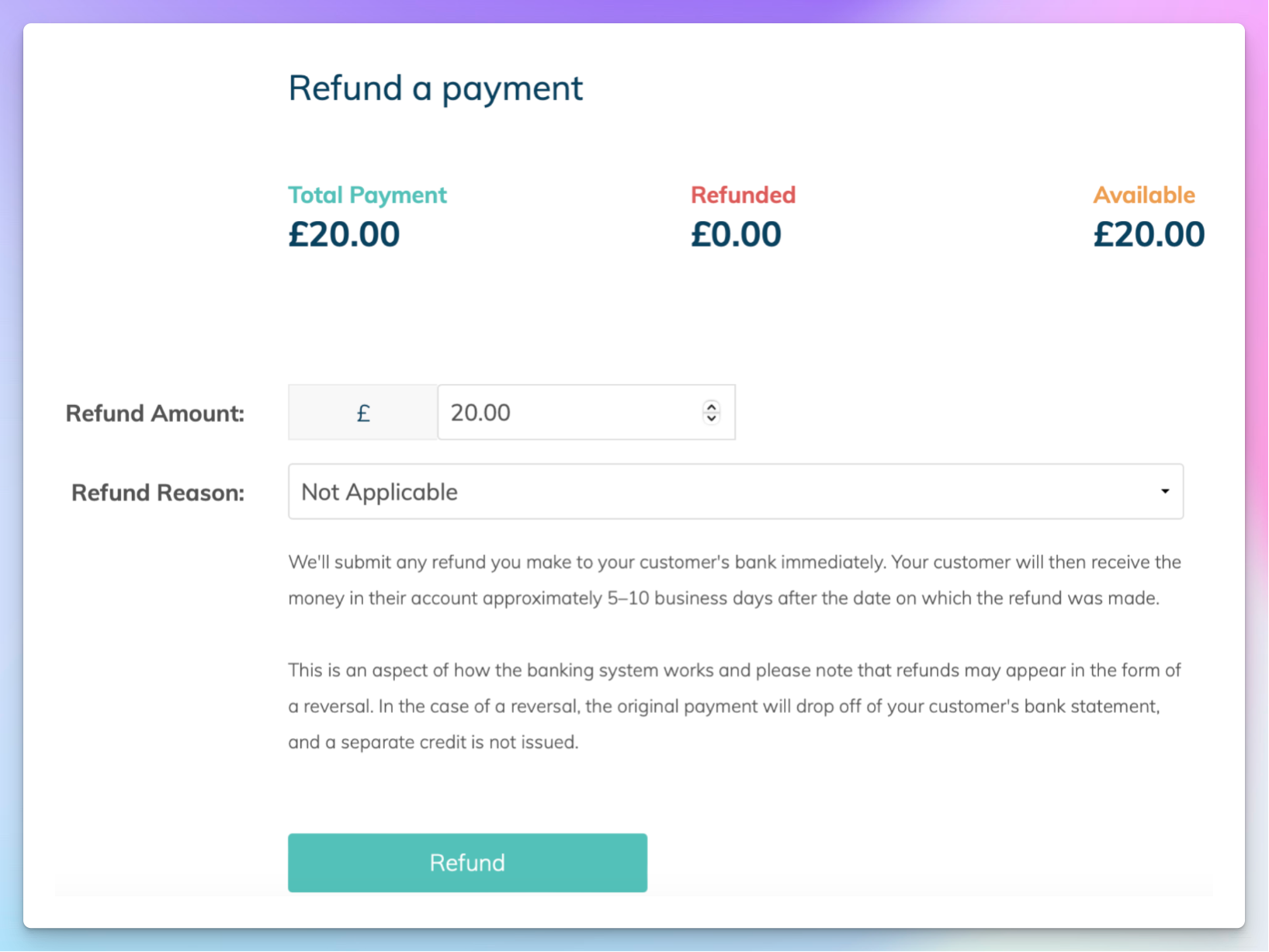
ClassForKids bundles everything into one fee: processing, platform access, data storage, emails, texts and subscriptions in a single rate advertised as from 2.5%, with the actual rate set per club. Payouts land three days after processing, failed payments retry automatically, and the company's FAQ is explicit that you can absorb the fee or pass it to parents. Childcare vouchers are the weak point. Their help centre confirms vouchers can be recorded as paid but "must be managed outside of the system", and the documented workaround is a 100% discount code at checkout followed by manually restoring the invoice amount, with discount codes only usable on public booking-page bookings.
Pebble takes the opposite approach. Stripe and Klarna handle cards, and PonchoPay puts Tax-Free Childcare and childcare vouchers in the checkout as a parent-facing payment option, with TFC Express settling instantly in the right conditions. The trade-off is that the per-booking fee sits on top of Stripe's own fees rather than including them, and parents booking several activities have to check out separately for each.
The failure mode both tools share is the one that costs you time. In both review sets, parents report being unable to cancel a recurring payment or remove a saved card themselves: "No way to cancel the recurring payments with them so they kept trying to take my money even after i'd cancelled" on one side, "you cannot delete it and they have automatic payments" on the other. Whichever you pick, your inbox is the escalation path.
Edge: split by scenario. Pebble for wraparound care and holiday camps taking significant Tax-Free Childcare and voucher payments. ClassForKids for term-fee and subscription clubs that need failed-payment recovery and the option to pass the fee to parents.
Getting found: marketplace reach
ClassForKids includes a free listing on its Discovery Site with every Year-Round licence, and claims more than a million parents using it alongside 4,500+ clubs. It pairs that with Meta Pixel tracking and retention tools aimed at converting and keeping those parents.
Pebble's marketplace is the front door of the whole company rather than an add-on, but it is smaller: 1,000+ providers and "thousands of parents" a week on the company's own numbers. Core includes selected promo campaigns, and Premium adds preferential marketing support.
Both figures are vendor-claimed and neither company publishes data on bookings actually generated for providers. Treat marketplace reach as a bonus on top of your own marketing, not a business plan. On claimed scale alone, though, the difference is not close.
Edge: ClassForKids, on a substantially larger claimed parent audience.
Support and onboarding
Onboarding is the top five-star theme for both. ClassForKids gives you a named account manager, free with the licence, and reviewers repeatedly credit that person by name: "Colin was a real star from start to finish" (Nippon Club London, September 2026). Pebble's guided setup gets similar praise, with the added note that the team acts on feature requests: "The team have really gone above and beyond to onboard us and are always available when support is required" (Chris Webb-Butler, November 2025).
Post-onboarding support is also the top one-star theme for both, which is the honest headline of this dimension. ClassForKids: "they bill us monthly for a product that they don't support" (June 2026). Pebble: "There is no aftercare and nothing is actioned" (March 2025).
What separates them is the evidence base. ClassForKids carries 4.5 from 119 Trustpilot reviews with 14% at one star, and a recent, dense run of positive onboarding reviews. Pebble carries 4.0 from 81 with 8% at one star, but that score sits oddly against an 85% five-star share, which suggests Trustpilot's recency weighting is pulling it down. Pebble also has no usable software-review-site sample to cross-check against, so you are relying on one source.
Edge: ClassForKids, narrowly, on volume, recency and the named-account-manager model. Be clear-eyed that support thinning out after setup is a live complaint about both.
Pricing, fees and lock-in
Headline prices flatter both, in different ways. ClassForKids is £34.99 a month with a transaction fee advertised as from 2.5% including card processing, but its own pricing page calls that figure an estimate, to be confirmed by your account manager against your revenue and online volume. The rates clubs have actually disclosed are higher: a football school's parent FAQ lists a 3.1% platform fee with Stripe's 1.5% + 20p on top as of January 2024, and a January 2026 Trustpilot reviewer was told clubs sit on 2.7%, 3.7% or 4.7%. Pebble's pricing page opens on £25 or £35 a month, but those are the full-year-commitment prices; paid month to month, which is the like-for-like comparison with ClassForKids' £34.99, the same plans are £35 and £45. On top sits a fixed 3% or 2.5% per-booking fee plus VAT, and then Stripe's UK rates, currently 1.5% + 20p for standard UK cards on Stripe's published standard pricing.
Here is what that looks like for a club processing £2,000 a month online, across 50 bookings averaging £40, with every licence at its month-to-month price. ClassForKids appears twice: once at its advertised rate and once at the rate a club has documented paying. Illustrative, ex-VAT, and your mix of card types will move it.
| Monthly licence | Booking fee | Card processing | Rough monthly total | |
|---|---|---|---|---|
| ClassForKids Year-Round, advertised rate | £34.99 | 2.5% = £50 (estimate) | included in the 2.5% | ~£85 |
| ClassForKids Year-Round, documented rate | £34.99 | 3.1% = £62 | ~£40 via Stripe | ~£137 |
| Pebble Premium | £45 | 2.5% = £50 | ~£40 via Stripe | ~£135 |
| Pebble Core | £35 | 3% = £60 | ~£40 via Stripe | ~£135 |
Your club is not on those exact numbers, so put your own in. The ClassForKids selector covers the advertised figure and the rates clubs have disclosed, or choose "your quoted rate" and type what the account manager gave you. Switch the licence to annual to see the committed prices.
| Software | Licence | Platform fee | Card processing | A month | A year |
|---|---|---|---|---|---|
ClassForKids Year-Round £85 a month Rate confirmed per club by an account manager. Reported tiers are treated like the documented rate, with Stripe on top. Excludes the ~0.5% Stripe Billing surcharge on recurring subscriptions. | £34.99 | £502.5% incl. cards | included | £85 | £1,020 |
Pebble Core £135 a month 3% per booking, quoted plus VAT Annual price needs a full-year commitment. | £35 | £603% | £40 | £135 | £1,620 |
Pebble Premium £135 a month 2.5% per booking, quoted plus VAT Annual price needs a full-year commitment. | £45 | £502.5% | £40 | £135 | £1,620 |
Pembee Standard £82 a month 0.59% application fee Two months free paid annually. No contract. | £30 | £120.59% | £40 | £82 | £982 |
Annual billing moves every row by about the same amount. Commit to a year with Pebble and each row drops by £10, to roughly £125. Pay ClassForKids annually and its two months free takes the licence to about £29 a month, so around £79 at the advertised rate and around £131 at the documented one.
Two caveats in ClassForKids' direction and one in Pebble's. Both ClassForKids figures exclude the extra 0.5% on recurring subscriptions via Stripe Billing, which its help centre says cannot be passed on to parents and which is not on the public pricing page, and neither its page nor the club disclosures state VAT treatment on the platform fee. Pebble's per-booking fee is quoted plus VAT, and every figure here is ex-VAT, which is the right basis if your club is VAT-registered. If it is not, add 20% to Pebble's fee column. For reference, our own fee structure is a 0.59% application fee on Stripe payments on top of a flat licence, which on the same £2,000 is about £12 in platform fees; more on that below.
Lock-in is closer than Pebble's pricing page first suggests. ClassForKids does not publish a minimum term on its pricing page. Pebble's "*Full year commitment" footnote belongs to the annual prices: switch the toggle to monthly and it disappears, which squares with the "no contracts and no exit fees" line elsewhere on its site. So the real choice with Pebble is £10 a month more for the freedom to leave, or a 12-month tie-in for the headline price. Whichever you take, get the term in writing before you sign, and with ClassForKids get your exact transaction rate, and whether it includes Stripe, in writing too.
Edge: too close to call on the evidence. At its advertised 2.5%, ClassForKids is about £50 a month cheaper on this example. At the rates clubs have documented, the two are within a few pounds of each other and could go either way once your actual quote is known. ClassForKids' advantage is that a larger club can negotiate the rate down. Pebble's is that its fee is fixed and published, so the bill you model is the bill you get.
The verdict
This is a lopsided matchup on features and it would be dishonest to dress it up. ClassForKids took class and camp management, registers, marketplace reach and support. Pricing, which looks like a clear ClassForKids win on its advertised rate, is too close to call once you use the rates clubs report actually paying. Pebble did not take a dimension outright.
Choose ClassForKids if you run a term-based club of any size and want documented waiting lists, free account-managed onboarding and the biggest parent audience on offer, and you get your transaction rate confirmed in writing before you sign. If you only run holiday clubs, the £120-a-year Camps Only plan settles it on its own.
Choose Pebble for one specific reason: Tax-Free Childcare and childcare vouchers inside the checkout. If you are an Ofsted-registered wraparound or holiday-camp provider and a real share of your income arrives as childcare funding, Pebble removes an admin job that ClassForKids asks you to do by hand every single time. WhatsApp comms at no extra cost and network-level reporting for franchisors are genuine secondary reasons.
Switching between them is not free in either direction. Saved card details do not transfer between platforms, so every family has to re-enter payment details and re-authorise recurring payments, and that is where you lose people, not in the data export. Moving to ClassForKids is the easier of the two: onboarding is included in the licence and switchers describe it as guided ("Our switch over to C4K has been easy and the system is so simple to use", August 2026). Moving to Pebble, guided onboarding sits on the Premium plan (£45 month to month, £35 on a year's commitment), and if you take the annual price you want to time the move to the start of your busiest term, not the middle of it. If you are mid-year and the current tool mostly works, waiting is usually the right call.
If you read both columns thinking neither of these is really how your club fills its classes, the next section is for you.
The third option: what if neither fits?
Both of these are marketplace-first platforms that take a percentage of every payment you process and own the parent's account. That works if the marketplace is bringing you families. If your bookings already come from your own website, your school partnerships and word of mouth, you are paying a revenue share for demand you did not need, and you are still fielding the billing problems the platform will not let parents fix themselves. That second point is the strongest evidence in both review sets: parents on both tools report being unable to cancel a recurring payment or remove a card, and both of them are told to contact the club.
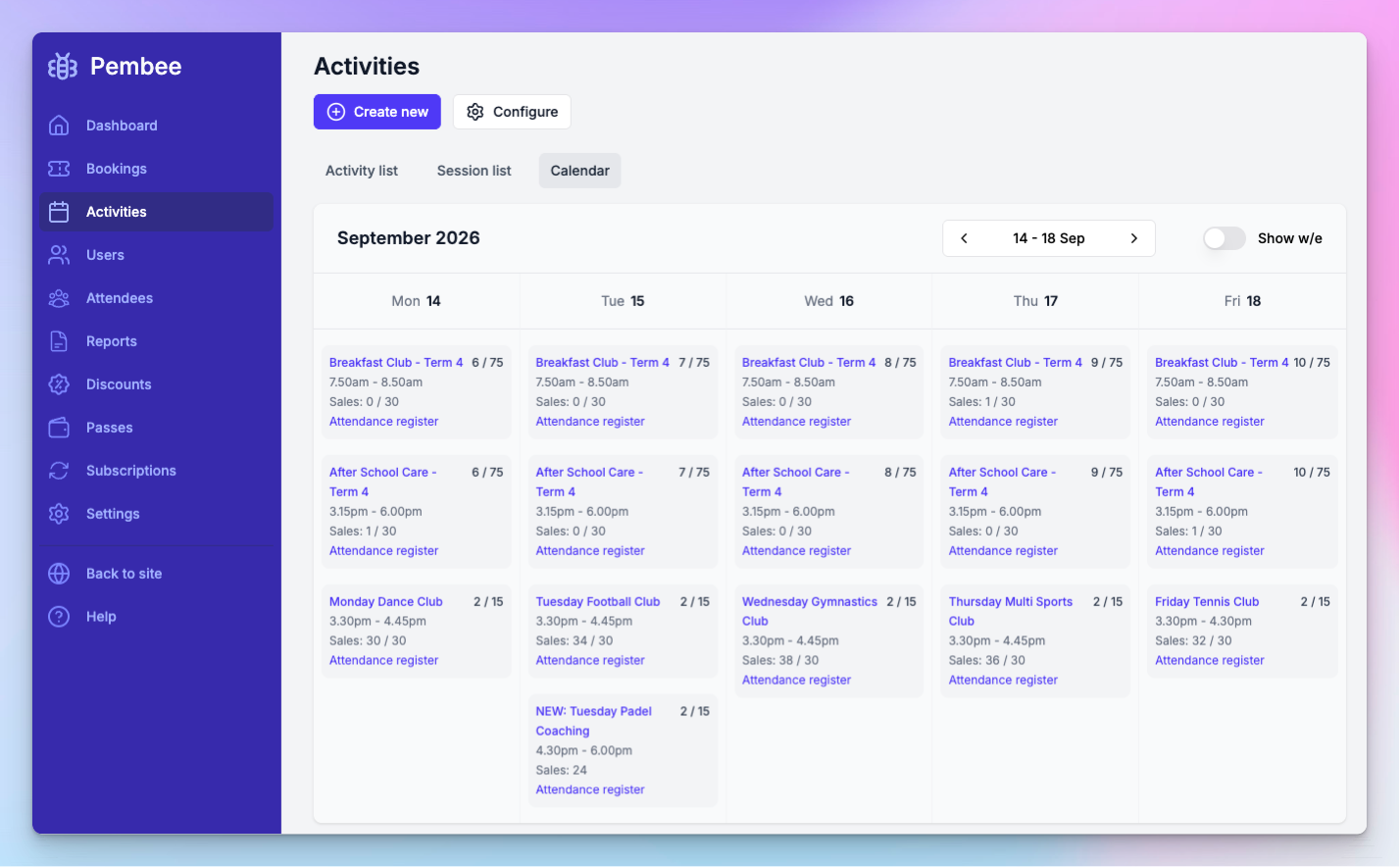
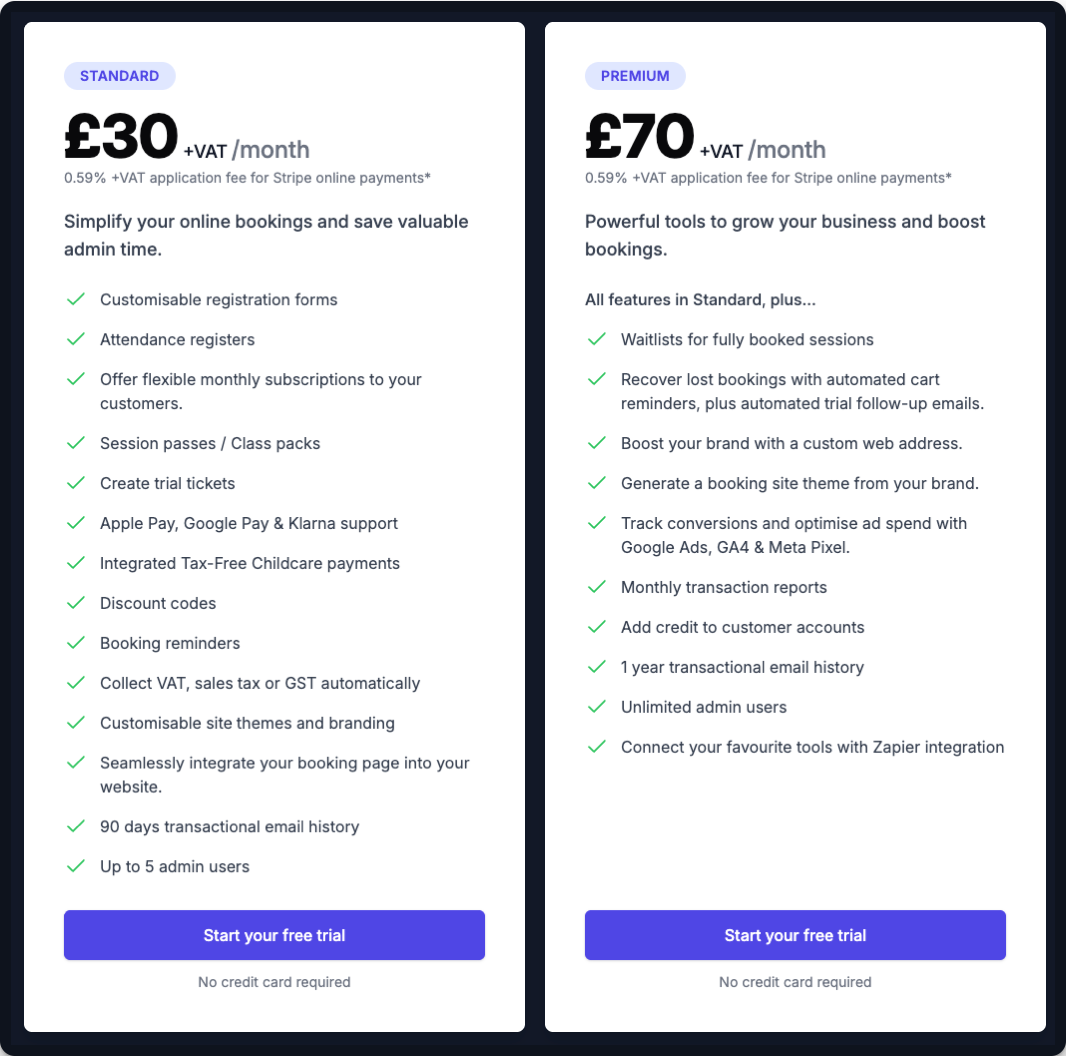
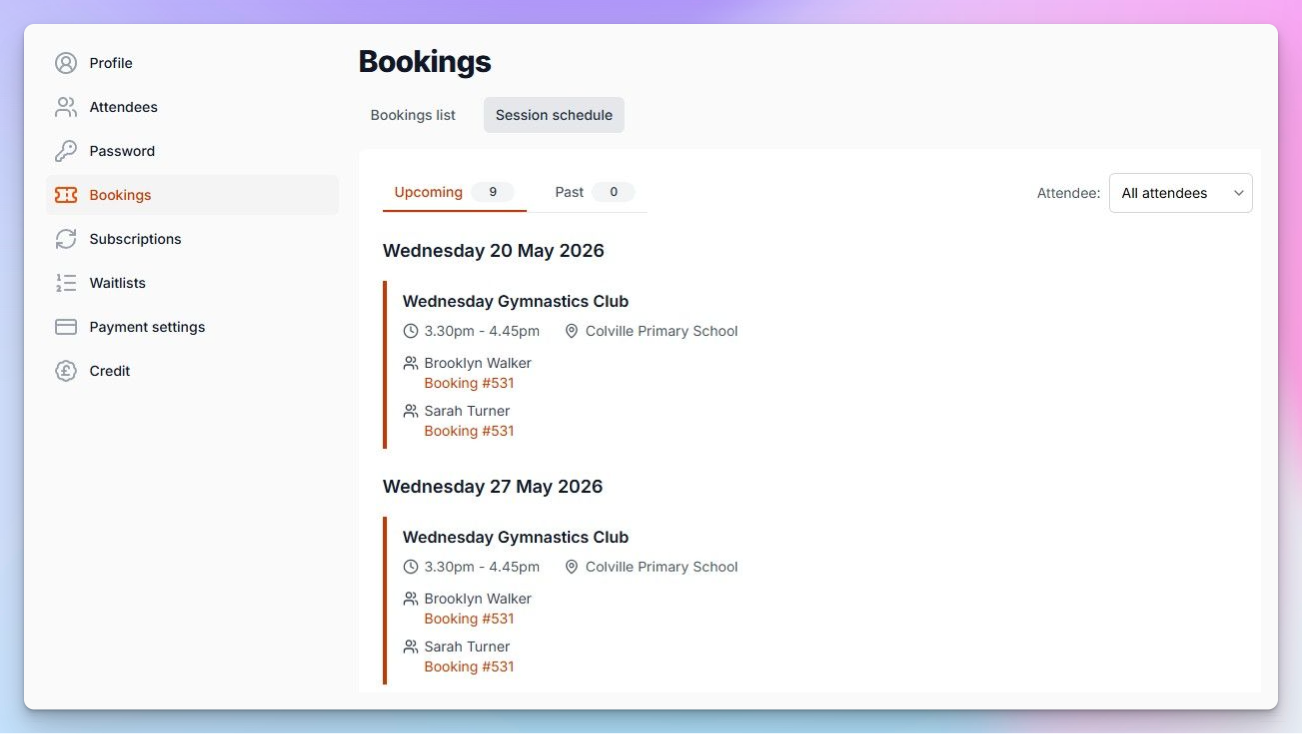
We built Pembee for that provider. Our pricing is a flat monthly licence with a 0.59% application fee on Stripe payments, not a slice of your takings, so a good term costs you the same as a quiet one. You sell from your own booking pages, embedded in your own site with your own branding, so the parent relationship stays yours. Tax-Free Childcare is integrated for all UK users, with parents paying from their TFC account during checkout at no additional transaction fee and the full amount reaching you, and childcare vouchers are supported as an offline payment method at checkout. Registers, registration forms, monthly subscriptions, session passes, trial tickets, discount codes, booking reminders and automatic VAT handling come as standard, and Premium adds waitlists on full sessions, basket-abandonment and trial follow-up emails, conversion tracking and Zapier.
Pricing: Standard is £30 a month and Premium is £70 a month, both with two months free paid annually, plus the 0.59% application fee on Stripe online payments and Stripe's own processing fees. On the same £2,000-a-month example above, that comes to roughly £82 all in on Standard. There is a 30-day free trial with no card required, and no contract. Pricing checked September 2026.
Where ClassForKids or Pebble still beats us:
- Neither we nor anyone else can hand you ClassForKids' Discovery Site. It claims over a million parents, we have no consumer marketplace at all, and if new-customer discovery is the job you are hiring software to do, that is a real reason to pick them.
- We do not have a dedicated parent mobile app, and it is the most consistent request in our own reviews. Parents book and manage through the browser. In this matchup it is a smaller gap than it sounds: we could not find a parent app for Pebble either, and ClassForKids' one sits at 1.9 stars on the App Store with a long run of login complaints.
- Our integrations catalogue is smaller, and Zapier sits on the Premium plan rather than Standard.
- There is no seasonal-only price point to match ClassForKids' £120-a-year Camps Only plan, so a holiday-only provider will pay more with us across a year.
- Our review base is much smaller: 23 Capterra reviews against ClassForKids' hundreds across Trustpilot and Capterra. Fewer reviews means less for you to cross-check.
Switching: most clubs move between terms, bringing across their class structure and customer list and opening bookings for the next term rather than migrating mid-block. The 30-day trial is long enough to build your real timetable and take live bookings before you commit, and we help with setup during it. Card details cannot be migrated from either platform, so plan the parent comms for re-authorising payments the same way you would for any switch.
What users say: we hold 4.9 from 23 reviews on Capterra, with 4.9 for ease of use, 5.0 for customer service and 5.0 for value. "Pembee is very easy to use and the customer support is very accessible" (Rebecca S., principal, March 2026); "It's incredibly easy to use on our end and it covers everything we have needed to run our programs successfully" (Courtney O., founder, April 2026). The fairest criticism in that set is specific: a reviewer in July 2025 flagged that the register is fixed to sort by surname. Our Trustpilot profile has no reviews on it, so Capterra is the only sample worth pointing you at.
You can see the full breakdown on our pricing page, or read how we stack up in our ClassForKids comparison and our roundup of ClassForKids alternatives.
If you run a term-based UK club and want the fullest feature set with the biggest parent audience attached, ClassForKids is the pick, once you have your transaction rate in writing. If you are Ofsted-registered and a serious share of your income arrives as Tax-Free Childcare or childcare vouchers, Pebble earns its higher total cost by taking that reconciliation off your desk.
If you already fill your classes yourself, neither marketplace is worth a percentage of every payment. That is the case we built for, whether you run an after-school or wraparound club, holiday camps or a gymnastics club.
FAQs
Is ClassForKids better than Pebble?
For most UK kids' clubs, yes. ClassForKids documents waiting lists, includes account-managed onboarding, and has a far larger claimed parent audience on its Discovery Site. On price the two are closer than ClassForKids' advertised 2.5% suggests, because that figure is an estimate set per club and clubs have reported paying 3.1% plus Stripe or more. Pebble wins in one specific case: Ofsted-registered providers taking significant Tax-Free Childcare or childcare voucher payments, which Pebble handles inside the checkout.
How much does ClassForKids cost?
The Year-Round plan starts at £34.99 a month, with two months free if you pay annually, plus a transaction fee advertised as from 2.5% including Stripe card processing. That figure is marked as an estimate on the pricing page and the final rate is confirmed per club by an account manager. Clubs have publicly reported paying a 3.1% platform fee plus Stripe's 1.5% + 20p (January 2024) and rates between 2.7% and 4.7% (January 2026). Enterprise and Franchise plans are quoted on request with fees from 1.5%. A Camps Only plan is £120 a year, pay as you go. Paid SMS costs 6p a text. Pricing checked September 2026.
How much does Pebble cost?
Paid month to month, Core is £35 a month with a 3% per-booking fee plus VAT, and Premium is £45 a month with a 2.5% per-booking fee plus VAT. Commit to a full year and those drop to £25 and £35 a month, which are the prices Pebble's pricing page shows by default. Stripe's card fees are charged separately on top, currently 1.5% + 20p for standard UK cards on Stripe's published standard pricing. Pricing checked September 2026.
Can parents pay with Tax-Free Childcare or childcare vouchers?
With Pebble, yes, through its PonchoPay integration, as a payment option in the checkout for Ofsted-registered providers. With ClassForKids, vouchers can be recorded against an order but the company's help centre states the processing and reconciliation happen outside the system, using a 100% discount code and a manual correction afterwards. Our [guide to accepting Tax-Free Childcare payments](/blog/how-to-accept-tax-free-childcare-payments) explains how the scheme works either way.
Am I tied into a contract with either?
ClassForKids does not publish a minimum term on its public pricing page, though it does not publish a free trial length either. Pebble gives you the choice: its £25 and £35 annual prices carry a "*Full year commitment" footnote, while the £35 and £45 month-to-month prices do not, in line with the "no contracts and no exit fees" copy elsewhere on its site. Either way, ask for the term in writing before you sign anything.
Who owns ClassForKids?
The Access Group, a large UK business-software provider, acquired ClassForKids in February 2023 and placed it in its Non-Profit and Education division. ClassForKids still trades under its own brand. Pebble is operated by Sprout Care Ltd.
Do ClassForKids and Pebble have mobile apps?
ClassForKids has a parent app for checking schedules and marking absences, but it is rated 1.9 from 44 ratings on the UK App Store, was last updated in November 2024, and most recent reviews report being unable to log in. We could not find a parent or provider app for Pebble; its registers are mobile-optimised for the browser instead. We do not have a parent app either, and parents book and manage through the browser.
What is the best alternative to ClassForKids and Pebble?
If your classes fill from your own website, school partnerships and word of mouth, a platform that charges a percentage of every payment to fund a marketplace is the wrong shape. We built Pembee for that: a flat £30 or £70 a month with a 0.59% application fee on Stripe payments, your own branded booking pages, integrated Tax-Free Childcare at no extra transaction fee, a 30-day free trial and no contract. We have no consumer marketplace, so if discovery is what you need, ClassForKids is the stronger choice.