


The recital venue wants a certificate of insurance by Friday. Your landlord's lease asks for $1 million per occurrence and $2 million aggregate. And in Tuesday's acro class, a nine-year-old just landed badly out of a cartwheel. Dance looks gentle from the lobby, but turned ankles, pulled hamstrings and lift accidents happen every week, so dance studio insurance is what stops one bad landing from becoming a lawsuit you can't afford.
Most dance studios need general liability, professional liability, participant accident medical and property coverage, plus workers' compensation once you hire employees and abuse and molestation coverage if you teach children. A complete policy for a small to mid-sized studio typically costs about $475 to $2,500 a year.
We're not insurance brokers, and this isn't legal or insurance advice. We build booking and registration software for dance studios, and this guide is what we've learned from working with them, checked against insurers' published terms. It covers each policy, real rate-card math, how to insure your recital, the style-by-style exclusions to check, and what to do when a dancer gets hurt.
Do you need insurance to run a dance studio?
No federal law says you must carry liability insurance to teach dance. In practice, you can't open without it.
- Landlords require it. Commercial leases set minimum limits, usually $1 million per occurrence and $2 million aggregate, and ask to be named as an additional insured.
- Venues require it. Schools, churches and community centers you rent hours from, and the theater you book for your recital, will want a certificate of insurance (COI) before you set foot on their floor.
- States require workers' comp. Once you have employees, most states make workers' compensation mandatory. It's the one policy the law actually requires, and we cover the state rules below.
That applies whether you lease a studio, rent hours in a church hall or teach from home. A venue's policy protects the venue, not you, and a homeowner's policy won't cover paying students. We cover each setup below.
Studio policy or instructor policy?
This is the first decision, and the one new owners get wrong most often. An instructor policy covers one teacher's own teaching. Insurance Canopy, for example, offers dance instructor cover starting at around $15 a month. It doesn't cover the facility, your employees or anyone else who teaches for you. A studio policy covers the business itself: the premises, the staff, the students and the events you run.
If your teachers are independent contractors, check whether your studio policy covers them at all. Many don't. DanceStudioInsurance.com's studio program, for instance, excludes independent contractor instructors from the base coverage and adds them for a fee that starts at $50. You have two options:
- Add contractors to your policy where the insurer allows it.
- Require each contractor to carry their own policy and name your studio as an additional insured. Collect the certificate before their first class, and put the expiration date on your calendar.
The same rule applies to guest choreographers, master-class teachers and anyone who runs a one-off workshop in your space. No certificate, no class.
The types of dance studio insurance
Here's what each policy does and who needs it.
| Policy | What it covers | Dance studio example | Who needs it |
|---|---|---|---|
| General liability | Injury or property damage to third parties, personal and advertising injury | A parent trips over a costume rack in the lobby | Every studio |
| Professional liability | Claims that your instruction or supervision caused an injury | A student says a teacher forced a stretch that tore her hamstring | Every studio |
| Participant accident medical | Dancers' medical bills after an injury, regardless of fault | A teen sprains an ankle landing a leap | Every studio |
| Property and equipment | Mirrors, barres, floors, sound system, costumes, lost income after a closure | A burst pipe warps the sprung floor | Studios with their own space or gear |
| Workers' compensation | Staff injuries at work, lost wages | A teacher injures a knee demonstrating a jump | Studios with employees (state rules vary) |
| Abuse and molestation | Defense and liability for abuse allegations | An allegation against a staff member or volunteer | Any studio teaching minors |
General liability
General liability covers bodily injury and property damage to people who aren't taking part in class: a parent in the viewing area, a sibling who slips on a wet floor, a delivery driver who trips on a stack of recital props. It also covers personal and advertising injury, such as a claim that your social post used someone's photo without permission.
The standard limit is $1 million per occurrence and $2 million aggregate. Insureon's customer data puts the median general liability premium for dance studios at $55 a month ($654 a year), with a $250 deductible.
One catch matters more than any other: some generic small-business and fitness policies exclude injuries to participants, meaning the people taking the class. That leaves you covered for the parent in the lobby and exposed for the dancer in the room. Dance-specific programs exist for exactly this reason. Before you compare prices, get written confirmation that injuries to students during class are covered.
Professional liability
Professional liability answers claims about how you teach. A teacher pushes a student's leg past her range in a stretch and tears a hamstring. A partner lift is taught without a spotter. A dancer is moved up to pointe before her ankles are ready. These are negligence claims about instruction, and a policy that only covers slips and falls in the lobby won't answer them.
On dance programs it's often bundled in. Sadler's dance program lists professional liability as automatically included. Bought separately, Insureon's median is $42 a month ($500 a year) for a $1 million per occurrence and $1 million aggregate limit. If a quote doesn't mention professional liability or "liability to participants" by name, ask.
Participant accident medical
Accident medical pays a dancer's medical bills after an injury, whoever was at fault. A family facing an urgent-care bill and an orthopedic follow-up for a fractured toe is far less likely to call a lawyer if your policy picks up what their health plan doesn't.
It's usually written as excess coverage, meaning it pays after the family's own health insurance. Published examples show how much limits vary:
- BKR's dance program includes a $100,000 accident medical benefit with a $100 deductible, plus an optional $5,000 spectator medical benefit. The first expense must be incurred within 90 days of the accident.
- Sadler's dance program lists accident limits of $25,000 with a $250 deductible.
A $25,000 limit and a $100,000 limit can look identical on a quote summary. Check the number.
Property and equipment
Property coverage protects what you own or installed: wall mirrors, barres, a sprung floor and marley, the sound system, costumes and props, the front-desk computer. A sprung floor alone can run to five figures, so insure at replacement cost, not depreciated value.
Two details to check. First, property is often a separate purchase from your liability program. The Dance Studio Owners Association's insurance FAQ notes that mirrors and floors count as business personal property, so they fall under property coverage and its deductible, not your liability policy. Second, water damage is a common gap. One program's base plan excludes water and flood damage in every state except California, which matters a lot when your most expensive asset is a wooden floor.
If gear travels to recitals, competitions or school residencies (portable marley, speakers, costume trunks), ask for inland marine or equipment coverage, because standard property cover is usually tied to your address. Our dance class equipment list is a useful starting point for the inventory your insurer will ask for.
A business owner's policy (BOP) bundles general liability, property and business income coverage. Insureon's median BOP for dance studios is $121 a month ($1,447 a year). Business income is the part owners skip and regret: a fire or flood in May can wipe out recital ticket sales and summer intensive tuition while rent and payroll keep going out.
Workers' compensation
Workers' comp covers medical bills and lost wages when an employee gets hurt at work, such as the teacher who tears a knee demonstrating a grand jeté. Insureon's median for dance studios is $42 a month ($500 a year), but your premium depends on payroll and your state.
The Dance Studio Owners Association's FAQ is blunt on one point: most studio liability and accident policies do not satisfy your legal workers' comp requirement. They're separate products. Rules vary by state:
- California requires it from the first employee.
- New York requires it for almost every employer with staff, including part-timers.
- Florida requires it for non-construction businesses with four or more employees.
- Texas lets most private employers choose whether to carry it, with reporting duties if they opt out.
Paying teachers as 1099 contractors doesn't automatically take you outside the rules. A teacher who follows your syllabus, on your schedule, in your studio, can look like an employee to a state auditor, especially after an injury. Check your state labor department's guidance before you set up payroll.
Abuse and molestation coverage
Most dance studios teach children, and many teach mostly children. Abuse and molestation coverage (often called SAM) is commonly excluded from general liability and sold as a separate add-on. If you teach anyone under 18, treat it as essential.
Limits vary widely. DanceStudioInsurance.com lists a $100,000 abuse and molestation limit on one of its programs, so check the number on every quote and ask whether a higher limit is available. Ask whether the coverage pays claims or only legal defense costs.
Underwriters increasingly ask what you do to prevent abuse, so have answers ready: background checks on every adult who teaches or volunteers, a two-adult or open-door rule, written changing-room and quick-change policies, and photo and video consent collected at registration.
Optional coverage worth pricing
- Hired and non-owned auto: covers your liability when staff drive their own or rented vehicles on studio business. Sadler includes it automatically; many generic policies don't.
- Commercial auto: if the studio owns a van for competition travel. Insureon's median is $245 a month.
- Cyber: you store family payment details, birth dates and medical notes. Insureon's median is $129 a month.
- Excess or umbrella liability: for leases or venues that demand more than $1 million per occurrence.
- Event cancellation: if a big recital at a rented theater carries non-refundable costs.
One thing insurance won't handle: music licensing. Playing recorded music in classes and recitals usually needs licenses from performing rights organizations such as ASCAP and BMI. That's a separate cost, not a coverage question.
How much does dance studio insurance cost?
A complete dance studio program usually costs about $475 to $2,500 a year. At the low end, dance-specific programs publish starting prices: BKR's program has a $475 annual minimum, and DanceStudioInsurance.com says its studio policies start around $475 to $500. At the top end, a leased studio with staff buying a BOP, professional liability and workers' comp at Insureon's medians pays about $2,450 a year.
Instructor-only policies cost less, from around $15 a month.
Here are Insureon's median premiums for dance studios by policy:
| Policy | Median per month | Median per year | Typical limits |
|---|---|---|---|
| General liability | $55 | $654 | $1M per occurrence / $2M aggregate, $250 deductible |
| Business owner's policy (BOP) | $121 | $1,447 | $1M per occurrence / $2M aggregate, $500 deductible |
| Professional liability | $42 | $500 | $1M per occurrence / $1M aggregate, $500 deductible |
| Workers' compensation | $42 | $500 | Set by state law |
| Cyber | $129 | $1,552 | Varies |
| Commercial auto | $245 | $2,942 | Varies |
Insureon customer medians for dance studios, last updated May 2025.
You won't buy all six. Most studios buy a dance program (liability, professional and accident medical together) or a BOP plus professional liability, then add workers' comp and abuse coverage as needed.
What drives your premium
- Participant count: per-participant programs multiply your headcount by a rate.
- Styles taught: acro, aerial, pole and competitive lifts cost more or need separate approval.
- Share of under-18 students: more children usually means abuse coverage on top.
- Off-site activity: outside recital venues, competitions and tours.
- Owning or renting: your own space adds property and business income.
- Location, limits and deductible: higher-claim states and $2 million limits cost more.
- Payroll and claims history: payroll drives workers' comp; a clean record keeps renewals down.
A worked example using a published rate card
Most guides stop at ranges. Here's how the math works on a real rate card. When we checked in November 2026, BKR's dance schools and studios program charged $4.15 per person per year with a $475 minimum premium and a $10 administrative fee on every order. The base includes $1 million general liability, $100,000 accident medical with a $100 deductible, and a $100,000 accidental death and dismemberment benefit.
| Studio | Participants | Calculated premium | You pay (incl. $10 fee) |
|---|---|---|---|
| New studio renting hours | 40 | 40 × $4.15 = $166 | $485 (minimum applies) |
| Small leased studio | 110 | 110 × $4.15 = $456.50 | $485 (minimum applies) |
| Established studio | 250 | 250 × $4.15 = $1,037.50 | $1,047.50 |
| Large studio with a competition team | 400 | 400 × $4.15 = $1,660 | $1,670 |
This is illustrative, based on one program's published rates. It excludes property coverage, workers' comp, the abuse and molestation add-on, contractor add-ons, taxes and the 3% fee BKR adds to card payments. Other insurers price by payroll, revenue or square footage. Three lessons still carry over:
- Below about 115 participants, you pay the minimum. A first-year studio pays the same whether it has 20 students or 110. Don't wait to buy coverage until you've grown into it.
- "Participants" is a headcount, and it grows. Studios often get a quote off September enrollment, then add a spring session, a summer intensive and a week of camp. If you declare 110 and register 180 by recital season, you're underinsured, and under-declaring can put a claim at risk. Tell your insurer when you grow.
- The base premium isn't your total. A 250-student studio leasing its own space will add property, workers' comp and abuse coverage, so expect the all-in figure to land well above $1,047.
Your participant count should come from your registration records, not a guess. If families enroll online, your booking system already knows how many unique dancers you had this year, including camp and workshop sign-ups. That's the number to give your insurer. Our dance studio business plan shows how to budget insurance as a fixed annual cost alongside rent and payroll.
How to lower your premium without cutting coverage
- Pay annually if your insurer charges for installments or card processing.
- Get at least two quotes from dance or sports specialty programs, not only generic small-business carriers.
- Write down your safety rules: warm-up before stretching, spotting rules for acro and lifts, no pointe without teacher approval.
- Log maintenance. Check floor panels, marley seams and mirror mounts monthly, and note what you fixed.
- Train staff in CPR and first aid, and check whether your dance association offers member group rates.
Coverage by how you teach
Your setup changes what you need most.
Your own leased studio
Read the lease's insurance clause with your broker before you sign. Ask for the landlord to be added as an additional insured, and check whether the lease makes you responsible for the whole building or only your unit. Insure your tenant improvements: the sprung floor, mirrors and changing rooms you paid to install usually belong to you, not the landlord's policy. Business income coverage matters most here, because rent doesn't stop if the studio closes.
Renting hours in a school, church or community center
This is the cheapest way to start and the one where paperwork matters most. Ask the venue for its insurance requirements in writing before you buy, because the additional insured wording on your certificate has to match. Don't assume the venue's policy covers you or your dancers. It doesn't. If you store portable barres, speakers or costumes on-site, they need your own contents or equipment coverage.
Home-based studio
Tell your homeowner's insurer what you're doing, check local zoning, and buy a business policy that lists your home address as a covered location. A homeowner's policy typically excludes business use, so a paying student hurt in your basement studio is unlikely to be covered by it. Our guide on how to open a dance studio compares the costs of a home setup, rented hours and a full lease.
Mobile teaching at schools and daycares
An instructor policy may be enough if you teach alone, plus equipment coverage for the speaker in your trunk. Schools and districts usually want their name on your certificate. Our guide on how to become a dance teacher covers the qualifications and paperwork side.
Recitals, competitions and off-site events
Your recital is probably the biggest single exposure of your year. Hundreds of spectators, dozens of children backstage, a venue you don't control and a rental contract with an insurance clause most owners skim. Here's how to handle it.
Insuring your recital
- Read the venue's insurance clause when you book, not the week before. The typical ask is $1 million per occurrence and $2 million aggregate, with the venue named as additional insured. Some city-owned theaters and school districts ask for more, and a few want specific wording or a waiver of subrogation.
- Check that your policy extends off-site. Some dance programs cover you wherever you operate as your studio at no extra cost. Others need an event endorsement, or you'll buy a one-day special event policy. Find out which you have before you sign the venue contract.
- Request a certificate of insurance early. Ask your insurer or broker for an ACORD 25 certificate naming the venue as additional insured. Venues often want it weeks before the show, and some won't release the keys for tech rehearsal without it.
- Think about spectators. General liability covers claims from audience members, such as a grandparent who falls on the theater steps. Some programs also sell spectator medical; BKR's is a $5,000 benefit.
- Plan backstage supervision. Set adult-to-child ratios for dressing rooms, a sign-in and sign-out process for younger dancers, a rule that only approved volunteers enter quick-change areas, and a written photography and video policy. Underwriters ask about these, and they prevent the incidents abuse coverage exists for.
For the creative side of the show, our dance recital ideas guide covers themes, show structure and running the day.
Competitions and travel
Competition organizers carry their own event liability, but it protects the organizer. It doesn't cover your teaching, your choreography or your dancers' travel. Before the season starts:
- Confirm competitions are covered as off-site activities, and declare them if your insurer asks.
- Sort out driving. Staff driving a rented van need hired and non-owned auto liability. Parents driving their own children are generally on their own auto policy.
- Cover gear in transit. Costume trunks and portable floors need equipment or inland marine coverage once they leave the studio.
- Prepare for overnight trips. Put chaperone ratios and room assignments in writing, and carry signed medical consent forms for every dancer.
Workshops, camps, birthday parties and adult events
Anything with outside participants may need to be declared or added. Sadler lists birthday and social parties, camps and clinics, exercise or yoga classes, tumbling and theater arts as activities that can be added for an extra charge. Summer intensives and camps also push your peak headcount up. If you run a full dance camp, our guide to summer camp insurance covers what camps need on top of a studio policy.
Exclusions to check before you sign
The cheapest quote is often cheap because of what it leaves out. These are the exclusions and special treatments we see most often in dance programs:
| Activity or situation | How programs often treat it | What to ask |
|---|---|---|
| Pole dance and pole fitness | Excluded from many standard programs; DanceStudioInsurance.com covers it only on one of its two programs | Is pole named on the policy as a covered activity? |
| Aerial silks, hoop and trapeze | Separate application, separate program or excluded | Are there rigging inspection or certification requirements? |
| Acro, tumbling and cheer | Often an add-on (Sadler lists tumbling separately) | What spotting and matting rules apply? |
| Partner lifts in competitive and adult classes | Usually covered, but worth confirming for advanced lifts | Are competitive lifts covered for adult students? |
| Adult dance-fitness, Zumba, heels and yoga | May need listing as a separate activity (Sadler lists yoga and exercise classes as add-ons) | Is it rated as dance or as fitness? |
| Independent contractor teachers | Often excluded unless added | What does a contractor add-on cost compared with requiring their own COI? |
| Abuse and molestation | Excluded from many general liability policies | Is there a separate limit, and does it pay claims or only defense costs? |
| Punitive damages | Excluded on some programs (Sadler warns buyers about this) | Are punitive damages covered where state law allows? |
| Flood and water damage | Often excluded from base property cover | Can I add water damage for my floor? |
| Undeclared events and tours | Excluded if not reported | Which competitions, tours and venues do I need to declare? |
Policies also carry conditions. Many cover only registered participants under your supervision, in activities you declared. If an unregistered friend joins a class for the afternoon and gets hurt, the claim can be denied. That's why registration and attendance records matter as much as the policy itself.
Before comparing prices, ask every insurer for the exclusions page and their definition of "participant."
1. Are injuries to students during class covered, or is there a participant exclusion? 2. Is professional liability included, and at what limit? 3. Is accident medical primary or excess, and what are the limit and deductible? 4. Which styles are covered by name, and are pole, aerial and acro included? 5. Does coverage extend to recitals at outside venues, or do I need an event policy? 6. Are competitions and travel covered, including hired and non-owned auto? 7. Is abuse and molestation coverage included, and does it pay claims or only defense? 8. Are all my teachers covered, including contractors, guest teachers and volunteers? 9. How do you count participants, and what happens if enrollment grows mid-year? 10. Can I add a landlord or venue as additional insured, and how fast can you issue a certificate?
Why waivers don't replace insurance
A waiver does real work. It records that the family understood the risks of dance, sets out your rules, and supports an assumption-of-risk defense. Signed by an adult student, it can bar ordinary negligence claims in many states.
The problem is children, and most dance students are children. A waiver signed only by a minor isn't enforceable. A waiver signed by a parent on a child's behalf is a patchwork: in waiver specialist Doyice Cotten's 2020 state-by-state review, courts in 12 states had enforced parental waivers, about 25 had refused, and the rest were unclear. State law changes, so have a local lawyer review your wording.
Waivers also generally don't protect you from gross negligence, such as letting dancers use a floor you knew was damaged. For a studio full of kids, professional liability and accident medical are the real protection. The waiver is a backup.
Waivers still belong in every registration, alongside medical conditions, emergency contacts, photo consent and your studio rules. Our dance registration form template covers what to include. In Pembee, families complete the form and accept the waiver when they register online, and the signed, dated record is stored against each dancer before their first class.
What to do when a dancer gets hurt
How you handle the first hour shapes how smoothly any claim goes. Build these steps into staff training so every teacher, including the 19-year-old assistant, can follow them:
- Give first aid and call 911 if needed. Stop the class, keep the dancer still if a head, neck or back injury is possible, and assign another adult to the rest of the room.
- Contact the parent or guardian right away for any minor.
- Write the incident report the same day, while memories are fresh.
- Collect witness names and contact details, including other dancers and parents watching.
- Photograph the area: the floor panel, the marley seam, the prop or mat involved.
- Preserve records. Don't edit attendance, forms or messages after the fact.
- Notify your insurer or broker promptly. Most policies require prompt notice, and late reporting is an easy reason to deny a claim.
- Give the family the accident medical claim form and explain how it works (see below).
- Don't admit fault or promise to pay bills. Be kind and concerned, and let the insurer handle liability.
- Follow up a day or two later to see how the dancer is doing.
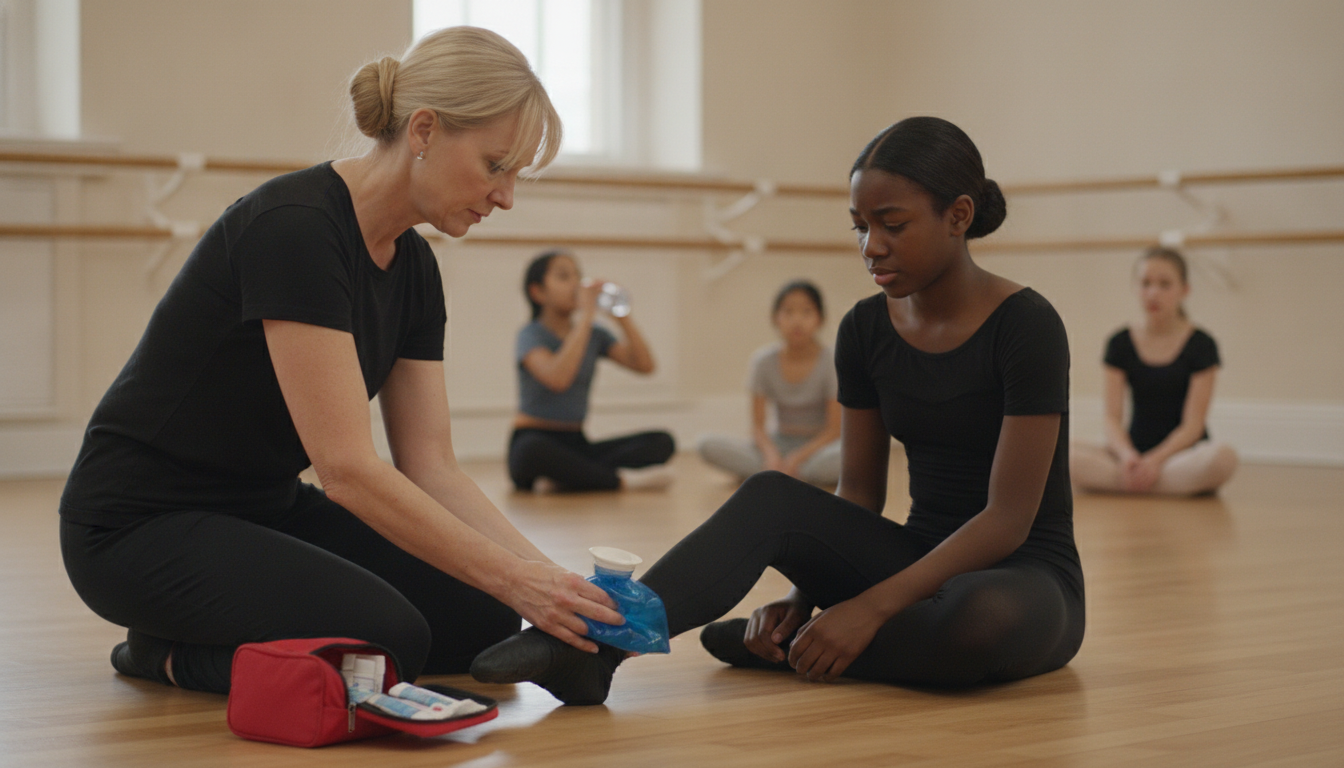
Date and time of incident: Class name, level and time slot: Teacher(s) and assistants present: Dancer's name and age: What happened (dancer's account): What happened (teacher's account): Step, skill or combination being practiced: Spotting or partner involved (if any): Floor, shoes or equipment involved: First aid given and by whom: Emergency services called (yes/no, time): Parent or guardian notified (name, time): Witnesses (names and contact details): Photos taken (yes/no, where stored): Insurer or broker notified (date, reference number): Follow-up with family (date, notes):
Records insurers ask for
When a claim comes in, the insurer or its adjuster will usually ask for:
- The incident report: date, time, class, teacher, what happened, witnesses and first aid given.
- The attendance register for that class, showing who was in the room and who was teaching. It also shows your teacher-to-student ratio.
- The dancer's signed registration form and waiver, dated before the incident.
- The class level and whether the dancer was enrolled at the right level for the skill.
- Your maintenance log for floors, mirrors and any rigging.
- Staff records: CPR and first aid certificates and background checks.
These are much easier to produce when they live in one system rather than a filing cabinet and a group chat. We built Pembee so registration forms capture waivers and medical details at sign-up, attendance tracking records who was in class from a teacher's phone, and class rosters show who was booked into each session, all timestamped.
How an accident medical claim usually works
Because accident medical is usually excess coverage, the family's own health insurance pays first. The studio's policy then covers eligible deductibles, co-pays and uncovered costs up to its limit, after the policy's own deductible. Time limits apply: on BKR's program, the first expense must be incurred within 90 days of the accident. If the family has no health insurance, the accident policy typically pays as primary.
Mention this coverage in your welcome email. It answers the first question most families ask after an injury: "who pays?"
When to review your policy
Most owners buy a policy and forget it until renewal. Your coverage should change when your studio does. Review it with your broker when you:
- Approach renewal (set a review date about 60 days before).
- Grow past the participant count you declared, including camp and workshop sign-ups.
- Add a style such as acro, aerial, pole or adult dance-fitness.
- Hire your first employee or move a contractor onto payroll.
- Sign a lease, move or open a second location.
- Start a competition team or book your first overnight trip.
- Add summer intensives, camps or birthday parties.
- Book a new recital venue with different insurance terms.
Get insured before your first class
Buy coverage before you teach your first class, including your first rented hour in a church hall. Work through it in order:
- List what you'll teach (every style), where, and roughly how many dancers you'll have at your busiest point in the year.
- Get quotes from at least two dance or sports specialty programs.
- Check each quote's exclusions and its definition of "participant," using the broker questions above.
- Collect certificates from every contractor and guest teacher.
- Set up online registration with waivers, plus attendance tracking, so your headcount and records are accurate from day one.
If you're still comparing systems for that last step, our roundup of the best dance studio management software covers what to look for, and our dance studio software page shows how we handle registration, waivers and attendance.
Key takeaways
- Most studios need general liability, professional liability, accident medical and property coverage, plus workers' comp once you hire and abuse and molestation coverage if you teach kids.
- Expect about $475 to $2,500 a year for a small to mid-sized studio.
- On per-participant programs, small studios pay the minimum, and your full-year headcount must be declared accurately.
- Avoid policies with a participant exclusion; confirm class injuries are covered in writing.
- Check exclusions for pole, aerial, acro, contractors and water damage before comparing prices.
- Confirm your policy covers your recital venue and request the certificate weeks ahead.
- Waivers help but won't protect you from most claims involving children.
FAQs
How much is insurance for a dance studio?
Most small to mid-sized dance studios pay about $475 to $2,500 a year for a complete policy. Dance-specific programs often start around $475 to $500, and per-participant programs have an annual minimum that new studios pay until they grow. Leased studios with staff pay more once property and workers' comp are added.
Do dance teachers need their own insurance?
If you teach as an employee under a studio's policy, you're usually covered, but confirm it in writing. If you're an independent contractor, teach at several studios, or run your own classes, you need your own policy. Instructor policies start at around $15 a month, and studios will often ask you to name them as additional insured.
Does general liability cover a dancer's injury in class?
Not always. Some generic small-business and fitness policies exclude injuries to participants, which removes cover for the dancers in the room. Dance programs add professional liability and accident medical, which are the policies that respond when a student gets hurt in class.
Is a waiver enough if I teach kids?
No. A waiver signed only by a minor isn't enforceable, and roughly half of states have refused to enforce waivers that parents sign on a child's behalf. Use a waiver in every registration, but rely on professional liability and accident medical for real protection.
Do I need workers' comp for part-time dance teachers?
It depends on your state. California requires it from the first employee, Florida requires it for non-construction businesses with four or more employees, and Texas lets most private employers opt out. Part-time teachers usually count as employees, and contractors can be reclassified after an injury, so check your state's rules.
Does my insurance cover my recital at another venue?
Some dance programs extend to off-site performances at no extra cost; others need an event endorsement or a one-day special event policy. Check before you sign the venue contract. Either way, the venue will want a certificate of insurance naming it as additional insured, often weeks before the show.
What is an additional insured, and why does my venue want it?
An additional insured is a person or business added to your policy so it's protected if a claim arises from your activities. Landlords, schools and recital venues ask for it so a dancer's injury claim against them is handled by your insurer, not theirs. Your insurer shows it on a certificate of insurance, usually an ACORD 25.
Does my homeowner's insurance cover a home dance studio?
Usually not. Homeowner's policies typically exclude business activity, so an injury to a paying student in your home studio may not be covered. Buy a business policy that lists your home address as a covered location, tell your homeowner's insurer, and check local zoning.
Are pole and aerial classes covered?
Often not on a standard dance policy. Many programs exclude pole and aerial work or cover it only on a specific program with a separate application, and aerial insurers may ask about rigging inspections. Ask for pole and aerial to be named as covered activities before you add the classes to your schedule.
Do I need abuse and molestation coverage?
If you teach anyone under 18, yes. General liability policies commonly exclude abuse claims, so the coverage is bought as an add-on, and limits can be as low as $100,000. Check whether it pays claims or only defense costs, and pair it with background checks and written changing-room and supervision policies.