


Most people searching for staff to child ratios get the nursery numbers and are then left to work out whether those numbers apply to them. If you run an after school club, a holiday club or a coaching session, they usually do not.
In England the statutory staff to child ratios are 1:3 for children under two, 1:5 for two-year-olds, and 1:8 for children aged three and over, rising to 1:13 where someone with qualified teacher status is working directly with the children. For before and after school care and holiday clubs serving reception-age children and above, there is no fixed ratio: the EYFS requires "sufficient staff as for a class of 30" and leaves the number to you. Scotland, Wales and Northern Ireland set their own figures.
Below are the numbers for every nation and setting type, what each ratio costs per child per hour, and what an inspector actually asks for when they want you to prove it.
UK staff to child ratios at a glance
| Setting and age | England | Scotland | Wales | Northern Ireland |
|---|---|---|---|---|
| Under 2 | 1:3 | 1:3 | 1:3 | 1:3 |
| Aged 2 | 1:5 | 1:5 | 1:4 | 1:5 |
| Aged 3 to school age | 1:8, or 1:13 with a qualified teacher working directly with the children | 1:8 | 1:8 (band runs 3 to 7) | 1:8 |
| Reception age and above during the school day | 30 pupils per school teacher under infant class size law | School staffing rules, not childcare ratios | School staffing rules, not childcare ratios | School staffing rules, not childcare ratios |
| Out of school and holiday care | No fixed ratio. Sufficient staff as for a class of 30, provider decides | 1:8, or 1:10 where every child is aged 8 or over. Minimum two staff | 1:8 for ages 3 to 7, 1:10 for ages 8 to 12. Minimum two staff | 1:8. Minimum two staff |
| Childminders | 6 under 8, of whom max 3 young children and max 1 under one | 8 under 16, of whom max 6 under 12, max 3 under school age, max 1 under 12 months | 10 under 12, max 6 under 8, max 4 under 5, max 3 under 2 | 8 under 12, max 6 under 8, max 3 under compulsory school age (from 9 November 2026) |
Two things about that table matter more than the numbers in it.
Every figure is a minimum, and your regulator can require more. Footnote 42 of the EYFS statutory framework says plainly that "Ofsted may determine that providers must observe a higher staff:child ratio than outlined here." That regulator is Ofsted in England, the Care Inspectorate in Scotland, Care Inspectorate Wales, and your local Health and Social Care Trust in Northern Ireland.
And the ratio that applies to you is set by your setting type first and the age of your children second. A four-year-old in a nursery and a four-year-old in a breakfast club sit under completely different rules on the same morning.
England: the EYFS ratios for nurseries, pre-schools and school-based settings
These come from the EYFS statutory framework for group and school-based providers in force from 1 September 2026. The paragraph numbers are worth quoting back at anyone who disputes them.
Paragraph 3.48, children under two: at least one member of staff for every three children. One of them must hold an approved level 3 and be suitably experienced with under-twos, at least half of all other staff must hold an approved level 2, and at least half of all staff must be trained specifically in the care of babies.
Paragraph 3.49, two-year-olds: one member of staff for every five children, with at least one at level 3 and at least half of the others at level 2.
Paragraphs 3.50 and 3.51, children aged three and over: 1:13 where a person with qualified teacher status, Early Years Professional Status or Early Years Teacher Status is working directly with the children, and 1:8 where nobody with those qualifications is. The trigger is working directly with the children, not being on the premises. A qualified teacher doing paperwork in the office does not buy you 1:13.
Independent schools follow paragraphs 3.52 and 3.53: with a qualified teacher or instructor, 1:30 for classes where the majority of children reach five or older during the school year and 1:13 otherwise; without one, 1:8.
Two rules catch schools out. Paragraph 3.54 sets 1:13 for maintained nursery schools and nursery classes with at least one school teacher present, but footnote 49 drops that to 1:8, with a level 3 present, where nursery-class children attend outside the school day or in the holidays in provision run by the governing body with no teacher there. If your school runs its own wraparound for its nursery class, that footnote is your ratio. Paragraph 3.55 puts reception classes under infant class size legislation instead: 30 pupils per school teacher, and teaching assistants and higher level teaching assistants are not school teachers.
One cap is easy to miss: no more than half of the staff counted at level 3 at a premises may hold that status through the experience-based route at any one time.
England: childminder ratios
A childminder may care for a maximum of six children under the age of eight per person providing care, including their own children and any others they are responsible for, such as children being fostered.
Within the six, a maximum of three may be young children, and a child counts as a young child until 31 August following their fifth birthday. Only one should be under the age of one.
Paragraph 3.53 of the childminder framework, which is a separate document from the group and school-based one, allows exceptions where individual needs are still met: for siblings, for a childminder's own child, to maintain continuity of care, and, most usefully for wraparound, where children aged three to five attend only before or after a normal school day or during school holidays. In that case they may be cared for alongside three other young children. A normal school day means 9am to 3pm, or the normal full day at the school the child attends. The six-under-eight cap per person holds in every one of those exceptions.
Assistants change the maths rather than the cap. An assistant or a second childminder each carries their own allowance of children, and children may be left in an assistant's sole care for up to two hours in a single day with parental permission.
The boundary is under-eights, not under-fives. Children aged eight and over do not count towards your six, but they must not dilute the care of the children who do.
England: after school clubs, breakfast clubs and holiday clubs
This is the section the rest of the internet skips, so here is the statutory position in full. EYFS paragraph 3.58:
Where the provision is solely before/after school care or holiday provision for children who normally attend reception class (or older) during the school day, there must be sufficient staff as for a class of 30 children. It is for providers to determine how many staff are needed to ensure the safety and welfare of children, bearing in mind the type(s) of activity and the age and needs of the children. It is also for providers to determine what qualifications, if any, the manager and/or staff should have.
Read that literally and your legal floor is one member of staff for 30 children, with no qualification requirement attached. Footnote 35 confirms it, disapplying the level 3 manager and level 2 staff requirements for out-of-school provision for reception-age children.
Three qualifications to that.
First, the exception that catches clubs out. If any child is aged three or over but has not yet started reception, your provision is not "solely" for reception age and above, so the EYFS ratio applies to that child. You are capped at eight such children per member of staff and the qualification conditions come back with it. One nursery-age sibling changes your staffing plan for the whole session.
Second, clubs solely for children aged eight and over sit outside compulsory registration, so no statutory ratio applies at all. Our guide to Ofsted registration for clubs sets out where that line falls.
Third, the legal floor and the operating reality are miles apart. Your insurer will ask for a number before it quotes, the host school will ask before it signs a lettings agreement, and parents ask on the first phone call. Across the clubs we work with, the answer is almost always 1:8 or 1:10 whatever the law permits, with two adults on site at all times so nobody is ever alone with a child and someone can leave the room in an emergency.

Lone working has an uncomfortable answer. There is no legal minimum of two staff for a club on the Childcare Register in England. A single member of staff is capped at 30 children, or eight if any are aged three or over and below reception age, in which case that person also needs a full and relevant level 3 qualification. Either way they need a full 12-hour paediatric first aid certificate plus child protection and food hygiene training, and must keep every child within sight or hearing. It is legal. We would not recommend it, because it leaves no cover for a toilet trip, an injury or a safeguarding disclosure.
Breakfast clubs sit under the same paragraph. The Department for Education's free breakfast clubs guidance sets no ratio of its own, saying only that staffing depends on the ages of the children and the qualification levels of staff. It does require a member of staff with a full paediatric first aid certificate in the room whenever EYFS children are eating. Our guides to wraparound care and breakfast club ideas cover the rest of the setup.
Ratios in Scotland, Wales and Northern Ireland
Scotland
Early learning and childcare in Scotland, regulated by the Care Inspectorate, runs at 1:3 for children under two, 1:5 for two to under three, and 1:8 for three and over.
Out of school care is where Scotland diverges most from England. The ratio is 1:8 for children aged three and over, or 1:10 where every child is aged eight or over, and the Care Inspectorate can allow 1:10 for children aged three and over attending sessions of under four continuous hours in a day. A minimum of two staff must be present at any one time, even with eight children or fewer, and space standards are 2.3 square metres per child aged three and over. In practice Scottish clubs are planned in blocks of eight places.
Scottish childminders may care for eight children under 16, of whom no more than six may be under 12, three under school age and one under 12 months. Their own children up to age 16 count towards that capacity even when they are not in the setting, because the childminder stays responsible for them and they can come home at any point in the day.
Wales
Standard 15 of the National Minimum Standards for Regulated Childcare sets 1:3 for children under two, 1:4 for two-year-olds, 1:8 for ages three to seven and 1:10 for ages eight to 12. The Welsh bands cut across reception rather than around it, so a five-year-old in a Welsh after school club sits at 1:8 where an English one would not.
Wales requires at least two staff on duty at all times, and ratios must be maintained on outings with the supervisor qualified to level 3. Management, meal preparation and premises tasks need staff over and above the ratio, so a manager doing paperwork is not part of your count.
Welsh childminders may care for up to 10 children under 12, of whom no more than six may be under eight, four under five, three under two and normally two under 18 months. Children due to start reception in September may be classed as over five for childminder ratios over the summer holidays immediately before, which is the one place the standards bend for wraparound. A 2025 Welsh Government consultation proposed raising the under-fives limit from three to four; that remains a proposal and is not in force.
Northern Ireland
Day care in Northern Ireland runs at 1:3 for children under two, 1:5 for two-year-olds, 1:8 for three-year-olds and 1:10 for children aged over four. Those ratios were introduced as a temporary measure in October 2021 and the Department of Health has since made them permanent. At least two staff must be on duty in each room at all times, which is stricter than "two on the premises". Out of school services run on a minimum of two staff and a ratio of 1:8, and register with the Early Years Team of their local Health and Social Care Trust rather than a national body.
From 9 November 2026, a Northern Irish childminder may care for up to eight children under 12 including their own, of whom no more than six may be under eight, three under compulsory school age (or four where two or more are siblings), and two under 18 months.
The line worth remembering across all four nations: England is the only one with no minimum staff count and no fixed out-of-school ratio.
Sports coaching, forest school and activity clubs
If you coach a listed activity rather than provide childcare, or work only with children aged eight and over, you are usually outside compulsory registration and no statutory ratio applies. That does not settle the question, because your insurer, your national governing body and your own risk assessment all impose one anyway.
The default fallback most UK organisations use is the NSPCC's recommended ratios: 1:3 for under-twos, 1:4 for ages two to three, 1:6 for ages four to eight, 1:8 for ages nine to 12 and 1:10 for ages 13 to 18, with at least two adults present even for small groups.
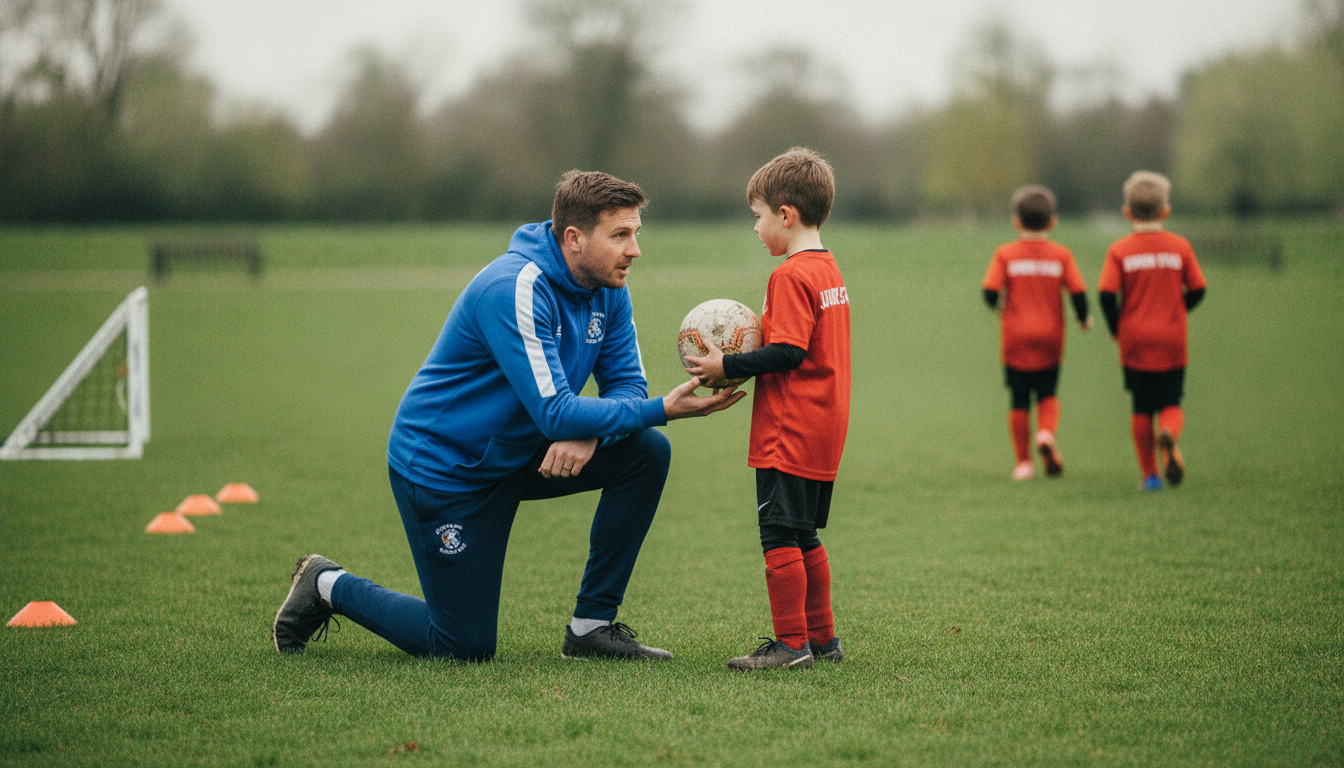
Two rules trip people up. The FA's ratios of adults to children guidance counts only those aged 18 or over, so a squad supported by 16 and 17 year old helpers needs more adults rather than fewer, and it sets a floor of two DBS-checked adults at any football activity for children whatever the age group. If your own national governing body publishes a figure, work to that rather than the NSPCC baseline, because that is the number you will be measured against.
Two more turn a policy into a rota. On any journey, one adult drives and a separate adult supervises. And volunteers who have not been vetted should never be alone with a child or take one to the toilet unaccompanied. Both come up far more often in practice than the headline ratio does, whether you are running a football camp or starting a forest school.
What each ratio actually costs you
Every page on this topic gives you the number. None gives you what the number costs.
A member of staff aged 21 or over on the National Living Wage costs £12.71 an hour from April 2026. Add employer National Insurance at 15% on earnings above the £5,000 annual secondary threshold and that becomes £14.62. The £10,500 Employment Allowance removes the National Insurance bill entirely for many small clubs, so plan between the two figures depending on whether you claim it.
| Ratio | Staff cost per child per hour at £12.71 | Staff cost per child per hour at £14.62 |
|---|---|---|
| 1:3 | £4.24 | £4.87 |
| 1:5 | £2.54 | £2.92 |
| 1:8 | £1.59 | £1.83 |
| 1:10 | £1.27 | £1.46 |
| 1:13 | £0.98 | £1.12 |
| 1:15 | £0.85 | £0.97 |
| 1:30 | £0.42 | £0.49 |

Those are direct staff costs only, at the 21-and-over National Living Wage, with no pension contribution assumed because many part-time club staff earn below the £10,000 auto-enrolment trigger. Premises, insurance and admin sit on top.
Set that against real revenue. Coram Family and Childcare's Childcare Survey 2026 puts the average English after school club at £69 a week in term time, which is £13.80 a session, and a typical 3.15pm to 6pm session runs 2 hours 45 minutes: £5.02 of revenue per child per hour.
At 1:8 and the loaded £14.62 rate, staff cost eats 36% of that. At 1:10 it eats 29%. On a club of 20 children the difference is starker still, because 1:8 needs three staff and 1:10 needs two: £120.62 of wages a session against £80.41. Over a 38-week school year that is roughly £7,600, which is the difference between funding a manager and not.
Holiday clubs run on different numbers again. Coram's Holiday Childcare Survey 2026 puts the average holiday club at £191 a week, with six weeks of summer cover costing £1,145 per child in Great Britain. Longer sessions mean more staff hours per child, which is why six weeks of holiday club costs a family £726 more than six weeks of after school care.
The ratio cliff, and the child who costs you a whole member of staff
Ratios are steps, not slopes, and the step is the whole cost of a person.
At 1:8, children one through eight share the cost of one member of staff and child nine adds a second in full. Because almost every club already runs two adults, the cliff most operators hit is the 17th child, which forces a third.
Run the numbers on a 2 hour 45 minute session at £13.80 a child and the loaded £14.62 rate. Sixteen children on two staff generate £220.80 and cost £80.41 in wages, leaving £140.39. The 17th child generates £234.60 and costs £120.62, leaving £113.98. That one extra booking takes £26 off your session margin, and you are not back to where you were until the 19th child walks in.
So set your capacity at the top of a ratio band rather than one or two places above the bottom of the next one, and price your waiting list accordingly. It is also why the number in your booking system should be your ratio capacity rather than what your hall could physically hold: one unexpected drop-in can turn a profitable session into a loss.
Who counts in your ratio, and who does not
Nobody under 17 can be counted, with one exception: apprentices may be included from 16. Nobody under 17 may care for children unsupervised.
Students and long-term volunteers aged 17 or over, and apprentices aged 16 or over, can be counted at the level below their level of study, provided they are suitable, competent and responsible and hold a current paediatric first aid qualification. In practice a level 3 student counts within the level 2 ratio and a level 6 student within the level 3 ratio.
Parents helping out, casual volunteers and anyone without an enhanced DBS check should not be in your count at all. They can be useful on the floor; they are not staff for ratio purposes.
Special educational needs and disabilities work the other way. An individual risk assessment can require one-to-one support, and a 1:1 support worker is there for that child. Counting them as general cover is the most common way a setting ends up under ratio without realising.
One planning difference worth knowing if you operate across borders: in Wales, management, meal preparation and premises tasks all need staff over and above the ratio, while in England a manager working directly with children counts in it.
Breaks, lunch cover and the "whole provision" rule
Paragraph 3.47 of the EYFS is the sentence most rotas fail: "The ratio requirements below apply to the total number of staff available to work directly with children, across the whole provision, not just each room."
That cuts both ways. You may move staff between rooms to cover breaks, because the count is setting-wide. But you may not be under ratio across the setting at any moment of the day, and "she was just on her break" is not a defence at inspection.
Two patterns work. Stagger breaks so the setting-wide count never dips below your number, and if you use a floating member of staff, make sure they are genuinely available to work directly with children rather than doing admin in the office. Apply paragraph 3.44 as the test on any cover arrangement: children must usually be within sight and hearing of staff, and always within sight or hearing.
Residential and overnight provision keeps its ratios overnight, and at least one member of staff must be awake at all times.
How to prove your ratio to an inspector
From 1 September 2026, Ofsted's early years inspection toolkit requires the relevant EYFS statutory requirements to be met before a setting can reach the expected standard in any evaluation area. A ratio breach is not a minor mark against one judgement; it caps all of them. The EYFS also requires the risk assessment for any outing to include consideration of staff to child ratios, which is the one place the framework makes your ratio thinking explicit rather than habitual.
Ratio evidence is a register question, not a policy question. What holds up:
- A time-stamped attendance register for every session showing children in and out, not a sign-up list of who was booked.
- A staff signing-in record with times, so the two can be compared for any moment of the day.
- Dates of birth on the register, because your ratio depends on ages and an inspector will check the youngest child first.
- A written plan for the moments when the ratio is tightest: arrivals, collection, outings and unplanned staff absence.
- A record of who is counted in ratio and at what level, with qualification and paediatric first aid certificates on file and in date.
Ratio evidence usually falls apart for a structural reason: the register lives on paper in a folder while the bookings live in a spreadsheet or an inbox. Keeping bookings, registers and attendance in one place turns "prove your ratio for last Tuesday at 4.40pm" into a five-second answer instead of an afternoon. That is the thinking behind our after school club booking system.
A ratio check for the start of every session
Six lines you can lift straight into a session-start routine or a rota template.
- Count the children actually present, by age band, not the children booked.
- Count the adults available to work directly with children, excluding anyone under 17 and anyone without an enhanced DBS.
- Check the tightest band first. One three-year-old in an otherwise school-age club sets your number for the whole session.
- Confirm at least one paediatric first aider is on site and their certificate is in date.
- Confirm two adults are present, whatever the law permits in your nation.
- Log both counts with a timestamp.

The ratio that applies to you is set by your setting type and your youngest child, not by the headline nursery numbers, and the ratio you should run is almost always tighter than the one the law allows. If you are building a club around these figures, our guide to setting up an after school club covers registration, budgets and break-even, and accepting Tax-Free Childcare covers how families end up paying less than your headline fee.
Key takeaways
- England's EYFS ratios are 1:3 under two, 1:5 at age two and 1:8 at three and over, rising to 1:13 only where a qualified teacher works directly with the children.
- Out-of-school care for reception age and above has no fixed English ratio: sufficient staff as for a class of 30. One child aged three or over but below reception age pulls it back to 1:8.
- English childminders may care for six children under eight, of whom three may be young children and one under one, including their own.
- Scotland, Wales and Northern Ireland all require a minimum of two staff in out of school care. England does not.
- Running 1:8 instead of 1:10 costs £0.37 more per child per hour, roughly £7,600 a year on a 20-place club.
- Ratios apply across the whole provision, not room by room, so stagger breaks rather than covering them late.
- Ratio evidence is a register question: time-stamped attendance, staff sign-in times and dates of birth.
FAQs
What is the staff to child ratio in the UK?
It depends on the child's age and the type of setting. In England, nurseries and pre-schools work to 1:3 for under-twos, 1:5 for two-year-olds and 1:8 for children aged three and over, or 1:13 with a qualified teacher working directly with the children. Scotland, Wales and Northern Ireland set slightly different figures, and out-of-school care follows different rules again.
What is the staff to child ratio for after school clubs in the UK?
In England there is no fixed statutory ratio for clubs serving children of reception age and above. The EYFS requires sufficient staff as for a class of 30 children and leaves the number to the provider. Scotland requires 1:8, or 1:10 where all children are aged eight or over. Wales requires 1:8 for ages three to seven and 1:10 for ages eight to 12. Northern Ireland requires 1:8.
Do after school clubs have to follow EYFS ratios?
Only if a child in the club is aged three or over and has not yet started reception. In that case the provision is not solely for reception age and above, so the 1:8 EYFS ratio and its qualification conditions apply. A club taking only reception-age children and older falls under paragraph 3.58 instead, and a club taking only children aged eight and over is outside compulsory registration altogether.
How many children can one childminder look after?
In England, six children under the age of eight per person providing care, including the childminder's own children and any they are fostering. No more than three of the six may be young children, and only one should be under the age of one. Scotland allows eight under 16 with no more than six under 12, Wales allows 10 under 12, and Northern Ireland allows eight under 12 from 9 November 2026, all with sub-limits by age.
Does the manager count in the ratio?
In England, yes, provided they are working directly with children rather than doing management tasks: paragraph 3.47 counts the staff available to work directly with children. Wales is stricter, because the National Minimum Standards require management, meal preparation and premises tasks to be staffed over and above the ratio. If you operate in more than one nation, plan your rotas separately.
Can a 16-year-old be counted in staff to child ratios?
Only if they are an apprentice. EYFS paragraph 3.57 says providers must not include anyone aged under 17 in ratios, except apprentices who may be counted from 16. Anyone counted this way must be suitable, competent and responsible and hold a current paediatric first aid qualification. Nobody under 17 may care for children unsupervised, and in sports settings only adults aged 18 and over count.
What is the ratio for holiday clubs and summer camps?
The same rules as before and after school care. In England there is no fixed ratio for provision serving reception-age children and above, though most operators run 1:8 or 1:10 because insurers and parents expect it. If any child is aged three or over and below reception age, 1:8 applies to that provision. The other three nations apply their standard out-of-school figures.
Is there a legal minimum of two staff?
Not in England. A single member of staff on the Childcare Register can lawfully supervise up to 30 children, or eight if any are aged three or over and below reception age, provided they hold a full 12-hour paediatric first aid certificate. Scotland, Wales and Northern Ireland all require a minimum of two. We recommend two adults everywhere, whatever the law permits.
Do ratios apply room by room or across the whole setting?
Across the whole setting. EYFS paragraph 3.47 states that the ratios apply to the total number of staff available to work directly with children across the whole provision, not just each room. You can move staff between rooms to cover breaks, but the setting-wide count must never drop below your required ratio at any point in the day.
Do volunteers and parent helpers count in the ratio?
Long-term volunteers aged 17 and over can be counted if they are suitable, competent and responsible and hold a current paediatric first aid qualification. Casual parent helpers and anyone without an enhanced DBS check should not be counted at all. A one-to-one support worker for a child with additional needs is supporting that child and does not fill a gap in your general ratio.