


The hard part of running a breakfast club is not thinking of activities. It is that children arrive across the whole half hour, eat in shifts, and the hall has to be clear before assembly. Most ideas lists ignore all three.
A breakfast club idea only works if a child can join it alone, nobody has to demonstrate it, Reception and Year 6 can both do it at the same table, and it packs away in under ten minutes. Here are 42 that pass, grouped by when in the 30 minutes they work, costed against the funding you actually get, and checked against the food standards that are about to change.
One number worth carrying into the planning. The Education Endowment Foundation's trial of Magic Breakfast found an average of two months' additional progress for Key Stage 1 pupils, with no equivalent effect at Key Stage 2, and the gain tracked attendance at the club rather than whether a child ate breakfast at all. The half hour is doing the work, which is a good reason to make it worth turning up for.
The rules that decide which ideas work
Four constraints come straight from the DfE's phase 1 guidance for schools and trusts, and every idea below has to survive all four.
- Thirty minutes minimum, immediately before the start of each compulsory school day.
- Free, and open to every pupil on roll from Reception to Year 6, with no compulsory charge attached to the free half hour, and no cap on the number of places.
- On the school site, or in the vicinity of it.
- Food that meets the school food standards for England.
Two staffing points shape what you can plan. A school delivering the club itself, employing the staff, with at least one registered pupil attending, does not need to register on the Early Years Register or the General Childcare Register. A private, voluntary or independent provider running it on your site does, and our explainer on Ofsted registration for after school clubs covers where that line falls.
There are no specific qualification requirements for school-aged childcare staff, but where Reception-aged children are eating there should always be someone in the room holding a valid paediatric first aid certificate, and anyone handling food needs hygiene and allergy training. No statutory ratio applies to school-led provision. Our guide to staff to child ratios in the UK covers what registered settings and insurers expect instead.
The rest of the UK works differently. Wales has offered free breakfast in maintained primary schools since 2004 under statutory guidance, and the Healthy Eating in Schools (Maintained Primary Schools) (Wales) Regulations 2025 come into force on 31 October 2026, changing what can be served. Scottish provision is council-led rather than national. Northern Ireland has no equivalent national entitlement, so what a club can run there depends on individual school budgets and grant funding.
The 30-minute timeline every idea has to fit
Children do not arrive in a line at 8:20. They trickle in from the moment the door opens until roughly ten minutes before the bell, which makes the club four short sessions with different rules rather than one slot.
| Time | What is happening | What an idea has to do |
|---|---|---|
| 8:20 to 8:30 | First arrivals, serving starts, register opens | Work for one child alone, need no demonstration, be joinable at any second |
| 8:30 to 8:40 | Peak. Most children eating, staff serving | Run at the table, need no adult, tolerate a half-eaten bowl next to it |
| 8:40 to 8:47 | Eating done, energy up | Absorb the whole group at once and burn ten minutes |
| 8:47 to 8:50 | Pack down, line up | Clear into a crate in under three minutes |
The rule that table implies is blunt. Anything needing a demonstration, needing the whole group present at the start, or taking more than eight minutes to put away is not a breakfast club idea. The DfE's qualitative research with early adopter schools describes what already works in practice as child-led activity under light-touch supervision: colouring, block building, games and active play, running in halls, canteens, gyms and quieter side rooms.
Calm-start ideas for the first ten minutes
Ideas 1 to 7 all pass the same test. One child can start alone, no adult has to explain anything, and a child walking in at minute 22 is not behind.
- Soft-start music and floor cushions. A speaker, a playlist, and cushions borrowed from the reading corner and put back at 8:47.
- Colouring and dot-to-dot on every table. The default for a reason. It costs pennies from stock you already hold, works from Reception to Year 6, and absorbs a late arrival without a word.
- Question of the morning. One prompt on a whiteboard, answers on sticky notes. Also the best signal you have that the club is a community rather than a canteen.
- The week-long jigsaw. One large puzzle left out across five mornings. Nobody has to start it and nobody has to finish it.
- Feelings check-in board. Named pegs onto a simple scale. Your pastoral lead gets information before 9am that would otherwise surface at lunchtime.
- Construction mat. Lego, Duplo or wooden blocks on a bordered mat so the whole thing tips into one crate. Block building is one of the activities the early adopter observations named specifically.
- Quiet corner with a book box. Not a reading activity, just permission to sit out. Quieter spaces and sensory rooms are what the early adopter schools reached for when children needed a calmer start.
Table-top ideas for staggered arrivals
One rule governs this group. Any game must reset in under five minutes, so a child who joins late still gets a turn before the bell.
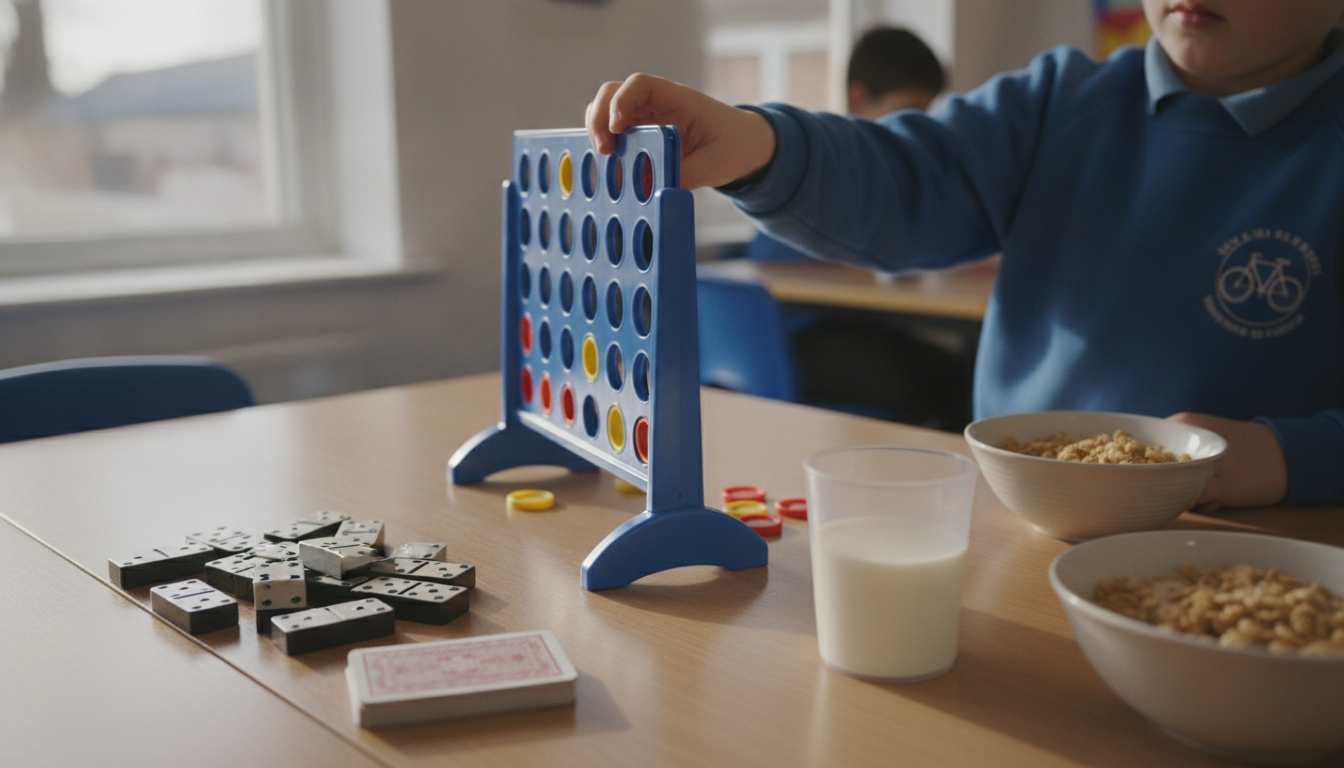
- Connect 4, draughts and snakes and ladders. Two players, three-minute rounds, instant reset.
- Fast card games in rounds. Uno-style and Dobble-style decks end constantly, so joining is never awkward.
- A standard deck of cards. Snap, pairs and go fish cost about a pound and teach turn-taking better than anything else on this list.
- Dominoes. A game, a pattern, or a chain across a whole table when the group is big.
- Top Trumps. Number comparison that nobody notices is number comparison.
- Jenga. One box, one table, and an audience that manages itself.
- Guess Who and other two-player logic games. Reliable for the children who want a game but not a crowd.
- Puzzle sheets by year group. Word searches for Key Stage 1, sudoku for Key Stage 2. Print once, laminate, reuse all year.
- A puzzle basket. Rubik's cubes, tangrams and wooden brainteasers. The cheapest way to keep Year 5 and 6 busy without supervising them.
Reading, words and numbers
- Reading buddies. Year 5 and 6 paired with Key Stage 1. It costs nothing and it gives your oldest children a job.
- Book swap shelf. Bring one, take one, no library system involved.
- Breakfast book club. One chapter read aloud a morning, one book a half term. The only idea here that rewards attending every day.
- Times tables bingo. Ten minutes, whole group, no prep at all after the first laminating session.
- Story-starter jar. One prompt, five minutes of writing, for the children who would rather write than play.
If you want more structure than a jar of prompts, our after school lesson plans transfer to a morning slot with the timings halved.
Making and active ideas
- Junk modelling from the recycling bin. Free materials. Set a one-table rule and the mess stays where you put it.
- Origami and paper folding. Paper only, and it scales to any number of children.
- Friendship bracelets and weaving. Slow, quiet, and popular with the group that finds the hall loud.
- Seasonal making. Diwali lanterns, Christmas decorations, Eid cards, Mother's Day cards. Diarise them in August so they are not a scramble in the week itself.
- Wake Up Shake Up. Ten minutes of led movement in the hall straight after eating, which fits the 8:40 block exactly.
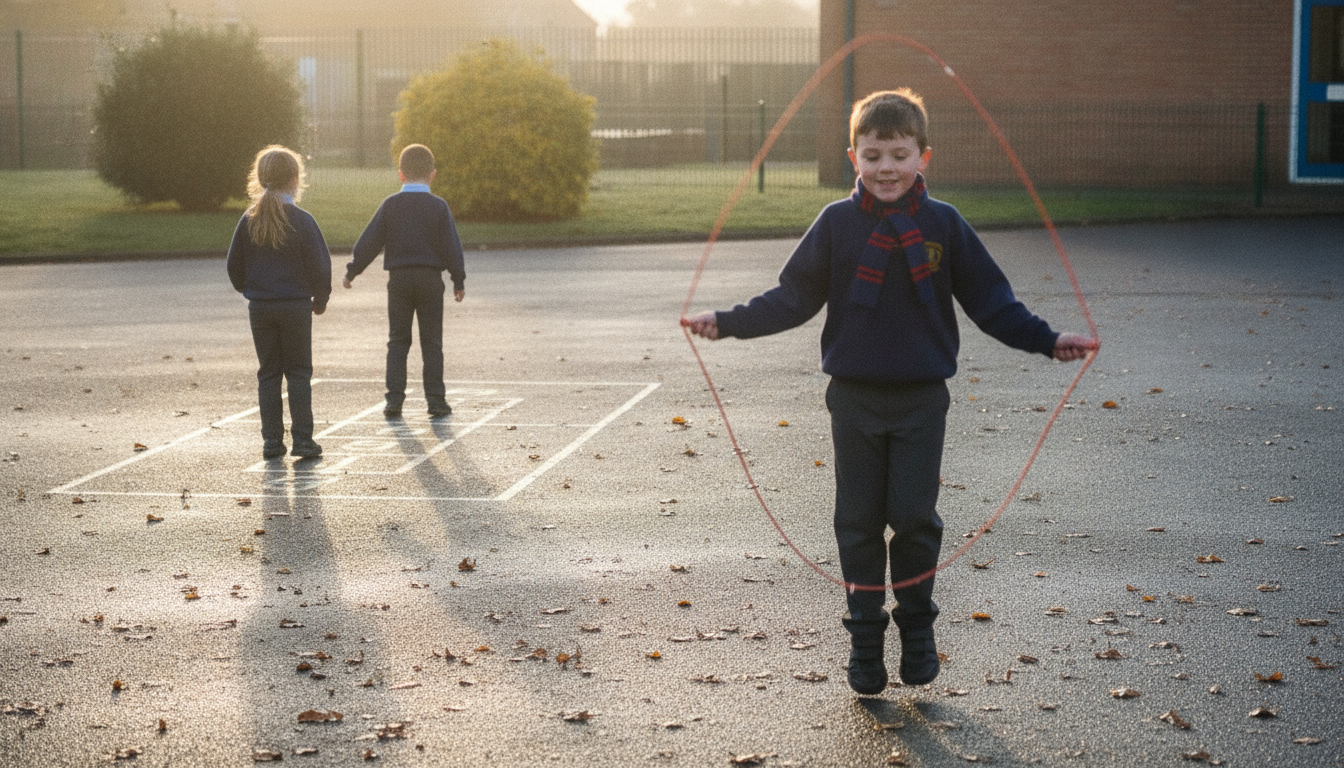
- Playground games. Skipping ropes, hopscotch and beanbag targets carry more children per adult than anything else here.
- Ten minutes of football or basketball in a marked area with a hard stop at 8:47.
Making is not just hands-busy time, and we have covered the benefits of arts and crafts for fine motor control and social confidence in more detail elsewhere.
Jobs that give children a role
These four cost nothing and change behaviour more than anything with a price tag.
- Breakfast monitors. Setting tables, carrying milk jugs, laying out fruit. Rotate weekly so it stays a privilege.
- Wipe-down rota. Named, rotating, on the wall. Pack-down time drops by a couple of minutes on its own.
- Menu board writer of the day. One child writes up what is being served. Parents read it at the door.
- Welcome buddy for new starters. Limited awareness of the club was one of the barriers families named in the early adopter research. A named child at the door fixes more of that than a newsletter does.
Giving children a job of their own sits under civic engagement, one of the five categories in the DfE's enrichment framework for schools and colleges, which Ofsted began weighing under personal development in September 2026. Our after school club ideas list groups its 32 activities by the same five kinds of enrichment.
Breakfast ideas that pass the new food standards
Breakfast is getting its own standalone standards in England for the first time. The DfE consultation on updating the school food standards closed on 12 June 2026, the government response is due from September 2026, and primary schools are expected to comply from September 2027. Nothing below is law yet, but the proposals have been consulted on rather than floated, so most menu lists written before this are about to be wrong. Build the new menu once rather than twice.
What the proposals take off the breakfast menu:
- Fried bread
- Pastries and croissants
- Fried potato products, including hash browns
- Processed meats such as sausage and bacon
- Chocolate spread, honey and syrups
The numbers that decide procurement matter as much as the bans, and they are all in the consultation document itself. Breakfast cereals need to be under 5g per 100g total sugar, with no-added-sugar muesli and plain unflavoured porridge both fine. Bread needs at least 3g per 100g fibre, which covers wholemeal, some seeded and higher-fibre white loaves, plus fruited bread buns and crumpets. A portion of fruit or vegetables must be available, and that portion cannot be fruit juice, potatoes or baked beans. Drinks are limited to plain water, plain semi-skimmed or skimmed milk, lactose-free milk, or unsweetened fortified soya or oat drinks. Dairy yoghurt has to be under 10g per 100g total sugar and plant-based versions under 7g, neither with non-sugar sweeteners, and spreads come as reduced sugar and salt sachets or portions of no more than 10g. The Education Hub's plain-English summary is the version to send to governors.
Ten menus that clear all of it:
- Plain porridge with unsweetened fruit compote. Cheapest hot option and the one that holds children until lunch.
- Overnight oats made the afternoon before. Zero morning cooking, which matters when one person is running the hatch.
- Higher-fibre toast with reduced sugar and salt spread sachets.
- Bagels, which toast faster than sliced bread and hold up in a hand.
- Lower-sugar cereal with semi-skimmed milk.
- Plain yoghurt with fruit and no-added-sugar muesli.
- Scrambled or boiled eggs on toast, never fried.
- Baked beans on toast. Permitted, though beans do not count towards the daily fruit and vegetable portion.
- Crumpets or fruited bread buns with fruit.
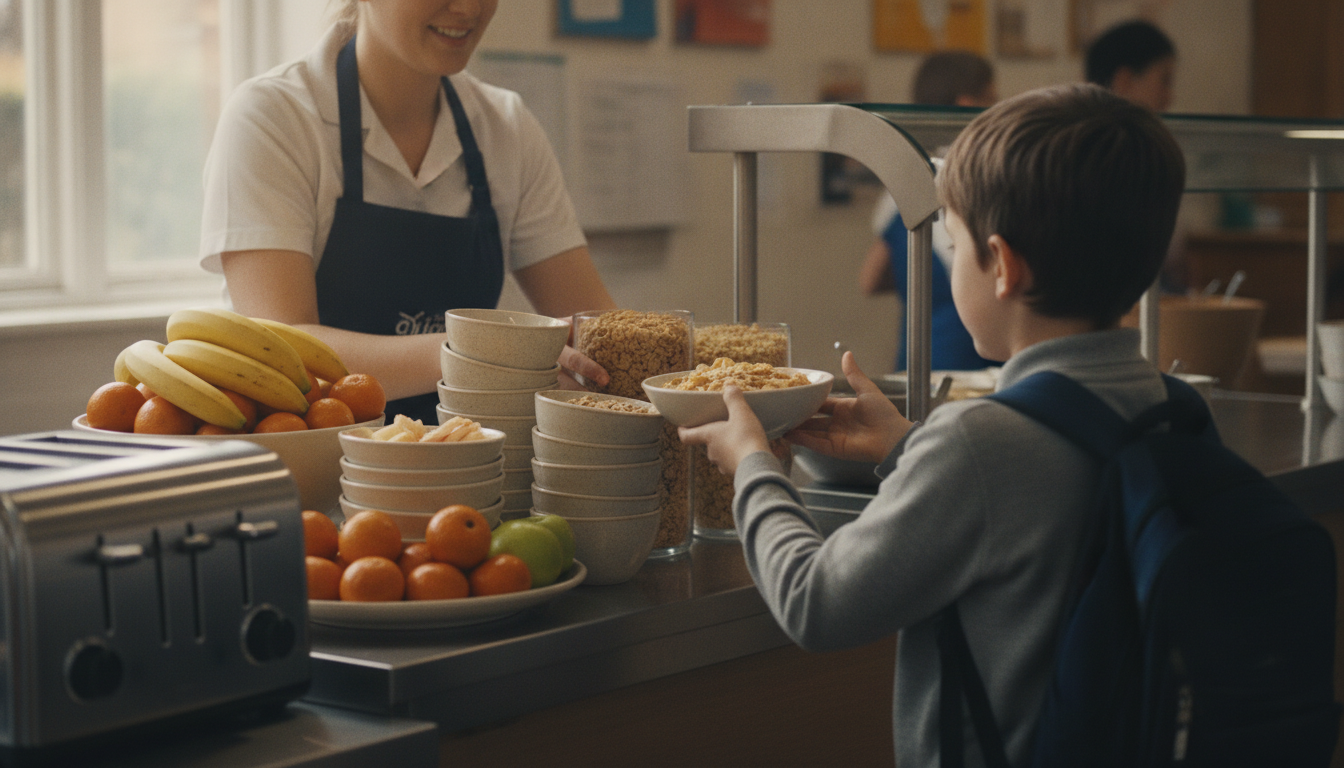
- A fruit and vegetable station. Bananas, satsumas, apple slices, cucumber and pepper sticks, out every single day.
A rotating five-item menu beats a ten-item one. Ordering gets predictable, staff stop improvising, and waste drops. Northumbria University's Healthy Living Lab publishes free breakfast club recipe ideas worth pinning up in the kitchen.
What the ideas cost, against £25 a day and £1 a child
Mainstream schools get £25 per day as a fixed rate plus £1 per pupil per day of attendance, paid in arrears, across 74 autumn days, 57 in spring and 63 in summer. Special schools and alternative provision are funded at £18.95 per day plus £3.23 per pupil. Schools new to the programme also get a one-off £1,000 start-up grant. Both rates carry an area cost adjustment, so your actual figure moves with where you are. All of it is set out in the DfE's grant methodology for September 2026 to July 2027.
Food comes off that first. Food procurement consultancy allmanhall's breakdown of what free breakfast clubs really cost puts weekly menus at £0.60 to £0.90 per pupil.
| Breakfast served | Cost per pupil |
|---|---|
| Porridge | around £0.65 |
| Cereal | around £0.70 |
| Toast | around £0.75 |
| Typical weekly menu | £0.60 to £0.90 |
| Running with a Magic Breakfast partnership | £0.30 to £0.40 |
Buying in bulk moves those figures again: oats at roughly £1.50 a kilo, bread at £0.80 to £1.20 a loaf, bananas at £0.15 to £0.20 each.
The table below is a starter kit for the ideas above, priced from live UK school and catering supplier pages in September 2026, excluding VAT.
| Item | Ideas it covers | Price (ex VAT) |
|---|---|---|
| Sticki Blocks, pack of 216 in a storage tub | Construction mat (6) | £71.99 |
| Hasbro Fun Games, pack of 4 | Two-player logic games (14), Guess Who plus three others | £96.96 |
| Ravensburger giant floor puzzles, pack of 5 | Week-long jigsaw (4) | £60.95 |
| Findel Everyday super budget playground pack, 99 pieces | Playground games (27), skipping and beanbags | £159.99 |
| Gratnells single column trolley, 850mm | Pack-down and storage (trays sold separately) | £235.00 |
| Six-slice commercial toaster | Toast, bagels, crumpets (35, 36, 41) | £99.17 |
| 16-litre catering urn | Porridge water and hot drinks | £68.00 |
| Total | £792.06 |
That leaves roughly £200 of the £1,000 start-up grant for paper, laminating pouches, card decks and a speaker.
Connect 4, draughts, dominoes, snakes and ladders and a deck of cards are deliberately not in the table. They cost a few pounds each from a supermarket or discount shop, and buying them through a school catalogue is the fastest way to spend a start-up grant on the cheapest ideas on this page.
Then the ongoing maths, which is where the ideas list stops being a wish list. Take a mainstream school with 60 children attending daily through the autumn term. The fixed rate brings £1,850 and attendance brings £4,440, so £6,290 for the term. Food at £0.75 a head costs £3,330, leaving about £2,960 across 74 mornings, or roughly £40 a morning for staffing and everything else. Across the full 194 term days the same club draws about £16,490.
Forty pounds a morning does not buy two teaching assistants and a craft budget. The grant funds food plus a thin staffing layer, which is why the ideas above lean on paper, cards, jobs and things already in the building. After year one, an activity idea that costs money is one that comes out of somewhere else.
Two top-ups are worth an application. The Kellogg's breakfast club grants programme awards up to £1,000 to state schools from Reception to Year 13, one grant per school per academic year, prioritising those with 35% or more pupils on pupil premium or in the 10% most deprived areas. It closed to primary applications in March 2026 and reopens in autumn 2026, and the money can go on food, staffing or equipment. The Greggs Foundation runs Feeding Brighter Futures, which pays termly cash grants straight to schools for breakfast provision, with after school and holiday clubs still at pilot stage through 2026.
A five-day rota you can copy
| Day | 8:20 to 8:40 | 8:40 to 8:47 | Breakfast |
|---|---|---|---|
| Monday | Construction mat | Wake Up Shake Up | Porridge and fruit |
| Tuesday | Board game tournament | Playground games | Bagels and yoghurt |
| Wednesday | Making table | Ten-minute football | Cereal and fruit |
| Thursday | Reading buddies and book swap | Skipping and beanbags | Eggs or beans on toast |
| Friday | Puzzle basket and question of the morning | Whole-group music | Crumpets and fruit |
The sequencing matters more than the contents. The early adopter evaluation found attendance dips on Fridays and through the winter, so Friday gets the thing children talk about, not the leftovers. Rotate the making table by season rather than by week and it plans itself for a year. If you are also building an after school programme around the same kit, our list of after school club ideas uses the same age bands and costings.
Matching ideas to the room you actually have
The hall is the biggest space and the first one you lose, because assembly needs it at 8:40. Everything in it has to clear in eight minutes into crates on a trolley, which rules out anything with small parts spread over the floor and anything wet.
A classroom or canteen holds fewer children and more tables, which suits games, puzzles and making, and suits movement badly. The playground carries the most children per adult and is entirely weather-dependent, so it can never be the only plan in November.
That gives you a test rather than a rule. If an idea cannot go from in use to invisible in the time it takes to line up a class, it is a Saturday idea, not a breakfast club idea. Favour dual-purpose furniture, one crate per activity, and a labelled trolley one adult can move alone.
One more room decision is worth making deliberately. The early adopter research found families holding back because they were not sure the setting could meet their child's SEND needs, and the schools that answered it used a side room, a sensory space, or simply a table where nothing is expected of anyone sitting at it. That is an idea, and it is the cheapest one on this page.
If you charge for wraparound before the free 30 minutes
Schools that already sold early morning childcare tend to end up with the same shape: a paid session from 7:45 to 8:20, then the free 30 minutes from 8:20 to 8:50. Three rules constrain it, and getting them wrong is how letters home end up being rewritten.
You cannot require families to buy the paid slot in order to reach the free one. Your paid fees have to be lower than they were before the free club existed, to reflect the half hour families are no longer paying for. And the grant cannot be spent on the paid part, on lunch, or on any other childcare, which the conditions of grant set out plainly.
There is a consequence for the ideas list too. The two sessions need different plans, because the early group is small, tired, and often the same handful of children every day. Give it its own rota rather than treating it as a longer version of the same thing. If you are still mapping out how the halves fit together, our explainers on what wraparound care is and how to set up an after school club in the UK cover the setup, and how to accept Tax-Free Childcare payments covers collecting the paid half.
Keeping the register off the club floor
Per-pupil funding is paid in arrears against recorded attendance, so the register is now the money. Attendance has to be recorded daily for Reception to Year 6 and submitted in fixed census weeks: 9 to 13 November 2026 with the form due by 4 December, 1 to 5 February 2027 due by 12 March, and 7 to 11 June 2027 due by 2 July. A late return delays payment by a full term, and records have to be kept for seven years.
At the same time, the DfE's research found advance booking is one of the reasons families do not come, and that clubs running pre-booking still did not turn children away at the door. So the register has to be accurate and the door has to stay easy, at the same time, on a tablet, at 8:20, while somebody is also serving toast.
Our take is to split the two jobs. Take bookings and payment for the paid wraparound session in one place, keep the free 30 minutes as a simple check-in that any adult can tap through in the hall, and put allergy flags at the serving point rather than in a folder in the office.
Key takeaways
- Staggered arrivals, not activity choice, are the real design brief. Group ideas by when in the 30 minutes they work.
- Anything needing a demonstration, a full group at the start, or more than eight minutes of pack-down does not belong in a breakfast club.
- At £25 a day plus £1 per pupil, the grant funds food and a thin staffing layer, so ideas have to be close to free after year one.
- Rebuild the menu against the proposed breakfast standards now, because pastries, hash browns, processed meat, chocolate spread, honey and syrups are all in line to go.
- Put the most popular idea on Friday, when attendance dips, and keep one quiet table where nothing is expected of anyone.
FAQs
How long does a school breakfast club have to be?
At least 30 minutes, immediately before the start of each compulsory school day, free to every pupil on roll from Reception to Year 6 for schools in the England rollout. Many schools run a paid wraparound session before it, which is allowed as long as families are not required to buy that session to reach the free one.
What activities should a breakfast club run?
Child-led activities a single child can join alone at any point: colouring, construction blocks, board games, jigsaws, reading corners and puzzle sheets, followed by ten minutes of led movement once eating finishes. Avoid anything needing a demonstration or the whole group present at the start, because children arrive across the entire half hour.
What can you serve at a breakfast club under the new school food standards?
Under the standards DfE consulted on in 2026, porridge, lower-sugar cereal, higher-fibre toast, bagels, crumpets, plain yoghurt, eggs that are not fried, baked beans and a daily fruit and vegetable station all pass. Cereals need under 5g per 100g total sugar and bread at least 3g per 100g fibre. Fried bread, pastries, hash browns, processed meats, chocolate spread, honey and syrups come off the menu. The rules are not law yet, and primaries in England are expected to comply from September 2027.
How much funding does a school get for breakfast club per child?
Mainstream schools in England receive £25 per day as a fixed rate plus £1 per pupil per day of attendance, paid in arrears. Special schools and alternative provision receive £18.95 per day plus £3.23 per pupil, and schools new to the programme also get a one-off £1,000 start-up grant. Term day counts for 2026 to 2027 are 74 in autumn, 57 in spring and 63 in summer.
How much does breakfast cost per child?
A typical weekly menu works out at £0.60 to £0.90 per pupil, with porridge around £0.65, cereal around £0.70 and toast around £0.75. Schools working with Magic Breakfast bring that down to roughly £0.30 to £0.40 a breakfast. On those figures a club with 60 daily attenders spends around £3,330 on food across an autumn term against £6,290 of grant income.
Do breakfast clubs need to register with Ofsted?
A school delivering the club itself, employing the staff, with at least one registered pupil attending, does not need to register on the Early Years Register or the General Childcare Register. A private, voluntary or independent provider or a childminder running it does. The exemption follows the provider, not the building, so check who the employer is before assuming you are covered.
What staff to child ratio does a breakfast club need?
No statutory ratio applies to school-led breakfast club provision in England, and there is no fixed legal ratio for registered settings caring for children aged eight and over either. In practice insurers, governing bodies and schools expect somewhere between 1:8 and 1:10 for primary-aged children, so treat that band as a planning floor rather than a rule. Where Reception-aged children are eating there must always be a member of staff in the room with a valid paediatric first aid certificate.
Can a school charge for breakfast club?
Not for the 30 minutes covered by the national rollout, which must be free with no charge that could deter access. Schools can still charge for wraparound care outside that half hour, but fees must be lower than they were before the free club existed, families cannot be required to buy the paid session to reach the free one, and the grant cannot be spent on the paid provision.
What breakfast club ideas work with mixed ages from Reception to Year 6?
Look for a low floor and a high ceiling, where a five-year-old and a ten-year-old can both be busy at the same table. Colouring, construction blocks, a shared jigsaw, junk modelling and playground games all qualify. Puzzle sheets are worth splitting by year group, with word searches for Key Stage 1 and sudoku for Key Stage 2. Reading buddies turn the age gap into the activity itself.
What do you need to start a school breakfast club?
A room you can clear by 8:40, a toaster and an urn, a food supplier, staff with food hygiene and allergy training, at least one paediatric first aider where Reception children eat, and a way of recording attendance daily. A starter kit of activity equipment and catering gear comes in under £800 excluding VAT, which the £1,000 start-up grant covers with room for consumables.