


Few activities work a child's body and brain at the same time, but gymnastics does both. Tumbling, balancing, and swinging build strength and coordination while the sequencing and focus those skills demand carry straight into the classroom. The CDC even counts gymnastics as both a muscle-strengthening and a bone-strengthening activity, two boxes most sports tick separately. The benefits of gymnastics for children fall into four groups: physical, cognitive, social and emotional, and confidence and character, and they start as early as toddlerhood. This guide covers what the research actually shows, what changes by age, whether gymnastics is safe, and how to pick a good class.
What counts as gymnastics for kids
Most children who do gymnastics never set foot in a competitive program, and that matters for understanding the benefits. Recreational or developmental gymnastics covers tumbling, basic apparatus work, balance, and parent-and-child "gym tots" classes for the youngest children. The aim is movement skill and fun, not medals.
Competitive gymnastics is a different commitment: structured training toward meets, more hours, and more specialized coaching. The key point for parents is that a child gets the full developmental benefit, the strength, the coordination, the focus, the confidence, from recreational classes alone, without the training load of an elite program.
| Type | Focus | Typical hours/week | Who it suits |
|---|---|---|---|
| Recreational / developmental | Movement skills, balance, fun, confidence | 1-2 hours | Most children, all ages and abilities |
| Competitive | Routines, apparatus mastery, competition | 5+ hours | Children who want to train and compete |
The physical benefits
Gymnastics is one of the most complete physical activities a young child can do. Supporting and moving their own body weight develops major and minor muscle groups together, while the constant reaching, holding, and landing builds flexibility, coordination, and posture in the same session.
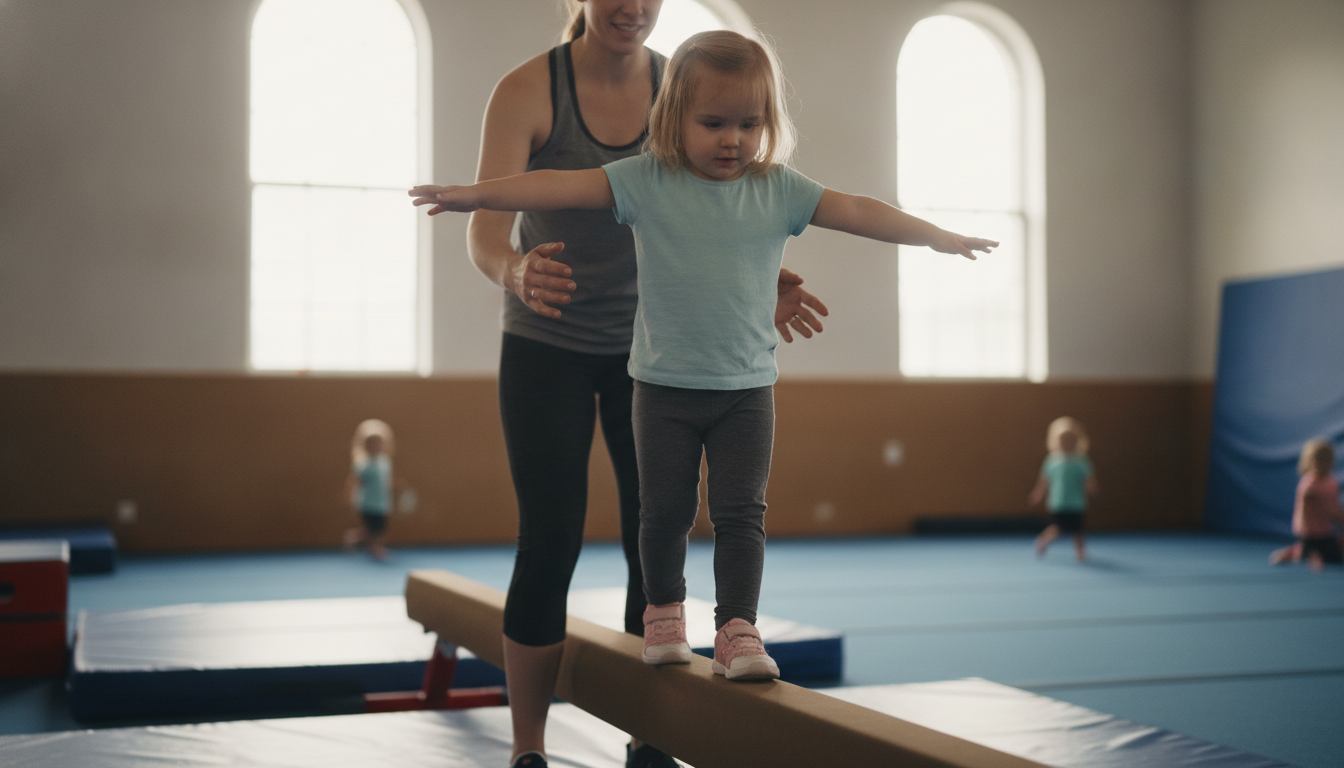
Balance and coordination
Balance is trainable, and gymnastics trains it directly. A 2025 study in Frontiers in Psychology found that a 12-week structured gymnastics program improved both static and dynamic balance in children aged three to six. Those are the years balance develops fastest, and beam work, hopping, and landing drills give a child far more practice than free play does.
Strength, flexibility, and healthy bones
Holding a plank on the floor, hanging from a bar, or pushing up into a handstand are all bodyweight strength work, and they build bone as well as muscle. The CDC classifies gymnastics as both a bone-strengthening and muscle-strengthening activity and recommends children aged 6 to 17 get 60 minutes of activity a day, including muscle- and bone-strengthening work three days a week. A single gymnastics class hits all of those targets at once. The motor-skill foundation transfers too: the body awareness a gymnast builds underpins almost every other sport they go on to try.
The cognitive benefits
The brain benefits are where gymnastics quietly stands out. Learning a routine means holding a sequence in memory, tracking where your body is in space, and adjusting on the fly, all of which lean on the same skills children use to follow instructions and concentrate at school.
The strongest evidence comes from a 2017 study published in Medicine & Science in Sports & Exercise. Researchers put 44 children aged 7 to 10 through eight weeks of after-school gymnastics, twice a week for 90 minutes, and tested their spatial working memory before and after. The gymnastics group improved both their accuracy on the memory task and a brain-activity marker (parietal P3 amplitude) linked to attention, while the control group did not.
The striking part is where the change showed up: not just in the children's test scores, but in a brain-activity marker of attention that the non-gymnasts never moved.
Those gains map onto classroom skills: holding a multi-step instruction in mind, concentrating through a task, and working out problems in space. It is the same pattern other structured activities show, which is why after-school clubs can support academic performance rather than competing with it.
The social and emotional benefits
Gymnastics classes are small social worlds. Children wait their turn at each station, listen for the coach's cue, follow directions, and cheer on the child ahead of them, and they do it week after week with the same group.
That repetition is what builds the skills. Taking turns, reading when it is your moment to go, coping when a skill clicks for someone else first: these transfer straight to the classroom and the dinner table. Children also learn to manage the emotional swings of trying something hard in front of others, which is the groundwork for emotional regulation.
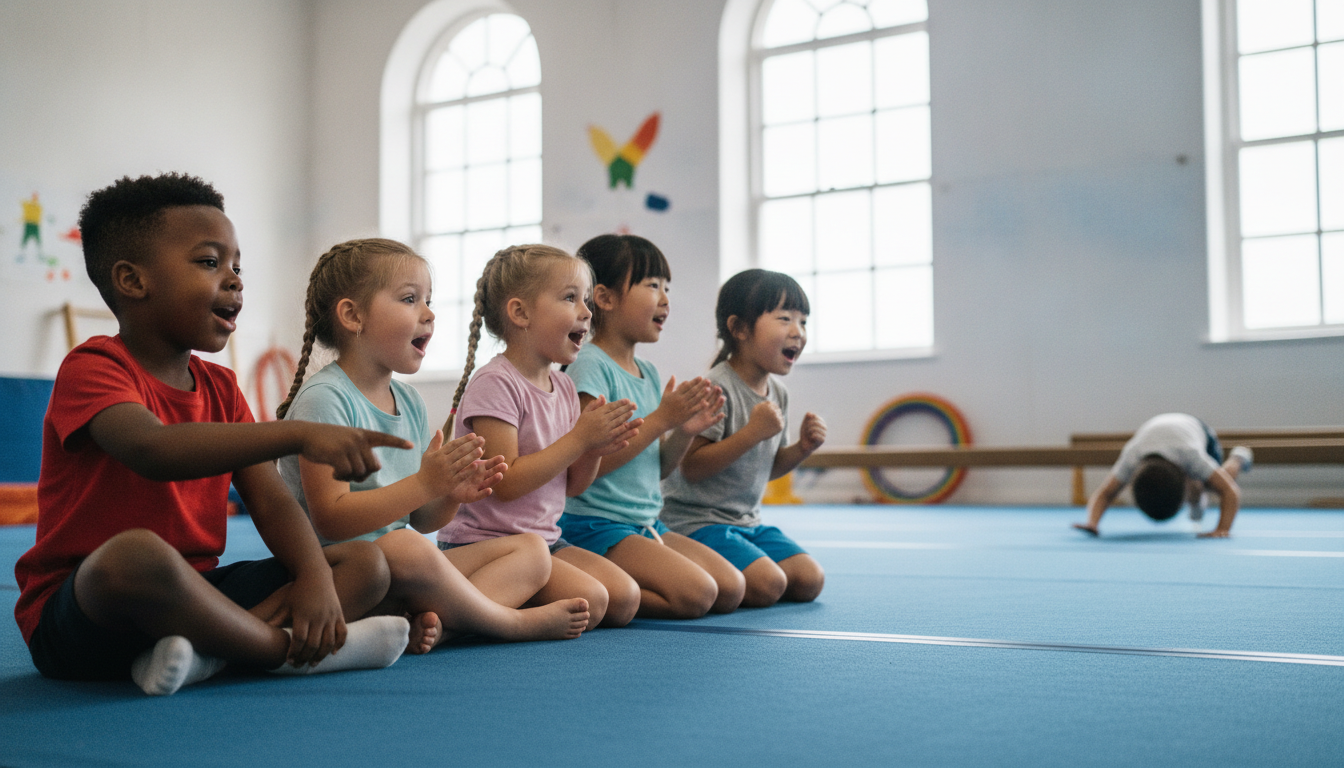
Much of this comes down to the structure of a class rather than the sport itself. The same group, the same stations, and the same expectations each week give a child a safe, predictable place to practice these skills, which is often what helps a shy child come out of their shell over a term or two.
Confidence, discipline, and resilience
Ask a parent what changed first after their child started gymnastics and most say confidence. The reason is built into the sport: skills are broken into small, achievable steps, so a child experiences earned achievement again and again, a forward roll today, a cartwheel next month.
Getting there teaches the harder lesson. No child lands a new skill on the first attempt, so gymnastics is steady practice in trying, missing, and trying again. That repetition builds perseverance and a healthier relationship with mistakes, treating them as part of learning rather than a reason to stop. Setting a goal, working at it, and reaching it also builds the self-discipline that follows a child well beyond the gym.
What gymnastics gives kids at each age
What a child gets from gymnastics changes as they grow, which is why "when should we start" has no single answer. Here is what to expect, and what is developmentally appropriate, at each stage.
| Age | What it looks like | Main benefits |
|---|---|---|
| Toddlers (2-3) | Parent-and-child "gym tots," guided play, soft apparatus | Basic motor skills, movement exploration, confidence in a new setting |
| Preschool (3-5) | Balance, jumping, rolling, listening in a group | Locomotor and object-control skills, balance, following directions |
| School age (6-9) | Real skill acquisition on beam, bars, and floor | Strength, cognitive gains, friendships, discipline |
| Pre-teen (10-12) | Mastery and a choice of recreational or competitive paths | Strength, technical skill, goal-setting, independence |
The preschool window has solid evidence behind it. A 2025 randomized controlled trial in the journal Children found that two structured developmental-gymnastics sessions a week improved preschoolers' locomotor and object-control skills, the building blocks for every sport that comes later. By school age the cognitive and social benefits come to the fore, and the pre-teen years are usually when a family decides whether to keep gymnastics recreational or move toward competition.
Benefits for neurodiverse children
Gymnastics suits a lot of neurodiverse children, and it is a benefit almost no one writes about. The structure is the reason: predictable routines, clear progressions, and plenty of proprioceptive input, the deep-pressure and movement feedback that comes from pushing, hanging, and landing, which many children with ADHD, autism, or sensory-processing needs actively seek out.
A class also lets a child work at their own pace inside a group, with the same stations and the same order each week. Early research backs the instinct: a randomized pilot study found that a gymnastics program improved executive function, the skills behind focus and self-control, in autistic children aged 6 to 9. It is emerging evidence, not a cure, and gymnastics is a supportive activity rather than a therapy. If your child has additional needs, the best move is to talk to coaches about inclusive or small-group classes before you enroll.
Is gymnastics safe for children?
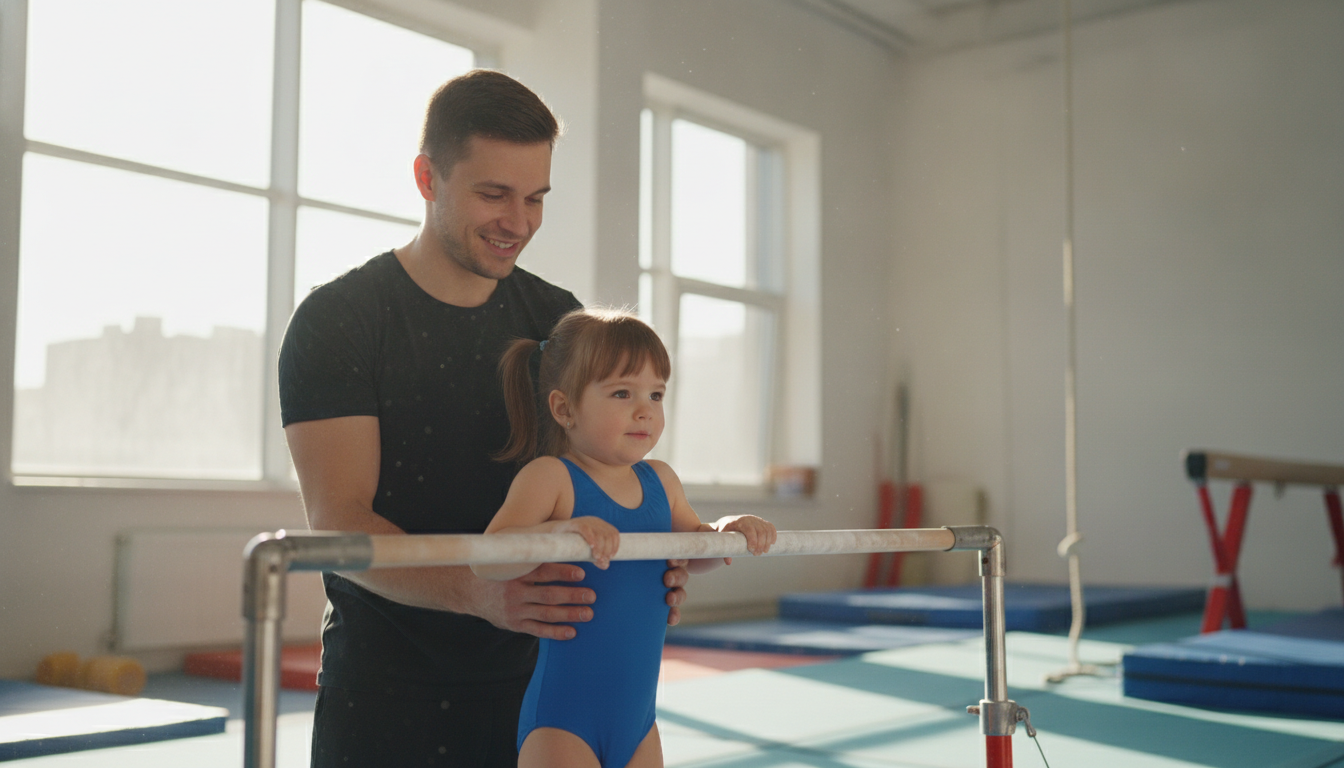
This is the question cautious parents ask and most gym pages skip, so here is the honest version. Yes, gymnastics carries injury risk, like any sport, but the nuance is reassuring. Recreational gymnasts get hurt far less often than competitive ones, roughly 2.76 injuries per 1,000 hours of participation versus about 5.39 for competitive athletes, because risk climbs with training volume. Children training five or more hours a week face notably higher risk than those doing under three.
In context, the overall rate is unremarkable. US emergency-department data on youth gymnastics injuries puts the rate at around 4.8 per 1,000 participants, comparable to soccer, basketball, and cheerleading. Most injuries are to the lower body (about 61%), and sprains and strains make up roughly 29% of those treated in emergency rooms, the everyday bumps of an active childhood rather than catastrophic events.
What keeps risk low is ordinary and within your control: qualified coaches, proper skill progression, apparatus matched to the child's size, soft matting, and keeping young children at the recreational level. A good club does all of this as a matter of course.
How to choose a gymnastics class
The right class turns all of the above from possible into likely. Use this checklist when you visit or enroll:
- Qualified, background-checked coaches. Ask about coaching certifications and safeguarding checks. This is non-negotiable.
- Sensible group sizes. Enough coach attention that your child is spotted and corrected, not lost in a crowd.
- Age-appropriate apparatus and progressions. Skills built up in small steps on equipment matched to the child, never rushed.
- A recreational-first philosophy for young children. Fun and fundamentals before competition.
- A welcoming, encouraging culture. Children should leave keen to come back.
- Easy admin. Clear schedules and simple online booking and payment, so signing up takes minutes instead of a paper form and a phone call.
That last point is easy to overlook until you are juggling a waitlist and a missed payment. The smoothest clubs let you browse classes and enroll online in a few minutes, and the coaches running them lean on a good library of gymnastics drills for kids and gymnastics games and warm-ups to keep every session moving.
If you run a club yourself, the admin side is where a lot of goodwill is won or lost. Strong gymnastics lesson plans keep the floor running, and getting bookings, registrations, and payments into one place is what frees coaches to coach. Our roundup of the best gymnastics management software compares the tools that do it.
Key takeaways
- Gymnastics is a rare all-rounder: it builds physical strength and coordination, cognitive focus and memory, social skills, and confidence, often in the same class.
- The evidence is real. Studies link gymnastics to better spatial working memory in 7-to-10-year-olds, improved balance in preschoolers, and stronger motor skills in young children.
- Benefits start in toddlerhood and shift with age, from movement play at 2-3 to skill mastery and a recreational-or-competitive choice by 10-12.
- It can suit neurodiverse children too, with predictable routines and sensory input, though it is a supportive activity, not a therapy.
- Gymnastics is reasonably safe at the recreational level, with injury rates similar to soccer and basketball and far lower than competitive training.
- A good class means qualified coaches, sensible group sizes, step-by-step progressions, a welcoming culture, and easy online booking.
FAQs
At what age can a child start gymnastics?
As early as walking age. Parent-and-child "gym tots" classes take children from around 18 months to 2 years, focused on guided play and basic movement. Structured preschool gymnastics usually starts around 3, and most children can join a recreational class by 4 or 5.
What are the main benefits of gymnastics for children?
The benefits fall into four groups: physical (strength, flexibility, balance, coordination), cognitive (focus, memory, spatial awareness), social and emotional (taking turns, listening, emotional regulation), and confidence and character (resilience, discipline, self-esteem). Most children get the full set from recreational classes alone.
Is gymnastics safe for kids?
For recreational gymnasts, yes. Injury rates at the recreational level are far lower than in competitive training and comparable to soccer or basketball, and most injuries are minor sprains and strains. Qualified coaches, proper progressions, and soft matting keep the risk low.
Does gymnastics help with brain development and school?
There is good evidence it helps. One study found eight weeks of gymnastics improved spatial working memory in 7-to-10-year-olds, and the sequencing, focus, and instruction-following the sport demands map directly onto classroom skills.
Is gymnastics good for children with ADHD or autism?
It can be a strong fit. The predictable routines, clear progressions, and proprioceptive input suit many neurodiverse children, and early research found gymnastics improved executive function in autistic children aged 6 to 9. Ask clubs about inclusive or small-group classes.
How many hours a week should a child do gymnastics?
For recreational benefit, one or two hours a week is plenty and keeps injury risk low. Five or more hours a week is competitive-level training and carries notably higher risk, so it is not necessary or advisable for most children.
Does my child need to be flexible or athletic to start?
No. Recreational classes are designed for beginners of all abilities and body types, and flexibility and strength are things gymnastics builds, not things a child needs first. The starting point is simply a willingness to try.
What should kids wear to gymnastics?
Comfortable, close-fitting clothing they can move in freely, such as a leotard, shorts, or leggings with a fitted top, and bare feet or grip socks. Avoid anything baggy that could catch on apparatus, and remove jewelry. Most clubs will tell you their specifics when you enroll.
Is gymnastics better for boys or girls?
It benefits both equally. Gymnastics builds strength, coordination, focus, and confidence regardless of gender, and many clubs run mixed recreational classes for young children before any split into discipline-specific training.
Will gymnastics help with other sports?
Yes. The body awareness, core strength, balance, and coordination gymnastics develops transfer to almost every other sport, which is why it is often recommended as a foundation activity before children specialize.
How do I find a good gymnastics class near me?
Look for qualified, background-checked coaches, sensible group sizes, age-appropriate equipment, and a welcoming, recreational-first culture for young children. Visit if you can, watch a class, and favor clubs that make scheduling and booking simple. Gymnastics is a rare all-rounder: physical, cognitive, social, and confidence gains, backed by research and available to most children at the recreational level with low risk. If you are weighing up activities, watch a class or two, trust what your child gravitates to, and start them recreational.