


A child decides they want to "do gymnastics" in the living room, or a new coach has a class on Saturday and a blank plan in front of them. Both need the same thing: a set of drills that are safe on a soft floor, simple enough to repeat, and actually building toward real skills. This guide gives you 25+ gymnastics drills for kids, grouped by skill area and banded by age 3 to 12. Every drill names the skill it builds, one coaching cue, and the common mistake to fix. We built Pembee for gymnastics clubs, so this is written from the coaching side of the mat.
What makes a good kids' gymnastics drill
A good drill for kids is safe, short, and pointed at a real skill. You should be able to set it up on a carpet or a folded mat, run it in under a minute, and repeat it without a child losing form or interest. The best drills also ladder toward something: a shape becomes a handstand, a tuck jump becomes a vault.
Every drill below builds one of the four foundations coaches train in every class:
- Shape and strength - the hollow, the arch, and the core and shoulder strength that hold them.
- Balance - controlling the body over a small base, the root of all beam work.
- Tumbling - rolls, bridges, cartwheels, and handstands on the floor.
- Jumping and landing - taking off with a tight body and landing soft and controlled.
There is a fifth area, bars and upper body, which needs a safe bar at home. We cover it last. Get a child solid across the foundations and the named skills (cartwheel, round-off, pull-over) come far faster than drilling the skill cold.
Before you start: safety and setup
Gymnastics is a contact-with-the-floor sport, so the floor matters more than anything. Clear roughly 6 by 6 feet of space, away from furniture corners, coffee tables, and the edge of a hard hearth. Carpet works for most drills; a folded camping mat or a couple of couch cushions add a softer landing for jumps and rolls.
Warm up first, every time. Cold joints and a racing-into-it child are how minor drills turn into knocks. A two to three minute pulse-raiser plus some shape work is enough. Our library of gymnastics warm-up games has ready-to-run options if you want a structure.
Here is the line almost no at-home guide draws clearly, and the one that matters most: some skills are safe to practice at home on a soft surface, and some genuinely need a coach and proper matting. The difference is head, neck, and landing risk.
The rule of thumb: if a skill puts a child upside down while moving fast or travels their weight over their head, it belongs in a gym with a coach spotting and a crash mat underneath, not on a bedroom carpet. Everything in the safe column is fair game at home. When in doubt, follow your governing body's supervision and spotting guidance: USA Gymnastics in the US or British Gymnastics in the UK.
Drills by skill area
These are the four foundations coaches build every class from, plus a short bars section for anyone with a safe bar at home. For each drill you get a one or two line how-to, the skill it builds toward, one coaching cue, and the common mistake to watch for.
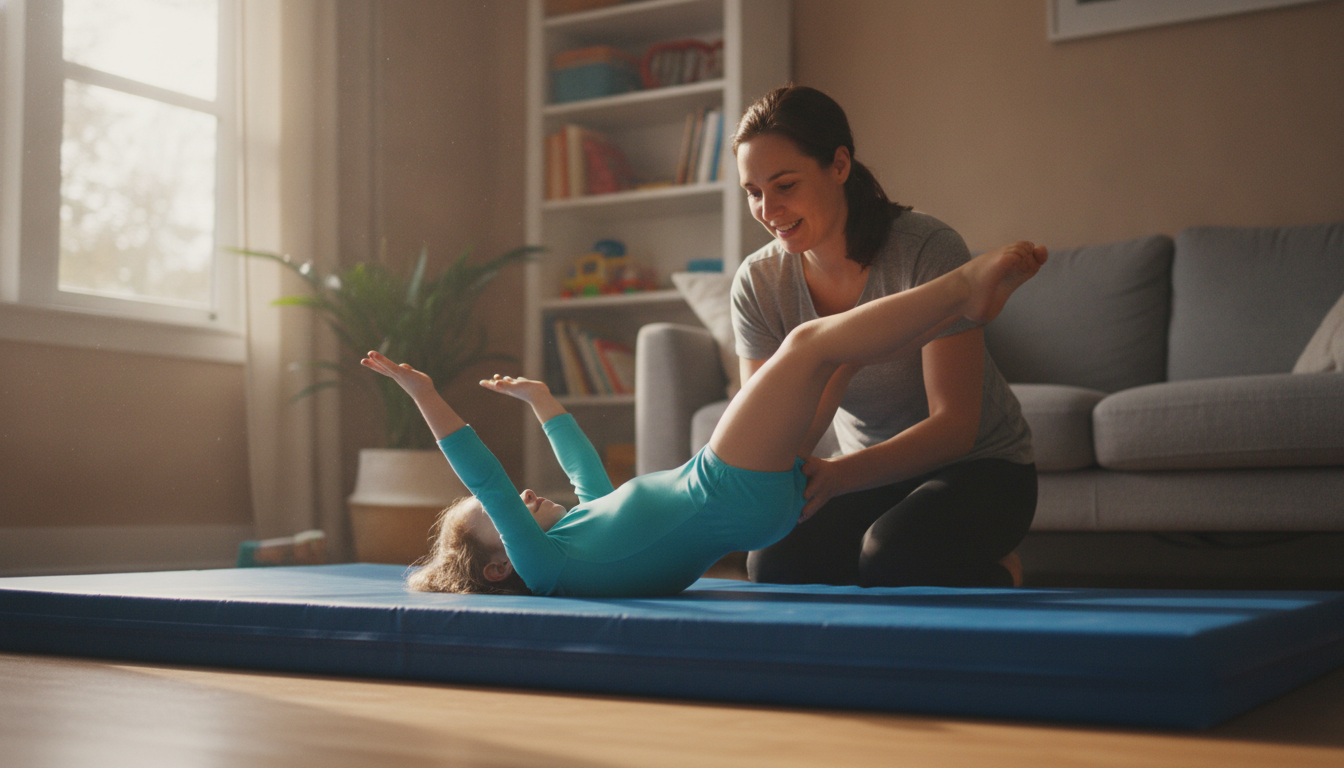
Shapes and strength drills
Shapes are the alphabet of gymnastics. A coach can spot a strong hollow or arch from across the gym, and almost every skill is just a shape moving through space. These also build the core and shoulder strength that makes everything else possible.
- Hollow hold - Lie on the back, arms by the ears, lift shoulders and legs a few inches, lower back pressed flat. Builds toward: the handstand and casting on bars. Cue: "squeeze your belly and press your back into the floor." Mistake: arching the lower back so a hand slides under it.
- Arch / Superman hold - Lie face down, arms and legs lifted, body in a banana shape. Builds toward: the bridge and all back skills. Cue: "reach long, fingers and toes away from each other." Mistake: bending the knees instead of lifting from the hips.
- Bear crawl - Crawl forward on hands and feet with knees off the floor and hips high. Builds toward: shoulder strength for tumbling. Cue: "move the same hand and foot together, keep your bum down." Mistake: hips rising into a downward-dog peak.
- Crab walk - Sit, hands behind, lift hips level and walk forwards and backwards. Builds toward: shoulder and tricep strength, bridge prep. Cue: "push your hips up to the ceiling." Mistake: letting the bottom sag toward the floor.
- Frog jumps - Squat low, hands down, jump forward landing soft in the squat. Builds toward: leg power for jumps and tumbling. Cue: "land quiet like a frog." Mistake: standing up tall between jumps instead of staying low.
- Plank, front and side - Hold a straight body on forearms, then rotate to one forearm for the side plank. Builds toward: the body tension every skill needs. Cue: "straight line from head to heels." Mistake: hips sagging or piking up.
- Tuck sit / V-sit hold - Sit, lift the feet off the floor, hold knees tucked, then progress to straight legs in a V. Builds toward: leg lifts on bars, compression strength. Cue: "sit tall, don't round your back." Mistake: leaning so far back the chest collapses.
Balance drills
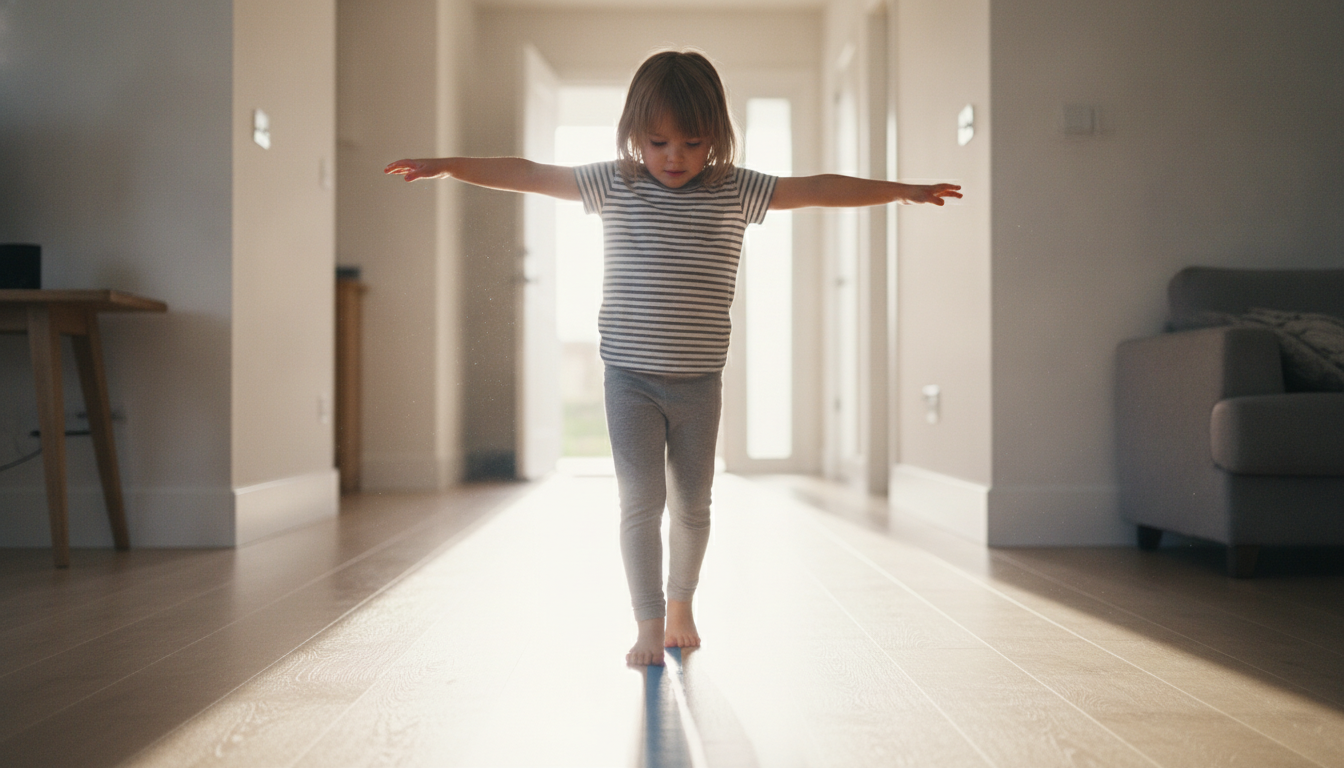
Balance is controlling the body over a small base, and it is the root of every beam skill. None of these need a real beam. A strip of tape on the floor is safer and does the same job.
- Tape-line walking - Walk a taped floor line forward, backward, sideways, and heel-to-toe. Builds toward: beam confidence and foot placement. Cue: "eyes on a fixed point ahead, not on your feet." Mistake: looking down, which drops the chest and the balance with it.
- One-foot "star" hold - Stand on one foot, arms out wide, hold for ten seconds, then switch. Builds toward: the scale and single-leg control. Cue: "squeeze the standing leg straight and strong." Mistake: the standing knee bending and wobbling.
- Slow-motion freeze - Walk the line in slow motion, then freeze on a coach's call and hold. Builds toward: control under pressure and stillness on beam. Cue: "move slow, freeze like a statue." Mistake: rushing the freeze instead of catching it on balance.
- Releve walks - Walk the line up on the toes, heels high. Builds toward: ankle strength and the lifted posture beam demands. Cue: "grow as tall as you can." Mistake: dropping the heels between steps.
- Bean-bag balance - Walk the line with a bean bag (or rolled sock) balanced on the head. Builds toward: posture and a still upper body. Cue: "head up so the bag stays put." Mistake: tipping the head forward to watch the line.
Floor and tumbling drills
This is the section kids ask for. It is also where the safe-at-home line matters most, so flag the cautions as you go. Rolls, handstands, and cartwheels are fine on a soft floor. Bridges into walkovers are a coach-only progression.
- Forward roll - From a squat, hands down, tuck the chin to the chest and roll over the back of the head and shoulders to the feet. Builds toward: tumbling comfort and round-off later. Cue: "chin to chest, look at your belly button." Mistake: rolling on the top of the head instead of tucking.
- Backward roll - From a squat, sit, roll back, push hard through the hands placed by the ears to lift the head clear. Builds toward: back tumbling and body awareness. Cue: "push the floor away with your hands." Mistake: turning the head to one side, which is unsafe; keep it straight and push through the hands.
- Log roll - Lie straight, arms overhead, roll the whole body sideways keeping it long and tight. Builds toward: body tension and the straight shape for later rolls. Cue: "stay long like a pencil." Mistake: bending in the middle so the roll wobbles off line.
- Bridge and bridge rocks - Lie on the back, hands by the ears, push up into a bridge, then rock gently forward and back over the hands. Builds toward: back flexibility for the backbend and walkover (coach-only). Cue: "push through your hands and straighten your arms." Mistake: keeping the feet too far from the hands so the shoulders cannot open. Stop here at home; the walkover needs a coach.
- Cartwheel - From a lunge on a taped line, hand-hand-foot-foot along the line, legs passing overhead. Builds toward: the round-off and side tumbling. Cue: "big strong lunge, look at your hands." Mistake: turning it into a bent-arm crumble; keep the arms and legs straight.
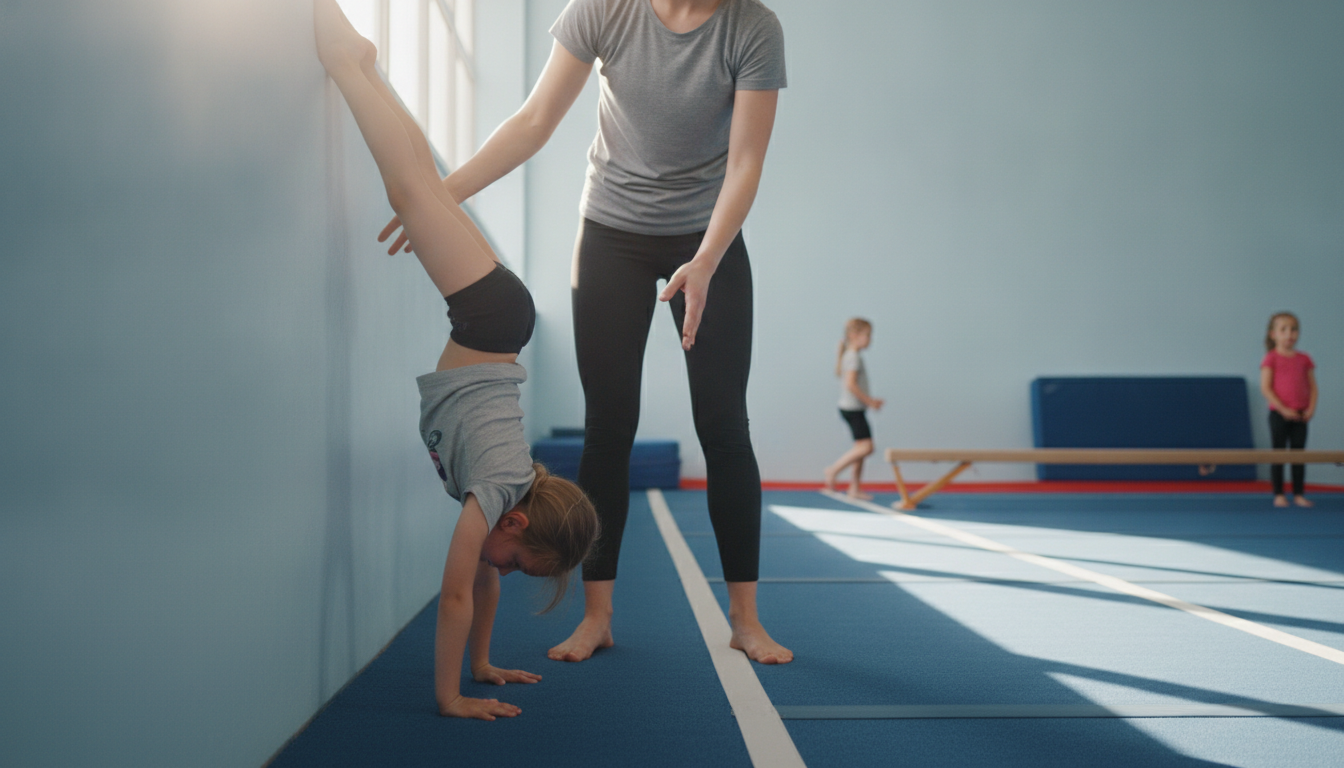
- Wall handstand (Spider-Man walk-up) - Start facing away from the wall in a plank with feet on the wall, walk the feet up and hands in toward the wall. Builds toward: the free handstand and the cartwheel shape. Cue: "squeeze everything tight, ears between your arms." Mistake: banana-ing the back; keep the hollow shape from the strength drills.
Jumping and landing drills
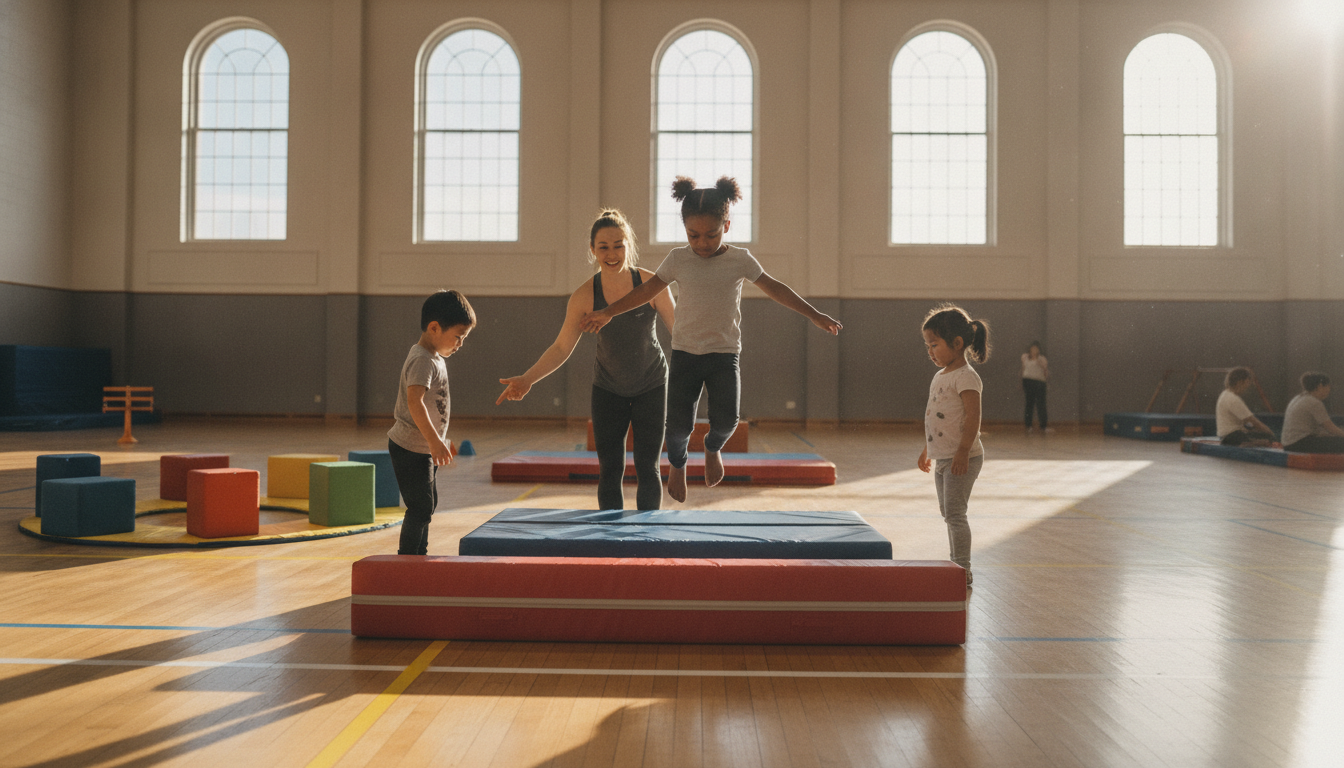
Landing comes before jumping. A child who can land soft and controlled is ready for vault and floor tumbling; a child who lands stiff is one awkward step from a rolled ankle. Teach the freeze first.
- Straight jump - Jump straight up, body tight, arms by the ears, land soft. Builds toward: every jump and the shape for vault. Cue: "arms up, tight body, freeze the landing." Mistake: throwing the arms back and breaking the straight line.
- Tuck jump - Jump and pull both knees to the chest, then land soft. Builds toward: aerial body awareness and floor jumps. Cue: "knees to your hands, not hands to your knees." Mistake: dropping the chest to meet the knees instead of lifting the knees.
- Straddle / pike jump - Jump and open the legs to a straddle or lift them straight in a pike, hands reaching to the toes. Builds toward: flexibility and shape in the air. Cue: "lift your legs to your hands." Mistake: folding forward at the chest instead of lifting the legs.
- Stick-the-landing drill - Jump off a low cushion, land on two feet, bend the knees, and freeze for three seconds. Builds toward: safe landings for every skill. Cue: "land soft and quiet, then freeze." Mistake: landing stiff-legged or stumbling a step out.
- Hurdle-and-punch - Run a few steps, hurdle (one big skipping step), and punch off two feet into a straight jump. Builds toward: the vault run-up and round-off entry. Cue: "fast feet, then a quick two-foot punch." Mistake: a slow, heavy landing on the punch instead of a snappy bounce.
This is the foundation of safe vault. No child should attempt apparatus vault until the landing freeze is automatic.
Bars and upper-body drills
Bars need a safe bar: a park monkey bar, a sturdy doorway pull-up bar, or a low bar at a gym. Check it holds the child's weight and that there is a soft surface underneath. For home options, our gymnastics equipment list covers what is worth buying.
- Dead hang - Hang from the bar with straight arms, shoulders active, for ten to twenty seconds. Builds toward: grip strength for every bar skill. Cue: "long strong arms, squeeze the bar." Mistake: shrugging up into the shoulders instead of hanging long.
- Tuck hang / leg lifts - From a dead hang, lift the knees to the chest, then lower with control. Builds toward: the pull-over and core strength. Cue: "lift with your belly, not a swing." Mistake: kicking and swinging to cheat the lift.
- Pull-over with help - On a low bar, with a hand supporting the back, pull the bar to the hips and roll the legs over the top to a front support. Builds toward: the pull-over as a first bar skill. Cue: "pull the bar to your tummy, then look for your toes over the bar." Mistake: leaving the hips too far from the bar to roll. This one needs a low bar and a helping hand.
- Cast - From a front support on a low bar, push the bar away and lift the hips slightly off it, then return. Builds toward: casting to handstand later. Cue: "push the bar away and squeeze a hollow shape." Mistake: bending the arms instead of pushing tall through them.
Match drills to your child's age
Age changes what a child can hold, control, and stay interested in. These bands are guidance, not hard rules; a strong 5-year-old may reach into the next band, and that is fine. Use it to pick a handful of drills, not to limit a keen child.
| Age band | Focus | Best drills | What to avoid |
|---|---|---|---|
| 3-5 (preschool) | Play-led movement, short bursts | Animal walks, log and forward rolls, tape-line walking, two-foot jumps, dead hangs | Sustained strength holds, anything inverted with rotation |
| 6-8 (early rec) | Shapes and first skills | Hollow and arch holds, cartwheel, wall handstand, tuck jumps, backward roll, one-foot holds | Bridges into walkovers, high or raised balance |
| 9-12 (developing rec) | Combinations and conditioning | Handstand-to-cartwheel, round-off prep, jump series, plank and V-sit conditioning, cast on bars | Unsupervised back-tumbling, vault at home |
Short, frequent drill sessions also count toward the activity children need; the CDC recommends that kids aged 6 to 17 get at least 60 minutes of physical activity a day, and gymnastics covers strength, balance, and bone-loading movement in one go. Preschoolers learn through play and rotate fast, so keep each drill to two or three minutes and dress it up as a game. Early rec gymnasts can hold a shape and chase a real skill, which is when cues start to land. By 9 to 12, children can combine drills and take on real conditioning, but the safety line is unchanged: back-tumbling and vault stay in the gym. If you want the reasons gymnastics suits this whole age range, our piece on the benefits of gymnastics for children makes the case.
Turn drills into a 30-minute session
Drills are more effective strung into a session than thrown out at random. Whether you are a parent at home or a coach with a new class, the same shape works: warm up, rotate through a few skill stations, then cool down.
- Warm-up (5 minutes) - A pulse-raiser and some shapes: a quick tag game plus hollow and arch holds.
- Skill stations (20 minutes) - Three or four drills, 4 to 5 minutes each, rotating between them. Mix one drill from two or three different skill areas so the body is not overloaded in one place.
- Cool-down (5 minutes) - Gentle stretching and a calm finish: pike sit, straddle sit, and a few slow breaths.
Here is one worked session for a 6 to 8 year old:
- Warm-up: a tag game plus 20-second hollow and arch holds (5 min).
- Station 1, tumbling: forward rolls and the Spider-Man wall handstand (5 min).
- Station 2, balance: tape-line walking forward, backward, and on toes (5 min).
- Station 3, jumping: straight jumps and the stick-the-landing freeze (5 min).
- Station 4, strength: bear crawl and frog jump relay (5 min).
- Cool-down: pike and straddle stretches, slow breathing (5 min).
For ready-made plans by age, our gymnastics lesson plans give full templates you can run this week.
Common mistakes coaches see
The same handful of errors show up across living rooms and rec classes alike. Each has a one-line fix.
- Rushing to the skill before the shape is solid. A cartwheel built on a weak handstand stays messy for years. Fix: drill the hollow and wall handstand until they are clean, then chase the skill.
- Skipping the warm-up. Cold kids pull and tweak things. Fix: two or three minutes of movement and shapes, every single time.
- Practicing on a hard or cluttered floor. A coffee-table corner is the most common at-home injury. Fix: clear the space and put something soft down for jumps and rolls.
- Muscling skills instead of using technique. A child who forces a skill builds a habit a coach later has to undo. Fix: slow it down and reward clean shape over a finished skill.
- Too many reps until form falls apart. The tenth sloppy roll teaches the wrong pattern. Fix: stop the set while it still looks good.
- Attempting coach-only skills at home. Back handsprings on a bed end badly. Fix: keep to the safe-at-home column and leave back-tumbling, beam, and vault to the gym.
Home equipment substitutes
You do not need to buy gym kit to run the safe-at-home drills. A few household swaps cover most of it.
| Gym equipment | Safe home substitute |
|---|---|
| Balance beam | A line of tape on the floor (never a raised surface at home) |
| Landing mat | A folded duvet or couch cushions, for jump-down drills only |
| Bars | A sturdy doorway pull-up bar or park monkey bars |
| Floor strip | Carpet or a yoga / exercise mat |
| Wedge mat | A couch cushion for gentle downhill rolls |
One caution: these substitutes are for the at-home-safe drills only. They are not a replacement for proper matting in a gym, and a club buying real apparatus needs gym-grade kit, not household swaps.
Key takeaways
- Pick a few drills that match your child's age band rather than working through the whole list at once.
- Build the shape before the skill: a clean hollow and wall handstand make the cartwheel and round-off come faster.
- Keep sessions short and on a soft, clear floor, and always warm up first.
- Stay in the safe-at-home column. Back-tumbling, raised beam, and vault need a coach and proper matting.
- String drills into a simple warm-up, stations, cool-down session for the best results.
- Name the skill each drill builds toward; it motivates kids and keeps practice purposeful.
Where to go next
Pick a few drills for your child's age, keep the sessions short and on a soft surface, and build the shape before the skill. That is the whole method, and it is the same one a good coach uses on the floor.
The lesson plans and warm-up games linked above turn these drills into full sessions, and the equipment list covers what to buy once a child is committed. If you are thinking about coaching yourself, here is how to become a gymnastics coach. And if you already run classes of your own, our roundup of the best gymnastics management software compares the tools that keep the admin side out of your evenings.
FAQs
What age can kids start gymnastics drills?
Children can start play-based movement at 2 to 3, mostly animal walks, rolls, and simple jumping dressed up as games. More structured drills with cues and repetition suit around age 5 to 6, when attention span and body control catch up. Keep everything age-appropriate and short, and let preschoolers play rather than drill.
How long should a kid practice gymnastics at home?
Ten to twenty minutes is plenty, and short frequent sessions beat one long one. A young child loses form and focus past about fifteen minutes, so two short sessions across a week build more than a single marathon. Stop while the drills still look clean rather than grinding out tired reps.
Which gymnastics skills are safe to practice at home?
Rolls, shapes and balance holds on the floor, wall handstands, cartwheels on a line, and straight or tuck jumps onto a cushion are all safe on a soft, clear floor. Skills that put a child upside down while moving fast, like back handsprings, walkovers, vault, and anything on a raised beam, need a coach and proper matting. Use the safe versus needs-a-coach split earlier in this guide as your checklist.
What gymnastics drills build a cartwheel?
The cartwheel sits on top of a strong handstand shape, so the wall handstand and hollow hold come first. Add lunge practice and hand-hand-foot-foot along a taped line so the legs learn to pass overhead in order. Keep the arms and legs straight and the lunge big; a bent-arm cartwheel is the most common fault to fix early.
How do I teach my child a handstand?
Start with the hollow hold so they learn the tight straight shape, then move to the Spider-Man wall walk-up, climbing the feet up the wall into a handstand. Cue them to squeeze everything tight with the ears between the arms and avoid arching the back. Build the hold against the wall before working toward a free handstand on the floor.
Do kids need equipment for gymnastics drills?
No. Most safe-at-home drills need only a clear soft floor, a strip of tape for a balance line, and a couple of cushions for jump landings. A doorway pull-up bar or park monkey bars add the bars drills. Our equipment list covers what is worth buying once a child is committed.
What is the most important gymnastics skill for a beginner?
The body shapes, especially the hollow and the arch, plus a soft controlled landing. Almost every gymnastics skill is a shape moving through space, so a child with a strong hollow learns handstands, cartwheels, and bar skills far faster. Landing safely matters just as much, since it keeps the child injury-free as the skills get bigger.
Are gymnastics drills safe for a 4-year-old?
Yes, the play-led ones are: animal walks, log and forward rolls, tape-line walking, and two-foot jumps suit a 4-year-old well. Keep each drill to two or three minutes, supervise closely, and skip sustained strength holds and anything inverted with rotation. At this age the goal is movement and fun, not polished skills.
Do these drills replace a gymnastics class?
No. They supplement a class and give a keen child something to practice between sessions, but they do not replace it. A coach provides spotting, structured progression, and proper matting that make the bigger skills safe to learn, none of which a living room can offer. Treat home drills as practice for the foundations and let the gym handle the rest.