
Gymnastics Equipment List: All the Names, Uses & Costs


Most people who search for a gymnastics equipment list want one of two things: to learn what each apparatus is, or to plan and budget a floor. The trouble is that the detailed reference articles skip cost and space, and the gym-planning articles skip the apparatus detail. This guide covers both. You get every apparatus, mat, and accessory with dimensions and uses, plus what each costs, how much floor space it needs in use, and a tiered checklist for building a home setup, a rec gym, or a competitive club.
The short version: a complete floor is artistic apparatus (beam, bars, vault, floor for women; floor, pommel, rings, vault, parallel bars, high bar for men), the mats and landing systems that go around them, foam pits and training aids, the small accessories every gymnast needs, and rhythmic or trampoline gear if you run those programs.
The Core Gymnastics Apparatus
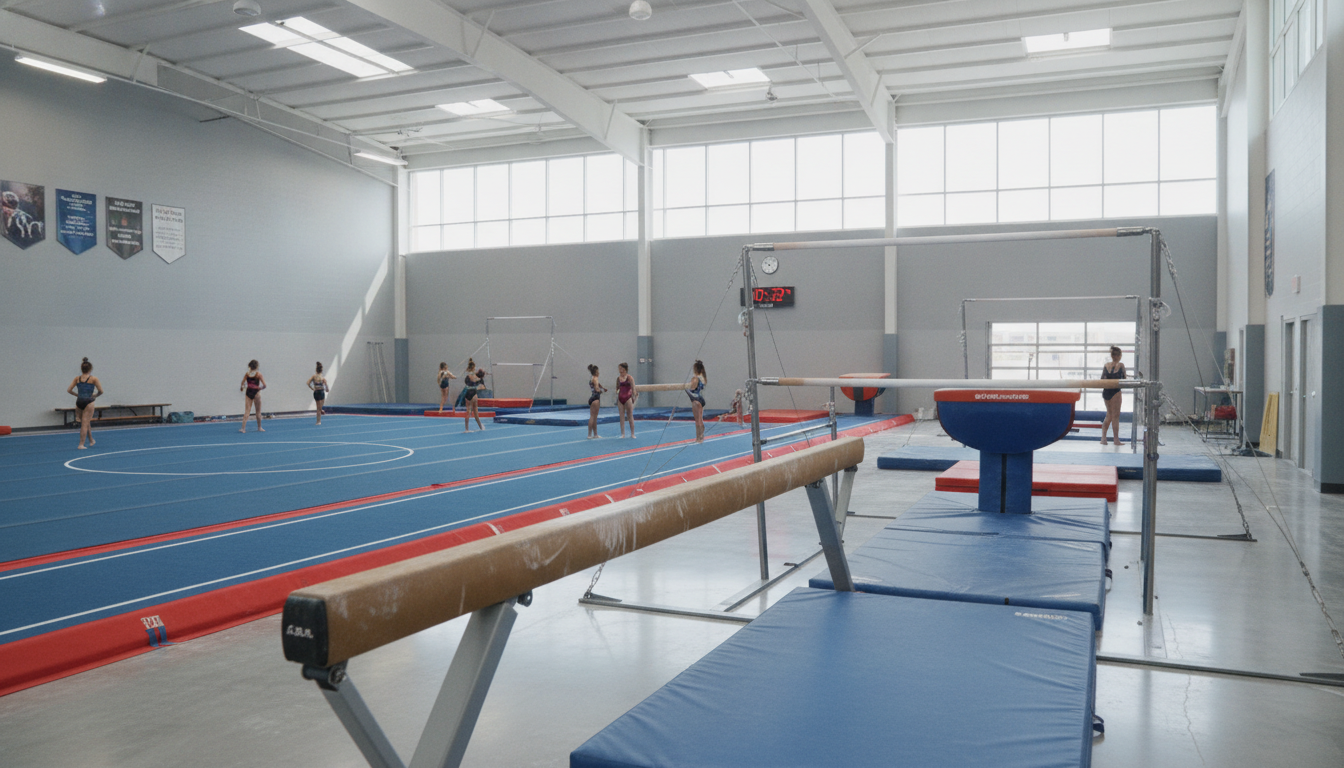
Artistic gymnastics, the discipline most people picture, splits into two programs. Women compete on four apparatus and men on six, with floor and vault shared in different forms. These are the load-bearing, competition-grade pieces, and they sit at the center of any equipment list. Official dimensions are set by the Fédération Internationale de Gymnastique (FIG), the sport's world governing body, though rec-grade versions are often shorter or adjustable.
| Apparatus | Discipline | Key dimensions | What it's for |
|---|---|---|---|
| Balance beam | Women | 5 m long, 10 cm wide, 1.25 m high | Balance, turns, leaps, dismounts |
| Uneven bars | Women | High bar ~2.5 m, low bar ~1.7 m, set apart | Swing, release, transition skills |
| Vault | Both | Adjustable table, runway up to 25 m | Explosive run-and-jump skills |
| Floor | Both | 12 x 12 m sprung floor | Tumbling, leaps, dance passes |
| Pommel horse | Men | Padded body with two pommels | Circles and leg-swing work |
| Still rings | Men | 2.75 m high, 50 cm apart | Strength holds and swings |
| Parallel bars | Men | ~3.5 m long, adjustable height | Support swings and holds |
| High bar | Men | 2.75 m high, single steel bar | Giants, releases, dismounts |
Women's Artistic Apparatus
The balance beam is a padded beam 5 meters long and just 10 centimeters (about 4 inches) wide, set 1.25 meters (around 4 feet) off the floor. Gymnasts perform leaps, turns, and dismounts on a surface narrower than a hand span, which is why matting on both sides is non-negotiable.
The uneven bars are two fiberglass-and-wood rails at different heights, the high bar around 2.5 meters and the low bar around 1.7 meters, set apart so a gymnast can swing and release between them. This is the apparatus that needs the most overhead clearance and the most matting underneath.
The vault is a runway of up to 25 meters leading to a springboard and a padded vaulting table. The gymnast sprints, hurdles onto the board, and pushes off the table for an aerial skill. The table itself is small, but the runway and landing zone make it one of the longest footprints in the gym.
Floor exercise takes place on a 12-by-12-meter sprung floor, a layer of foam and plywood over springs that returns energy for tumbling. Women's floor routines combine tumbling passes with dance and leaps, set to music.
Men's Artistic Apparatus
Men share the floor and vault with women but compete on four more apparatus. The pommel horse is a padded body topped with two handles, or pommels, used for continuous circular leg work that demands constant support on the arms.
Still rings hang from a tall frame so the rings sit about 2.75 meters off the floor, with the two rings set roughly 50 centimeters apart. Gymnasts perform strength holds, swings, and dismounts while the rings stay as still as possible, which is the hardest part.
Parallel bars are two flexible rails about 3.5 meters long, set at adjustable height and width, used for support swings, holds, and releases. The high bar is a single steel bar 2.75 meters off the ground that gymnasts swing around for giant rotations, release moves, and high dismounts. Like the uneven bars, both need generous matting and ceiling height.
Mats and Landing Systems
Mats are the category that costs the most over time and matters most for safety, so plan them before the apparatus. A complete floor uses several types, each for a different job.
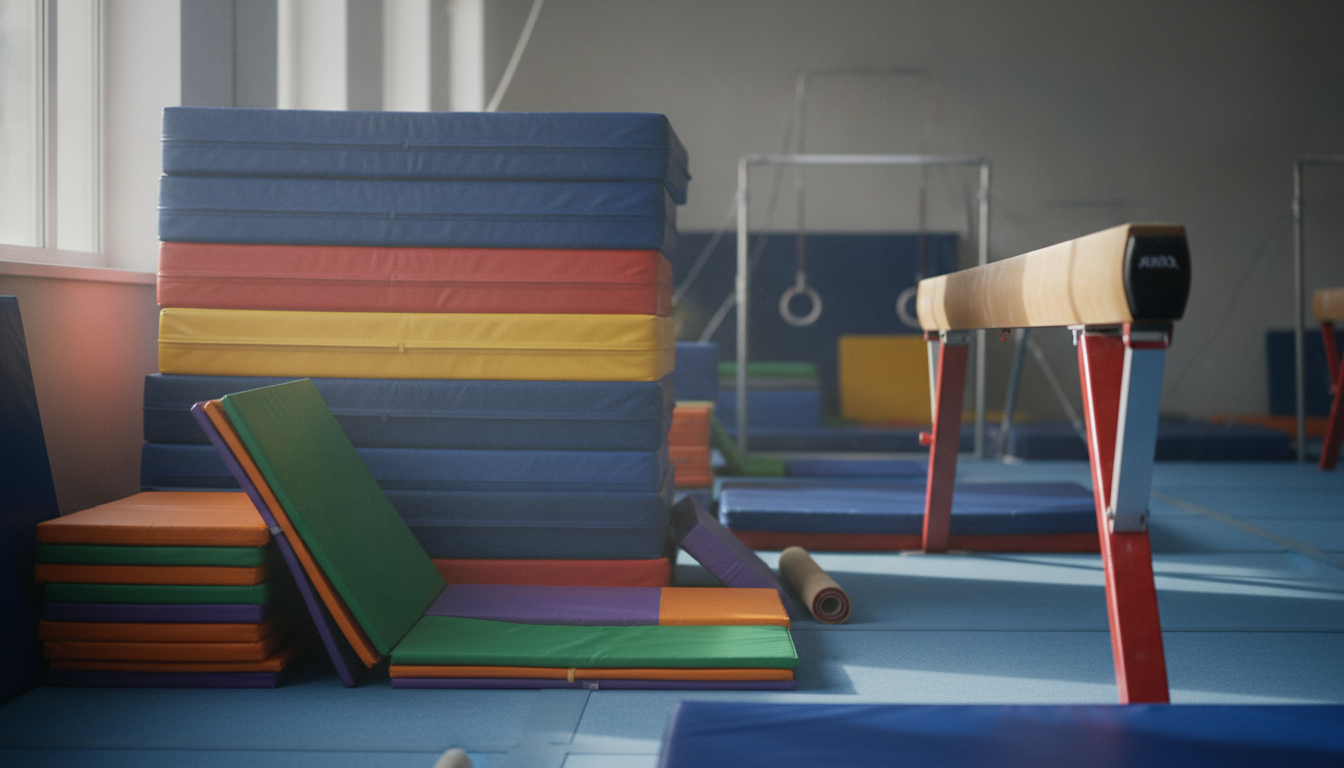
The sprung floor is the foundation for tumbling, a system of foam, board, and springs sized at 12 by 12 meters for competition. Landing or crash mats are thick foam cushions placed at dismount points to absorb impact. Folding panel mats, typically 4 feet by 8 feet and 1.5 inches thick, are the everyday workhorse for floor drills and stations; under bars you want 2 inches or more.
Incline or cheese mats are wedge-shaped foam blocks that help beginners roll and learn handsprings with gravity's help. Throw mats are thin, light mats a coach can drop onto a landing spot mid-skill. Wedges, octagons, and barrel shapes round out the soft-skills kit for younger classes.
Air tracks and air floors are inflatable tumbling strips, usually 10 to 20-plus feet long and available in 4, 6, or 8-inch thicknesses. They cost far less than a full sprung floor, pack away, and have become the standard lower-cost tumbling surface for home users and small gyms.
Matting requirements are apparatus-specific and tie directly to safety and insurance. Put matting on both sides of every beam, run 4 to 6 inches of matting under bars, and surround any vault landing zone. Where a club trains big dismounts, a foam pit or resi pit replaces stacked mats entirely.
Foam Pits, Trampolines, and Training Apparatus
These pieces are not competition apparatus. They are the progression tools that let gymnasts learn big skills safely before taking them to the real thing.
A foam pit is a recessed pit filled with foam cubes that swallows a hard landing, used for learning dismounts, vaults, and release moves. A resi (resilient foam) pit is a firmer covered version that bridges the gap between the loose pit and a competition mat. In-ground pits cost more and need a dug-out floor; above-ground versions are cheaper to install.
Trampolines, tumble tracks, mini-tramps, and rod floors give gymnasts extra rebound to drill twisting and somersaulting before they perform a skill on the floor or off an apparatus. Spotting blocks, octagons, wedges, and mushroom trainers (a domed version of the pommel horse) build the preschool and entry-level skills that feed the rest of the program. Treat all of these as training aids: they develop skills, but they do not appear in a competition lineup.
Accessories and Small Equipment
The small stuff is cheap per item but adds up, and every gymnast needs it, so it belongs on a complete list.
Chalk, which is magnesium carbonate, dries the hands and improves grip on bars and beam; you will also want a chalk bowl or storage tray. Hand grips are leather straps worn on the bars to protect the palms and improve bar contact, sold in dowel and no-dowel versions for different levels. Wrist guards and braces support tumbling and pommel work.
Spotting belts and overhead spotting rigs let a coach support a gymnast through a new skill, either handheld or on an overhead pulley for somersaults. Beam pads and bar pads soften the apparatus for drills, and a grip bag keeps each gymnast's kit together. None of these is expensive on its own, but a full roster of gymnasts turns them into a recurring line in the budget.
Rhythmic, Trampoline, and Other-Discipline Equipment
Many clubs run more than artistic gymnastics, and each added discipline brings its own gear.
Rhythmic gymnastics uses five hand apparatus on a carpeted floor: a ball (18 to 20 centimeters, around 400 grams), a hoop (80 to 90 centimeters, around 300 grams), a rope (traditionally hemp with knotted ends), a pair of clubs (about 150 grams each), and a ribbon (around 7 meters on a stick). The apparatus are inexpensive, but a dedicated rhythmic carpet is the real cost.
Trampoline gymnastics is its own competitive sport with a large sprung bed (roughly 5.05 by 2.91 meters) set in a steel frame with safety end decks and surrounding mats. Beyond these, plenty of clubs add preschool, parkour or ninja, cheer, and tumbling programs. Each needs its own kit, from soft-play shapes and obstacle blocks to a warped wall, and we cover the cost of those add-ons in the next section.
How Much Does Gymnastics Equipment Cost?
Prices swing widely, and the single biggest reason is spec. The same apparatus can be a rec-grade trainer or a FIG-certified competition piece, and the gap between them drives most of the spread. The chart below maps typical US price ranges, not quotes. Treat them as planning estimates and confirm current figures with manufacturers before you buy.
The per-item ranges show how wide that spec gap runs. A balance beam is about $50 as a low floor trainer and up to $6,000 at full competition height; bars run from a junior adjustable set to a FIG-spec rig; and a vault spans a lone springboard to a complete table-and-runway setup. Even the flooring splits this way: a few hundred dollars of base matting or rubber long before you commit to a sprung floor.
Two patterns matter for budgeting. The sprung floor, foam pit, and full vault setup are the heavyweights, and together they can account for the majority of a competitive build. Preschool and add-on programs, by contrast, are genuinely cheap to start, which is why many gyms launch them first to test demand before committing to competition apparatus.
How Much Floor Space Does Each Piece Need?
This is the part most equipment lists miss. An apparatus footprint is not the same as the space it needs in use. A vaulting table is small, but the runway and landing turn it into one of the longest setups in the building. Plan for clearance, run-up, and landing zones, not just the apparatus itself.
A small recreational studio running preschool and entry classes can work in a few thousand square feet with air tracks, panel mats, a low beam, and an adjustable bar. A full competitive floor with a 12-meter sprung floor, a 25-meter vault runway, both bars, beam, men's apparatus, and a pit needs several times that, often 8,000 to 12,000-plus square feet, and that is before offices, viewing areas, and storage.
Ceiling height matters as much as floor area. The high bar, still rings, rope climbs, and any release skill on bars need clearance overhead, so check the height of a unit before you sign a lease, not after.
Gymnastics Equipment Checklist by Setup
Use whichever of these three checklists matches your situation. They build on each other, from a compact home setup to a full competitive club.
Home / Beginner Setup
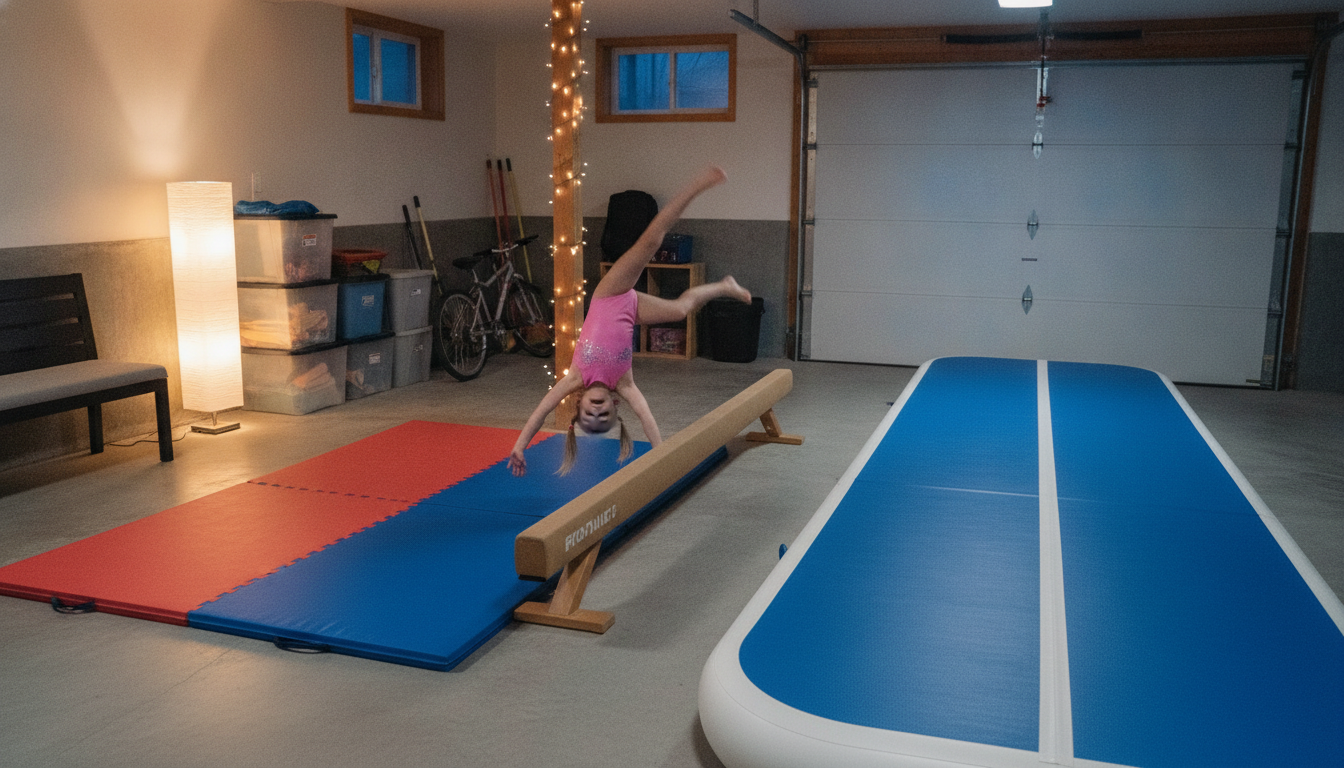
A home setup is about safe practice in a small space, so prioritize compact, foldable gear and matting on both sides of anything raised.
- A folding panel mat (4 x 8 feet) as the base surface
- An adjustable junior bar with a 4 to 6-inch landing mat under it
- A low or floor beam to learn balance skills safely
- An air track or air floor for tumbling
- Awareness of weight limits on junior apparatus, and matting on both sides of the beam
Recreational / Starter Gym
A rec gym needs one of each core apparatus in rec grade, plus the matting and accessories to run classes.
- Base flooring and matting across the training area
- One each of beam, bars, and vault (rec grade), plus a springboard
- Incline and panel mats, and either landing mats or a basic foam pit
- Preschool soft-play shapes and a low beam for entry classes
- The accessory kit: chalk, grips, wrist guards, spotting belts
As a ballpark, a modest starter rec floor built from rec-grade apparatus, base matting, a basic landing system, preschool kit, and accessories often lands somewhere in the low tens of thousands of dollars, before a full sprung floor or in-ground pit. That figure is an estimate built from the ranges above, not a quote; your number depends on spec, supplier, and how much you buy new. Add a competition-spec sprung floor and a foam pit and you move toward six figures.
Competitive Club
A competitive club runs the full lineup to competition spec, which is where the budget climbs.
- Full women's and men's apparatus to FIG or competition certification
- A competition sprung floor
- An in-ground foam or resi pit
- A tumble track and mini-tramps for skill progression
- Overhead spotting rigs and a full matting inventory
The jump in cost from rec to competitive is almost entirely the spec step-up. The apparatus look similar, but certification, materials, and tolerances are what meets and insurers require, and what you pay for.
Buying, Certification, and Maintenance
New vs Used and Where to Source
Used equipment makes sense for low-risk, non-load-bearing items like preschool soft shapes, panel mats in good condition, and low beams. Buy new for anything load-bearing or competition-spec: bars, vault, rings, and the sprung floor. The price difference is real, but so is the liability if a used apparatus fails.
Source from established gymnastics manufacturers rather than general fitness retailers, check the warranty, and confirm the weight rating for the ages you teach. A cheap apparatus that voids your insurance or fails an inspection is not a saving.
Certification and Spec
Rec-grade equipment is built for training and recreational classes. FIG or competition-certified equipment meets the governing-body specification for sanctioned meets, and it is usually what your insurer expects for higher-level training. In the US, your national body's safety and equipment guidance, published by USA Gymnastics, is the reference point for what spec you need at each level. Decide which apparatus actually need competition certification, because that decision drives most of your budget.
Maintenance, Inspection, and Lifespan
Equipment is only safe if it stays safe, so build inspection into the routine rather than waiting for a problem.
- Before every session, do a quick visual check: mats flat and gapped correctly, bolts tight, cables and straps sound, no exposed hardware
- Clean and sanitize mats regularly, following guidance like the CDC's hygiene recommendations, because shared surfaces spread skin infections fast
- On a periodic schedule, check apparatus for wear, retighten fittings, and inspect cables, springs, and foam compression
- Track replacement lifespan: mats and foam compress and lose protection over years of use, grips and straps wear out fastest, and steel apparatus lasts longest if maintained
A short written inspection schedule, assigned to a named coach, is the simplest way to keep this from slipping. It also gives you a record if an insurer or governing body ever asks.
Key Takeaways
- A complete gymnastics floor is four parts: artistic apparatus, the mats and landing systems around them, foam pits and training aids, and the small accessories every gymnast needs.
- Women compete on beam, bars, vault, and floor; men add pommel horse, rings, parallel bars, and high bar, with floor and vault shared.
- Mats are the highest-stakes category for safety and a major ongoing cost; match matting to each apparatus, especially under bars and on both sides of the beam.
- The rec-grade versus competition-spec choice drives most of the budget spread, far more than the choice of apparatus itself.
- Plan space for run-ups, landings, and ceiling height, not just the apparatus footprint; a vault needs up to a 25-meter runway.
- Use the tiered checklist to build the right list for a home, a rec gym, or a competitive club, and start cheap programs first to test demand.
Equipping the floor is only the first job. Once the apparatus is in, the work shifts to filling classes and running the day-to-day, from registers and skill tracking to parent communication. If you are still planning the build, our guide to opening a gymnastics gym walks through the steps and the gymnastics business plan covers the numbers behind the equipment. When the floor is ready and you need to run it, our gymnastics management software is built for exactly that, and our roundup of the best gymnastics management software lays out the options if you want to compare.
FAQs
What is the basic equipment for gymnastics?
The basics are the four core apparatus plus matting. For most beginners that means a balance beam, bars, a vault setup, and a floor or air track, with panel and landing mats around them. At home, a panel mat, a low beam, an adjustable bar, and an air track cover almost everything a young gymnast needs.
What equipment do you need to start a gymnastics gym?
To open, you need base flooring and matting, one each of the core apparatus (beam, bars, vault, floor) in at least rec grade, a landing system or basic foam pit, preschool soft-play kit, and the accessory set of chalk, grips, and spotting belts. Many gyms start rec-grade and add competition apparatus once enrollment is steady.
How much does it cost to equip a gymnastics gym?
It ranges from the low tens of thousands of dollars for a modest rec floor to the mid-six figures for a full competitive club. The biggest single lines are the sprung floor, the foam pit, and a complete vault setup. Spec is the main variable: competition-certified apparatus can cost many times the rec-grade equivalent.
What is the safest gymnastics equipment for beginners at home?
A folding panel mat, an air track, and a low or floor beam are the safest starting point. They keep practice close to the ground, fold away in a small space, and let a child build balance and tumbling skills without the height and overhead clearance that bars and high beams require. Add matting on both sides of any raised beam.
How long does gymnastics equipment last?
Steel apparatus can last decades if it is maintained and inspected, while mats and foam compress and lose their protective value over years of heavy use. Grips, straps, and chalk are consumables that wear out fastest. Lifespan depends on usage and care, which is why a regular inspection schedule matters more than any fixed replacement date.
What are the four main apparatus in women's gymnastics?
Women's artistic gymnastics uses the balance beam, the uneven bars, the vault, and the floor exercise. The beam tests balance, the bars test swing and release skills, the vault tests explosive power, and the floor combines tumbling with dance. Men compete on six apparatus, sharing the vault and floor with women.
Do I need a foam pit to run a gymnastics gym?
Not to start. A rec gym can run safely with landing mats and resi mats for the skills it teaches at entry and intermediate levels. A foam pit becomes important once gymnasts learn big dismounts, vaults, and release moves, which is why it is more of a competitive-club requirement than a starter one.
What is the difference between rec-grade and competition equipment?
Rec-grade equipment is built for training and recreational classes and costs less, while competition equipment meets the governing-body specification for sanctioned meets in materials, dimensions, and tolerances. Insurers and meets usually require certified apparatus at higher levels. The spec difference is the main reason the same apparatus can vary so widely in price.
How much space do I need for a gymnastics gym?
A small recreational studio can run preschool and entry classes in a few thousand square feet using air tracks, panel mats, a low beam, and an adjustable bar. A full competitive floor with a sprung floor, a 25-meter vault runway, both bars, beam, men's apparatus, and a pit typically needs 8,000 to 12,000-plus square feet, plus offices and storage. Ceiling height matters too, especially for bars, rings, and rope climbs.
What accessories does every gymnast need?
Every gymnast needs chalk for grip, and most bar workers need hand grips to protect their palms. Wrist guards or braces help with tumbling and pommel work, and a grip bag keeps the kit together. These are inexpensive individually, but across a full roster they become a recurring cost worth budgeting for.