


It is Saturday morning, you have a squad of kids in front of you, and the plan in your head is one drill deep before it dissolves into a queue of bored children kicking each other's shins. Every volunteer coach knows the feeling. This guide fixes it with 20+ football coaching drills for kids (soccer, for our US readers), banded by age 4 to 12. Each one names the skill it builds, one coaching cue, and the common mistake to fix, then we assemble them into a 60-minute session you can run tomorrow. One rule governs all of it: maximum ball touches, minimum standing in line. We work with grassroots clubs every day, so this is written from the coaching side of the white line.
What makes a good football drill for kids
A good drill for kids is safe, short, high in ball contact, and pointed at one real skill. If you can set it up in a minute, run it in under a couple of minutes, and every child has a ball at their feet for most of that time, you are most of the way there. The best drills also carry a single teaching point, so a coach can watch for one thing and fix one thing rather than shouting six.
Every drill below is built on four things:
- Safe - the right space, no collisions, nobody eliminated and left standing out.
- Short - a young child's attention runs out fast, so activities last 3 to 8 minutes and change often.
- Loaded with touches - a ball each wherever possible, no single-file lines, no laps.
- One skill deep - dribbling, passing, finishing, or a decision, not all four at once.
Short, active sessions also help kids hit the movement they need. The CDC recommends that children aged 6 to 17 get at least 60 minutes of physical activity a day, and a well-run football session covers plenty of it while a queue of standing kids covers none.
The reason drills change as kids grow is that children develop in phases. What a 5-year-old needs (comfort on the ball, fun, movement) is not what a 10-year-old needs (decisions under a bit of pressure). Grassroots development frameworks from bodies like US Youth Soccer and England Football group young players into three broad phases, and it is worth knowing them because they tell you why a drill should change, not just that it should.
How the drills change by age
The bands below are guidance, not hard rules. A confident 6-year-old may reach into the next band, and a quiet 8-year-old may need the one before it. Use them to pick a handful of drills and to set the format, not to box a child in.
Ages 4-6: fundamental movement
Everything is play. Frame drills as animal games and stories, give every child a ball, and keep each activity to 3 to 5 minutes before the wheels come off. Avoid elimination games that leave a child watching from the side. The whole job is comfort on the ball: running with it, stopping it, and changing direction.
Ages 7-9: skill acquisition
This is the golden window for technique. Add simple opposition and small decisions: a defender to beat, a target to hit, a choice of two passes. Blocks of 5 to 8 minutes work well, and cues start to stick because children can now hold a technical thought while they move.
Ages 10-12: game understanding
Players can handle real pressure and read a picture. Lean into small-sided games, rondos, and scanning before they receive. Coach with questions ("where is the space?") more than commands, and let the game do most of the teaching.
| Age band | Priority skills | Drill format | Time per activity |
|---|---|---|---|
| 4-6 | Comfort on the ball, stopping, changing direction | Ball each, games and stories, no elimination | 3-5 minutes |
| 7-9 | First touch, 1v1s, passing to a target | Simple opposition, one decision, pairs and small groups | 5-8 minutes |
| 10-12 | Scanning, decisions under pressure, combining | Rondos and small-sided games, questions not commands | 8-12 minutes |
Warm-up games
Warm-ups raise the heart rate with a ball at every foot, never a lap of the pitch. Each of these doubles as a skill starter. For every drill you get a one-line how-to, the skill it builds, one cue, and the mistake to watch for.
- Traffic Light (ages 4-9) - Every child dribbles in a grid. "Green" is dribble fast, "amber" is slow, "red" is a foot on the ball and freeze. Builds: control at speed and stopping the ball. Cue: "small touches, head up." Mistake: kicking the ball too far ahead on green, then chasing it.
- Sharks and Minnows (ages 4-12) - Minnows dribble across a grid while one or two sharks (no ball) try to kick their ball out. Lose your ball and you become a shark. Builds: dribbling under pressure and shielding. Cue: "protect the ball with your body." Mistake: freezing and standing on the ball instead of moving it away. Scale it for any age by changing shark count and grid size.
- Animal dribbles (ages 4-6) - Dribble like a mouse (tiny toe-taps), then a giant (big strong touches), then away from a "sleeping" coach who wakes up. Builds: touch variety and keeping the ball close. Cue: "keep the ball in your bubble." Mistake: losing the ball to join in the chasing game.
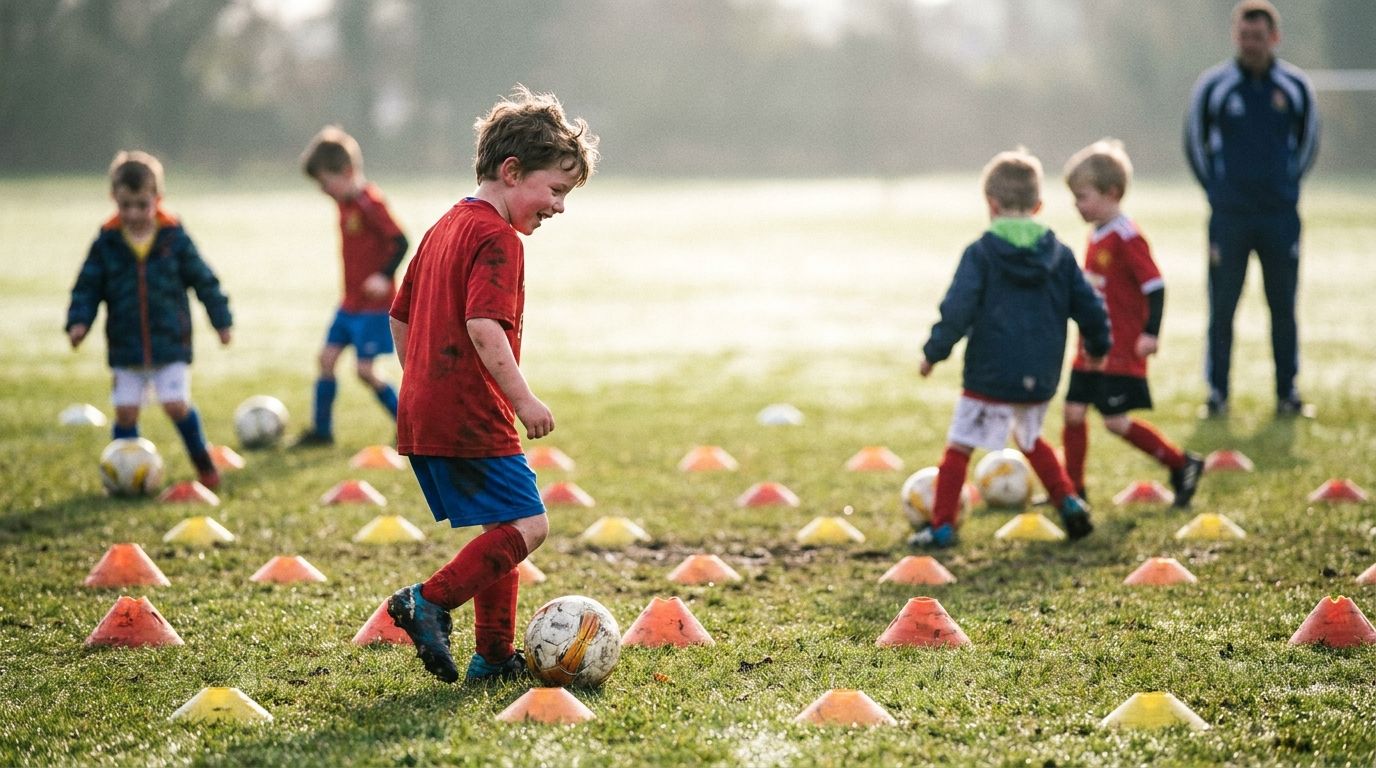
Dribbling and ball-mastery drills
Dribbling is where young players spend the most productive minutes, because touches per minute matter far more than tricks. The aim is a child who is comfortable running with the ball under control and can beat a defender or find a moment of space.
- Cone slalom and gates (ages 5-12) - Dribble through a line of cones, then through scattered "gates" (two cones a stride apart) as fast as control allows. Builds: close control and change of direction. Cue: "both feet, eyes up between touches." Mistake: using only the strong foot, which leaves half the skill undeveloped.
- Toe-taps and ball mastery (ages 4-8) - Static ball-mastery moves: toe-taps on top of the ball, side-to-side rolls, then simple stop turns. Builds: a feel for the ball and coordination. Cue: "light and quick, like the ball is hot." Mistake: looking down the whole time instead of glancing up.
- 1v1 to a line (ages 7-12) - In pairs, one attacker tries to dribble over a line the defender is guarding. Swap after each go. Builds: beating a player and committing to a move. Cue: "change speed to beat them, don't slow down." Mistake: over-dribbling into trouble instead of taking the space when it opens.
- Protect your ball (ages 6-12) - Everyone dribbles in a grid and tries to knock others' balls out while keeping their own. Lose yours, do three toe-taps, and rejoin (nobody sits out). Builds: shielding and awareness. Cue: "body between the ball and the danger." Mistake: head down, so they never see who is coming.
- Dribble relay to a turn (ages 5-9) - In small groups, dribble to a cone, perform one turn (drag-back or inside-hook), and dribble back for the next player. Keep groups to two or three so the wait is tiny. Builds: turning with the ball under mild time pressure. Cue: "plant, turn, accelerate away." Mistake: a loose touch out of the turn that kills the speed.
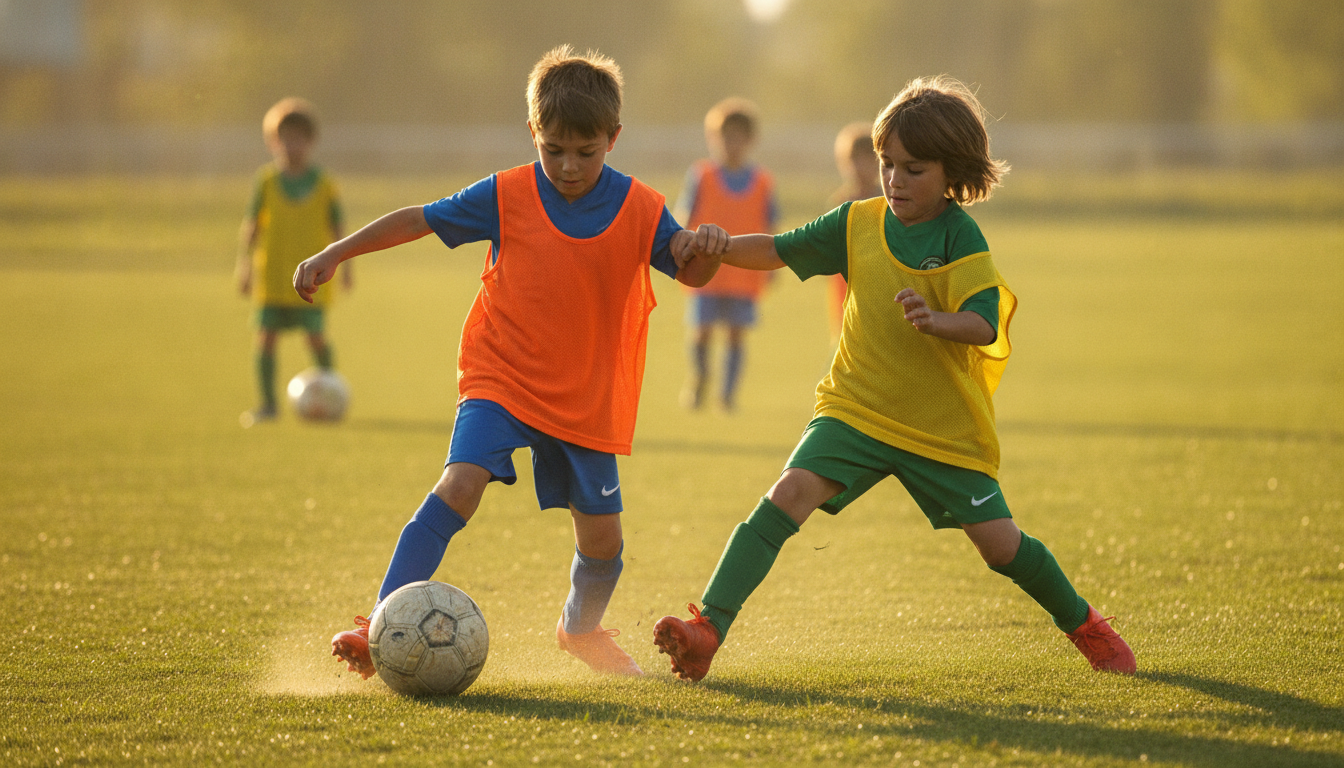
Passing and receiving drills
Passing only sticks once a child can plant their standing foot and use the inside of the boot with a still head. Keep groups small so nobody queues, and pair players up so both are always working.
- Gate passing (ages 6-12) - In pairs, pass the ball back and forth through a "gate" of two cones a stride apart. Move the gate wider or narrower to change the challenge. Builds: passing accuracy with the inside of the foot. Cue: "plant foot beside the ball, pass with the inside of your foot." Mistake: toe-poking the ball so it skews off line.
- Triangle passing (ages 7-12) - Three players in a triangle, passing and following their pass to the next cone. Builds: passing plus movement, the start of pass-and-move. Cue: "pass, then go, don't admire it." Mistake: standing still after the pass instead of moving to a new position.
- Pass and move to a target (ages 7-12) - Pairs pass toward a target player or mini-goal, with a soft first touch to set up the next pass. Builds: first touch and passing with a purpose. Cue: "first touch out of your feet, into space." Mistake: a heavy first touch that has to be chased before the pass.
- Simple rondo (ages 9-12) - Four or five players in a small circle keep the ball from one defender in the middle. Defender wins it and swaps with whoever lost it. Builds: quick decisions and scanning under light pressure. Cue: "look before it arrives, know your next pass." Mistake: passing straight to the defender because they never checked their options.
Shooting and finishing drills
Kids love shooting, so protect that energy by using several balls and goals to keep the queues short. Teach technique before power: a clean strike beats a wild one every time.
- Open-goal striking (ages 5-10) - Strike a still ball into an empty small goal from a few strides, focusing on a clean contact. Builds: striking technique. Cue: "laces through the middle of the ball, follow through." Mistake: leaning back and blazing it over.
- Four-goal shooting (ages 8-12) - Set up several mini-goals around a grid and let players pick which to attack, adding a decision to the finish. Builds: finishing plus choosing a target. Cue: "eyes up, pick your spot, then look at the ball." Mistake: always aiming centrally instead of finding the open goal.
- Beat the keeper (ages 7-12) - Rotate players in to finish 1v1 against a keeper (or a defender guarding a small goal), then jog to the back with their own ball. Builds: composure in front of goal. Cue: "side-foot into the corner beats a blast at the keeper." Mistake: rushing the shot instead of settling the ball first.
- Finish from a pass (ages 8-12) - A feeder passes across the box and the striker takes a touch and finishes first or second time. Builds: finishing off a moving ball. Cue: "get your body over the ball to keep it down." Mistake: swinging at it without a settling touch and skying it.
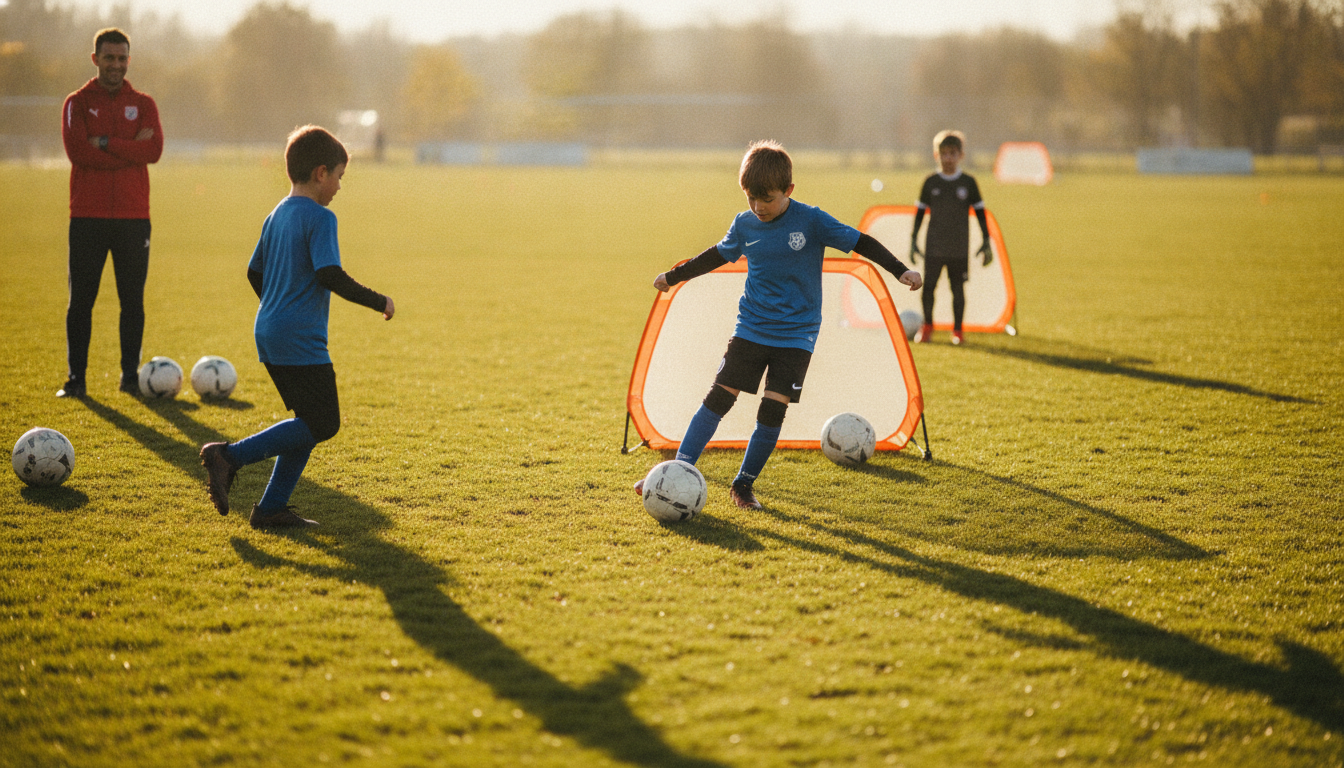
Small-sided games: the best drill of all
The game itself is the highest-value drill you have. It packs in the most touches, the most decisions, and the most fun, and it is where everything else finally connects. Keep the teams small so nobody can hide, and coach lightly.
- 4v4 to mini-goals (ages 8-12) - Two mini-goals each end, no keepers, small pitch. Builds: attacking and defending decisions with lots of touches. Cue: ask "where's the space?" rather than telling them where to run. Mistake: the coach stopping play every ten seconds and draining the game.
- 3v3 end-zone (ages 6-10) - Score by dribbling the ball under control into the opponent's end zone. Builds: dribbling with a purpose and defending as a small group. Cue: "look up for the free player." Mistake: everyone chasing the ball in a swarm.
- Everybody's a striker (ages 4-8) - Tiny teams, every child free to score, no fixed positions. Builds: confidence and pure ball involvement. Cue: "get free and shout for it." Mistake: one child hogging the ball while others drift off; smaller teams fix this.
- Conditioned games (ages 9-12) - Add one rule to nudge a habit: two-touch only, or a team must complete three passes before they can score. Builds: the specific skill the condition targets. Cue: name the condition, then let them play. Mistake: stacking on so many rules that the game stops being a game.
The youngest players get the most out of 3v3 or smaller. Once you go past four or five a side at this age, half the squad stops touching the ball.
A ready 60-minute session plan
Here is one session you can run this week. It assembles the drills above into a flow that warms up, teaches one thing, and finishes with the game they came for. Swap the skill block for whichever drill fits your age band using the table earlier in this guide, and if you want a library of structures beyond this one, our guide to football training session plans goes deeper.
- Arrival, 5 minutes - A ball each, free dribbling in a grid the moment they arrive. No standing around waiting for latecomers.
- Warm-up game, 10 minutes - Traffic Light or Sharks and Minnows to raise the heart rate with the ball.
- Skill block, 15 minutes - One drill from the dribbling or passing section, matched to the age band. This is your teaching focus for the day, so pick one cue and stick to it.
- Small-sided game, 20 minutes - 4v4 or 3v3, the biggest block of the session. Coach with questions and let them play.
- Cool-down, 10 minutes - A gentle dribble or stretch, then ask each child one thing they learned or did well.
Running a term of these sessions means registrations, payments, and rosters piling up alongside the coaching. Our guide to the best football club management software covers the tools that keep that side off your Saturday.
Coaching one squad with mixed abilities
The problem no drill list addresses is the real one: a single squad spanning a two-year skill range, all in the same session. You do not need to split them. You need one drill that runs at three difficulty levels at once.
The trick is a small set of dials you can turn up or down per player without stopping the group:
- To make it easier: more space, no defender or a passive one, more touches allowed, slower.
- To make it harder: less space, an active defender, a touch limit, a time or target challenge.
Take Sharks and Minnows as a worked example. For a developing minnow, give a bigger grid and a slower shark so they get across more often. For a confident minnow, shrink the grid, add a second shark, and challenge them to cross five times without losing the ball. Same game, same whistle, three levels running side by side. In small-sided games, pair a stronger player with a developing one on the same team so the game itself does some of the balancing.
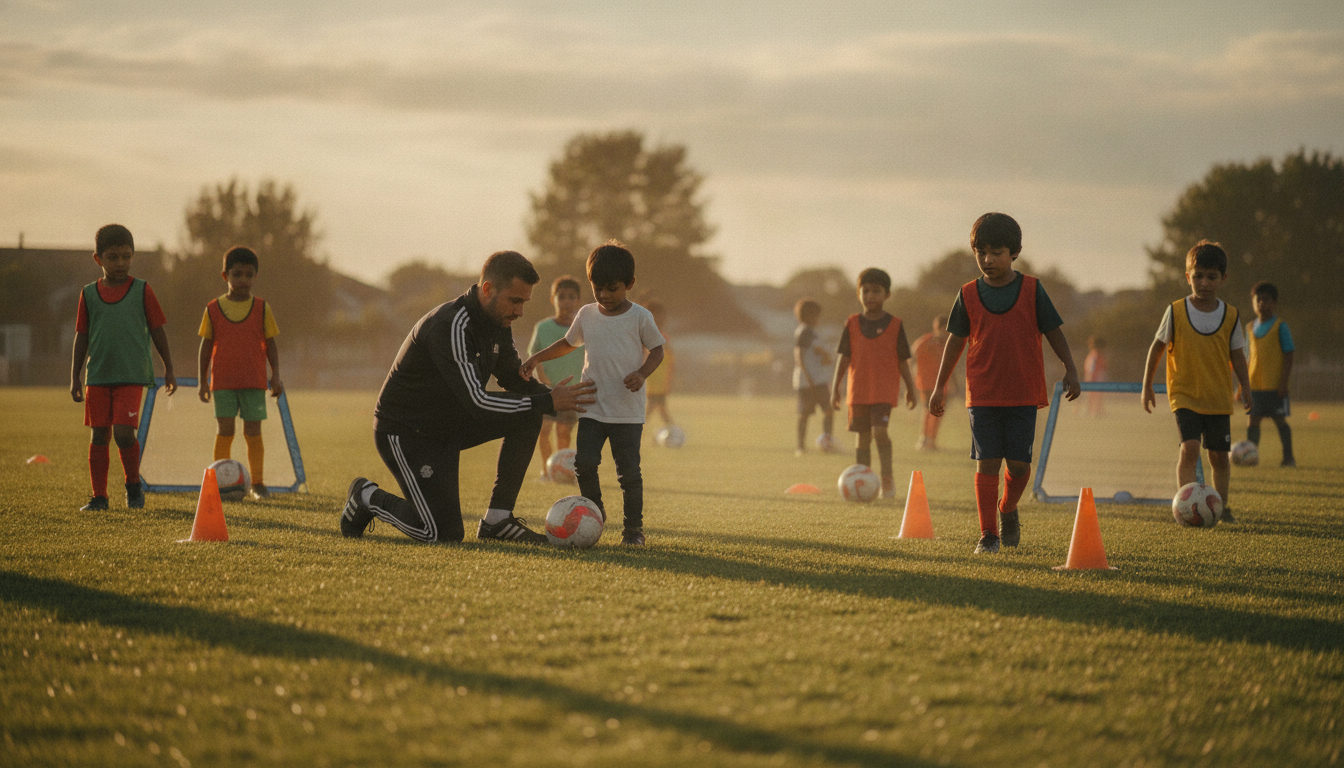
Keep every kid on the ball: the no-queue rules
Every source on kids' football says "maximize ball touches" and then hands you a drill with one ball and a line of eight children. Here is that principle turned into a checklist you can actually run against your own session:
- One ball per child wherever the drill allows.
- Ban single-file lines. If a drill has a queue, split it into two or three smaller groups.
- Use pairs and stations so everyone works at once.
- Keep reps short so the wait is never long.
- For shooting, use several balls and several goals, never one of each.
- Keep teams small (3v3, 4v4) so nobody hides.
You can run almost all of this with cones and a ball each. With just six kids and eight cones you have a full session: a cone-grid warm-up, gate passing in pairs, a Protect Your Ball game, and a 3v3 to finish. No fancy kit required.
The quickest way to judge a drill is the smell test: if the children are standing more than they are moving, change it. A drill that keeps them touching the ball, thinking, and smiling is doing its job, whatever the coaching manual calls it.
Key takeaways
- Band drills by age: play and touches for 4 to 6, technique and 1v1s for 7 to 9, decisions and small games for 10 to 12.
- Give every drill one cue and one common mistake to fix, so you coach one thing at a time.
- Maximum ball touches, minimum standing in line, is the rule that governs every good session.
- Assemble drills into a simple arrival, warm-up, skill block, small-sided game, cool-down flow, and give the game the biggest slice.
- For mixed abilities, run one drill at three difficulty levels rather than splitting the group.
- The small-sided game is your highest-value drill: most touches, most decisions, most fun.
Where to go next
Band your drills by age, give each one a cue and a fix, keep every child on the ball, and let the game do the heavy lifting. That is the whole method, and it is the same one a good grassroots coach uses week in, week out.
If you are ready to take the next step, our guides on how to become a football coach and how to run a football camp pick up where this one leaves off. And when the coaching is sorted, the admin behind the club is the next thing to make easy.
FAQs
How long should a kids' football training session be?
For most youth ages, 45 to 60 minutes is the sweet spot. Keep individual activities short and matched to age: 3 to 5 minutes each for 4 to 6 year olds, stretching to 8 to 12 minutes for 10 to 12 year olds. A session that runs long past attention span teaches kids to switch off, so it is better to finish on a high than to drag it out.
How many drills should I do in one session?
Two or three skill activities plus a game is plenty. Cramming in six drills means each one gets cut short before it teaches anything, and the transitions eat your time. Pick one skill focus for the day, run a couple of drills that build it, then let the small-sided game bring it together.
What football drills are best for 5-year-olds?
Play-based drills where every child has a ball and nobody is eliminated. Traffic Light, animal dribbles, and "everybody's a striker" mini-games suit this age well. Keep each activity to a few minutes, dress it up as a game or story, and prize fun and ball touches over any polished technique.
How do I stop kids getting bored in training?
Ball touches, small games, and no queues. Boredom in youth football is almost always a symptom of children standing in line waiting for a turn. Give everyone a ball, split big groups into pairs or stations, keep reps short, and finish with a small-sided game where every child is involved.
What equipment do I need to coach kids' football?
Very little. A ball per child if you can manage it, a set of cones, some bibs to make teams, and a few small or pop-up goals will run almost every drill in this guide. You can deliver a full session with just cones and a ball each, so do not let a lack of kit stop you starting. Our [football coaching equipment](/blog/football-coaching-equipment) guide covers what is worth buying when you do.
At what age can kids start structured football drills?
Play-based sessions work from around age 4, though at that stage it is really guided play rather than drilling. More structured drills with a cue and repetition tend to land from about age 6 or 7, when attention span and coordination catch up. Keep it fun and short at every age, and let the youngest players play more than they practice.
Should young players specialize in one position?
No. Up to around age 11 or 12, let children play everywhere, including in goal. Fixing a young player into one position narrows their development and their touches, and most kids do not settle into a best position until later anyway. Rotate freely and let them experience the whole game.
How do I coach a football drill without over-coaching?
Pick one teaching point per drill and use a single cue for it, then let the players play. Stopping the game every few seconds kills the flow and the fun, so save your interventions for a quick, specific fix and ask questions ("where was the space?") more than you give commands. If the drill is well set up, it teaches most of the lesson on its own.
What is the best single drill for young footballers?
The small-sided game, every time. A 3v3 or 4v4 packs in more touches, decisions, and enjoyment than any isolated drill, and it is the closest thing to the real game. Use drills to build a specific skill, then let a small game be where that skill actually gets used under a bit of pressure.