


This guide is about football in the soccer sense: grassroots and youth clubs, soccer schools, and academies. To become a football coach you pick your route (grassroots or performance), complete an entry coaching course (the FA's Introduction to Coaching Football in the UK, or a US Soccer Grassroots license in the US), clear a safeguarding and background check, get first aid certified, and build experience as an assistant before you run your own sessions. Below are the routes, the badges, what they cost, what you can earn, how long each takes, and where coaching can lead.
What does a football coach do?
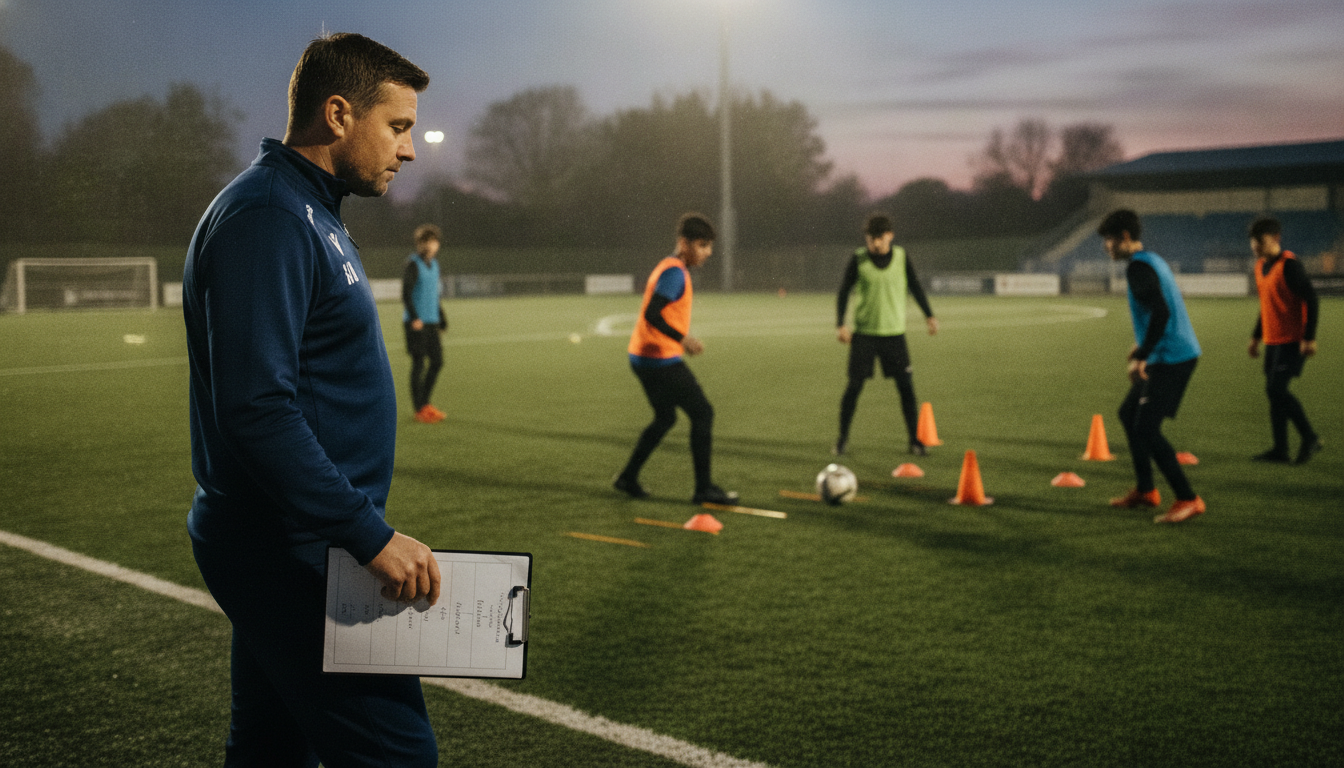
A football coach plans and runs training sessions, teaches technique and game understanding, and helps players improve from their first controlled touch to competitive match play. The job is part teaching, part safety, and part people management, and most coaches do all three inside a single session.
Day to day that means planning sessions and warm-ups, demonstrating and breaking down skills, managing groups of mixed ability at once, keeping players safe, tracking each player's progress, and communicating with players and, for youth football, their parents. The setting you coach in shapes everything else, from the badges you need to the pay you can expect:
- Grassroots and youth clubs running Sunday-league and junior teams, the highest-volume entry point into coaching.
- Soccer schools and academies offering paid weekly coaching for children and improvers.
- Holiday camps and after-school football, seasonal, high-volume, and usually parent-paying.
- School and college teams, often coached by a teacher or a hired coach.
- Semi-pro and performance clubs, where the badges are higher and the stakes are too.
- Adult and recreational football, a growing area of the game.

Do you need experience or a degree to coach football?
This is the question most aspiring coaches actually want answered, so here is the honest version. For grassroots and youth coaching you do not need a degree, and formal playing experience helps but is not required. Plenty of good grassroots coaches start as parent volunteers or as teenage helpers and learn the craft on the job.
Performance and academy roles are different. Clubs developing competitive players expect a strong playing or coaching record, because reading technique and running a high-tempo session demands a feel for the game you mostly get from time in it.
School and college coaching follows the same split. You do not need a degree to coach at a grassroots club or soccer school. School and college roles usually do, and US high school and college positions often add a teaching or athletic-association requirement on top of a coaching license. Most US youth coaches hold a bachelor's degree, but that reflects who takes those roles rather than a hard requirement for grassroots work.
Coaching with no experience? Start grassroots. The safeguarding and first aid certificates matter more than a playing past, and clubs will train you alongside experienced coaches while you build your hours.
Choose your route: grassroots, performance, or school/college
Most guides blur these routes together, which is why the requirements feel murky. They are genuinely different paths with different entry bars, and picking yours first makes every later decision simpler. Here is how they compare.
| Route | Experience needed | Core requirements | Typical pay | Best for |
|---|---|---|---|---|
| Grassroots / youth club | Helpful, not required | Entry coaching course, safeguarding and DBS or background check, first aid | Volunteer to ~£15-£25/hr ($18-$22/hr US) | Newcomers, parents, teens starting out |
| Soccer school / academy (paid) | Some coaching background | Entry course plus UEFA C or US D license, safeguarding and background check | Session or hourly rates, plus business income if self-employed | Coaches building a paid client base |
| Semi-pro / performance | Strong playing and coaching record | UEFA B/A or US B/A license, ongoing CPD | £20k-£40k+ / $40k+ | Those developing competitive players |
| School / college | Coaching or playing background | Often a degree plus teaching or association requirements | Stipend or salary | Educators and school settings |
The quickest way to choose is to be honest about two things: how much experience you bring, and how much time you can commit. If you want to start soon and learn as you go, grassroots is the entry point. If you have a playing background and want to develop competitive players long term, aim at the performance route from the start.
Step-by-step: how to become a football coach
The steps below follow the UK route through the Football Association, with the US Soccer equivalent noted inline. The order is the same everywhere, even where the badge names differ.
1. Choose your route and take the free intro
Start by deciding which route from the table above you are aiming for, then get a feel for coaching with a free taster. In the UK that is EE Playmaker (formerly BT Playmaker), a free online introduction that takes around four to five hours and is open from age 14. In the US, US Soccer offers a free 20-minute Grassroots introduction. No cost, no prerequisites, and you can do either at home before you commit a penny.
2. Complete the entry coaching course
Next comes the first real rung. In the UK that is the FA Introduction to Coaching Football, a four-week fully online course open from age 16 that costs around £160. In the US you complete two in-person Grassroots courses across the small-sided formats (4v4, 7v7, 9v9 and 11v11), each about two hours and roughly $25, which together unlock the D License. This is where you learn session structure, progressions, and how to teach beginners; our guide to football training session plans shows what you will be building toward.
3. Clear safeguarding and a background check
Before you work with under-18s you have to clear safeguarding. In the UK that means an FA Safeguarding Children course plus an FA DBS check. In the US, background screening and US Center for SafeSport training are built into every US Soccer course. These are non-negotiable and they gate everything else, so do them early rather than leaving them until a club asks.
4. Get first aid certified
Complete a recognized first aid course, such as the FA's Emergency Aid course in the UK or an approved provider in the US. It is a small cost that makes you more hireable and, more importantly, prepares you for the moment a player goes down injured on the pitch.

5. Take your license course for the route
Now take the license your route needs. In the UK the grassroots-depth qualification is the UEFA C License (which replaced the old FA Level 2), a roughly 60-hour course spread over 16 to 20 weeks, followed by UEFA B (9 to 12 months) and beyond for performance coaching. In the US you take the D License (four in-person days over about nine weeks, focused on U6 to U12), then climb to C, B and A. Expect assessment by theory, an assessed coaching session, and a practical.
6. Gain supervised experience
Credentials get you in the door, but coaching is a craft you learn by doing. Assist at a local club, holiday camp, or school and shadow a senior coach before you run your own group. Watch how experienced coaches manage a session, sequence a drill, and handle the player who is nervous about a new skill, and start building your own library of football coaching drills for kids as you go. Most coaches spend weeks to months here before taking full responsibility for a group.
7. Apply for roles and keep developing
Once you are certified and have some hours behind you, apply. Grassroots clubs, soccer schools, holiday camps, and councils all hire, and many take direct or walk-in applications. From there, keep your certificates current, climb the badge ladder, and consider specializing, whether that is goalkeeping, a specific age group, or the business side of running your own sessions.
The badge ladders: FA/UEFA vs US Soccer
Here is the part most guides skip: the two systems side by side. Wherever you coach, the shape of the ladder is similar even though the names and prices differ.
| Level | UK (FA / UEFA) | US (US Soccer) | Who it's for |
|---|---|---|---|
| Taster | EE Playmaker (free, 4-5 hrs, 14+) | Grassroots intro (free, ~20 min) | Anyone starting out |
| Entry | Intro to Coaching Football (4 wks, 16+, ~£160) | Grassroots small-sided courses (~$25 each) | New grassroots coaches |
| Grassroots depth | UEFA C License (~60 hrs / 16-20 wks) | D License ($300-$550, U6-U12) | Committed youth coaches |
| Intermediate | UEFA B License (9-12 mo, 18+, ~£960) | C License ($1,500-$2,000, U13-U17) | Soccer schools and semi-pro |
| Advanced | UEFA A License (~£3,645, 18+) | B / A License ($1,300-$3,500) | Performance coaches |
| Elite | UEFA Pro License (18 mo, ~£9,890) | Pro License (~$10,000, MLS/NWSL/USL) | Professional-level coaches |
One important difference: the US ladder is gated by time and hours. You typically hold each license for six to twelve months, and log coaching hours, before you are eligible for the next. The UEFA ladder gates on the course below rather than a fixed holding period, but the higher badges are competitive to get onto. Either way, you only need the badge your route requires, not the whole ladder.
What it costs to get qualified
Few guides total this up cleanly, so here is the full breakdown. The headline: a grassroots coach can start for very little (a free taster, plus first aid and safeguarding), while the elite badges run into thousands. Prices shift year to year and vary by County FA and by state, so treat the figures below as typical rather than fixed.
| Item | UK cost | US cost |
|---|---|---|
| Free taster | Free (EE Playmaker) | Free (Grassroots intro) |
| Entry course | ~£160 (Intro to Coaching Football) | ~$25 per Grassroots course |
| Safeguarding | Added fee | Included in course (SafeSport) |
| Background check | Added fee (FA DBS) | Included in course |
| First aid | ~£30-£90 | Varies by provider |
| Grassroots-depth license | UEFA C ~£500 | D License $300-$550 |
| Intermediate license | UEFA B ~£960 | C License $1,500-$2,000 |
| Advanced license | UEFA A ~£3,645 | A License up to $3,500 |
| Elite license | UEFA Pro ~£9,890 | Pro License ~$10,000 |
A few things worth knowing before you pay. Many clubs and County FAs subsidize or reimburse entry badges for coaches they take on, so always ask before covering it yourself, and grassroots clubs can often tap funding for football clubs to help with coach education. Renewals and continued professional development are the ongoing cost, not the one-time entry fee. And you only ever pay for the badge your route needs, so a grassroots coach never has to fund the UEFA Pro License to get on the pitch.
How long does it take?
There is no single number, because the routes differ so much, so think in effort rather than a fixed timeline.
For grassroots the timeline is short. The free taster is a few hours, the entry course runs four weeks, and safeguarding and first aid can be completed online within days. Many people are assisting at a club within a few weeks of deciding to start.
Soccer school and semi-pro coaching takes months. The UEFA C License runs 16 to 20 weeks and UEFA B is a 9 to 12 month commitment, while the US ladder gates each license behind six to twelve months held plus coaching hours before you move up.
Elite coaching is measured in years. The UEFA Pro License is an 18-month course that sits on top of every badge below it. If you want to be coaching soon, start grassroots and let the higher badges follow.
How much do football coaches earn?
Treat pay as a range, not a single salary, because most grassroots coaching is part-time or voluntary. In the UK the National Careers Service puts a football coach's pay at roughly £19,000 for a starter rising to about £29,000 with experience, with a typical week of 20 to 37 hours often built around evenings and weekends. Elite and professional coaching pays far more, but those roles are few and hard-won.
In the US, youth and session coaching commonly pays $18 to $22 per hour. ZipRecruiter puts the average youth soccer coach around $41,300 a year, while Indeed's blended average across all soccer-coach roles is higher because it mixes in full-time and club positions. Headline figures above that usually blend in senior and full-time roles, so treat them with care if you are pricing grassroots work.
What moves you within the range comes down to a few factors:
- Setting: academy and semi-pro roles generally pay more than grassroots.
- Hours: much coaching is part-time, which caps annual earnings.
- Level coached: developing competitive players commands higher rates than beginner sessions.
- Employee vs. owner: coaches who run their own sessions earn from the business, not an hourly wage.
That last point is where the real earning ceiling lives, and it is worth understanding before you start.
Coaching football outside the UK and US
The search for how to become a football coach is global, and the pathway shape is the same wherever you are: join your national body, clear safeguarding, complete a coaching qualification, and build experience. Only the badge names change.
UEFA licenses (C, B, A and Pro) are recognized across Europe and widely respected around the world, which is why the UK route above travels well. National associations elsewhere run their own tiered accreditation aligned to their federations, for example in Canada and Australia. Start at your national association's coaching pages, pick the entry-level award, and follow their published pathway from there.
From coach to running your own club, camps, or academy
Coaching is a career with a clear ladder, and it is worth seeing the whole thing before you take the first rung. Many football coaches move from assistant, to grassroots coach, to running their own paid sessions, a soccer school, holiday camps, or an academy. If that is where you are heading, our guides to how to start a football academy and how to run a football camp map out the setup for each.
That last step changes the job. On top of coaching you are handling registrations, recurring session payments, attendance registers, waivers, and parent communication, and that admin quietly eats the week. The coaches who thrive are the ones who systematize it early rather than running it out of a spreadsheet and a group chat. When you reach that point, our roundup of the best football club management software compares the tools built for exactly this job.
This is where we fit. Our small business booking system handles bookings, recurring payments, and registrations in one place for an independent coach or a growing club, with no website needed. It is the difference between a club that runs you and one you run.
Key takeaways
- You become a football (soccer) coach by picking a route, taking an entry coaching course, clearing safeguarding and a background check, getting first aid certified, and building experience.
- Grassroots is the fastest entry: no degree, playing experience optional, and you can be assisting within a few weeks.
- The UK spine is the FA/UEFA ladder (Intro to Coaching Football, then UEFA C, B, A and Pro); the US spine is US Soccer Grassroots, then D, C, B, A and Pro.
- Costs range from near-free (a taster plus first aid) to around £9,890 or $10,000 for the elite license, and you only pay for the badge your route needs. Clubs often subsidize entry badges.
- Pay is mostly part-time: roughly £19k-£29k in the UK and $18-$22/hr or about $41k a year for US youth coaches, with the ceiling highest for those who run their own club.
FAQs
Can you become a football coach with no experience?
Yes, for grassroots and youth coaching. The safeguarding and first aid certificates matter more than a playing past, and many coaches start as parent volunteers or teenage helpers and learn on the job. Performance and academy roles are different and expect a strong playing or coaching record.
What qualifications do you need to coach football?
At entry level you need a coaching course, a safeguarding and background check, and a first aid certificate. Beyond that the badges scale by route, following the FA and UEFA ladder in the UK or the US Soccer license ladder in the US. You only need the badge your route requires, not the whole ladder.
How long does it take to become a football coach?
For grassroots, a few weeks: the taster is a few hours, the entry course runs four weeks, and safeguarding and first aid can be done online quickly. Higher badges take longer, with UEFA C at 16 to 20 weeks, UEFA B at 9 to 12 months, and the UEFA Pro License an 18-month course on top of everything below it.
How much does it cost to become a football coach?
A grassroots coach can start for very little, with a free taster plus modest first aid and safeguarding fees. The FA Introduction to Coaching Football is around £160 and the US Grassroots courses about $25 each. From there the ladder climbs to roughly £9,890 for the UEFA Pro License or $10,000 for the US Pro License, but you only pay for the badge your route needs.
Do you need a degree to be a football coach?
No degree is required to coach at a grassroots club or soccer school. School and college roles usually do require one, and US high school and college positions often add a teaching or athletic-association requirement on top of a coaching license.
What age can you start coaching football?
You can start a free taster like EE Playmaker from age 14, and the FA Introduction to Coaching Football and US Soccer Grassroots entry courses are open from age 16. Many clubs take on teenage assistant coaches who help under supervision while they build experience and complete their credentials.
Do football coaches need a DBS or background check?
Yes. In the UK you need an FA DBS check plus a safeguarding course before working with under-18s, and in the US background screening and SafeSport training are built into every US Soccer course. These are non-negotiable and they gate the rest of the pathway, so complete them early.
How much do football coaches earn?
In the UK the National Careers Service puts pay at roughly £19,000 for a starter rising to about £29,000 with experience. In the US, youth coaching commonly pays $18 to $22 per hour and averages around $41,300 a year per ZipRecruiter. Performance roles and coaches who run their own club earn more.
How do I get football coaching jobs?
Grassroots clubs, soccer schools, holiday camps, and local councils all hire, and many take direct or walk-in applications. Getting certified first and gaining supervised hours as an assistant makes you far more hireable, because clubs can put you on the pitch sooner.
Is being a football coach a good career?
It can be, depending on what you want from it. Part-time grassroots coaching is flexible and rewarding but rarely a full income on its own. Performance roles and running your own sessions, camps, or academy pay more and offer the highest ceiling, along with the most responsibility. Becoming a football coach comes down to the same core path wherever you are: pick a route, take an entry course, clear the safeguarding checks, and build experience. It scales from a few weeks of grassroots qualifying to a full career or your own club. If you coach more than one sport, our guide to [how to become a gymnastics coach](/blog/how-to-become-a-gymnastics-coach) walks the same ladder for a different discipline.