


Most grassroots coaches turn up with a bag of balls and improvise, and it shows in the first ten minutes: kids stood in lines, one ball between eight, and no idea what today is about. A plan fixes that. A football training session runs 60 to 90 minutes across five phases: arrival and warm-up, technical practice, a skill or possession game, a small-sided game, and a cool-down with review. This guide gives you that structure, four session shapes to pick from, three ready-to-run plans by age, a blank template, and a way to handle the admin around it.
What makes a football training session plan work
Before any template, five things separate a session that develops players from one that just fills 90 minutes.
- One clear objective. Pick a single focus, like dribbling or pressing, not five. Everything in the session should serve it.
- Game realism. Practices should look like the game. A drill that never happens in a match teaches a skill players can't transfer.
- Maximum ball contacts. Count the touches. If players spend more time queuing than playing, the plan is wrong.
- Age and ability appropriate. A U8 session and a U15 session share a shape but almost nothing else.
- Progressive. Each block should be harder than the last, building toward the objective under game pressure.
Two frameworks coaches are taught to plan against are worth knowing. The Player Development Project frames good practice design as the Three Rs: Repetition (enough reps to learn), Relevance (tied to the game), and Realism (opposed, decision-based practice). The Four Corner Model, used across the England Football coaching pathway, reminds you that a player develops in four areas at once: technical and tactical, physical, social, and psychological. A good plan touches more than one corner. (If you're still working through your badges, our guide on how to become a football coach maps out that pathway.)
One more rule for youth: fun is a performance requirement, not a bonus. Kids who enjoy a session try harder, come back, and learn faster.
The anatomy of a session: five phases and how long each takes
Nearly every effective session moves through the same five phases. The only thing that changes is how long you spend in each. Here is how the timings stretch across a 60-minute and a 90-minute session.
| Phase | Purpose | 60-min session | 90-min session |
|---|---|---|---|
| Arrival / warm-up | Ball-based activation, players active as they arrive | 10 min | 15 min |
| Technical practice | Unopposed or lightly opposed skill reps | 15 min | 20 min |
| Skill / possession game | Opposed, decisions under light pressure | 15 min | 20 min |
| Small-sided game | The objective applied in a real game | 15 min | 25 min |
| Cool-down & review | Light movement, stretches, short debrief | 5 min | 10 min |
A few notes on getting each phase right.
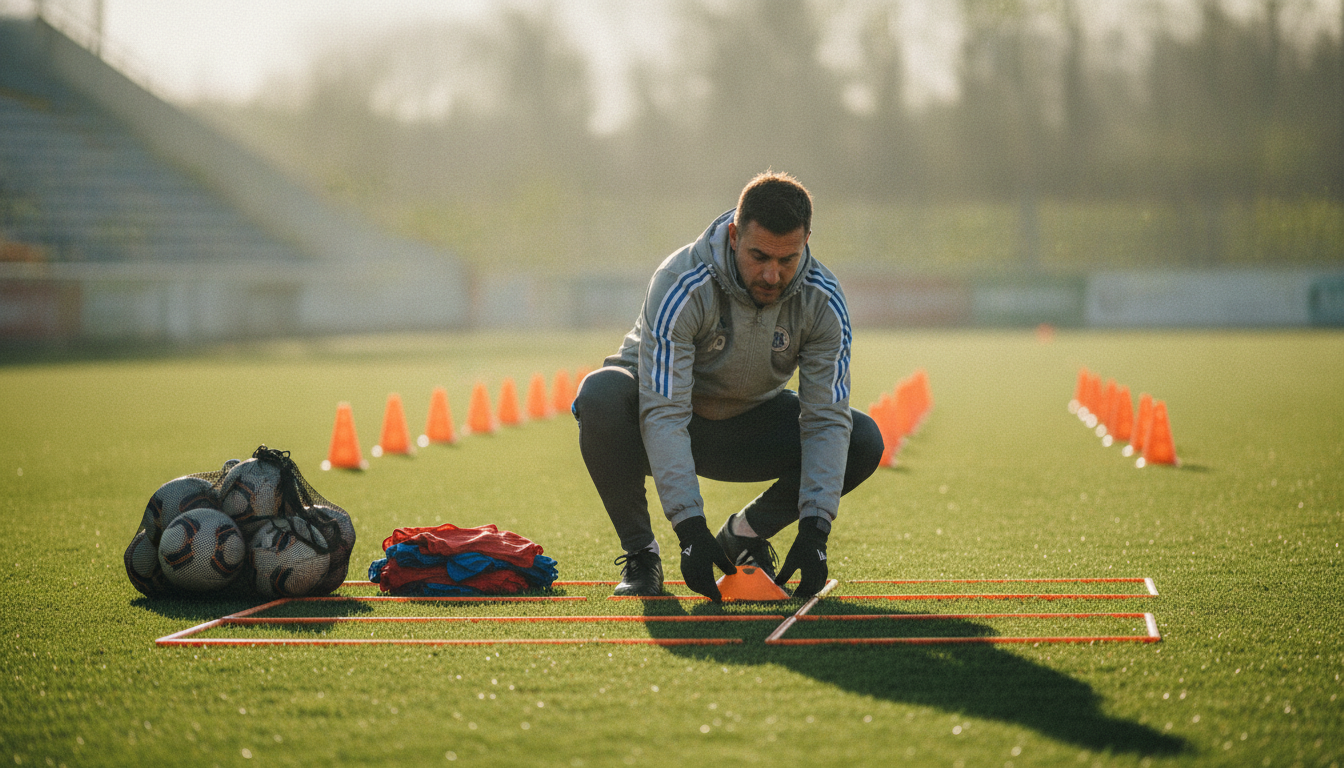
The arrival activity solves a problem most guides ignore: players never all show up at once. Put a ball at every player's feet and give them something to do the moment they arrive, ball-mastery moves or a simple dribbling grid, so nobody stands around waiting for the session to "start." Keep static stretching out of the warm-up; use ball-based movement instead.
For the opposed phases, sensible area sizes give you a starting point. A warm-up grid of around 25x25m, a possession area of roughly 30x40m, and a full small-sided game of about 60x40m work well for U13 and up. Treat these as defaults to adjust, not fixed rules, and scale them down for younger players.
The cool-down and review is where learning sticks. Light movement, a few static stretches held 20 to 30 seconds each, and a two-minute debrief where you ask players what worked. Don't skip it to squeeze in one more game.
Pick a session shape
The five phases are the skeleton. The "shape" is how you sequence practice within them, and the right one depends on what you're coaching that night. Four are worth knowing.
Up the steps
Start unopposed, add a small-sided element, then finish with a full game, raising difficulty at each step. This is the most common shape and the safest default. Use it when you're teaching a new technique and want players to groove it before facing full pressure.
Whole-part-whole
Start with a game, spot what's breaking down, isolate and coach that one thing, then return to the game to see if it holds. Use it when a specific problem keeps showing up in matches, like losing the ball in your own half, and you want players to feel the fix in context.
Carousel
Set up three or four stations and rotate small groups through them, then bring everyone together for a match. Use it when you have a bigger squad or more than one coach, or when you're working with young players who need to keep moving to stay engaged.
Play-Practice-Play
Start with a game, pause for a short coached practice on one theme, then play again. This is the US Youth Soccer grassroots default, and it suits foundation-phase players who learn best by simply playing. The first "play" also doubles as your warm-up.
Three ready-to-run football training session plans
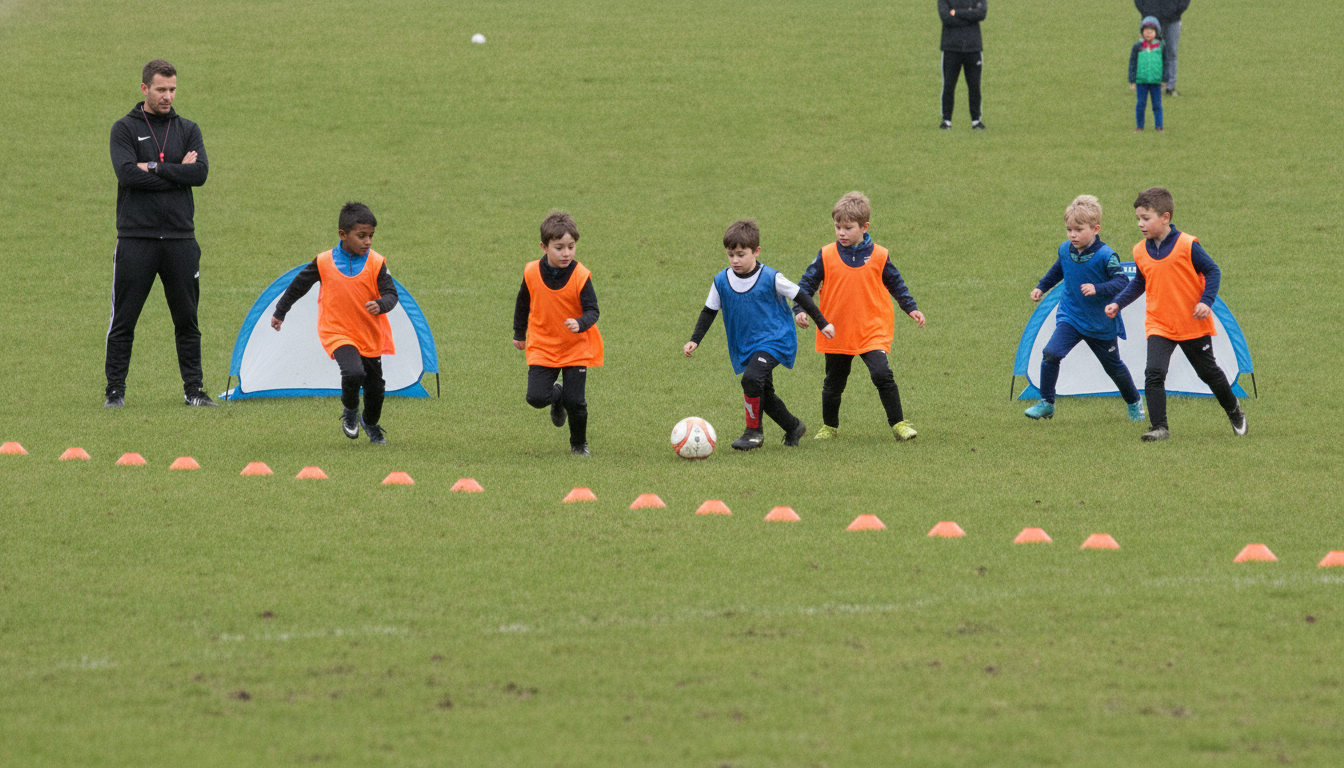
Here is where most guides stop and hand you a single generic sample. Coaches search for session plans because they want one for their age group, so here are three. Copy the one that fits, swap the focus for whatever you're working on, and you have a session. Each states its objective at the top, so you can see the template applied, and each is also a free one-page PDF you can print and take pitch-side.
U7 to U9 (Foundation): 60 minutes, focus on dribbling and ball mastery
Objective: every player comfortable running with the ball under light pressure.
| Block | Time | What they do | Coaching point |
|---|---|---|---|
| Arrival | 10 min | Every player a ball, freestyle dribbling with called ball-mastery moves (toe taps, rolls) | Lots of touches, heads up when they can |
| Technical | 15 min | 1v1 dribbling through gates, score by dribbling through any gate | Change of speed after the beat |
| Skill game | 15 min | Sharks and minnows across a grid | Protect the ball, use both feet |
| Small-sided | 15 min | 3v3 games, no keepers, multiple small pitches | Encourage dribbling, ask questions not lectures |
| Cool-down | 5 min | Gentle jog and stretch, quick chat | Name one thing they did well |
Download the U7 to U9 plan as a printable PDF. If you want more practices pitched at this age group, our roundup of football coaching drills for kids gives you plenty to swap into the technical and skill-game blocks.
U10 to U12 (Development): 75 minutes, focus on passing and keeping the ball
Objective: keep possession under pressure by passing and moving.
| Block | Time | What they do | Coaching point |
|---|---|---|---|
| Arrival | 12 min | Passing-pattern warm-up in small groups, one and two touch | Weight and accuracy of the pass |
| Technical | 18 min | 4v2 rondo in a 10x10m grid | Angle of support, scan before receiving |
| Skill game | 15 min | 5v5 possession with a 2-touch condition | Move after you pass |
| Small-sided | 22 min | 7v7 game, a set number of passes before a shot is allowed | Patience, then punish the gap |
| Cool-down | 8 min | Stretch and two-minute debrief | What made keeping the ball easier? |
Download the U10 to U12 plan as a printable PDF.
U13 to U16 (Youth): 90 minutes, focus on pressing and transitions
Objective: win the ball back quickly and attack the moment you do.
| Block | Time | What they do | Coaching point |
|---|---|---|---|
| Arrival | 15 min | Dynamic warm-up plus a 5v2 rondo | Intensity from the first minute |
| Technical | 20 min | 6v6 plus 2 jokers possession, 30x40m | Press as a unit, trigger on a bad touch |
| Skill game | 20 min | Pressing-trigger practice, defenders react to a set cue | First defender sets the trap, others cover |
| Small-sided | 25 min | 10v10 conditioned game, 60x40m, extra point for scoring within seconds of winning the ball | Attack the transition before they set |
| Cool-down | 10 min | Cool-down jog, stretch, review | When did our press win the ball? |
Download the U13 to U16 plan as a printable PDF.
Each of these plans is what the blank template below looks like once it's filled in.
A blank session plan template you can copy
Strip the three plans back and you get a reusable template. Download it as a printable PDF to fill in by hand, or paste the list below into a doc, and complete it before every session.
- Date / age group / number of players: who's coming and how many
- Session objective: one line, the single focus for tonight
- Area size and equipment: pitch dimensions, plus balls, bibs, cones, and goals (our football coaching equipment list covers the full session kit)
- Arrival activity: what players do the second they step on the pitch
- Main practices (2 to 3): each with its time, organization (area, numbers, rules), and two or three coaching points
- STEP adaptations: how you'll make each practice easier or harder on the fly (see next section)
- Cool-down and review: stretches, debrief questions, and what to carry into next week
Keep the filled-in template somewhere you'll actually see it. It pairs naturally with taking the register digitally so the plan and the attendance for the session live in the same place, rather than a printout in one pocket and a headcount in your memory.
Adapt any drill on the fly with STEP
Every coaching guide tells you to make practices "age-appropriate" but stops short of showing how. STEP is the tool coaches are taught for exactly this: four levers you can pull mid-session to change difficulty without stopping to re-explain a new drill.
- Space: a bigger area makes keeping the ball easier; a smaller one makes it harder and faster.
- Task: change the rules or conditions, like adding a touch limit or awarding points for a run of passes.
- Equipment: change the ball size, the goal size, or the number of balls in play.
- Players: change the numbers to tilt the balance, adding attackers to help the team in possession or defenders to pressure them.
Worked example: your 4v2 rondo is too easy and nobody's losing the ball. Shrink the grid (Space) and add a defender to make it 4v3 (Players). Two small changes, no stoppage, and the practice is challenging again. Pull the levers the other way when a drill is too hard and confidence is draining.
Common session-planning mistakes to avoid
Even a good plan gets undone by a few recurring habits. Watch for these.
- Long lines and queues. A player standing in a line isn't learning. Add more balls, shrink the groups, and run more stations so everyone's active.
- Talking too much. If the coach is on the ball more than the players, the balance is wrong. Set a stopwatch and keep interventions under about 30 seconds.
- Drills with no game relevance. Pretty passing patterns that never occur in a match look organized but transfer nothing. If it doesn't happen in a game, question why it's in the session.
- No plan for the first and last ten minutes. The arrival activity fixes the start; a set cool-down fixes the end. Both are where sessions usually leak time.
- Ignoring the wider plan. A session that connects to neither the last one nor the next is a one-off. Each should build on what came before.
Fit each session into your week and season
One session is a building block, not the whole structure. Zoom out and it should sit inside a week and a term.
A simple grassroots week for a team that trains twice might run technical work midweek, tactical or team-shape work closer to matchday, and something lighter or more fun straight after a game when legs are tired. Adjust to your own fixtures, but the principle holds: harder, sharper work earlier in the week, recovery around matches.
Then pick a theme for a block of four to six weeks, like ball retention or defending as a unit, so your sessions compound instead of jumping around. Each week you revisit the theme from a slightly different angle, and by the end of the block players have genuinely moved on. If you run terms or holiday camps (our guide to running a football camp covers the latter), this also makes it far easier to tell parents what their child is working toward.
Handle the admin so you can focus on coaching
The plan is half the job. Running the session week after week is the other half, and it's where volunteer coaches lose their evenings. Every session carries the same admin: knowing who's actually coming (which you need before you can set up numbers-dependent drills), taking the register, keeping parents in the loop about venue changes or a weather cancellation, having consent and medical information to hand pitchside, and collecting payments for weekly subs, blocks, or holiday camps.
Handled on scraps of paper and group chats, that admin swallows the time you should spend planning practice. This is where we help. We let you take the register in seconds on your phone at the side of the pitch, keep rosters and medical notes in one place so nothing important lives only in your head, message parents in a tap, and collect payments automatically so you're not chasing cash. A waitlist fills the spots when a block or camp sells out, and registrations come in online instead of on a clipboard. If you're weighing up tools for this, our guide to the best football club management software compares the main options.
Coaches thinking about turning this into a business will find our guide to starting a football academy a natural next step.
Key takeaways
- A good football training session plan comes down to one clear objective, five phases (arrival, technical, skill game, small-sided game, cool-down), and 60 to 90 minutes.
- Pick a session shape to match your goal: Up the steps for new techniques, Whole-part-whole for fixing a match problem, Carousel for big squads, Play-Practice-Play for young players.
- Use the three age-band plans as starting points and the blank template to build your own, always leading with the objective.
- STEP (Space, Task, Equipment, Players) lets you make any drill easier or harder without stopping the session.
- The plan is only half the job. Handling registers, parent comms, and payments in one place frees your time for actual coaching.
FAQs
How long should a football training session be?
Between 60 and 90 minutes for most teams. Foundation-phase players (roughly U7 to U9) do well with 60 minutes before focus drifts, while youth and older players can handle 90. Beyond 90 minutes, quality drops faster than fitness gains rise, especially for younger age groups.
How many drills should a football session have?
Aim for one clear objective and two to three practices that build toward it, plus a warm-up and a game. More than that and each practice gets too little time to stick. The practices should rise in difficulty, ending with the objective applied in a small-sided game.
What is a good football training session for beginners?
Use a Play-Practice-Play shape: start with a game, pause for a short practice on one simple theme, then play again. Give every player a ball for maximum touches, keep the groups and pitches small, and keep instructions short. Dribbling and ball mastery are the best early focus.
How many players do you need for a football training session?
You can run a useful session from about six players upward. Use the STEP tool to scale drills to your numbers: a rondo works with five, small-sided games flex from 3v3 up to 10v10, and stations suit larger squads. Plan for a couple of absences either way.
How often should a football team train?
Most grassroots teams train once or twice a week alongside a weekend match, which is plenty for development at youth level. If you train twice, put technical work earlier in the week and tactical or team-shape work closer to the game. Consistency across a term matters more than the number of sessions in any one week.
What is the STEP tool in football coaching?
STEP stands for Space, Task, Equipment, and Players: the four things you can change to make a practice easier or harder. Widen the space or add attackers to help the team in possession; shrink the space or add defenders to challenge them. It lets you adjust difficulty live without stopping to explain a new drill.
What is the Four Corner Model?
It's a coaching framework that treats a player as developing in four areas at once: technical and tactical, physical, social, and psychological. Used across the England Football coaching pathway, it reminds coaches that a session should do more than drill technique. Even a passing practice can build communication (social) and decision-making (psychological).
Should a warm-up include stretching?
Use dynamic, ball-based movement rather than static stretching at the start. Static stretches before activity can reduce power output, so save them for the cool-down, held 20 to 30 seconds each. A good warm-up gets players moving with a ball at their feet from the moment they arrive.
How do I plan a session for mixed abilities?
Plan the practice once, then use STEP to differentiate within it. Give a stronger player a touch limit or an extra defender to beat, and give a developing player more space or time. Because you change conditions rather than drills, everyone works on the same theme at a level that stretches them.
How far in advance should I plan football sessions?
Plan each session in detail the week before, but decide your theme for a block of four to six weeks in advance so sessions build on each other. That way you know each week's focus fits the bigger picture, and you can tell parents what their players are working toward across the term.