


Most coaches over-buy gadgets and under-buy the four things every session actually runs on. A speed ladder gets used twice a month; footballs, cones, bibs and a first aid kit get used every single time. This guide covers the full football coaching equipment list by category, with how many of each a squad needs, real UK price ranges, three worked budget tiers, and a checklist you can print. Buy the five essentials well and you can run great sessions from around £100 (about $130 if you're in the US).
A quick note on terms: this is football in the soccer sense, for grassroots teams, youth clubs, academies and holiday camps. If you coach American football and need blocking sleds and tackling dummies, this isn't the list for you.
The essential football coaching kit
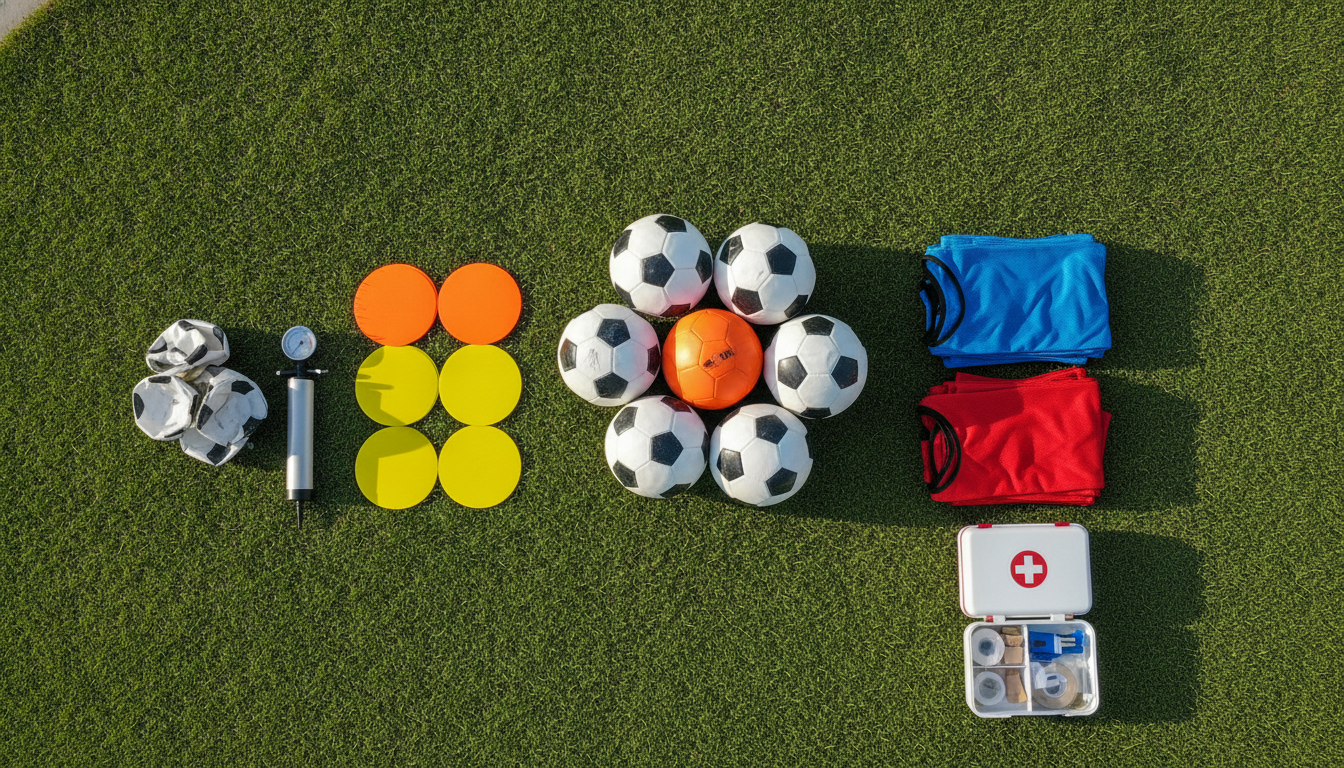
If you only buy five things, buy these. They cover a full training session for any age group, and everything else is an upgrade on top.
- Footballs and a pump (one per player, plus a few spares)
- Flat discs and dome cones for grids, gates and boundaries
- Training bibs in two colors
- A pair of pop-up goals
- A stocked first aid kit
A grassroots starter kit of these runs roughly £100 to £160 depending on how many players you have and how hard-wearing you buy. Spread across a season of weekly training, that is under £8 a week, and it is the cheapest part of running a team by a wide margin. Many clubs reimburse kit against receipts, so check with your committee or treasurer before you spend your own money.
Ball size and goal size by age group
Buying the wrong ball size is one of the most common and most wasteful mistakes. A size 5 ball is too big and heavy for an eight-year-old to strike cleanly, so it teaches poor technique and it wastes money when you have to replace it. Match the ball and the goal to the age group instead.
| Age group | Ball size | Typical goal size | Notes |
|---|---|---|---|
| U6 to U8 | Size 3 | Around 1.2 m (4 ft), mini or pop-up | Light ball, small goals, small-sided games |
| U9 to U12 | Size 4 | Around 1.8 m (6 ft) | Small-sided formats, 7v7 and 9v9 |
| U13 and up, adult | Size 5 | Full or 11-a-side goals | Match ball, full pitch |
Treat these as typical ranges, not rules. Your local league or national association sets the official ball and goal sizes for each age band, and those override anything here, so check the current rules for the competition you play in before you buy in bulk.
The full football coaching equipment list
Here is the complete kit by category. Start with the master table for quantities and prices at a glance, then read the notes under each category for what to actually look for.
| Item | What it does | Suggested quantity (squad of ~15) | UK price range |
|---|---|---|---|
| Footballs | Every drill and game | 12 to 15, plus 2 to 3 spares | £8 to £20 each, or bulk packs of 10 |
| Pump and needles | Keep balls at pressure | 1 dual-action pump, spare needles | £8 to £15 |
| Flat discs | Grids, boundaries, targets | 40 or more | £8 to £30 per 50-pack |
| Dome or saucer cones | Gates, turns, slaloms | 20 or more | £10 to £25 per set |
| Training bibs | Split teams by color | 10 to 15 per color, 2 to 3 colors | £25 to £40 per color set |
| Pop-up or portable goals | Shooting and small-sided games | 1 pair minimum, 2 pairs ideal | £30 to £150 per pair |
| Agility poles | Slaloms, dribbling gates | 12 | £40 to £70 for 12 |
| Speed ladder and hurdles | Footwork and coordination | 1 ladder, 6 micro-hurdles | £30 to £60 combined |
| Rebounder | Passing and solo work | 1 | £70 to £130 |
| Mannequins | Set pieces and defending shape | 3 to 5 | £25 to £50 each |
| Tactical board | Explain drills and shape | 1 | £15 to £30 |
| First aid kit | Injury response, safeguarding | 1, sized to the squad | £20 to £50 |
Footballs and a pump
Aim for one ball per player so nobody stands waiting for a touch, then keep two or three spares for the balls that inevitably get booted over a fence. A dual-action pump inflates faster than a single-action one, and a small pack of spare needles costs almost nothing but saves a session when the first one snaps. Balls run £8 to £20 each, and buying a bulk pack of 10 is usually cheaper per ball than buying them singly.
Cones, markers and discs
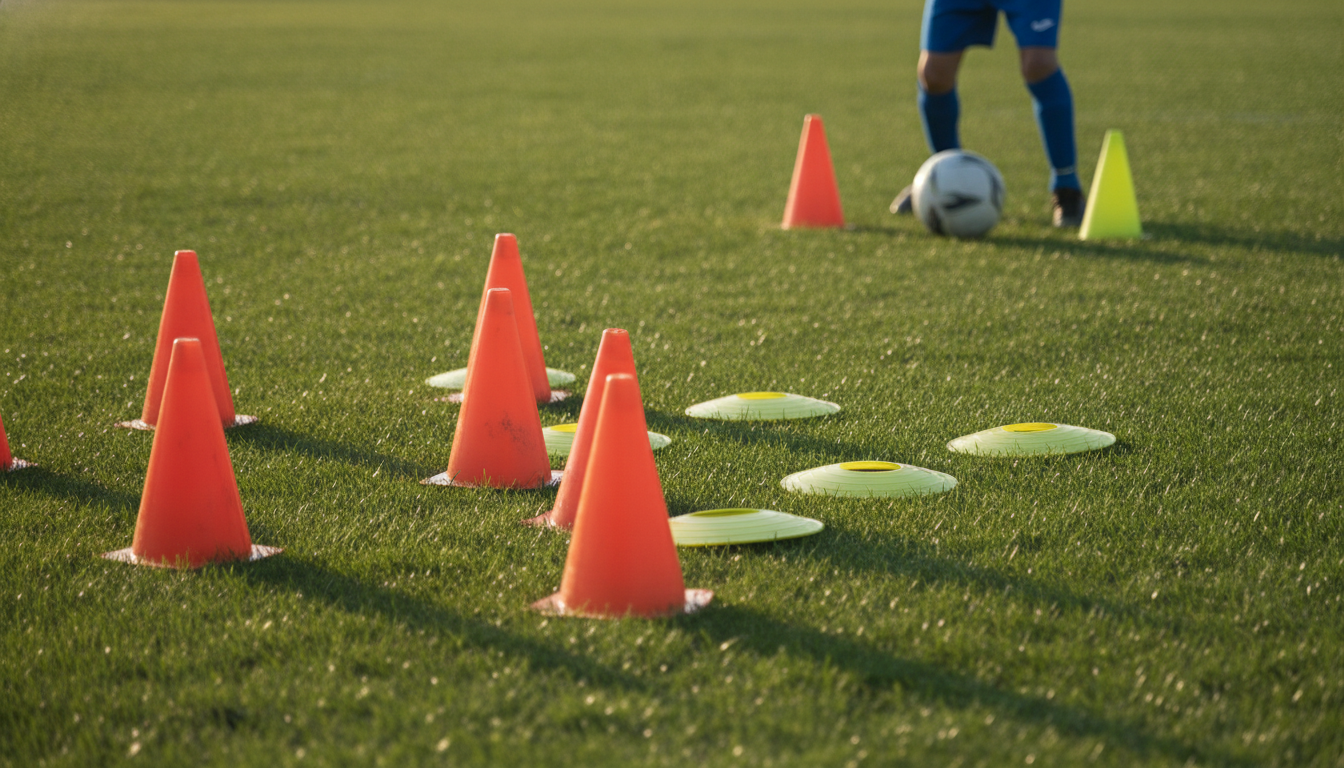
You want two types. Flat discs, 40 or more, mark out grids, boundaries and targets without tripping anyone up. Dome or saucer cones, 20 or more, sit higher for gates, turns and slalom runs. The real choice is durability: a cheap brittle 50-pack cracks within a season, while UV-stabilized cones last three or four. Judge cost per season, not the sticker price, and expect to pay £8 to £12 for cheap discs against £20 to £30 for the hard-wearing kind.
Training bibs
Two colors is the minimum so you can split a group into teams; a third color lets you run three-team rotations and possession games. Buy 10 to 15 per color to cover the largest small-sided format you run, choose mesh for breathability, and consider numbered sets for match day. A color set typically costs £25 to £40. Wash and count them every session, because bibs are the item that quietly disappears.
Portable goals and nets
Pop-up goals are light, fold flat and go up in seconds, which makes them the workhorse for shooting drills and small-sided games. Match the size to the age group, around 1.2 m for younger players and 1.8 m for older ones. A fold-up steel-framed goal is sturdier and better for regular finishing work. Keep a spare UV-treated net, since nets perish before frames do. Pop-ups run £30 to £60 a pair, fold-ups £80 to £150, and spare nets £15 to £40.
Agility and speed equipment
A flat-rung speed ladder, a six-pack of micro-hurdles and a set of 12 spring-based slalom poles cover footwork, coordination and dribbling. This is also where coaches over-spend. Pitch time and touches on the ball improve players more than drilling the ladder, so buy this after the essentials, not before. Budget around £10 to £25 for a ladder, £20 to £35 for hurdles, and £40 to £70 for a set of 12 poles.
Rebounders and mannequins
A dual-angle rebounder lets a player practice passing and control alone, which is useful for individual work and for keeping a station busy. Inflatable mannequins or a free-kick wall, three to five of them, stand in for defenders on set pieces and help teach defensive shape. A rebounder costs £70 to £130, and mannequins run £25 to £50 each, with inflatable sets often cheaper per unit.
Tactical board and the coach's kit
An A4 or A3 magnetic tactics board makes it far quicker to explain a drill or a shape than describing it from memory. Round out the personal kit with a pealess or electronic whistle, a session planner or journal to keep your football training session plans in one place, and a bag to carry all of it. A board is £15 to £30, a good whistle £4 to £12, and a planner £8 to £15.
First aid and hydration
This one is non-negotiable for safeguarding. Carry a stocked first aid or medic bag sized to your squad, a couple of ice packs, and a bottle carrier that holds 10 to 16 bottles so nobody shares. A first aid kit runs £20 to £50 and a bottle set £15 to £30. Check the contents before every session, not after you need them.
How much of each do you actually need?
The most common question new coaches ask is some version of "how many cones and bibs do I need for a squad of 15?" The answer scales with squad size, but not always in a straight line. Balls scale with players, cones scale with how many stations you run at once, and bibs scale with the biggest small-sided game you play.
| Squad size | Footballs | Flat discs | Dome cones | Bibs (per color) | Goals |
|---|---|---|---|---|---|
| 10 players | 10 to 12 | 30 | 15 | 8 to 10 | 1 pair |
| 15 players | 15 to 18 | 40 | 20 | 10 to 12 | 2 pairs |
| 20 players | 20 to 24 | 50 | 30 | 12 to 15 | 2 pairs |
Use this as practical guidance, not gospel. The rule of thumb is one ball per player, enough discs to mark every grid you run in parallel, and enough bibs of one color to field the largest team in your biggest small-sided game.
Three budget tiers: what a full kit costs
What you spend depends entirely on what you run. A volunteer coaching one weekly session needs a fraction of what a paid academy or a week-long camp does. Here are three worked kits with real total ranges. Framed across a season, even the largest kit works out to a small cost per session, and reimbursement against receipts is common, so keep them. If the club is footing the bill, it is also worth checking what funding for football clubs is available, since kit and equipment are exactly what small grants tend to cover.
| Tier | What's in it | Typical total |
|---|---|---|
| Grassroots starter | Balls, pump, 50 discs, 2-color bibs, a pair of pop-up goals, first aid kit | £100 to £160 |
| Academy or paid sessions | Adds quality cones, a third bib color, fold-up goals, a rebounder, agility set, tactics board, and spare balls at scale | £350 to £600 |
| Holiday camp or multi-station | Adds bulk balls, multiple goal pairs, several first aid kits, mannequins, station cones, a large hydration setup, and shade or storage | £600 to £1,000 |
Grassroots starter (~£100 to £160)
The volunteer weekly-training minimum. It runs a full session for one squad, holds up for a season, and is the tier most coaches should start on. Everything in it gets used every single week.
Academy or paid sessions (~£350 to £600)
Once you are charging for sessions and running multiple groups, you need hard-wearing cones that survive daily use, more bib colors for possession work, sturdier goals for finishing, and enough balls that two stations never run short. The jump in cost is mostly durability and quantity, not new categories.
Holiday camp or multi-station (~£600 to £1,000)
A camp cycles far more players through parallel stations across long days, so it needs more of everything and a few things a weekly squad does not: multiple goal pairs, several first aid kits, mannequins for skills stations, and hydration at volume. More on that next.
Equipment for holiday camps and multi-week courses
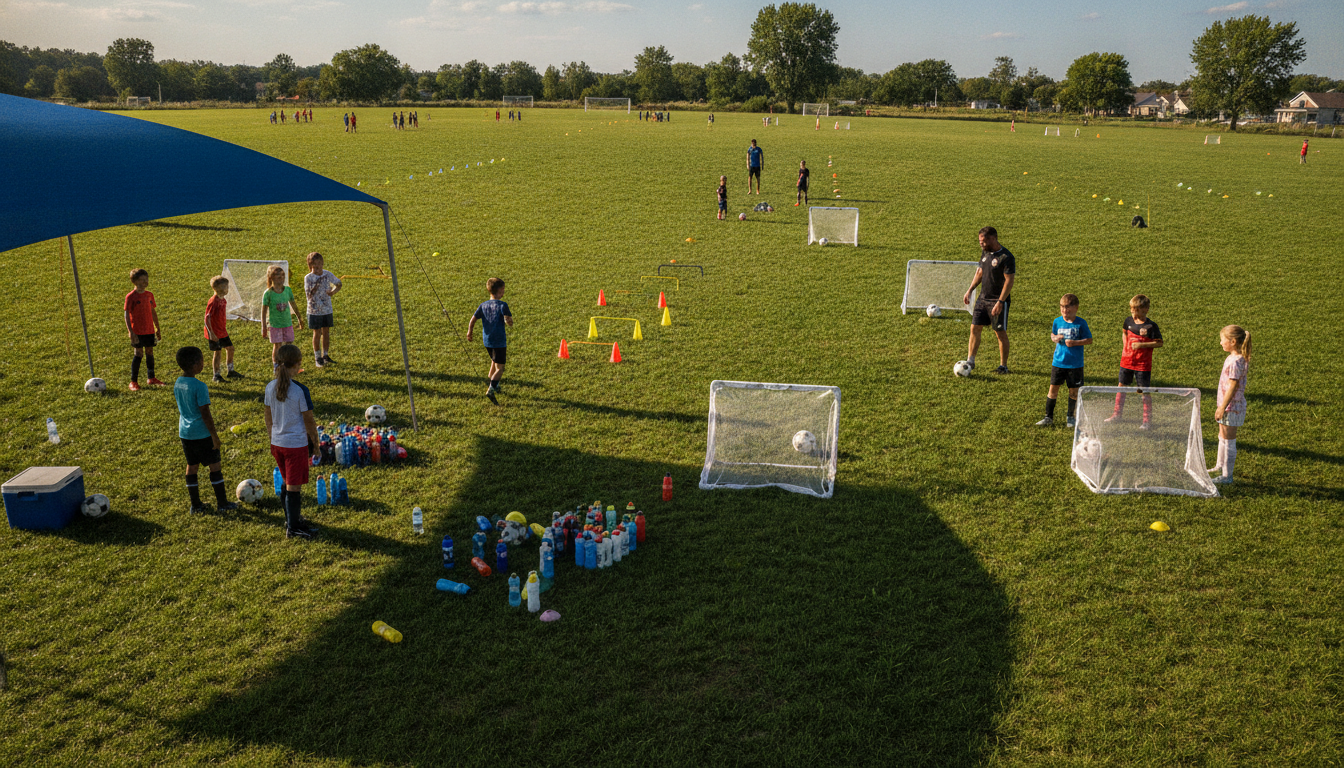
A holiday camp is a different job from weekly training, and the kit reflects it. You have more players cycling through more stations, longer days in the sun, and higher wear on everything, so plan for roughly two to three times the balls, multiple goal pairs so parallel stations run at once, and station cones that stay out all day.
The load on first aid and hydration is the part coaches underestimate. Longer days and more children mean more scrapes and more risk of heat, so carry extra first aid kits, plenty of water, and shade or a shelter for breaks. The kit is only one part of the job, though: our guide to how to run a football camp covers the rest, from staffing and scheduling to sign-ups. For the coaching side, a bank of football drills for kids keeps a full day of stations fresh without more kit.
The other camp-specific need has nothing to do with equipment: knowing exactly who is on site. A quick check-in and a headcount at the start of each day is a safeguarding basic, and it is the natural handover point from the kit bag to the admin side we cover below.
What to skip (for now) on a grassroots budget
An honest list of what not to buy yet is worth as much as the list of what to buy. On a grassroots budget, spend on the things every session uses and defer the things a few sessions a year use.
- GPS trackers and wearable player monitoring. Useful data at academy and pro level, overkill for a Sunday-league team. Revisit it later if you ever need it.
- AI match-analysis cameras. Nice to have, but they do not make you a better coach, and a tactics board and your own eyes cover almost everything for now.
- More agility gadgets before you have enough balls and cones. Touches on the ball beat another ladder drill, every time.
- Cheap brittle cones that crack within a season. A false economy; the hard-wearing set is cheaper over three years.
The principle is simple: buy the things every single session depends on, and put off the things that only a handful of sessions a year would use.
Storing, transporting and making kit last
Kit lasts longer when you treat it as a cost per season, not a one-off purchase. A £30 UV-stabilized cone set that survives three seasons beats a £10 set you replace every year, and the same logic applies to nets, bibs and goals.
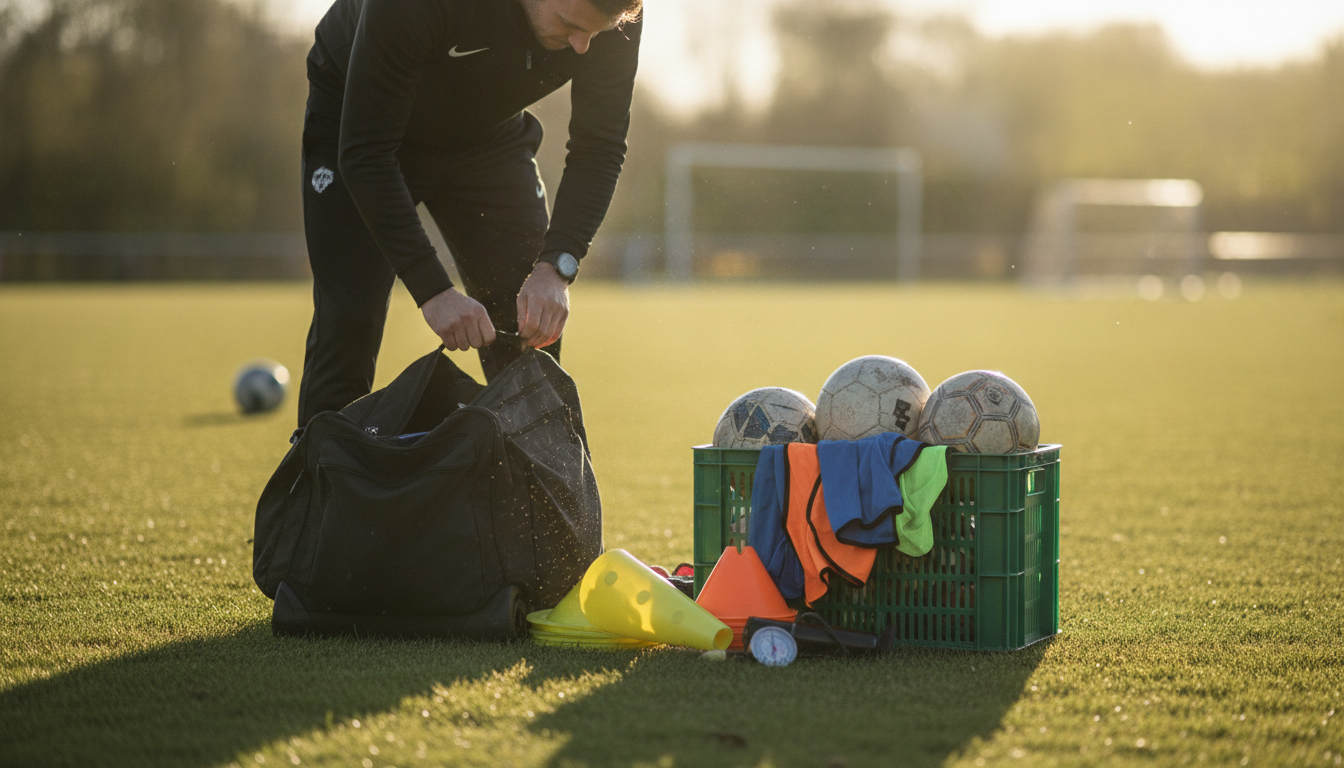
A wheeled kit bag or a stackable crate makes it possible to move everything in one trip and to see at a glance what is missing. Count kit in and out every session so nothing walks off, deflate balls partially for long storage to protect the bladders, and keep a small repair kit of a pump, spare needles and net ties. If several coaches share the equipment, label it, so the right kit comes back to the right bag.
Beyond the kit bag: running the sessions the equipment is for
Here is the point no equipment guide makes: the kit is the cheap part. The work that actually eats your week is administering the sessions the kit is used in. Taking registrations, collecting session or membership payments, keeping accurate registers, and messaging parents adds up to far more time and hassle than a bag of cones ever will.
This is where we fit. Pembee handles online registration, recurring payments and attendance registers in one place, so the money side of running a squad, an academy or a camp does not fall on a spreadsheet and a volunteer treasurer. If you are weighing up tools for this, our roundup of the best football club management software compares the options. Coaches thinking about turning sessions into a paid business will also find our guide to how to start a football academy walks through the structure, pricing and admin side step by step.
Football coaching equipment checklist
Screenshot or print this. It groups the kit by when to buy it, so you can build up in tiers instead of all at once.
Essential (buy first):
- Footballs, one per player, plus 2 to 3 spares
- A dual-action pump and spare needles
- 40 or more flat discs
- Training bibs in two colors
- A pair of pop-up goals
- A stocked first aid kit and a bottle carrier
Add next (paid or academy sessions):
- 20 or more hard-wearing dome cones
- A third bib color
- Fold-up goals for finishing work
- 12 slalom poles, a speed ladder and hurdles
- A rebounder and a tactics board
Camp extras (multi-station days):
- Bulk balls and multiple goal pairs
- Several first aid kits and hydration at volume
- Mannequins and station cones
- Shade or shelter, and a wheeled bag or crate
Key takeaways
- The five essentials, footballs, discs, bibs, pop-up goals and a first aid kit, run roughly £100 to £160 and cover a full session for any age.
- Match the ball and goal to the age group: size 3 and mini goals for the youngest, size 5 and full goals from U13 up.
- Quantities scale with your squad: one ball per player, discs for every parallel station, and bibs for your biggest small-sided team.
- Build in tiers. Grassroots starter, academy, and camp kits cost more because of durability, quantity and station gear, not new categories.
- Spend on what every session uses and defer GPS trackers, AI cameras and extra agility gadgets until you genuinely need them.
- The kit is the cheap part; the recurring cost of running a team is the admin, from registrations and payments to registers and parent comms.
FAQs
What equipment does a beginner football coach need?
Start with the five essentials: footballs with a pump, a set of flat discs, training bibs in two colors, a pair of pop-up goals, and a stocked first aid kit. That covers a full session for any age group and runs around £100 to £160. Everything else, from agility gear to rebounders, is an upgrade you can add later.
How many cones and bibs do I need for a squad of 15?
For 15 players, plan on around 40 flat discs and 20 dome cones, which is enough to mark several grids and gates at once, plus 10 to 12 bibs in each of two colors. Cones scale with how many stations you run at the same time, while bibs scale with the largest team in your biggest small-sided game.
What size football should I use for each age group?
Use a size 3 ball for U6 to U8, a size 4 for U9 to U12, and a size 5 from U13 up and for adults. Smaller and lighter balls suit younger players and protect technique. Your league or national association sets the official sizes for each age band, so confirm the current rules before buying in bulk.
Are GPS trackers worth it for grassroots teams?
For most grassroots teams, no. GPS trackers and wearable monitoring produce useful data at academy and professional level, but they are overkill for a volunteer-run squad and the money is better spent on balls, cones and coaching. Revisit them if you move into a high-performance setup that will actually use the data.
How much should a grassroots coach budget for equipment?
Around £100 to £160 gets a full grassroots starter kit that runs a season of weekly training. Spread across the season, that is under £8 a week, which is small next to pitch hire and other running costs. Many clubs reimburse kit against receipts, so check with your committee before spending your own money.
What do you need to run a football holiday camp?
A camp needs more of everything than weekly training: roughly two to three times the balls, multiple goal pairs for parallel stations, several first aid kits, and hydration and shade at volume. You also need a check-in and headcount process so you always know who is on site, plus the right insurance cover for a camp rather than a single session.
How do I make football coaching equipment last longer?
Buy hard-wearing, UV-stabilized cones and nets, since they survive several seasons where cheap plastic cracks in one. Count kit in and out of a wheeled bag or crate every session, partially deflate balls for long storage, and keep a small repair kit of a pump, needles and net ties. Label everything if several coaches share it.
What is the difference between flat discs and dome cones?
Flat discs are low, flexible markers used for grids, boundaries and targets, and players can run over them safely. Dome or saucer cones sit higher, which makes them better for gates, turns and slalom runs that need a visible obstacle. Most sessions use both, so a full kit carries 40 or more discs and 20 or more dome cones.
Do I need portable goals or will cones do?
Cones can mark a target goal in a pinch, but a pair of pop-up goals transforms shooting drills and small-sided games and takes seconds to set up. They are one of the five essentials for that reason. Match the size to the age group, around 1.2 m for young players and 1.8 m for older ones, and keep a spare net.