


Finding a list of outdoor learning activities takes about eight seconds. Turning one of those ideas into a session you can staff, kit, price and still run on a wet Tuesday takes a lot longer, and almost nothing written on the subject helps you do it. Most of it is written for a classroom teacher with a field behind the building and nobody to refund.
This is for the other group: forest school leaders, holiday camp operators, after-school clubs, nature nurseries and outdoor education companies who charge for these sessions and deliver them whatever the sky is doing.
Outdoor learning activities are structured learning experiences delivered outdoors, where the outdoor setting is doing the teaching rather than just hosting it. They span literacy, math, science, art and teamwork, run in anything from a school field to woodland, and typically last 15 to 90 minutes.
Below are 30 activities, each with an age band, a run time, a workable group size and a kit list, plus wet-weather swaps, a costed starter kit, and a six-week plan that builds instead of jumping around.
What counts as outdoor learning (and what doesn't)
The line worth drawing for parents is between outdoor learning and outdoor play. Outdoor learning has a learning intention: someone decided what the session was for before it started, and there is a way to tell whether it landed. Free play has no such intention and is every bit as valuable. Good sessions carry both, in that order, with play as the reward rather than the filler.
Three delivery modes cover almost everything you will run. Curriculum taken outside is a lesson that would otherwise happen indoors, moved onto the field because the field does it better, which sits closer to enrichment than to core curriculum delivery. Nature-led sessions let the site drive the content, so the tree that came down overnight becomes the lesson. Adventure and challenge work uses orienteering, shelter building and team tasks to teach through the problem rather than the place.
None of this is only for young children. Adult foraging courses, corporate team days, family nature clubs and teen expedition programs run on the same operational model: a site, a leader, a plan, a ratio and a way to take bookings.
The setting bar is lower than most people assume. A hedge, a strip of grass and a parking lot with three planters is enough for most of what follows.
What the research actually says about learning outdoors
The strongest single finding for anyone selling sessions to a school comes from Ming Kuo, Matthew Browning and Milbert Penner in Frontiers in Psychology. Across 20 matched lesson pairs with two third-grade classes, teacher redirects in the lesson that followed fell from 5.70 per 20-minute observation after an indoor lesson to 3.10 after a lesson in nature. Teachers went about 6.5 minutes between redirects after a nature lesson against 3.5 minutes after an indoor one, and 61 of 100 paired comparisons favored the nature lesson.
The Chartered College of Teaching's review of the outdoor learning evidence base adds three findings worth quoting to a school or a parent. Dettweiler and colleagues found a day a week of curriculum learning outdoors produced lower cortisol and better stress regulation. Ulset and colleagues found the more time preschoolers spent outdoors, the better they scored on memory and attention tests, and a follow-up 10 years later found those children still had better attentional control as teenagers. A review of 58 UK studies by Fiennes and colleagues found almost all types of outdoor learning had a positive impact, strongest where sessions were sustained over time and paired with preparation and follow-up work.
Build your program around that last point. It is why the six-week plan further down exists.
Newer work is worth quoting accurately, because the honest version is more useful than the headline. Arianna Pikus and colleagues, writing in AERA Open, followed 82 children at a nature-based preschool and 58 at a conventional one across a school year. The nature-based group gained early literacy, working memory and inhibitory control at the same rate as their indoor peers, while the conventional group grew more on behavioral self-regulation. That answers the question a cautious parent is really asking, which is whether the outdoor hours cost their child academic ground. The companion finding matters commercially: Pikus reports that teachers who spend more time outdoors have less stress and are less likely to burn out. Staff retention is a real cost line, and this is evidence you can point at.
30 outdoor learning activities, grouped by subject
Every activity carries the same spec line: age band, run time, workable group size, kit. Treat the ages as a starting point, because nearly all of these stretch up or down by changing the difficulty rather than the activity. A sound map works for a five-year-old and for adults on a wellbeing day; only the debrief changes. Kit appears in the starter kit table further down, and 21 of the 30 need nothing you have to buy in specially: found materials plus chalk, string, paper, pencils and clipboards.
Den building, mud kitchens, fire building and forest mindfulness are missing on purpose. We cover those in our forest school activity ideas, and our after-school activity ideas pair well with these.
Literacy and storytelling outdoors
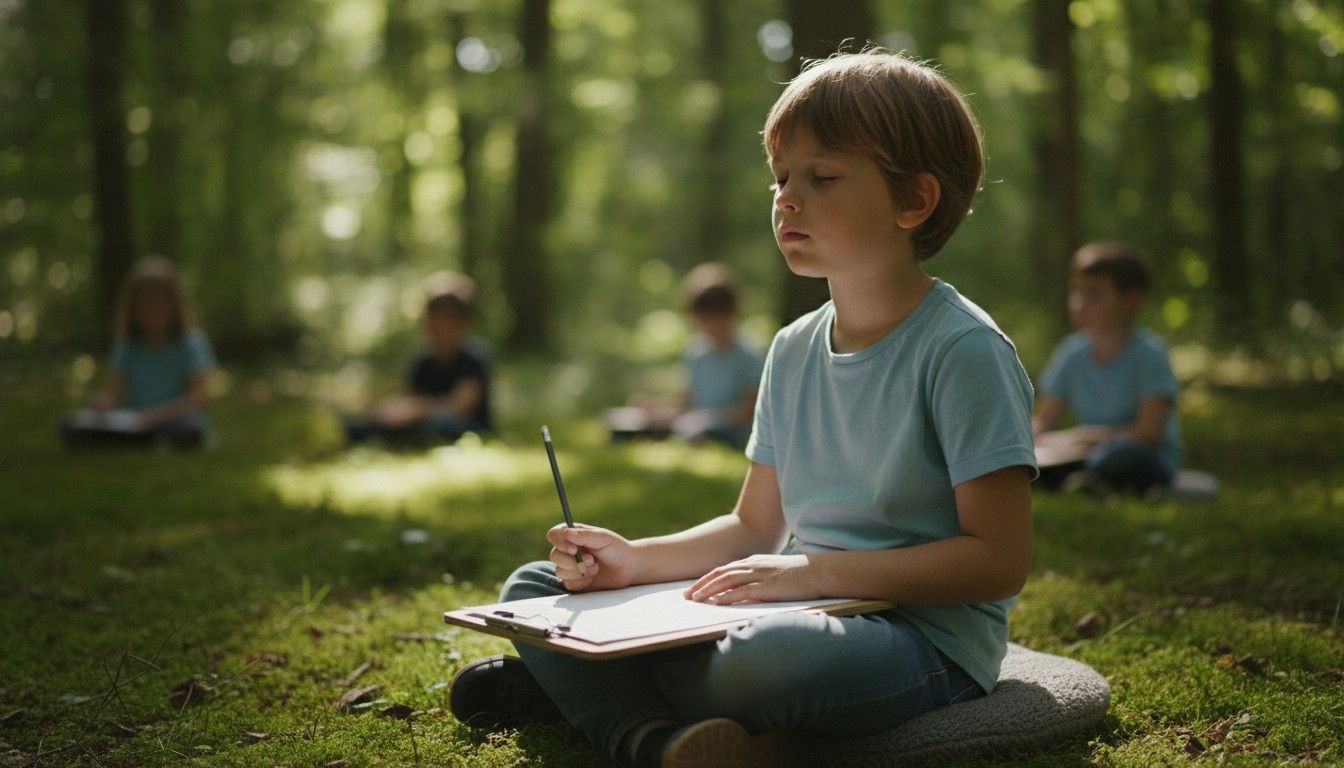
1. Sound map · Ages 5–11 · 15 min · 6–30 · kit: paper, clipboards, pencils Children mark themselves at the center of a page, close their eyes for two minutes, then plot every sound by direction and distance. Feeds straight into descriptive writing back at base.
2. Story stones · Ages 4–9 · 25 min · 6–24 · kit: smooth stones, chalk or paint Each child marks a symbol on ten stones, then draws three at random and builds a story from them. Bag them up and they work every term after.
3. Alphabet and spelling trail · Ages 4–8 · 20 min · 8–30 · kit: laminated letters, a bag per pair Hide letters around the site and send pairs to collect and build words. Swap in spelling patterns or prefixes and it runs for a 10-year-old.
4. Interview an object · Ages 6–12 · 20 min · 6–30 · kit: paper, pencils A child picks a tree, rock or fence post, interviews it in pairs and writes the answers in first person. Funnier than anything you will plan.
5. Reading nest · Ages 5–14 · 20 min · any · kit: tarp, cushions, books Self-chosen reading on a tarp under cover. Zero prep, and the best cooldown on this list after a high-energy game.
Math on grass
6. Estimate then measure · Ages 7–13 · 20 min · 6–30 · kit: string, tape measure Children estimate a tree's girth by hugging it, then measure with string. Percentage error is the lesson, and it lands harder because they made the guess.
7. Shadow-ratio tree height · Ages 9–14 · 25 min · 6–24 · kit: meter stick, tape measure Measure a stick and its shadow, then the tree's shadow, then scale up. Ratios made physical. Sunny days only, so keep a swap ready.
8. Nature tally and survey · Ages 6–12 · 25 min · 8–30 · kit: string or hoops, paper, pencils Mark a square meter, count leaf types, species or litter inside it, then chart it. Compare squares and the variation writes the discussion.
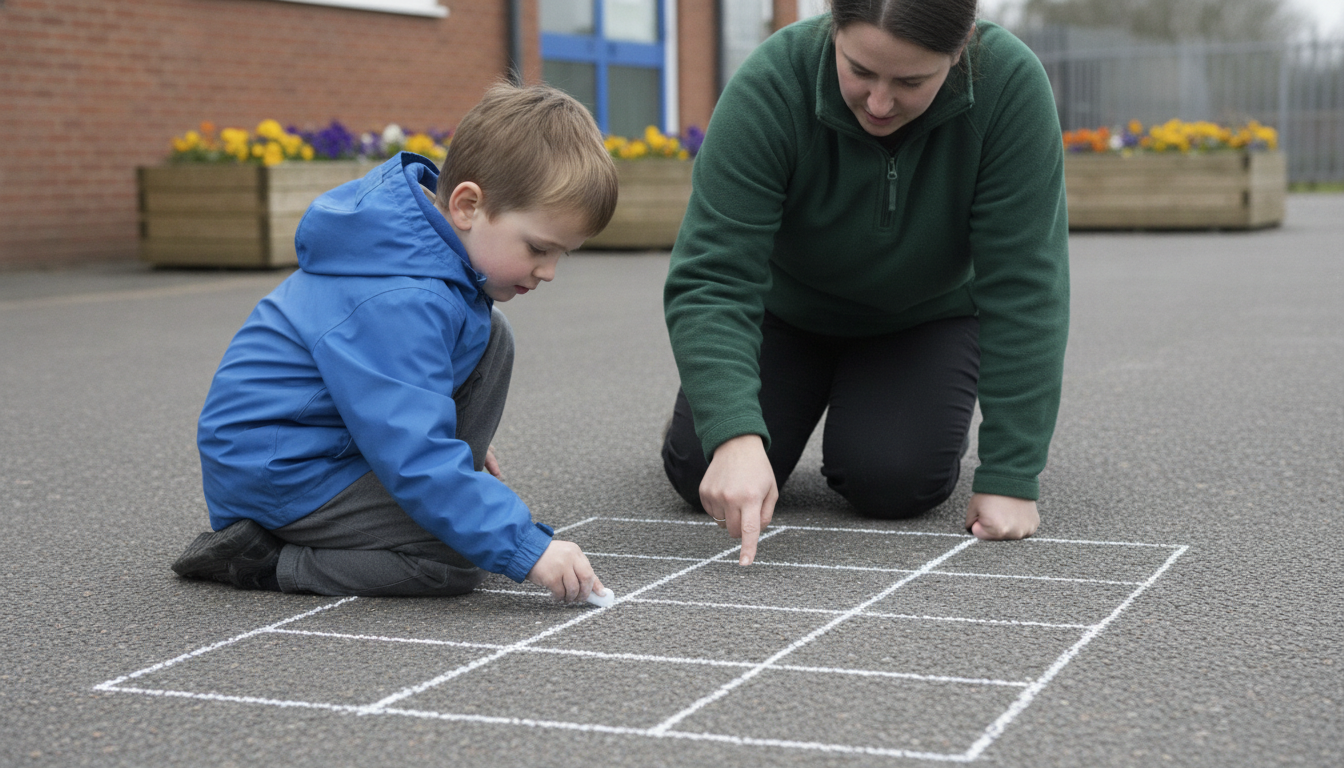
9. Chalk coordinate grid · Ages 6–11 · 15 min · 8–30 · kit: chalk, hard surface Draw a grid on any hard standing, call coordinates, children run to them. Doubles as an arrival warm-up on cold mornings.
10. Stick fractions and symmetry · Ages 5–10 · 20 min · 6–24 · kit: sticks, leaves Snap sticks into halves, thirds and quarters, then fold leaves along their lines of symmetry. Free, and it survives being dropped in mud.
Science and investigation
11. Bug hotel build · Ages 4–11 · 40 min · 6–24 · kit: pallet or crate, hollow stems, bark, straw Build as a group, site it somewhere shaded and damp. The part everyone skips is the follow-up: return in three weeks and log what moved in.
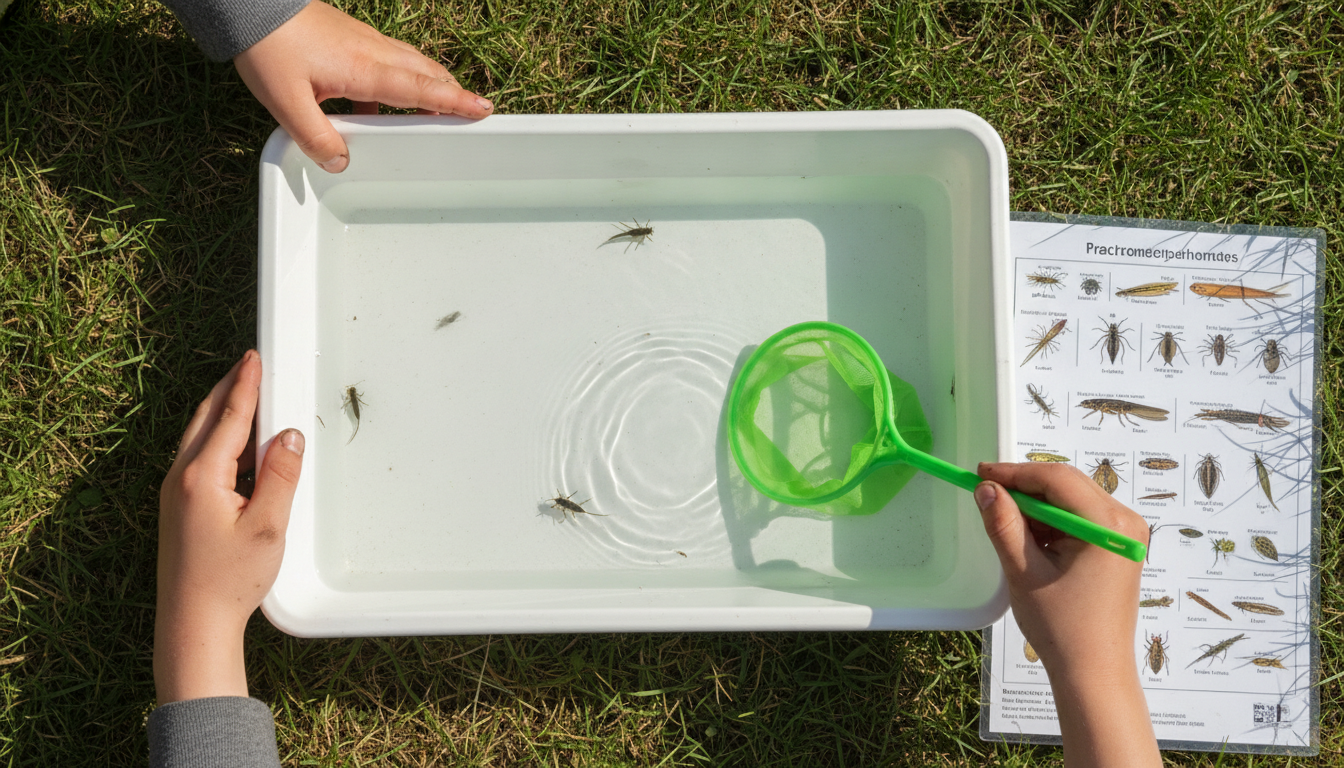
12. Pond or puddle dipping · Ages 5–12 · 30 min · 6–16 · kit: nets, white trays, ID sheets Sweep, tip into a white tray, identify. Water tightens your ratio, so plan the extra adult and a fixed edge before the science.
13. Rain gauge and weather station · Ages 6–12 · 30 min · 6–24 · kit: cut bottle, ruler, marker, log sheet Build it in week one, then read and log it weekly. This is what gives your program a data set of its own.
14. Soil and worm survey · Ages 5–11 · 25 min · 6–24 · kit: trowels, hoops, paper Mark a square, dig a spit, count what is in it, put it back. The cheapest science here and reliably the most popular.
15. Seed dispersal race · Ages 7–12 · 30 min · 6–30 · kit: paper, tape, found materials Children design seeds that fly, float or stick, then test them from a set height. Redesign after the first run and you have an engineering cycle.
16. Ten-minute bird count · Ages 6–14 · 15 min · 6–20 · kit: ID sheet, binoculars if you have them A fixed spot, a fixed 10 minutes, everything recorded. Repeat weekly from the same place and the numbers become comparable.
Art, making and sensory
17. Land art mandala · Ages 4–14 · 30 min · 6–30 · kit: none A group builds a radial pattern from leaves, stones, petals and seed heads. Photograph it, then leave it to come apart. The impermanence is the conversation.
18. Bark and leaf rubbings · Ages 4–9 · 20 min · 6–30 · kit: paper, wax crayons Pair each rubbing with identifying the tree it came from and it stops being craft and starts being classification.
19. Sunprints · Ages 5–12 · 20 min · 6–24 · kit: cyanotype paper, water tray Arrange found objects on light-sensitive paper, expose, rinse. The main consumable on this list, so budget it per session.
20. Journey stick · Ages 4–10 · 30 min · 6–24 · kit: sticks, wool or string Tie a found item to a stick at each stop on a walk to build a physical timeline. Best take-home here, and parents keep them.
21. Mud paint and natural dye · Ages 4–11 · 30 min · 6–24 · kit: mud, charcoal, berries, onion skins, paper Mix pigments from the site and paint with fingers and sticks. Warn parents in the kit list, because berry and onion stains do not come out.
Movement, teamwork and challenge
22. Map-making and mini orienteering · Ages 8–14 · 45 min · 8–30 · kit: paper, clipboards, markers or cones One group maps the site, then sets a short course for another group to run. Handing over the design is what makes it work.
23. Predator and prey camouflage game · Ages 6–12 · 20 min · 10–30 · kit: none The highest-energy item here. Burns off arrival energy, and warms a cold group faster than any amount of standing still.
24. Knots and rope challenge · Ages 8–14 · 30 min · 6–20 · kit: rope, cord, tarp Teach three knots, then set one real task such as rigging a tarp between two trees. Transfers straight into shelter work.
25. Design-your-own obstacle course · Ages 7–13 · 45 min · 8–24 · kit: found materials, rope, cones Groups design a course, then risk-assess their own before anyone runs it. The second half is the part that teaches, and it feeds the section below.
26. Blindfold trust trail · Ages 8–14 · 25 min · 8–24 · kit: rope line, blindfolds A guided rope line walked with eyes closed or covered. Make the blindfold optional and check consent out loud, because it frightens some children.
Seasonal and weather-led
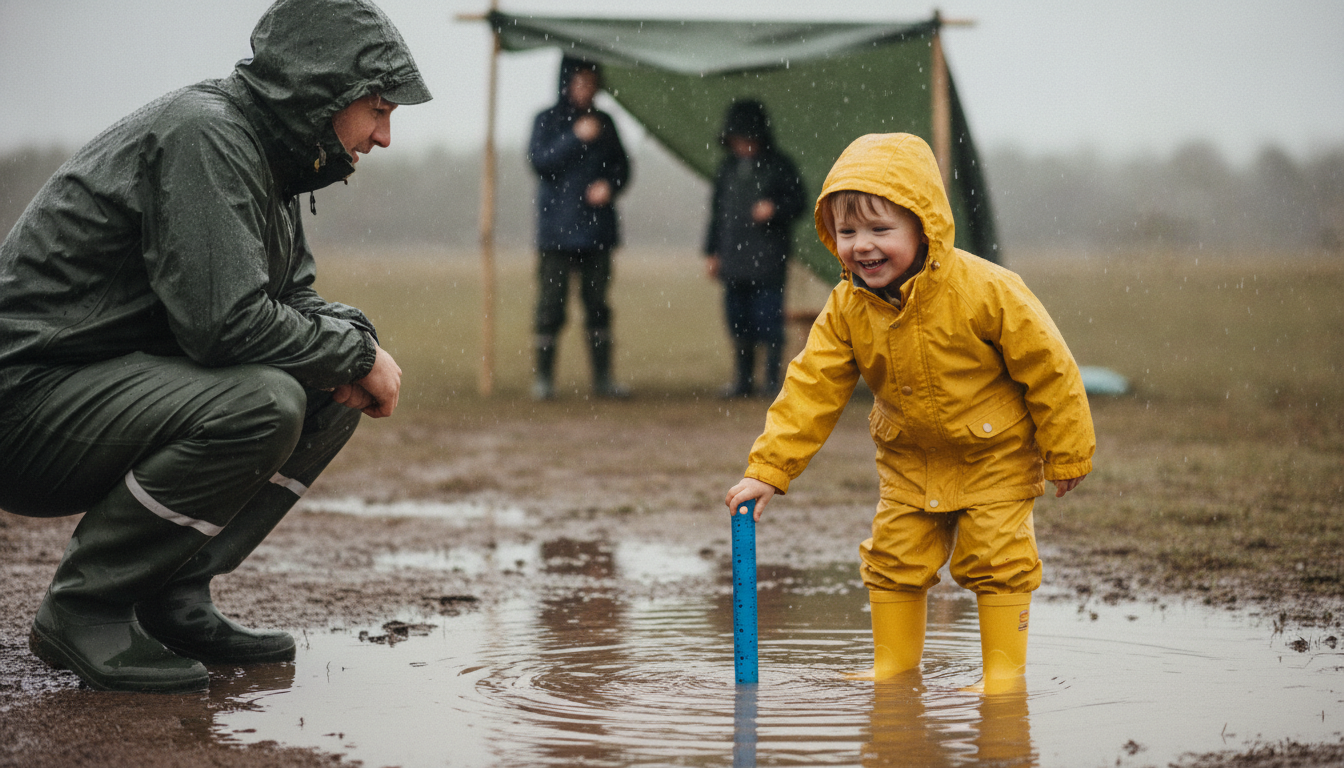
27. Puddle science · Ages 5–11 · 25 min · 6–30 · kit: rulers, chalk, paper Measure depth, chalk the edge, come back and measure again. Evaporation, flow and catchment, using the weather everyone else cancels for.
28. Frost and ice investigation · Ages 6–12 · 30 min · 6–24 · kit: tubs, salt, wool, timers Freeze objects in tubs overnight, then test melt rates against salt, insulation and sun. A winter session from a freezer and some containers.
29. Leaf fall phenology log · Ages 5–12 · 10 min weekly · any · kit: paper, phone camera Mark one tree, photograph it from the same spot each week, log the change. Runs a whole fall term for nothing.
30. Shadow tracing across a day · Ages 5–10 · 3 × 10 min · 6–30 · kit: chalk, hard surface Chalk around a child's shadow at three points in the day. Earth science made visible, and the third tracing does the teaching.
What to run when it rains
A school can retreat indoors and lose nothing. A provider who has taken payment for a Saturday forest session cannot: a cancellation is a refund, a complaint and a rebooking you will not get. So the weather plan has to be a swap, not a stop.
Sessions fail on wet feet and cold hands, not on rain. That means the kit list you send parents is a safety document, not a nicety: waterproof jacket and pants, boots that seal, a spare pair of socks, gloves. Keep spare gloves, socks and a couple of adult-sized waterproofs in the leader bag, because the one child who arrives in sneakers is the one who ends the session early for everyone.
| Rained off | Run this instead | Why it works |
|---|---|---|
| Shadow-ratio tree height | Puddle science | Same measurement and ratio skills, and it needs the rain |
| Sunprints | Mud paint and natural dye | Wet ground makes the pigments better, not worse |
| Ten-minute bird count | Knots and rope challenge under a tarp | Keeps the group under cover and working with their hands |
| Land art mandala | Story stones under a tarp | No fine motor work in cold rain, and stones do not blow away |
| Mini orienteering | Predator and prey camouflage game | High movement warms a cold group faster than a hot drink |
Four things genuinely stop a session: high wind, lightning, ice underfoot and extreme heat. High wind under a tree canopy is the one that actually cancels forest sessions, because falling limbs are not a risk you can manage with better clothing. Move to open ground or call it.
Publish the weather policy before the season starts, decide by a fixed time on the day, and send one message to the whole group at once. Nobody should be negotiating a refund in a downpour. If you do have to move a session indoors, our indoor activity ideas cover the full fallback.
Risk-benefit assessment without the paperwork spiral
Outdoor education does not try to remove hazard, it weighs hazard against the developmental value of the activity. The Forest School Association builds this into its principles for good practice, which require a risk-benefit process managed jointly by practitioner and learner and tuned to the learner's stage. A child learning to carry a stick safely or tie off a tarp is the point of the session, not a supervision failure.
Written down for the obstacle course above, it looks like this. Hazard: trips, falls from height, collisions. Who is affected: participants, mainly the fastest and least cautious. Benefit of running it anyway: risk judgment, negotiation, physical problem solving, and children learning to spot hazards themselves. Control measures: knee height maximum, no fixed sharp edges, one group runs while the other watches, designers walk the course first. Residual risk: low, and accepted. Sixty words, and a stronger document than any blank template.
Run a 10-minute site check on arrival, every time: dead wood overhead, ground hazards and holes, water, boundaries and exits, sharps and litter, ticks and stinging plants, and where the phone signal drops out.
On ratios, start from something workable and then defer. Around 1:6 for under-fives, 1:8 for ages 5 to 8 and 1:10 for 8 and up is a reasonable planning baseline, but the binding numbers come from your regulator, your insurer and the venue, not from us. Water, fire, tools, off-site travel and additional needs all tighten them.
Three things to have before the first paid session: public liability insurance that explicitly names outdoor and off-site activity, an outdoor-appropriate first aid qualification, and a written emergency plan naming the nearest vehicle access point for an ambulance. That last one is almost never mentioned and is the first thing you will want. Parental consent has to be on file before anyone leaves base, which our field trip permission slip guide covers in full.
What it costs to kit out an outdoor learning program
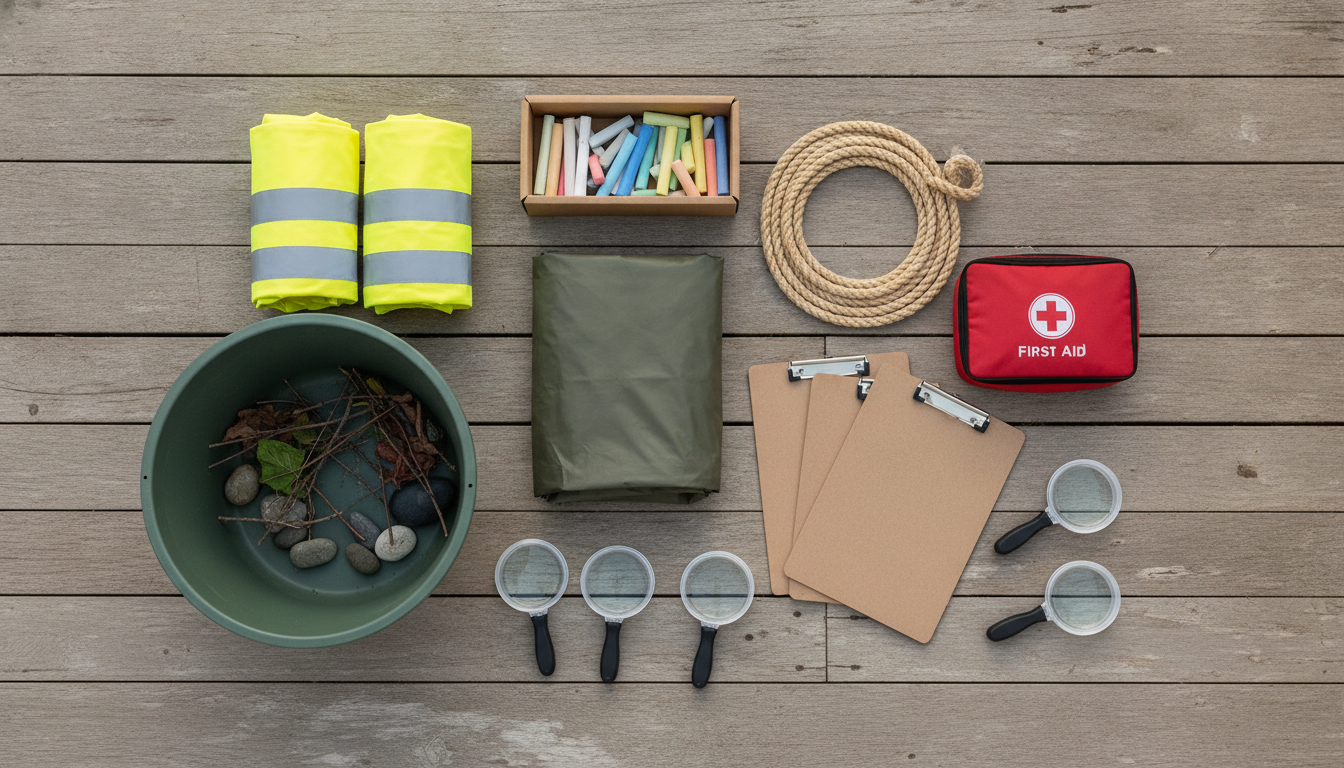
Every roundup says you only need sticks and stones, then lists activities needing clipboards, magnifiers, tarps, rope, trays and a first aid kit. Here is the actual bill for a group of around 15.
| Item | Tier | Indicative cost |
|---|---|---|
| Tarp, 3 x 3 m, plus guy line | Day one | $30–60 |
| Rope and cord bundle | Day one | $20–40 |
| Outdoor first aid kit | Day one | $40–80 |
| Clipboards x15 | Day one | $25–45 |
| Hand lenses and bug pots x15 | Day one | $20–40 |
| Trugs or collection buckets x6 | Day one | $30–50 |
| High-visibility vests x30 | Day one | $40–70 |
| Spare gloves, hats and socks | Day one | $30–50 |
| Kelly kettle or fire kit | Build up later | $80–150 |
| Pond dipping nets and trays | Build up later | $50–90 |
| Laminated species ID sheets | Build up later | $20–40 |
| Sunprint paper (consumable) | Build up later | $15–25 per pack |
| Storage crates and a wheeled cart | Build up later | $60–120 |
Day one comes to roughly $235 to $435. The second tier adds about $225 to $425 once the program is earning. These are indicative US retail ranges rather than quoted prices, so check two or three against your own suppliers before you build a budget on them.
Almost all of it is one-time spend. The tarp, rope, clipboards, lenses, trugs and vests last years with basic care, and the only true consumables on the whole list are sunprint paper, chalk and the odd roll of string. Waterproofs, boots and spare clothes are parent-supplied, which is exactly why they belong on the kit list you send with the booking rather than in your equipment budget.
A six-week outdoor learning plan that builds
The Fiennes review found the strongest results where outdoor learning was sustained over time with preparation and follow-up, rather than delivered as one-offs. Every activity roundup ignores this and presents its list as an unordered pick-and-mix. Here is the sequenced version.
| Week | Focus | Activities | Builds toward |
|---|---|---|---|
| 1 | Get to know the site | Sound map, boundary walk, mark one tree | Baseline observation and group rules |
| 2 | Observe and record | Ten-minute bird count, leaf phenology log, rain gauge build | A data habit and a weekly comparison |
| 3 | Investigate | Soil and worm survey, bug hotel build | Hypothesis and evidence |
| 4 | Measure | Estimate then measure, shadow-ratio tree height | Number applied to their own site |
| 5 | Make | Land art mandala, journey stick, mud paint | A creative response to the site |
| 6 | Lead | Design-your-own obstacle course, children set an orienteering course | Handing ownership over |
Inside each session, keep the same rhythm: arrival and boundary check, a warm-up game, the main activity, then a reflection circle. Predictability at the edges is what lets you take risks in the middle.
Return to the same site every week rather than chasing new locations. Repeat visits are the mechanism, not a budget compromise, because the bird count only means something the fourth time and the marked tree only tells a story once it has changed. Our forest school curriculum guide covers the longer arc across a full year, and the same sequencing logic applies to after-school lesson planning.
Turning outdoor learning into sessions people book
Everything above is the easy half. The half that decides whether families rebook is the admin around it, and it starts before anyone leaves base.
Collect it once, at booking: emergency contacts, medical and allergy details, photo consent, who is allowed to collect the child, and any additional needs the leader has to know in the field. Photo consent deserves particular care outdoors, because parents love the session photos right up until the one they did not agree to, and our photo consent guide covers the wording.
Send the kit list with the booking confirmation, not in a newsletter three weeks out. Parents read confirmations. The child in sneakers is a communication failure, not a parenting one.
Then the headcount. Paper registers get wet and signal disappears in woodland, so pull up your attendance list before you leave base and download the PDF roster as the backup for the spots where signal drops out.
On weather, publish the policy, default to a credit or transfer rather than a refund, and message everyone at once. And sell in blocks. A six-week block sells the progression above, gives you attendance you can staff against, and stops week four collapsing because it rained in week three. Drop-ins fill the gaps.
We handle the bookings, the custom medical and consent forms, the attendance lists and the payments for forest school and outdoor programs, for after-school clubs and for holiday camps, which is what turns the plan above into something a parent can book in two minutes.
The activities are the easy part
Thirty ideas will fill a term. What separates a program families rebook is the layer around them: timings that fit the slot you sold, kit that is in the cart before you leave, a swap ready for the rain, ratios you can defend to an insurer, and admin that does not eat the leader's evening. Pick six activities, sequence them, run them on the same site six weeks running, and you have a product rather than a list.
Key takeaways
- Outdoor learning has a learning intention behind it. Free play does not, and a good session carries both, in that order.
- Teacher redirects fell from 5.70 to 3.10 per 20-minute observation in the lesson after children learned in nature, and sustained programs beat one-off sessions.
- Every activity needs four numbers before it is plannable: age band, run time, group size and kit.
- Build a wet-weather swap for every activity that needs sun. A cancellation costs you a refund, a complaint and the rebooking.
- Use risk-benefit rather than risk elimination, site-check on arrival, and treat your regulator, insurer and venue as binding on ratios.
- Day one kit for 15 children runs roughly $235 to $435, and 21 of these 30 activities need nothing you have to buy in beyond found materials, chalk, string, paper, pencils and clipboards.
- Sell six-week blocks, send the kit list with the booking confirmation, and download the roster before you head somewhere without signal.
FAQs
What are outdoor learning activities?
They are learning experiences run outdoors where the setting does the teaching rather than just holding it. They cover literacy, math, science, art and teamwork, run anywhere from a school field to woodland, and usually last 15 to 90 minutes with a stated learning intention.
How long should an outdoor learning session be?
A single curriculum activity taken outside works in 20 to 30 minutes. A nature-led session needs 90 minutes to three hours. Anything under 45 minutes barely covers arrival, kit changes and settling for an off-site group, so it rarely justifies the travel.
Do you need a qualification to run outdoor learning?
Not to take your own group outside. In practice you do to run it commercially, because insurers and venues ask for a recognized leader qualification plus an outdoor first aid certificate before they will cover or host you.
What if we don't have woodland?
Only two of the 30 activities above need a site feature you cannot improvise: pond dipping needs standing water and the worm survey needs diggable ground. The rest run on a school field, a park, a churchyard, a parking lot with planters, or hard standing with one mature tree nearby. Chalk, string and paper cover most of the list.
How many adults do you need?
Around 1:6 for under-fives, 1:8 for ages 5 to 8 and 1:10 for 8 and up is a workable planning baseline. Your regulator, insurer and venue set the binding number. Water, fire, tools, off-site travel and additional needs all tighten it further.
What ages are outdoor learning activities for?
Most of these run from four to fourteen by changing the difficulty rather than the activity. Sound maps, land art, journey sticks and knot work also work with teenagers, families and adult groups on wellbeing or team days, so the model is not kids-only.
Can outdoor learning replace classroom teaching?
It works alongside classroom teaching rather than instead of it. The research on improved engagement measures what happens in the lesson after children learn outdoors, so the value comes from the alternation. One sustained outdoor session a week is a realistic target.
What do children need to wear for outdoor learning?
A waterproof jacket and pants, boots that seal, layers underneath, spare socks, and gloves and a hat in cold weather. Send that list with the booking confirmation, and keep spare gloves, socks and a couple of adult waterproofs in your own bag for the family who forgets.
How do you run outdoor learning in the rain?
Swap the activity rather than cancel. Sun-dependent work like shadow ratios becomes puddle science, fine motor work moves under a tarp, and cold groups get a running game. Real stop conditions are high wind under trees, lightning, ice underfoot and extreme heat.
How much does it cost to start an outdoor learning program?
Budget roughly $235 to $435 for day one kit for a group of 15, covering a tarp, rope, first aid kit, clipboards, hand lenses, trugs, high-visibility vests and spares. A second tier of fire kit, dipping gear and storage adds about $225 to $425 once you are earning.
How do you take bookings and payments for outdoor sessions?
Use one online form that captures emergency contacts, medical details and photo consent at signup, takes card payment upfront and caps the group size. Sell six-week blocks so the progression holds together, and download a PDF roster before you head to a site with no signal.