


About 8.7 million US kids do some form of martial arts each year, according to the American Academy of Pediatrics. Most parents sign them up hoping for more confidence or better discipline. The research backs some of those hopes more firmly than you might expect, and others far less, so we pulled the studies together and graded each claim.
The benefits of martial arts for kids fall into four groups: physical (coordination, fitness, stronger bones), cognitive (focus and self-control), social and emotional (less aggression, more resilience), and confidence and character (goal setting through belts). The strongest evidence is for self-control and classroom behavior.
Below you'll find what the studies show, what changes by age, which style fits which child, how safe it is, and how to pick a good school.
What counts as martial arts for kids
Martial arts are structured combat and movement systems taught through drills, set sequences called forms, and a graded belt system. For children they fall into three rough families. Striking styles such as karate, taekwondo, and kung fu use punches, kicks, and blocks. Grappling styles such as judo and Brazilian jiu-jitsu use throws, holds, and groundwork. Low-impact styles such as tai chi use slow, flowing movement.
Kids' programs are mostly skill work, not fighting: a warm-up, technique, pad work, a game, and a short talk about a value like respect. To see what that looks like, our guide to martial arts drills for kids walks through the drills instructors actually run.
The belt system matters for the rest of this article. Each new color is earned by passing a test, which is where much of the confidence and goal-setting benefit comes from.
How strong is the evidence?
Not every benefit on a dojo flyer has the same backing. Some have been tested in randomized trials in schools, some only in small or observational studies, and some rest mostly on instructor experience. Here is how they stack up.
| Benefit | Evidence | What the research shows |
|---|---|---|
| Self-regulation and self-control | Strong | Two school-based randomized trials (207 and 240 children) found better self-control than regular PE |
| Attention and focus | Strong to moderate | Better teacher-rated attention and executive attention scores after 11 weeks of taekwondo |
| Behavior and less aggression | Moderate | A meta-analysis of 12 studies (507 youth aged 6-18) found reduced aggression; a 721-child trial found fewer conduct problems |
| Academic performance | Moderate, small effect | A 1-year karate program raised average grades in 7- and 8-year-olds; an earlier trial saw better mental math scores |
| Physical fitness | Moderate | Gains in cardiorespiratory fitness and balance versus regular PE, with a trend toward better flexibility |
| Bone density | Emerging | Higher bone mineral density in adolescent judo practitioners, mostly ages 11-14 |
| Resilience and self-efficacy | Emerging | One trial of 283 secondary school students found gains after 10 sessions |
| Bullying | Mixed | One school program reduced aggression and increased helpful bystanding in boys, with no effect in girls |
| Self-defense ability and respect | Mostly anecdotal | Widely reported by instructors, with little direct research |
The evidence has limits, and they are worth knowing. A large analysis of US national data found that martial arts participation had no measurable link to children's mental health as rated by classroom teachers. A 2026 scoping review of 13 karate studies in children and teens called the evidence "preliminary and highly heterogeneous", with small samples and some risk of bias.
Our read: the benefits come from well-structured programs, not from the words "martial arts" on the door. The trials that worked had trained instructors, a clear curriculum, and regular classes. That is why choosing the right school, covered further down, matters as much as choosing the activity.
The physical benefits
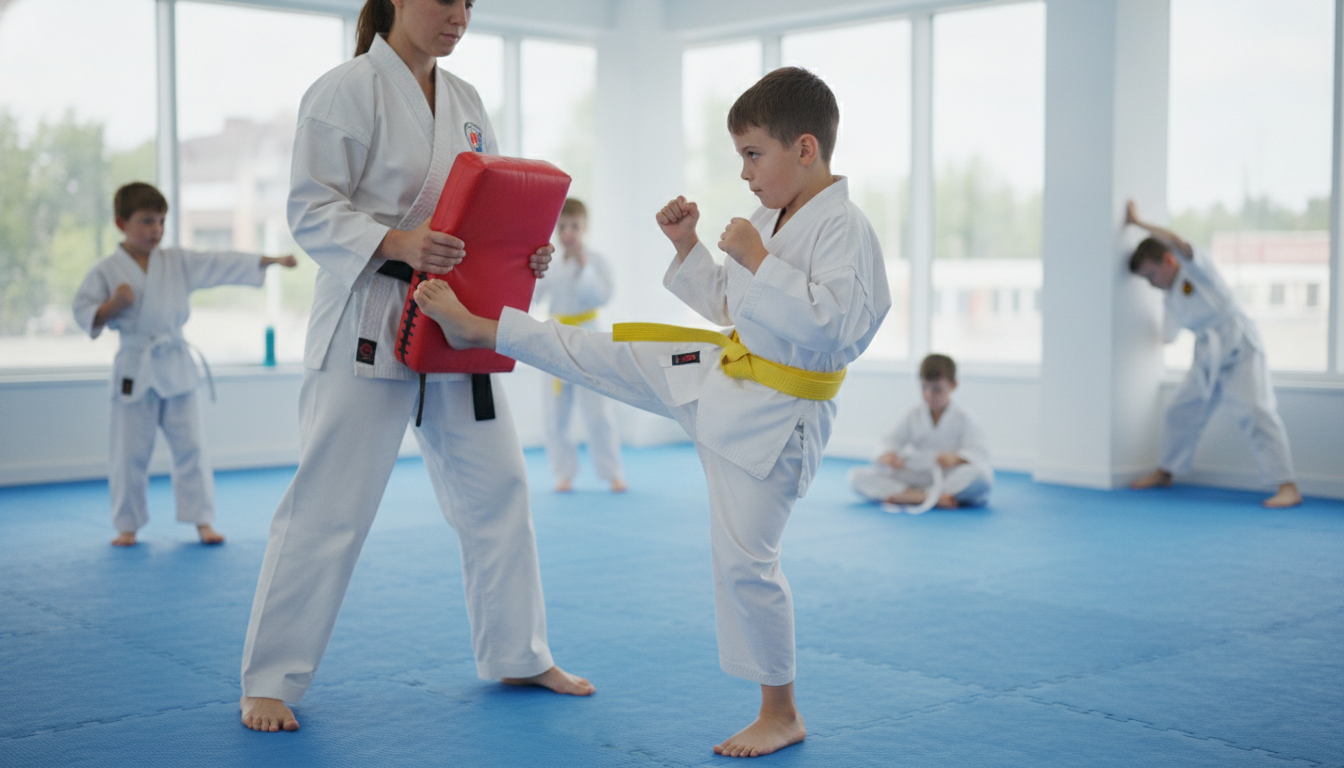
Martial arts work the whole body: kids squat into stances, pivot, kick, drop to the mat, and get back up dozens of times an hour.
Coordination, balance, and body awareness
A roundhouse kick means balancing on one leg while the other swings through a precise arc. Forms chain these movements into a sequence the child has to remember and control. A cluster randomized trial of 721 children aged 7 and 8 across five European countries swapped one year of regular PE for a karate program and measured better balance and cardiorespiratory fitness, plus a smaller trend toward better flexibility. For kids who feel clumsy in ball sports, this kind of body awareness often transfers to other activities.
Fitness, strength, and stronger bones
The CDC recommends that children aged 6 to 17 get 60 minutes of physical activity a day, including muscle- and bone-strengthening activity three days a week. A martial arts class covers both: bodyweight strength work, jumping, and impact from kicks and falls.
The bone evidence is newer. A study of 138 adolescents aged 11 to 14 found that those practicing judo had higher bone mineral density in their arms than non-practitioners, and different styles were linked to stronger bones in different body regions. Treat this as promising rather than proven, and note it mostly applies to older kids.
The cognitive benefits: focus and self-control
This is where martial arts has the best evidence of any benefit, and it is the one most parents are quietly hoping for.
In a randomized trial of 207 children from kindergarten to 5th grade, researchers assigned whole homeroom classes to either three months of school-based taekwondo or regular PE. The taekwondo group improved more on cognitive and emotional self-regulation, prosocial behavior, classroom conduct, and a mental math test. Boys gained the most on self-regulation and conduct.
A more recent University of Surrey trial tested the idea again. 240 children aged 7 to 11 took two 45-minute taekwondo classes a week for 11 weeks, while a control group took PE. Teachers rated the taekwondo group as more attentive with fewer conduct problems, and the children scored better on a computer test of executive attention. They also placed more value on self-control.
Much of a class is rehearsal in impulse control. Kids bow before they start, wait for the instructor's command, hold a stance while their legs burn, and stop a kick an inch from the target. Breath control and body awareness overlap with mindfulness practice, too.
The effect carries into school work, although it is modest. The 721-child karate trial found a small but real improvement in average grades compared with regular PE.
The social and emotional benefits
"Won't it make my kid more aggressive?" is one of the most common parent worries. The research points the other way. A meta-analysis of 12 studies covering 507 children and teens aged 6 to 18 found that martial arts training reduced aggression, anger, and other externalizing behavior. Classes that stress control and respect teach kids to treat force as a last resort.
Resilience looks promising for older kids. In a randomized trial of 283 secondary school students, a 10-session martial arts program raised resilience and self-efficacy scores, while the control group's scores fell over the same period.
Bullying is a mixed picture. An elementary school program called Gentle Warrior found that boys who attended more sessions reported less aggression and more helpful bystanding, stepping in to support bullied classmates, but there were no significant effects for girls. Martial arts is better seen as a way to build confidence and de-escalation skills than as a way to fight back.
The social side is simpler. Kids train with partners, bow to each other, and see the same faces every week. Progress is individual, so there is no benching or team selection, which suits children who struggle in team sports.
Confidence, discipline, and goal setting
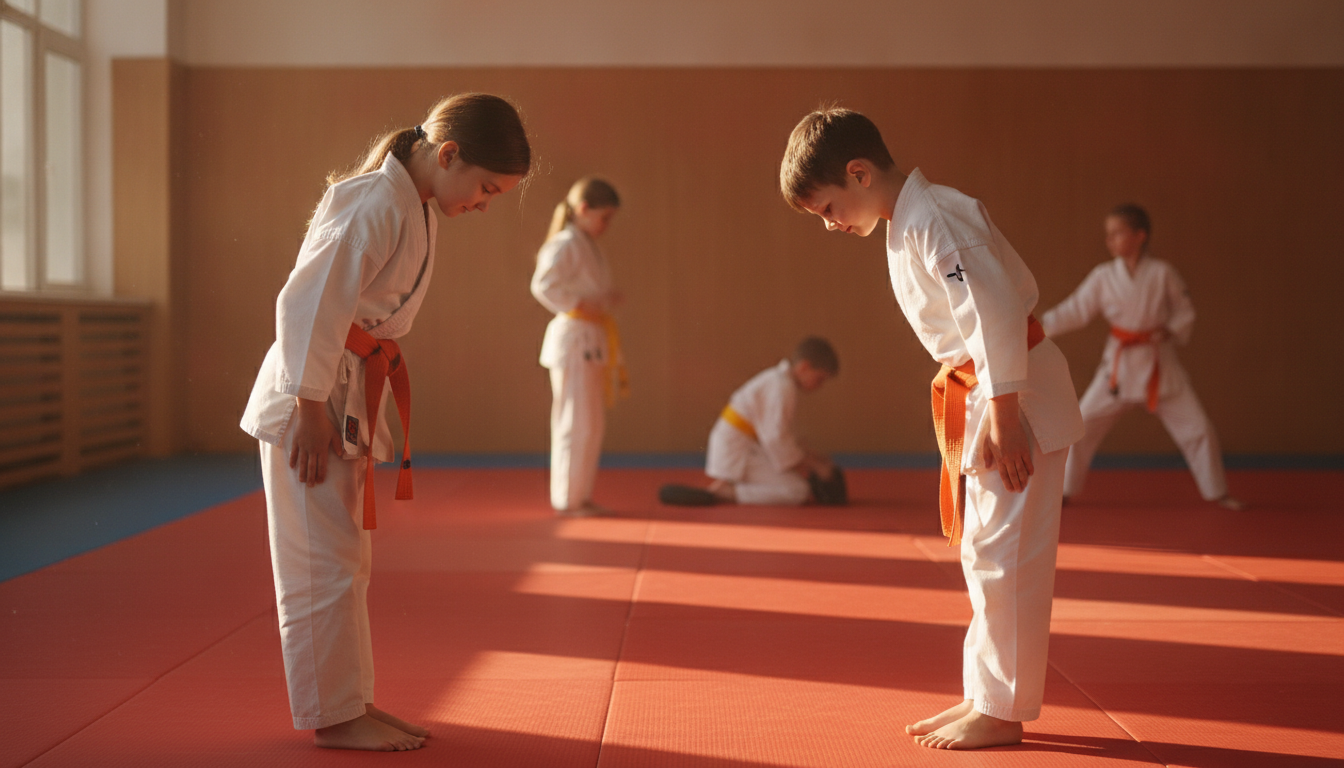
The belt system is the engine here. A child can see their progress on their waist, and stripes between belts add frequent, concrete wins. Each belt takes months, so kids learn to work toward something that doesn't arrive by next week.
Failure is built in too. Take a 7-year-old who can't break a practice board at a grading, practices for three weeks, and passes on the retest. That child has just learned, in a very physical way, that effort changes outcomes.
This benefit rests mainly on what instructors and parents report. The self-efficacy gains above support it indirectly, but no study has isolated the belt system itself.
What martial arts gives kids at each age
What a child gets from martial arts shifts as they grow. Here is what to expect at each stage.
| Age | What classes focus on | Main benefits | Typical class |
|---|---|---|---|
| 3-5 | Listening, taking turns, balance, simple kicks through games | Gross motor skills, following instructions, confidence in a group | 30 minutes, 1-2 times a week |
| 6-9 | First real technique, forms, belt testing | Self-control, attention, coordination, friendships | 45-60 minutes, twice a week |
| 10-13 | Harder forms, light controlled sparring in some styles, helping younger students | Strength, bone health, leadership, goal setting | 60 minutes, 2-3 times a week |
| Teens | Advanced technique, fitness, optional competition | Fitness, stress relief, resilience, self-defense confidence | 60-90 minutes, 2-3 times a week |
Preschool classes are really movement and listening classes in a uniform. Most children under 6 don't yet have the motor control for precise technique, so good programs teach through games. From about 6 to 9, kids are ready for the real curriculum, and this is the age the research covers best: the self-control trials above ran with children aged about 5 to 11. Instructors planning for these bands can find sessions split by age and belt in our martial arts lesson plans.
How soon will you see a difference? The trials measured changes after 11 weeks to three months, at about two classes a week. Commit to a full term before you judge it, not a single trial class.
Which martial art is best for kids?
Each style trains the same core habits in a different way. This table matches styles to goals.
| Style | Focus | Contact for kids | Best for |
|---|---|---|---|
| Karate | Strikes, blocks, forms (kata) | Low to moderate | A first martial art, discipline, focus |
| Taekwondo | Kicking, flexibility, speed | Low to moderate | Self-control (both self-control trials above used it), energetic kids |
| Judo | Throws, holds, falling safely | Grappling, no strikes | Strength, bone health, learning to fall |
| Brazilian jiu-jitsu | Ground grappling, positions, problem-solving | Grappling, no strikes | Kids who dislike striking, thinkers |
| Kung fu / wushu | Forms, acrobatics, flexibility | Low | Coordination, kids who like performing |
| Tai chi | Slow, flowing movement and breathing | None | Anxious kids, balance, a gentle start |
| Mixed martial arts (MMA) | Striking and grappling combined | High | Not recommended for young children |
The AAP says MMA should be generally discouraged for young participants. In grappling styles, check that the kids' program bans chokes and submissions for younger children.
In practice, the school and the instructor matter more than the style.
Kids with ADHD, autism, or who learn differently
Martial arts suits many neurodivergent children for practical reasons. Rules are clear, classes follow the same routine every week, skills are broken into small chunks, and each child moves at their own pace. There is also a lot of movement, which gives busy bodies somewhere to put their energy.
The research is encouraging but early. In the 2026 karate scoping review, 7 of the 13 studies involved clinical or special populations. Those studies reported less aggression and oppositional behavior in children with behavior problems and improvements in social and communication difficulties in autistic children. For ADHD, a 2026 network meta-analysis of 19 trials with 845 children found exercise improved executive function in children with ADHD. Mind-body training, a group that included taekwondo and judo, ranked among the more effective options for inhibitory control, behind coordination-heavy activities.
Treat martial arts as a helpful addition, not a treatment. Talk to your child's care team, look for a smaller class or an inclusive program, and ask for a trial lesson so your child can see the room before they commit.
Is martial arts safe for kids?
Yes, with the right setup. The best numbers come from US emergency department data from 2004 to 2021, analyzed by researchers at Nationwide Children's Hospital. An estimated 176,947 children aged 3 to 17 were treated for martial arts injuries over those 18 years. That works out to about 1.15 injuries per 10,000 children aged 3 to 11 each year, and 2.22 per 10,000 for ages 12 to 17. The most common injuries were strains and sprains (28.4%), and the most common cause was falling (26.9%).
Risk climbs with contact. The AAP's clinical report on youth participation and injury risk in martial arts says non-contact forms carry a lower relative risk, while sparring and competition carry more. Its guidance for parents and schools:
- Discourage blows to the head, and scoring systems that reward them.
- Avoid chokes and submission moves for young children.
- Hold off on contact and competition until a child is fully competent in non-contact technique.
- Teach defensive blocking properly.
Protective gear helps with some things and not others. Mouthguards reduce mouth and dental injuries, but no protective equipment has been shown to prevent concussions, so headgear is not a license for head contact.
How to choose a martial arts school
The trials that showed benefits used structured, well-run programs. Use this checklist when you visit:
- A free trial class. Your child gets to try it and you get to watch before signing anything.
- A low student-to-instructor ratio. Kids' classes should have assistants so every child gets corrected, not just the front row.
- Age-grouped classes. A separate class for 3- to 5-year-olds is a good sign the school understands child development.
- Checked, trained instructors. Ask about background checks, first aid, and a written safeguarding policy.
- Non-contact training for young kids. Sparring, if any, should come later, with gear, close supervision, and no head contact.
- Character built into class. Look for short talks on focus, respect, or effort, and instructors who praise effort as well as results.
- Clear pricing. Ask about the monthly fee, belt testing fees, uniform costs, and contract length. Be wary of long lock-in contracts.
- Easy admin. Online booking for trials, a clear timetable, simple payments, and regular updates on attendance and progress.
- A class you'd be happy to watch. Kids should be engaged and smiling, not waiting in lines or being pushed to fight.
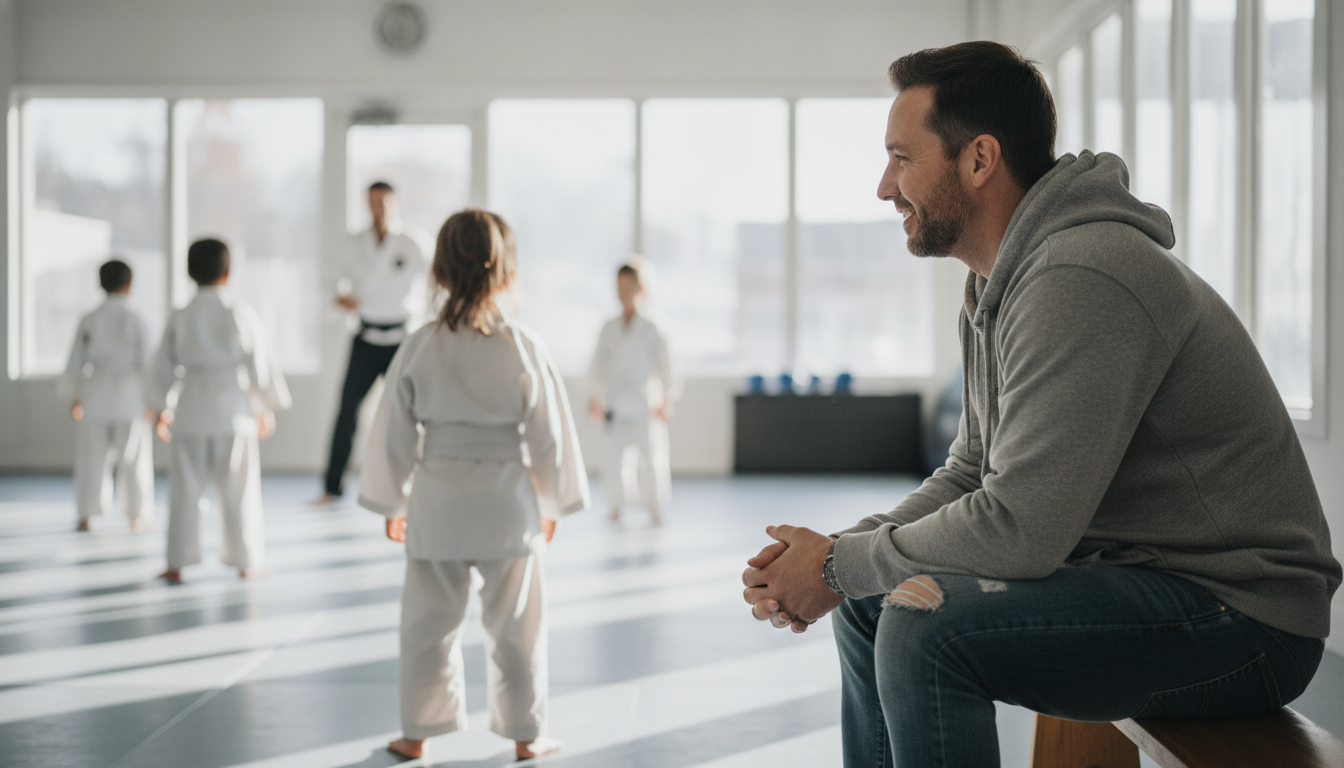
If you run a dojo, parents are checking for exactly these signs, and the admin is part of the first impression. A clear schedule, easy online trial bookings, and simple payments tell a parent the school is organized before they walk through the door. Our guides on how to start a martial arts school and how to promote a martial arts school cover the rest, and our upcoming piece on how to run a martial arts class goes deeper on the mat itself.
Key takeaways
- The best evidence is for self-control, attention, and classroom behavior, from school trials with children aged 5 to 11.
- The trials used about two classes a week for 11 weeks to three months, so give it at least a term.
- Martial arts reduces aggression rather than increasing it, according to a meta-analysis of 12 studies.
- Preschool classes build listening and motor skills; real technique starts around age 6.
- Injury rates are low for younger kids, and keeping them to non-contact training with no head blows keeps it that way.
- The school and instructor matter more than the style.
FAQs
What age should a child start martial arts?
Most schools take children from about 3 or 4 in preschool classes that focus on listening, balance, and simple movements through games. Around age 6, most kids have the motor control and attention for real technique and belt testing. Ages 6 to 9 are also the best-studied age group in the research.
What are the main benefits of martial arts for kids?
The benefits fall into four groups: physical (coordination, fitness, stronger bones), cognitive (focus and self-control), social and emotional (less aggression, more resilience), and confidence and character (goal setting through belts). The strongest research support is for self-control and classroom behavior.
Does martial arts make kids more aggressive?
No. A meta-analysis of 12 studies with 507 children and teens found martial arts training reduced aggression and anger. Good classes teach control, respect, and when not to use force. Avoid schools that push young kids into full-contact sparring.
Is martial arts good for kids with ADHD?
It can be a good fit. Clear rules, repetition, and plenty of movement suit many kids with ADHD, and research shows exercise can improve executive function skills such as impulse control in kids with ADHD. Treat it as an addition to your child's care, not a replacement for it.
How often should kids do martial arts?
Twice a week is a good target for school-age children. That is the dose used in the trials that found gains in self-control, typically 45 to 60 minutes per class. Preschoolers do well with one or two 30-minute classes a week.
How long before I see a difference in my child?
In the research, measurable changes showed up after 11 weeks to three months of about two classes a week. Some kids show more confidence sooner, but give it a full term before deciding whether it's working.
Which martial art is best for kids?
Karate and taekwondo are the most common first martial arts, and both self-control trials we cite used taekwondo. Judo and Brazilian jiu-jitsu suit kids who prefer grappling to striking, and tai chi suits anxious kids. The quality of the school matters more than the style.
Is martial arts safe for kids?
Yes, at the recreational level. US emergency department data shows about 1.15 injuries per 10,000 children aged 3 to 11 each year, mostly sprains and strains from falls. Keep young kids to non-contact training with no blows to the head and no chokes.
Will martial arts help my child deal with bullying?
It can help indirectly by building confidence, body language, and de-escalation skills. One school program reduced aggression and increased helpful bystanding in boys, though it showed no effect in girls. Look for a school that teaches avoiding fights rather than winning them.
Is martial arts good for shy kids?
Often, yes. Progress is individual, there's no team selection, and the same small group trains together every week, so a shy child can settle in. Belt tests add regular, visible wins.