


Most martial arts schools don't have a marketing problem. They have a leak between "interested" and "enrolled." Owners post on Instagram, print flyers and try a Facebook ad, then inquiries wait a day for a reply, booked trials don't show, and the families who do come get a follow-up call three days later. This guide shows you how to promote a martial arts school in the right order, so each new inquiry has a real chance of becoming a student.
To promote a martial arts school, get found locally first (Google Business Profile, reviews and a website with online trial booking), then turn your current students into referrers, get in front of families through schools and community events, and use short video and targeted ads to fill specific programs. Follow up every inquiry fast, because promotion only works if trials turn into members.
Here are the 12 tactics this guide covers:
- Set up and work your Google Business Profile
- Ask for reviews on a schedule
- Make your website book the trial
- Reply fast and book the trial in the first message
- Cut trial no-shows
- Run a referral program people actually use
- Host buddy days and belt promotion events
- Partner with schools, PTAs and after-school programs
- Show up at community events and team up with local businesses
- Post short videos of real classes
- Run local ads for one program at a time
- Email and text past trials and cold leads
We rank them by cost and speed below, then cover how to promote kids' and adult programs differently, a 12-month promotion calendar, what to stop doing, and a 90-day plan.
Start with the funnel, not the flyer
Every new member moves through the same five steps: they inquire, book a trial, attend the trial, join, and are still training three months later. Promotion fills the top of that funnel. Most of your students are lost further down.
Here's an illustrative month for a small school, using the same planning assumptions as our martial arts business plan example:
- 40 inquiries
- 25 book a trial class
- 20 attend the trial
- 10 join
- 8 are still training at 90 days
These are planning assumptions, not industry benchmarks. Swap in your own numbers after a couple of months. The point is where the drops happen: 15 people asked and never booked, 5 booked and didn't show, and 10 tried a class and walked away.
Before you spend another dollar on ads, find your leakiest step:
- Few inquiries: a visibility problem. Work on tactics 1 to 3 and 8 to 10.
- Inquiries but few bookings: slow replies, no online booking or an unclear price (tactics 3 and 4).
- Bookings but no-shows: missing reminders and pre-trial contact (tactic 5).
- Attended but didn't join: the trial experience and the join conversation need work.
- Joined but gone by month three: onboarding and retention (see "Keep the students you win" below).
Doubling your ad spend with a leak at step three just pays for more people to leave.
12 ways to promote a martial arts school, ranked
We ranked each tactic by what it costs, how fast it usually brings in a first student, how much weekly time it takes, and who it reaches best. The time and effort figures are our estimates for a small school with one or two instructors, not measured benchmarks. Ad budgets are typical starting points, not targets.
The "Priority" column is the order we'd do them in. Everything marked "Do first" is free or close to it and fixes the top and middle of the funnel. Paid ads come last on purpose: they amplify whatever you already have, including the leaks.
| Tactic | Cost | Time to first students | Weekly effort | Best for | Priority |
|---|---|---|---|---|---|
| 1. Google Business Profile | Free | 2 to 6 weeks | 1 hr | Kids and adults | Do first |
| 2. Reviews on a schedule | Free | 2 to 6 weeks | 15 min | Everyone | Do first |
| 3. Website with online trial booking | Low | 1 to 4 weeks | Setup, then low | Everyone | Do first |
| 4. Fast replies that book the trial | Free | Immediate | Daily | Everyone | Do first |
| 5. Cut trial no-shows | Free | Immediate | Setup once | Everyone | Do first |
| 6. Referral program | Low (rewards) | 2 to 4 weeks | 1 hr | Everyone | Do next |
| 7. Buddy days and belt events | Free | One event | 3 to 5 hrs per event | Kids and teens | Do next |
| 8. School and PTA partnerships | Free to low | 1 to 2 months | 2 to 4 hrs | Kids (via parents) | Do next |
| 9. Community events and local businesses | Low | 1 to 2 months | 1 hr, plus events | Families | Do next |
| 10. Short videos of real classes | Free (your time) | 1 to 3 months | 2 to 3 hrs | Adults, teens, parents | Do next |
| 11. Local Meta and Google ads | $10 to $40 a day | Days to 2 weeks | 1 to 2 hrs | Parents, adults, high-intent searchers | Add when 1 to 5 work |
| 12. Email and text to past trials | Free to low | Immediate | 1 hr | Warm leads | Do next |
If you only have a few hours a week, pick three from the top of the table and do them well for a month before adding more.
Get found locally first
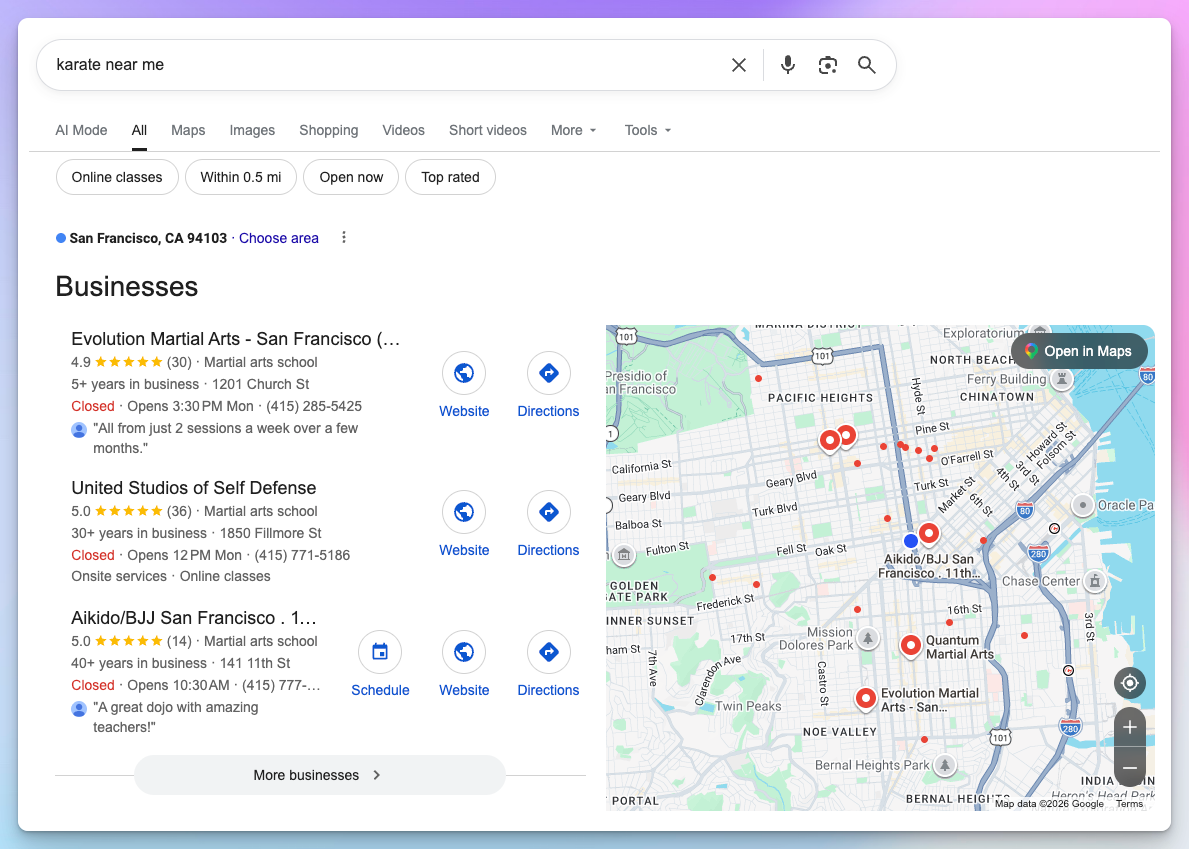
When a parent or adult decides to try martial arts, they usually search "karate near me" or "BJJ [town]," look at the map results and read reviews. If you aren't there, the rest of your promotion is working uphill.
1. Set up and work your Google Business Profile
Claim your Google Business Profile as soon as you have a location students can visit. It's free and it's what appears in the map pack for local searches.
Get the basics right:
- Categories: pick "Martial arts school" as the primary category, then add secondaries that match what you teach, such as karate school, kickboxing school or self-defense school.
- Photos: real classes, your mat, the entrance and the parking lot. Update them every few months.
- Hours and schedule: accurate hours, plus your class schedule in the description or posts.
- Booking link: point the "Book" or website button straight at your trial booking page, not your homepage.
- Posts: one a week is enough. A belt promotion, a new intro course date, a holiday closure.
A complete, active profile matters more every year. The BrightLocal Local Consumer Review Survey 2026 found that 45% of consumers now use ChatGPT and other AI tools for local recommendations, up from 6% the year before, and those tools lean on the same profile details and reviews that Google shows.
2. Ask for reviews on a schedule
Reviews decide whether a searcher clicks you or the school down the road. According to the same BrightLocal survey, 97% of consumers read reviews for local businesses, 68% will only use a business with four or more stars, and 31% now want 4.5 stars or higher.
Recency counts too: 74% look for reviews written in the last three months. So a burst of 30 reviews in your first month, followed by silence, loses its value quickly. Ask steadily instead, at moments when families and students feel good about you:
- Right after a belt promotion or grading
- After a new student's first month
- After a tournament, seminar or great event
Keep a QR code at the front desk that opens your review form, and send the link by text after gradings. Don't offer rewards in exchange for reviews. Google's review policies prohibit it, and the FTC's rule on fake reviews bans rewards tied to positive ones.
Reply to every review, good or bad. BrightLocal found 80% of consumers are likely to use a business that responds to all its reviews, and 42% are unlikely to use one that never replies.
3. Make your website book the trial
Your website has one job: get a visitor to book a trial class. It needs:
- Your class schedule and prices (or at least "from $X a month")
- Location, parking and drop-off details
- Real photos of classes, not stock images
- Instructor bios with rank, lineage and background checks for anyone teaching kids
- A "Book a trial class" button above the fold that opens a booking form, not a contact form
Give kids' and adult programs their own pages or sections, each naming your town ("kids karate in Plano," "beginner BJJ in Plano"). That's how you show up for the specific searches parents and adults type. Our SEO guide for activity providers covers the on-page basics.
Use the booking form to collect age, experience level, health notes and parental consent, so the trial class isn't spent on paperwork at the door. With our martial arts software, your booking page has its own link you can put on your website, Instagram bio, Google profile and printed QR codes, and the registration form collects all of this before anyone arrives.
Turn inquiries into trial students
This is where most schools lose people they already paid to attract. The next two tactics cost nothing and often do more for enrollment than any new channel.
4. Reply fast and book the trial in the first message
A parent comparing three schools on a Tuesday evening will book with whoever replies first with a clear next step. Research on online leads backs this up. A study published in Harvard Business Review found companies that tried to contact a lead within an hour were nearly seven times as likely to qualify that lead as those that waited even an hour longer. It studied B2B sales, but the principle carries over to a family choosing a class the same evening they started looking.
Aim to reply within the hour during opening times, and make the first reply do three things: answer the question, offer two specific trial slots, and include a booking link. For example:
Hi Sarah, thanks for reaching out! Yes, our Little Dragons class is for ages 5 to 7 and there's no experience needed. We have trial spots this Thursday at 4:30 pm or Saturday at 9:00 am. You can book either one here: [link]. Wear comfy clothes and bring a water bottle. See you on the mat!
For messages that come in after hours, set up an auto-reply on your website chat, Instagram and Facebook with the booking link and a note that you'll follow up in the morning. Some will book from the link before you're awake.
5. Cut trial no-shows
Owners commonly report that a large share of booked trials, sometimes close to half, never show up. You can win most of those back with a few automatic messages:
- Confirmation right away: date, time, what to wear, where to park, when to arrive and who will greet them.
- Reminder the day before and again two hours before.
- A short personal note from the instructor: "Looking forward to meeting Leo on Thursday." A name makes it harder to skip.
- Ask parents to arrive 10 minutes early, so the child isn't walking into a class that's already started.
Consider your intro offer too. A free trial gets more bookings, while a paid intro course (commonly $29 to $99 for two to four weeks) gets fewer bookings but better attendance, because people show up for what they've paid for. We cover the tradeoff in our guide on how to start a martial arts school.
In Pembee, every trial booking sends a confirmation email automatically, and you can sell intro courses alongside monthly memberships, so a trial student can move straight onto a plan.
Make your current students your best promoters
Your students already know people who would train with you. Most of them just need a reason, a moment and something to hand over.
6. Run a referral program people actually use
A referral program works when it's simple and rewards both sides. A common structure:
- The referrer gets a free month, a gear credit or a new rash guard.
- The new student gets a free uniform or their first week free.
- Pay out when the new student joins, not when they book a trial. That keeps the program focused on real members and stops it becoming a free class giveaway.
Give students something physical to pass on: a few buddy pass cards each, with a QR code to your booking page. A card in a parent's wallet gets handed over at a birthday party. A line in a newsletter gets forgotten.
Timing matters. Remind students about referrals right after a belt promotion, when they're proud and talking about it, and ahead of your busy seasons (see the calendar below).
Add a "How did you hear about us?" question to your booking form, with the option to name a friend. It tells you who to reward and which students are your best ambassadors, and it feeds the tracking table in the 90-day plan.
7. Host buddy days and belt promotion events
Once a quarter, run a buddy week where every student brings a friend to a normal class. Plan a lesson that's fun for complete beginners: partner games, pad work and a short self-defense drill. Our list of martial arts drills for kids has ideas that work with mixed experience levels.
Turn belt promotions into events families want to invite people to. Hold them on a Saturday, invite grandparents and friends, give each student a moment in front of the room, and keep trial booking QR codes on a table by the door. Every guest who watches a child earn a new belt is a potential new family.
Get written parental consent before posting any photos or video of children from these events.
Keep the students you win
Promotion and retention are the same problem. It's a common rule of thumb in fitness that keeping a member is far cheaper than finding a new one, and the math backs it up. In the retention example from our business plan guide, cutting monthly churn by one percentage point raises a school's long-run size by 50 members without an extra dollar of advertising.
The riskiest period is the first 90 days. Check in personally at day 7, day 30 and day 90, and give every new student a first stripe or belt goal they can reach within about eight weeks. Well-run classes do the rest; our guide on how to run a martial arts class covers structure and pacing.
Get in front of local families and adults
Once your local presence and follow-up are working, it's time to reach people who don't know you exist yet.
8. Partner with schools, PTAs and after-school programs
Local elementary and middle schools put you in front of hundreds of families at once. Ways in:
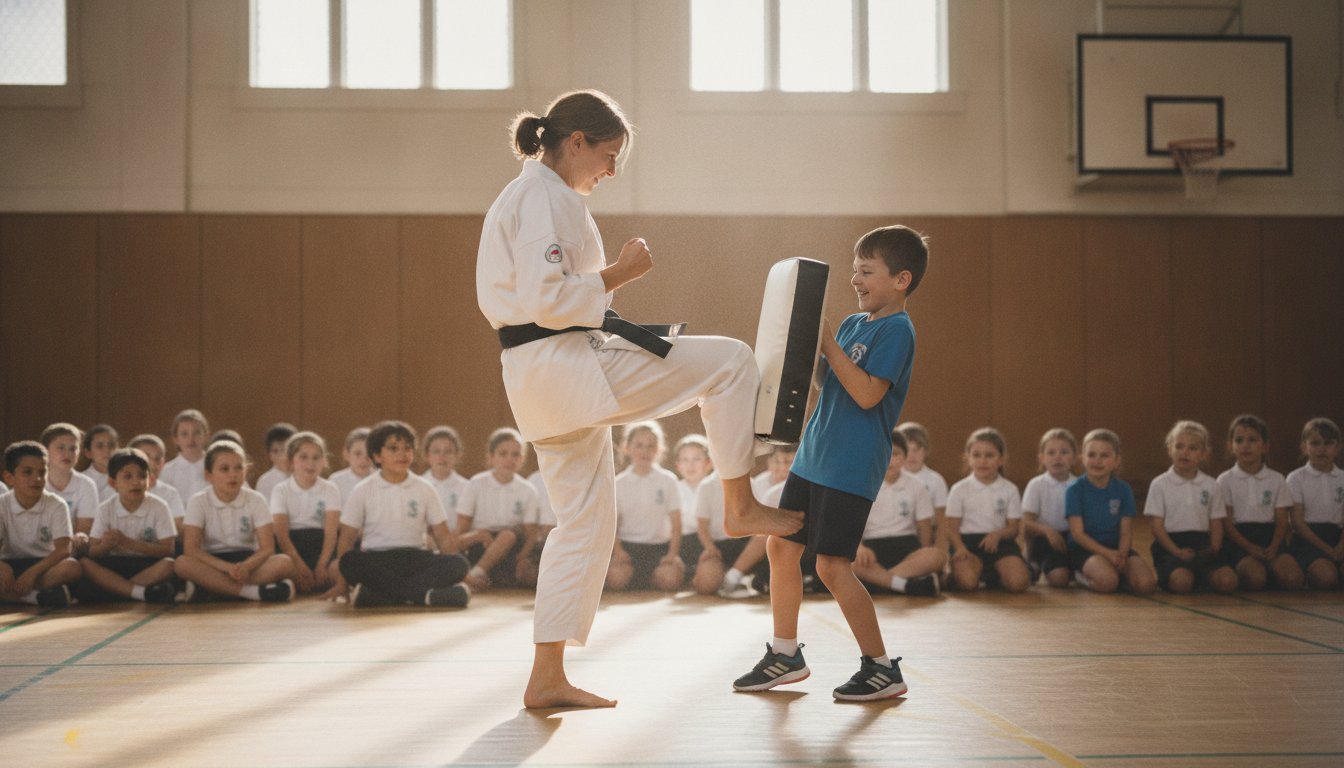
- Demos at school assemblies, PE classes and field days
- Anti-bullying or stranger-safety talks for students and parents
- Ads or short articles in PTA newsletters
- An after-school program with pick-up from nearby schools, or an on-site club
Owners in martial arts business forums regularly say a single school demo brings in more visits than any amount of flyers or posters. Kids go home excited, and the parent sees your name twice in one day.
Always bring a clear offer with a deadline ("free uniform with any intro course booked by Friday") and a QR code to your booking page. Handouts on the benefits of martial arts for kids, such as confidence, focus and fitness, give parents something useful to keep.
9. Show up at community events and team up with local businesses
Take a booth at county fairs, farmers markets, Fourth of July events and fall festivals, or run a Halloween trunk-or-treat at your school. Better still, offer a free one-hour self-defense workshop at the library, rec center or a local employer's lunch-and-learn. People who've already thrown a strike with you are much easier to book than people who took a flyer.
Cross-promote with businesses that serve the same families: pediatric dentists, kids' shoe stores, physical therapists, and yoga or CrossFit studios that don't teach martial arts. Swap flyers, run a joint offer or share each other's posts.
At every event, collect emails and phone numbers with a small giveaway, then follow up within 48 hours (see tactic 12). A stack of sign-up sheets that nobody contacts until next month is wasted.
10. Post short videos of real classes
Short video is where many adults and teens discover a school, and where parents check that you're safe and friendly. Post 20 to 45 second clips of:
- A real drill or partner game
- A beginner's first class, start to finish
- Belt promotions and student milestones
- Quick technique tips from an instructor
- "What a kids' class looks like" for nervous parents
Real beats polished. A phone on a tripod in the corner of the mat is plenty. Three or four posts a week is a common target, but consistency matters more than volume; two a week for a year beats ten a week for a month.
Speak to one audience per video. A clip for adults should answer "am I too unfit to start?" A clip for parents should show a patient instructor and happy kids. Get written parental consent before posting any child, and don't tag the exact location on kids' content. For more on channels and posting habits, see our guide to social media marketing for activity providers.
Paid ads and follow-up that fill specific programs
Paid ads work best once the free tactics above are in place, because the traffic lands on a profile with good reviews, a booking page and fast replies.
11. Run local ads for one program at a time
Meta ads (Facebook and Instagram). Target a 5 to 10 mile radius and advertise one program with one offer. "Kids' BJJ in Round Rock, first week free" beats "martial arts for everyone." Use a real class video as the creative. A typical starting budget is $10 to $30 a day.
Google Search ads. Bid on searches such as "[style] classes near me" and "kids karate [town]," and send clicks to the matching program page with booking, not your homepage. Starting budgets of $15 to $40 a day are common.
Judge ads on cost per booked trial and cost per new member, not clicks or likes. If an ad brings cheap inquiries that never book, it's either the wrong audience or your follow-up is leaking. Our guide to measuring marketing campaign effectiveness explains how to track this.
For the overall budget, a common rule of thumb is that established schools spend around 5% to 10% of revenue on marketing, and new schools often plan for 10% to 20% in the first year. Our business plan example uses $800 a month once open.
12. Email and text past trials and cold leads
Trial students who didn't join are your cheapest future members. They already know your school, your instructors and your mat. Set up a short sequence:
- Day 1: thank you for coming, plus a join offer with a deadline
- Day 4: a short story from a student or parent who started the same way
- Day 7: a reminder that the offer ends soon
- After that: a monthly update and seasonal offers
Re-invite everyone on the list before your peak months, especially back to school and January. Get written consent before sending marketing texts, since the federal Telephone Consumer Protection Act (TCPA) requires it. Our guide to email marketing for activity providers covers list building and what to send.
In Pembee, you can email everyone booked in a class, term or location in one click.
Promoting kids' programs vs adult programs
Most marketing advice treats martial arts students as one audience. They're two. With kids' programs you're selling to the parent. With adult programs you're selling to the person who'll be on the mat, and they're often nervous about it.
| Kids' programs (selling to parents) | Adult programs | |
|---|---|---|
| What they care about | Safety, confidence, focus, anti-bullying, schedule fit, instructor background checks | Fitness, stress relief, self-defense, community, "am I too old or unfit?" |
| Where to reach them | School partnerships, PTA newsletters, parent Facebook groups, birthday parties, Google search | Short-form video, Google search, Meta ads, workplaces, gyms without martial arts |
| Offer that works | Intro course with a uniform, sibling discount, after-school pick-up | Beginner-only intro series, first week free, flexible class packs |
| Proof they want | Reviews from parents, background checks, safety policies | Reviews from beginners, videos of beginner classes |
Parents buy outcomes and trust. Lead with what changes for the child (confidence, focus, a safe outlet for energy) and prove you're safe: background-checked instructors, clear policies, reviews from other parents. Schedule fit is often the deciding factor, so show class times that work around school pick-up.
Adults buy relief from the fear of not fitting in. Many adults want to try BJJ, Muay Thai or kickboxing but worry they'll be the least fit person in the room. Beginner-only classes, videos of real beginners and messaging like "no experience or fitness level needed" answer that fear directly.
Family classes bridge the two. A parent who trains alongside their child is less likely to quit, and they often bring a friend's family along too.
A 12-month martial arts promotion calendar
Enrollment follows the school year and the New Year. Plan campaigns six to eight weeks before each peak, so ads, emails and events are ready when families start looking. These are common patterns, not fixed rules; check your own enrollment data after your first year and adjust.
| Month | What's happening | Promotion to run |
|---|---|---|
| January | New Year fitness goals | Adult and teen intro course, New Year ads, email past trials |
| February to March | Winter routines settle | Buddy week, spring belt promotion events, review push |
| April to May | Families plan summer | Summer camp pre-sales, school field days and demos |
| June to July | Kids are out of school | Summer camps and day camps, summer intro courses |
| August to September | Back to school, the biggest kids' window | School partnerships, after-school pick-up, back-to-school ads |
| October | National Bullying Prevention Month, Halloween | Anti-bullying workshops, Halloween events, trunk-or-treat |
| November | Before the holidays | Bring-a-friend week, gift certificate pre-sales |
| December | Gift season, quiet classes | Intro course gift packs, plan and schedule January campaign |
A few notes on the big windows:
- August and September is when parents lock in the year's activities. Have your school partnerships, demos and after-school program ready by early August, not mid-September.
- January is your adult peak. Run a beginner-only intro course that starts the first or second week of the month, and promote it from mid-December.
- Summer is the churn risk, as families travel and routines break. Camps keep kids connected to the school; if you run them, camp registration software handles weekly sign-ups and payments.
- October is National Bullying Prevention Month, led by PACER's National Bullying Prevention Center. It's a natural reason to offer schools and libraries a free anti-bullying or confidence workshop.
What usually doesn't work
Owners who've been through it tend to agree on the list below. None of these channels are useless, but they usually fail for the same reason: no specific offer and no follow-up.
- Flyers and door hangers with no offer, deadline or QR code. A logo and a phone number rarely gets a call. If you print, give people a reason to act this week and a way to book from their phone.
- Direct mail and shopping-cart or shopping-center ads. Owners in martial arts forums report poor returns for the cost. Spend the same money on a school demo or a month of targeted ads.
- A Facebook page as your only online presence. Good for keeping current families updated, weak for being found by new ones. You still need a Google profile and a website.
- "First month free for everyone." Deep discounts attract people who leave when the discount ends, and they train your market to wait for the next deal.
- Boosting posts with no targeting or offer. The boost button reaches people outside your area who were never going to drive to class.
- Running ads while inquiries sit unanswered for a day. You're paying to send people to the school that replies faster.
Your first 90 days of promotion
Here's how we'd sequence the 12 tactics for a school starting from scratch, or one that's been relying on word of mouth.
Weeks 1 to 2: fix the foundations
- Complete your Google Business Profile with photos, hours, categories and a booking link
- Put online trial booking live on your website, with a "How did you hear about us?" question
- Write your reply templates for calls, texts, email and social messages
- Set up confirmation and reminder messages for trial bookings
Weeks 3 to 4: activate your students
- Ask current students and families for reviews, and set a regular trigger (after each grading)
- Launch your referral program and hand out buddy pass cards
- Film your first 8 to 12 short videos of real classes
Month 2: get into the community
- Run your first buddy day or open house
- Pitch demos or talks to three local schools or PTAs
- Set up two cross-promotions with local businesses
- Start the email sequence to past trial students
Month 3: test paid and measure
- Run your first paid ad test for one program, with $300 to $600 for the month
- Review your funnel numbers by source
- Double down on the best source and cut the worst
Track every source in a simple table like this, updated monthly:
| Source | Inquiries | Trials booked | Attended | Joined | Cost | Cost per member |
|---|---|---|---|---|---|---|
| Referrals | 8 | 7 | 6 | 4 | $120 (rewards) | $30 |
| Google profile | 14 | 9 | 7 | 3 | $0 | $0 |
| Meta ads | 18 | 9 | 7 | 3 | $450 | $150 |
The figures above are an example to show how the table works, not benchmarks. What matters is comparing your own sources: in this example, referrals convert far better than ads, so they deserve more attention before the ad budget goes up.
We built Pembee so the systems behind this plan run in one place: online trial booking, automatic booking confirmations, intro courses and memberships side by side, family accounts, and one-click emails to a class. Add a "How did you hear about us?" question to your registration form to see where each student came from, and there's a 30-day free trial with no card required. You can compare options in our roundup of the best martial arts software.
Key takeaways
- Fix the funnel before buying more traffic. Most students are lost between inquiry and joining, not at the top.
- Start with the free tactics: Google Business Profile, steady reviews, online trial booking, fast replies and reminders.
- Reply within the hour and book the trial in your first message.
- Turn current students into promoters with a two-sided referral reward paid on joining, buddy days and public belt promotions.
- Market kids' programs to parents (safety, confidence, schedule) and adult programs to the adult (beginner-friendly, no fitness needed).
- Plan campaigns around back to school and January, six to eight weeks ahead.
- Run ads for one program at a time, and judge them on cost per new member.
- Track every source monthly, then double down on what works.
FAQs
How much should a martial arts school spend on marketing?
A common rule of thumb is 5% to 10% of revenue for established schools, and new schools often plan for 10% to 20% in their first year while they build referrals and reviews. Our business plan example budgets $800 a month once the school is open. Spend the first chunk on free foundations and follow-up before paid ads.
What is the best way to get new martial arts students?
For most schools, the best sources are referrals from current students, a strong Google Business Profile with recent reviews, and fast follow-up on every inquiry. Referrals convert well because the new student already trusts someone who trains with you. Fast replies make sure the people who find you actually book.
Should I offer a free trial class or a paid intro course?
A free trial brings in more bookings, while a paid intro course (commonly $29 to $99 for two to four weeks) brings fewer bookings but better attendance and commitment. Many schools run a free first class for kids and a paid beginner course for adults. Test both and compare how many members each produces three months later.
How do I promote a martial arts school with no budget?
Start with the free tactics at the top of our ranking table: set up your Google Business Profile, ask for reviews regularly, add online trial booking to your website, and reply to every inquiry within the hour. Then add a referral program, buddy days, school demos and short videos filmed on your phone. None of these need an ad budget, only time.
How long does it take to see results from martial arts marketing?
Paid ads can bring inquiries within days. A Google Business Profile and new reviews usually start producing calls within two to six weeks, referrals often bring students within a few weeks, and community events within one to two months. Website SEO and social video take longer, typically three months or more of steady effort.
How do I get more kids to sign up for martial arts?
Reach parents where they already are: school demos, PTA newsletters, after-school programs, birthday parties and parent Facebook groups. Talk about confidence, focus and safety, show that your instructors are background-checked, and time your biggest push for August and September. An intro course that includes a uniform gives parents a clear, low-risk first step.
How do I attract adults to a martial arts school?
Adults respond to short videos of real beginner classes, Google search ads and messaging that answers "am I too unfit to start?" Run beginner-only classes or intro series so nobody has to step onto the mat with experienced students on day one. January is the best time to launch an adult intro course.
Do flyers work for martial arts schools?
Flyers on their own rarely bring many students. They work better when they carry a specific offer, a deadline and a QR code that opens your booking page, and when they go home with kids after a school demo rather than into mailboxes. Track them with the "How did you hear about us?" question to see whether they're worth reprinting.
How do I stop trial class no-shows?
Send a confirmation straight away with what to wear, where to park and when to arrive, then reminders the day before and two hours before. A short personal note from the instructor makes a no-show less likely. A paid intro course also improves attendance, because people show up for what they've paid for.
How can I get more Google reviews for my martial arts school?
Ask at moments when students feel proud, such as after a belt promotion or at the end of their first month, and make it easy with a QR code at the front desk and a link sent by text. Ask steadily rather than in one burst, because most people look for reviews from the last three months. Don't offer rewards for reviews, and reply to every one you receive.