


It's the 4:30 kids' class. Fifteen 6- to 9-year-olds, one instructor, and a plan that says "kicks." Ten minutes of waiting in lines later, half the class is rolling on the mat. Kids stay focused when every drill has one job, one clear cue, and a short timer, and that's what the martial arts drills for kids below are built to do.
The best martial arts drills for kids teach one real skill through movement or a game: stance and footwork, punching, kicking, blocking, falling, or reaction. Keep each drill to 3 to 7 minutes, use soft targets, avoid head contact, and give every drill an easier and a harder version so every belt in the room stays busy.
Inside: 30 drills in six skill groups, age bands from 3 to 12, a drill picker table, safety rules, fixes for big classes, and a 10-minute set for home. We build booking and attendance software for martial arts schools, so this is written for instructors running real classes.
What makes a good martial arts drill for kids
Every drill in this post passes four tests. Use them to judge any drill you pick up from a seminar, a video, or another instructor.
- It teaches a real technique or attribute. A game that only burns energy belongs in the warm-up, not the core of class. Pick games that teach a technique rather than replace it.
- Everyone is moving. If more than a third of the class is standing and waiting, change the format. The big-class section below shows how.
- It has one cue. Kids can hold one correction at a time. Pick the cue that fixes the biggest problem and save the rest for next week.
- It's short. Aim for 3 to 4 minutes per block for ages 3-5 and 5 to 7 minutes for ages 6-12, then change the activity.
It also helps to separate drills from games. Drills build the pattern: the chamber, the stance, the breakfall. Games test that pattern under pressure, with a partner, a timer, or a moving target. A good class uses both.
Instructors argue about "silly games" on martial arts forums, and both sides have a point. Our position: games are fine when the technique is the scoring rule. "Only clean kicks count" turns a relay from a sprint into practice. If you want to see where drills sit inside a full class, our martial arts lesson plans break down warm-up, technique, apply, and cool-down blocks by age and belt.
The same drills (minus a few of the games) also work as warm-ups for teen and adult beginner classes, so you can reuse most of this list across your timetable.
Safety rules before you start
Martial arts are safe for most kids when the drills are age-appropriate, but they're not risk-free. The American Academy of Pediatrics clinical report Youth Participation and Injury Risk in Martial Arts (Pediatrics, December 2016) puts injury rates at 41 to 133 per 1,000 athletic exposures, depending on the style. Most of those injuries are bruises and sprains. The more serious ones happen mostly in free sparring and competition.
The AAP's advice for instructors is clear. Kids should be competent at noncontact technique before they move to contact, and they should show physical and emotional maturity before they compete. Blows to the head should be avoided. Soft helmets and face guards haven't been shown to prevent concussion and can give a false sense of safety. The CDC's HEADS UP concussion guidance adds that a child with multiple concussions has a greater chance of chronic health problems later on, so keeping heads out of drills matters beyond the day of class.
Every drill below follows these rules:
- Soft objects only for reaction games: pool noodles, foam balls, balloons, and kick shields.
- No head targets. Pads sit at chest height or below in every drill in this post.
- Pair by size and age. A simple rule works: similar height, similar belt.
- Breakfalls before throws. No throw or takedown game until the class can fall safely.
- Space. Leave roughly an arm and a leg's length between kids, and keep walls and mat edges clear.
- Control first, speed later. Racing makes technique sloppy. If form drops, slow the game down.
- A stop word everyone knows. "Freeze!" or "Matte!" stops every drill instantly.
If you're a parent reading this and weighing whether martial arts is right for your child, our guide to the benefits of martial arts for kids covers the physical and social side.
Martial arts drills by skill area
Six skill groups, five drills each. Every drill lists its age band (3-5 for little ones, 6-8, and 9-12) and the equipment it needs, then what it builds, the cue to use, the mistake to watch for, and a harder version. Most drills flex up or down a band with the "Harder" line, and they work for karate, taekwondo, kickboxing, judo, and jiu-jitsu classes alike.
Stance and footwork drills
1. Stance switch (ages 3-12, no equipment) The instructor calls "ready," "fighting stance," or "horse stance," and kids snap into it and freeze. Builds: stance recall and balance. Cue: "Feet wide like a table." Watch for: feet in a single line, which leaves no base. Harder: call stances while kids are moving, and add a technique after each one.
2. Mirror footwork (ages 6-12, no equipment) Pairs face each other. The leader steps forward, back, and sideways, and the follower keeps the same distance. Builds: distance control and footwork. Cue: "Keep your partner one kick away." Watch for: crossing the feet when stepping sideways. Harder: the leader adds a slow feint that the follower must block.
3. Line ladder (ages 6-12, tape or an agility ladder) Kids move through the ladder with in-in-out-out steps, staying in stance with hands up. Builds: foot speed and coordination. Cue: "Light feet, hands home." Watch for: hands dropping as the feet get faster. Harder: finish the ladder with a three-punch combination on a pad.
4. Stepping stones (ages 3-5, colored spots or small mats) Kids hop from spot to spot and land in stance on each one. Builds: balance and controlled landings. Cue: "Land quiet." Watch for: landing on straight legs with a thud. Harder: call a color, and kids have to find the right spot before they land.
5. Tails (ages 6-12, a belt or cloth strip per kid) Each kid tucks a "tail" into the back of their belt. They protect their own tail and try to take others using stance and footwork only, with no grabbing of clothing. Builds: movement, angles, and awareness. Cue: "Turn your body, not your back." Watch for: kids running flat out and colliding. Harder: you must be in fighting stance to steal a tail.
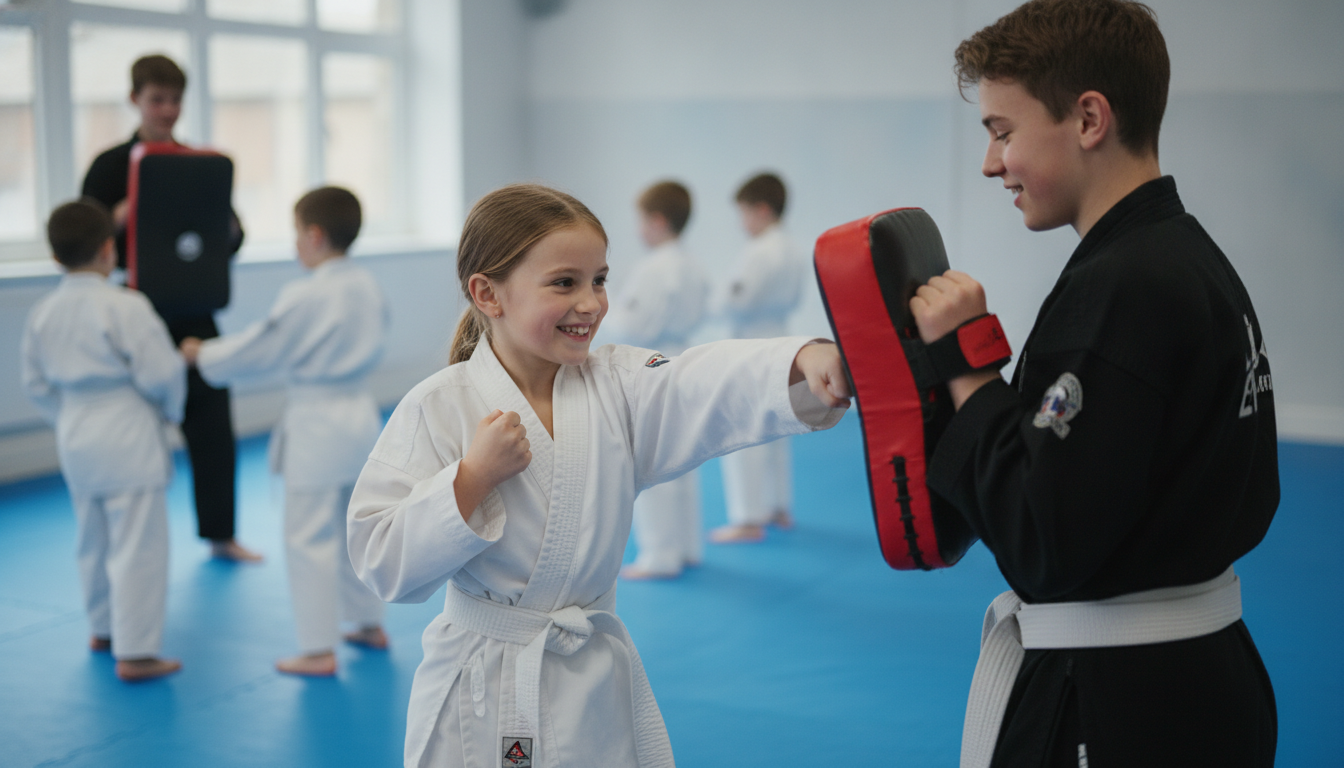
Punching drills
6. Balloon punch (ages 3-8, a balloon per group) Kids keep a balloon in the air using punches only, then lead hand only, then rear hand only. Builds: hand-eye coordination and chambering. Cue: "Punch and bring it home." Watch for: swinging arms instead of straight punches. Harder: count how many punches in a row before the balloon touches the floor.
7. Number call combos (ages 6-12, pads optional) Assign numbers to techniques: 1 is a jab, 2 is a cross, 3 is a hook, and so on. The instructor calls sequences ("1-2," "1-1-2") and speeds up as the class settles. Builds: combinations and listening. Cue: "Other hand guards your face." Watch for: the non-punching hand dropping. Harder: add blocks and kicks to the number system.
8. Pad-color reaction (ages 6-12, two different-colored focus mitts) The holder flashes a red or a blue mitt, and the kid strikes the matching pad with the correct hand. Builds: reaction time and decision-making. Cue: "See it, then hit it." Watch for: guessing early and punching the wrong pad. Harder: flash both mitts for a double strike, or show a mitt for a fraction of a second.
9. Partner palm taps (ages 6-12, no equipment) One partner holds their palms up at chest height. The other throws 10 fast, controlled punches that just touch the palms, then they switch. Builds: speed with control. Cue: "Snap, don't push." Watch for: full-power punches that knock the palms back. Harder: the holder moves their palms between punches.
10. Punch relay (ages 6-12, a kick shield or bag per team) Teams race to the pad, throw five clean punches, and run back to tag the next teammate. A sloppy punch means one more. Builds: technique under pressure. Cue: "Clean beats fast." Watch for: arm-only punches when kids rush. Harder: switch to a two-punch combination that must be thrown five times.
Kicking drills
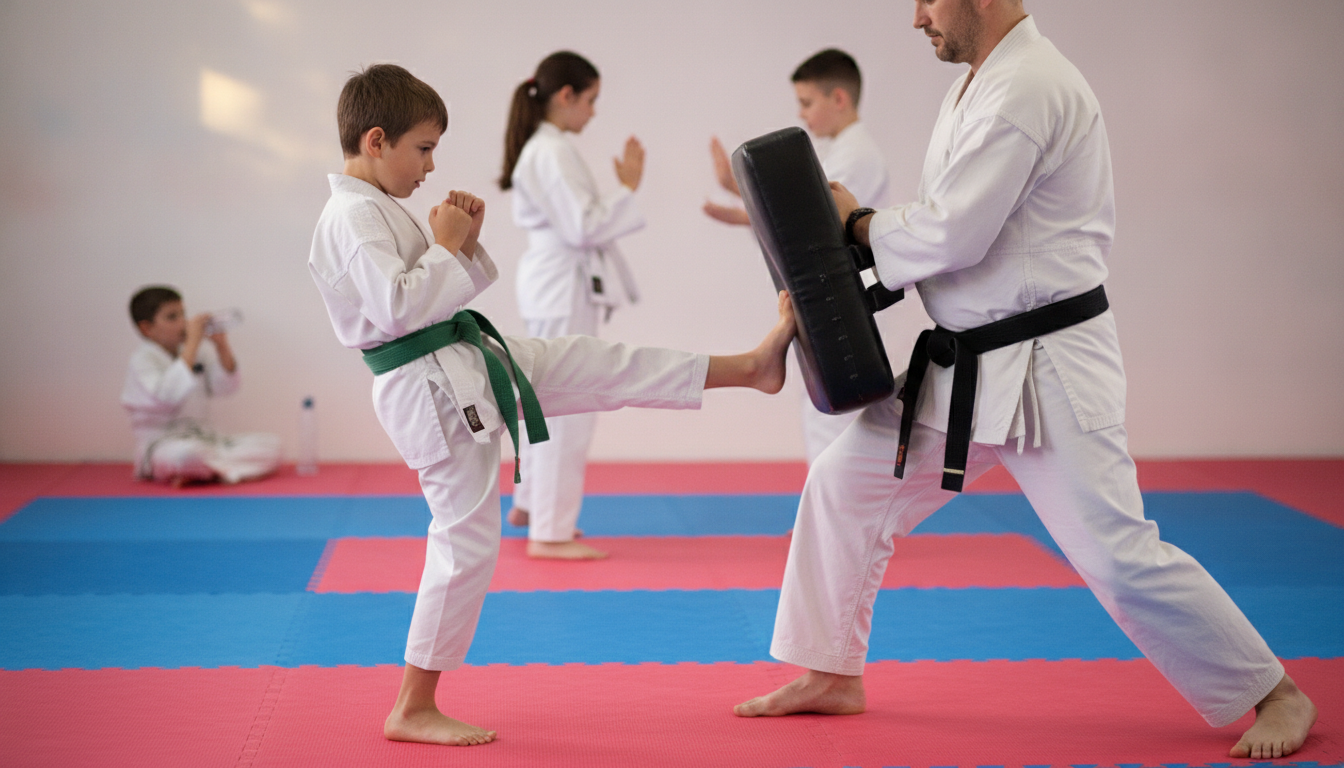
11. Knee first, then foot (ages 3-12, a wall or sturdy chair for balance) This is a three-step front kick. Kids chamber the knee and hold for three seconds, extend the kick, re-chamber, and place the foot down. Builds: chamber, balance, and kicking mechanics. Cue: "Knee points at the target." Watch for: kicking straight up from the floor with no chamber. Harder: take away the wall and hold the chamber for five seconds.
12. Drop and kick (ages 6-12, a foam ball or other soft object) The instructor drops a soft object from chest height, and the kid kicks it before it hits the floor. The rest of the class stands well back. Builds: timing and reaction. Cue: "Watch the ball, not my hand." Watch for: wild, off-balance kicks. Harder: drop from a lower height so the window is shorter.
13. Kick the noodle (ages 3-8, a pool noodle) The instructor holds a noodle at knee or waist height and moves it around. Kids kick it with the foot the instructor calls. Builds: accuracy and target tracking. Cue: "Look, then kick." Watch for: kids using the same leg every time. Harder: call the kick type as well as the leg (front, round, side).
14. Shield push kicks (ages 6-12, a kick shield) One partner braces behind the shield. The kicker's push kick should move them back one step. Builds: hip drive and power. Cue: "Push with your hips." Watch for: leaning back and kicking with the leg alone. Harder: the holder takes a step forward after each kick, so the kicker has to reset their distance.
15. Kick countdown (ages 9-12, pads) Kids throw 10 kicks, then 9, then 8, and so on down to 1, alternating legs. The instructor checks form at each round. Builds: endurance with control. Cue: "Every kick looks like the first one." Watch for: chambers shrinking as legs get tired. Harder: change the kick type on each round.
Blocking and evasion drills
16. Over and under (ages 3-12, a pool noodle) Kids stand in a circle. The instructor swings a noodle slowly, high for a duck call or low for a jump call. Keep duck swings at or below shoulder height and jump swings below the knee. Builds: evasion and quick decisions. Cue: "Eyes on the noodle." Watch for: kids ducking with their eyes closed. Harder: mix the two calls faster, or swing without calling.
17. Block call-out (ages 6-12, no equipment or a foam noodle) The instructor calls "high," "middle," or "low" and slowly taps toward that line with a noodle, and kids block. Builds: blocking technique and reaction. Cue: "Block, then look." Watch for: blocks that stop short of the body line. Harder: drop the call and use only the visual cue.
18. Mat sharks (ages 3-8, mats as "islands") Kids move between mat islands while the instructor plays the shark. When the shark tags a kid, they have to perform the block or dodge the instructor calls before moving again. Builds: blocking under light pressure. Cue: "Strong arms, strong stance." Watch for: floppy blocks as kids rush to escape. Harder: remove an island every round.
19. Slip the noodle (ages 9-12, a pool noodle) A partner pushes the noodle slowly toward shoulder height, and the kid slips to the side or steps offline. Builds: evasion without head contact. Cue: "Move your feet, not just your head." Watch for: leaning back instead of stepping off the line. Harder: add a counter punch to the pad after each slip.
20. Wrist-grab escape (ages 6-12, no equipment) A partner holds the kid's wrist. The kid rotates toward the thumb, pulls away, steps back into stance, and says "Stop!" in a loud voice. Builds: basic self-defense and a confident voice. Cue: "Turn to the thumb." Watch for: pulling straight back against the grip. Harder: the partner grabs with two hands, and the kid uses their free hand to help.
Falling, rolling, and ground movement drills
21. Back breakfall from sitting (ages 6-12, mats) Kids sit, tuck the chin, roll back, and slap the mat with both arms at about 45 degrees from the body. Builds: safe falling. Cue: "Chin to chest, arms slap." Watch for: the head touching the mat and elbows landing first. Harder: start from a squat, then from standing.
22. Log and forward rolls (ages 3-8, mats) Little ones log roll across the mat with arms overhead. Older kids progress to forward rolls. Builds: body awareness and comfort on the ground. Cue: "Roll like a pencil." Watch for: the head taking weight on a forward roll. Harder: forward roll straight up into a fighting stance.
23. Shrimp race (ages 6-12, mats) Kids hip escape ("shrimp") down the mat as a team relay. Builds: the core movement for escaping on the ground. Cue: "Push with your foot, hips go back." Watch for: sliding on the back without turning to the side. Harder: shrimp both directions on the way down and back.
24. Technical standup (ages 6-12, mats) From sitting, kids post one hand behind them, keep the other up as a guard, lift the hips, and swing the leg back to stand in stance. Builds: getting up safely. Cue: "Hand down, hand up, then stand." Watch for: standing up by rolling forward onto both hands. Harder: a partner stands in front holding a pad, and the kid has to keep their guard on the pad the whole way up.
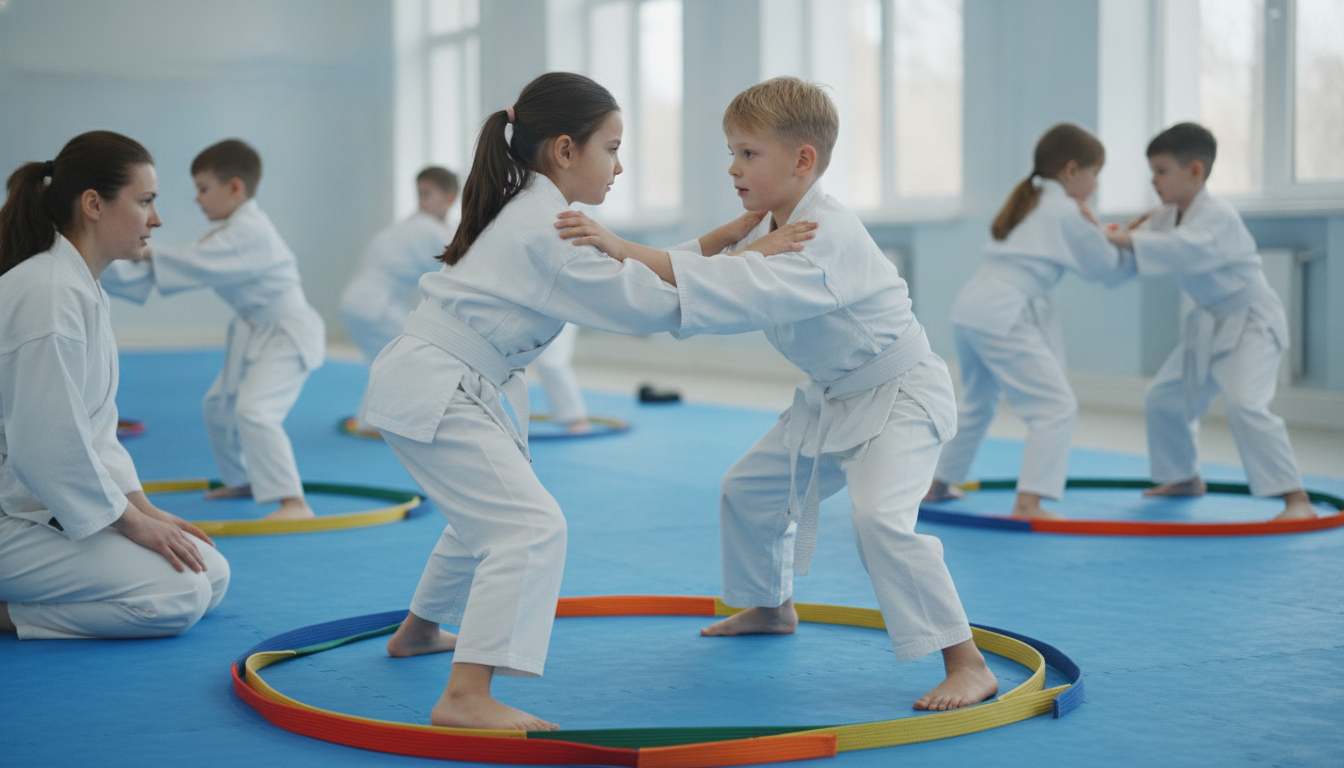
25. Sumo push (ages 6-12, belts laid out as a circle) Partners put their palms on each other's shoulders and try to push their partner out of the circle. No grabbing and no head contact. Pair by size. Builds: base, balance, and posture. Cue: "Low hips win." Watch for: leaning so far forward that kids fall when their partner steps aside. Harder: both partners must stay in a low stance throughout.
Reaction, focus, and memory games
26. Instructor says (ages 3-12, no equipment) This is the martial arts version of Simon Says. Commands come from the current syllabus, and kids only move when the command starts with "Instructor says." Builds: listening and technique recall. Cue: "Wait for the words." Watch for: half-effort techniques when kids focus only on not getting caught. Harder: call techniques by their names in your style's language, so kids learn the terminology.
27. Freeze ninja (ages 3-8, no equipment) Kids sneak up on the instructor, who has their back turned. When the instructor spins around, everyone freezes in stance. Anyone wobbling goes back to the start line. Builds: control and stillness. Cue: "Freeze like a statue." Watch for: kids running instead of sneaking. Harder: the instructor calls a stance as they turn, and kids must freeze in that one.
28. Form tag (ages 6-12, no equipment) This is freeze tag with a twist. Tagged kids freeze, and they unfreeze by performing the first section of their form. Builds: form memory under light pressure. Cue: "Clean form, then go." Watch for: rushed forms just to get back in the game. Harder: a frozen kid has to perform the section a partner calls.
29. Sequence builder (ages 6-12, no equipment) The instructor shows one move. The next student repeats it and adds one, and the class repeats the growing chain together. Builds: memory for forms and combinations. Cue: "Say it as you do it." Watch for: the sequence speeding up and losing its shape. Harder: perform the whole chain in reverse.
30. Technique obstacle course (ages 6-12, cones, hoops, kick shields, and a noodle) Kids hop through hoops in stance, throw three kicks at a shield, crawl under a noodle, and finish with a stance freeze. Builds: combining skills into one flow. Cue: "Every station done right." Watch for: skipped techniques at the shield. Harder: add a punch combination at a second pad. For ages 3-5, cut the course to three stations.
Drill picker: which drills for which age
Age matters more than belt when you choose drills for kids. Here's how the three bands differ in practice:
- Ages 3-5: 3 to 4 minute blocks, one cue, lots of imagery (animals, islands, statues), and no partner contact beyond a tag. Attention spans are shortest at this age, so plan more activities than you think you'll need.
- Ages 6-8: ready for partner drills, simple number systems, and relays with form rules.
- Ages 9-12: can hold 5 to 7 minute blocks, longer sequences, and light partner resistance, and they want to know why a technique works.
Use this table to pick drills by skill, age, equipment, and the class format they suit.
| Drill | Skill | Ages | Equipment | Best for |
|---|---|---|---|---|
| Stance switch | Stance | 3-12 | None | Big class, at home |
| Mirror footwork | Footwork | 6-12 | None | Big class, at home |
| Line ladder | Footwork | 6-12 | Tape or ladder | Small class, stations |
| Stepping stones | Balance | 3-5 | Spots or small mats | Small class |
| Tails | Movement | 6-12 | Belt or strip each | Big class |
| Balloon punch | Punching | 3-8 | Balloon | Small class, at home |
| Number call combos | Punching | 6-12 | Pads optional | Big class |
| Pad-color reaction | Reaction | 6-12 | Two colored mitts | Small class, stations |
| Partner palm taps | Punching | 6-12 | None | Big class |
| Punch relay | Punching | 6-12 | Shield or bag | Big class |
| Knee first, then foot | Kicking | 3-12 | Wall or chair | Big class, at home |
| Drop and kick | Kicking | 6-12 | Foam ball | Small class |
| Kick the noodle | Kicking | 3-8 | Pool noodle | Small class |
| Shield push kicks | Kicking | 6-12 | Kick shield | Big class (pairs) |
| Kick countdown | Kicking | 9-12 | Pads | Small class, stations |
| Over and under | Evasion | 3-12 | Pool noodle | Small class |
| Block call-out | Blocking | 6-12 | None or noodle | Big class |
| Mat sharks | Blocking | 3-8 | Mats | Big class |
| Slip the noodle | Evasion | 9-12 | Pool noodle | Big class (pairs) |
| Wrist-grab escape | Self-defense | 6-12 | None | Big class (pairs) |
| Back breakfall | Falling | 6-12 | Mats | Big class |
| Log and forward rolls | Falling | 3-8 | Mats | Small class |
| Shrimp race | Ground movement | 6-12 | Mats | Big class |
| Technical standup | Ground movement | 6-12 | Mats | Big class |
| Sumo push | Base and balance | 6-12 | Belts for a circle | Big class (pairs) |
| Instructor says | Listening | 3-12 | None | Big class, at home |
| Freeze ninja | Control | 3-8 | None | Big class |
| Form tag | Forms | 6-12 | None | Big class |
| Sequence builder | Memory | 6-12 | None | Small class |
| Technique obstacle course | Combined skills | 6-12 | Cones, hoops, shields | Stations |
Making drills work with 20 kids and one instructor
Most drill lists assume a small class. Real kids' classes often have 15 to 25 students, one instructor, and a few pads. In a class that size, most lost minutes come from waiting in line, so the fix is structure, not better games.
- Lines of four, not lines of fifteen. Split the class into more, shorter lines. A kid in a line of four gets a turn every 30 seconds or so.
- Re-entry, not elimination. The kids knocked out first are usually the ones who need the practice most. Instead of sitting out, they do five kicks or a section of their form and jump back in.
- Stations. Set up three stations on a 3 to 4 minute rotation. You run the teaching station, and an assistant or senior student runs the other two.
- Pairs before pads. When you're short on equipment, partner drills like mirror footwork, palm taps, and wrist-grab escapes keep everyone working.
- Transitions under 30 seconds. Set up the next drill during the water break, not after it.
- Use senior students. Holding pads for a younger class is good leadership practice for teens, and it's often the first step on the path to becoming a martial arts instructor.
- Know your numbers before class. When families book online, you know the headcount and ages ahead of time and can pick drills to match. Our class rosters show who's booked, with the belt level collected at signup, so the plan fits the kids who actually turn up.
Moving everyone also pays off beyond technique. The CDC recommends that kids aged 6 to 17 get 60 minutes or more of moderate-to-vigorous activity each day, including muscle- and bone-strengthening activity at least 3 days a week. A class where kids spend half the time in line gives them a fraction of that.
For the wider picture of class management, from lining up to bowing out, see our guide on how to run a martial arts class.
A 45-minute kids' class built from these drills
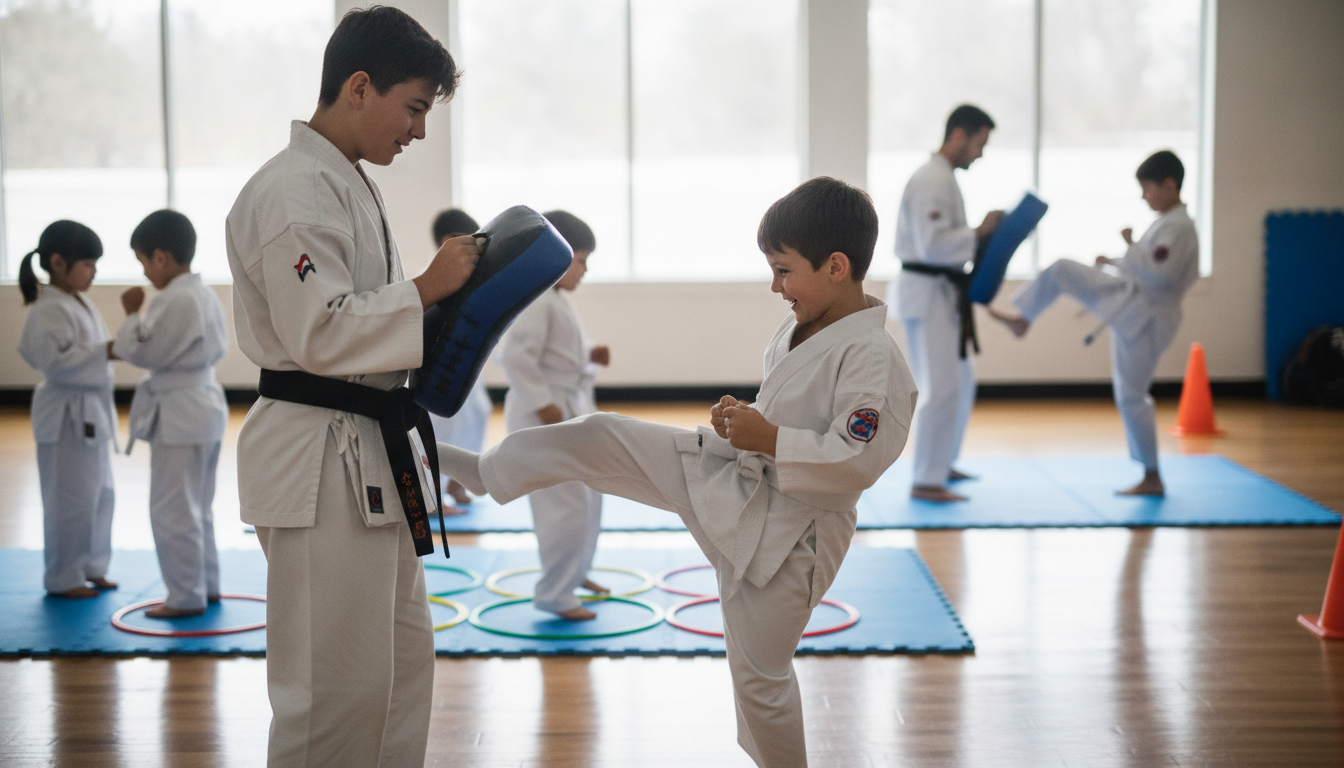
Here's how the drills above fit together in one class for ages 6-9. The technique focus is the front kick.
| Time | Block | Drill |
|---|---|---|
| 0-6 min | Warm-up | Stance switch, then animal walks across the mat |
| 6-12 min | Footwork | Mirror footwork |
| 12-22 min | Technique | Knee first, then foot (front kick) |
| 22-30 min | Apply | Kick the noodle, then shield push kicks |
| 30-38 min | Game | Punch relay run with front kicks: only clean kicks count |
| 38-43 min | Game | Form tag |
| 43-45 min | Close | Bow out, one sentence of feedback per group |
Notice the pattern: the technique is taught once, drilled on a moving target, tested on a static pad, and then pressure-tested in a game. Every block uses the same kick, so the class goes home having thrown a few hundred front kicks without anyone calling it repetition. For full plans by age and belt, including a mixed-rank class, use our lesson plan templates.
Martial arts drills kids can do at home
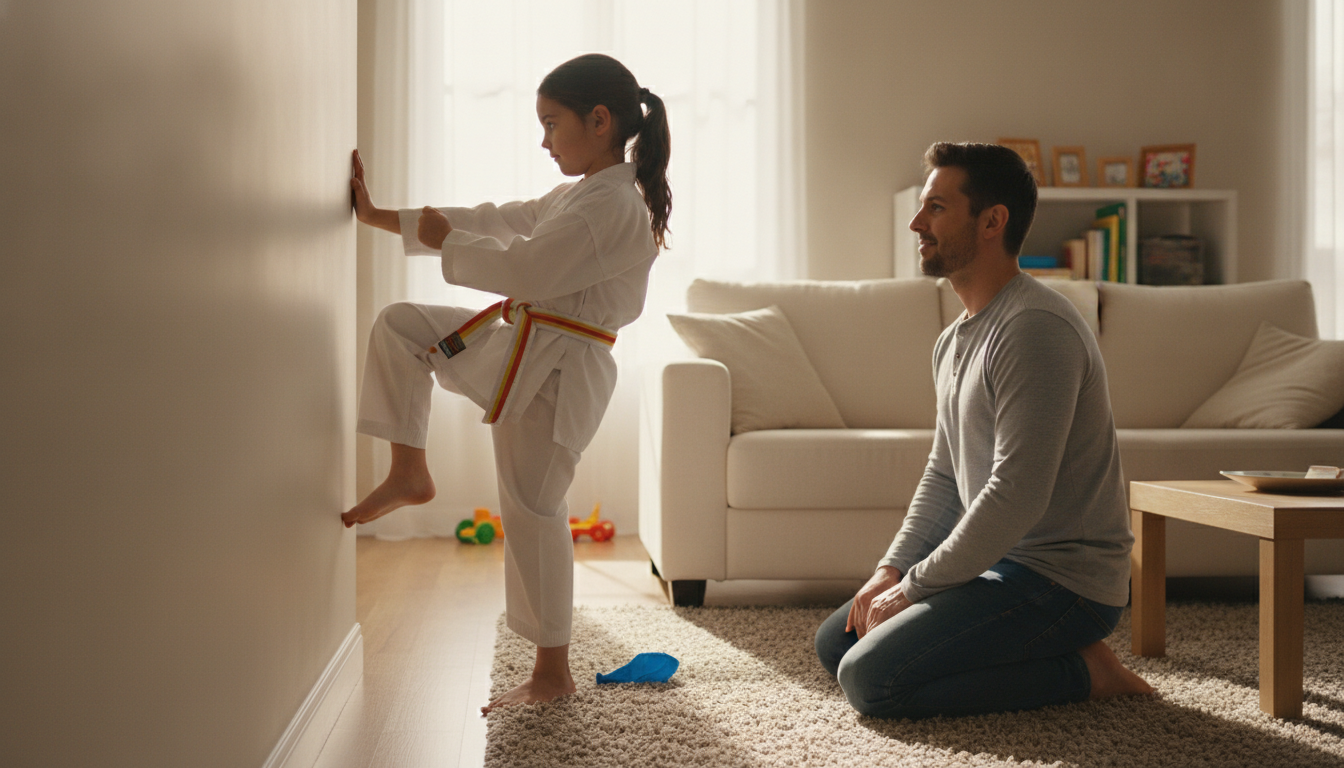
Parents often ask what their child can practice between classes, and schools can send this set home as weekly "dojo homework." It takes 10 minutes and needs no equipment beyond a wall and a balloon.
| Time | Drill | What to do |
|---|---|---|
| 2 min | Stance switch | A parent calls stances, and the child snaps into each and freezes |
| 2 min | Knee first, then foot | Five front kicks per leg with a hand on the wall, holding the chamber |
| 2 min | Balloon punch | Keep the balloon up with punches only |
| 2 min | Mirror game | Copy a parent's or sibling's steps at one kick's distance |
| 2 min | Form practice | The first section of their current form, slowly |
A few house rules keep it safe:
- Clear the floor space and move furniture back.
- No hitting people, including siblings who "volunteer."
- Take socks off on slippery floors.
- Agree on a stop word before you start.
Home drills help kids remember what they learned, but they don't replace an instructor's corrections. If a technique looks wrong at home, have your child ask about it at the next class rather than practicing the mistake all week.
Common mistakes instructors make with kids' drills
- Running a drill longer than kids can focus. Set a timer and change the activity before the energy drops, not after.
- Elimination games where the weakest kids sit out first. Use re-entry rules so everyone keeps practicing.
- Giving three corrections at once. Pick one cue per drill and hold the rest for next week.
- Racing before the technique is stable. Drill it slowly first, then add speed once most of the class has the shape.
- Games with no technique rule. Add a scoring rule like "only clean kicks count," or the game becomes recess.
- The same drills every week. Rotate two or three drills per skill group every few weeks to keep kids interested and fill gaps in their skills.
Key takeaways
- Give every drill one job, one cue, and a timer: 3 to 4 minutes for ages 3-5 and 5 to 7 minutes for ages 6-12.
- Use soft targets, keep pads below the head, pair kids by size, and teach breakfalls before any throw.
- Swap elimination for re-entry, and swap long lines for lines of four or stations.
- Give each drill an easier and a harder version so mixed belts can train side by side.
- Make the technique the scoring rule in games, so play is still practice.
Where to go next
Pick two or three drills from each skill group, match them to your age bands, and rotate them every few weeks. That's enough variety to keep kids interested without having to reinvent the class every week.
If you're building out your school, our guide on how to start a martial arts school covers the setup, and our tips on how to promote a martial arts school help fill the kids' classes these drills are for. When the admin starts eating into mat time, our roundup of the best martial arts software compares the options, and our martial arts software page shows how we handle bookings, attendance, and payments.
FAQs
What age can kids start martial arts drills?
Many schools start kids at 3 or 4 with movement and listening drills like stance switch, freeze ninja, and balloon punch. At that age the focus is balance, coordination, and following instructions. The AAP advises that contact and competition come later, once kids are competent at noncontact technique and show physical and emotional maturity.
How long should a kids' martial arts drill last?
Aim for 3 to 4 minutes per drill for ages 3-5 and 5 to 7 minutes for ages 6-12. Change the activity before focus drops rather than after. Longer drills work for older kids when they include built-in variety, like a kick countdown that changes the kick each round.
What are good martial arts games for kids?
Tails, instructor says, form tag, over and under, and mat sharks are reliable favorites. Each one works a real skill: footwork, listening, forms, evasion, and blocking. The best games make the technique the scoring rule, so kids are practicing while they play.
What equipment do you need for kids' martial arts drills?
A few kick shields, focus mitts, pool noodles, foam balls, cones, and a roll of tape cover most of the drills in this post. Mats are essential for any falling or ground work. Many drills, including stance switch, mirror footwork, palm taps, and form tag, need no equipment at all.
Are martial arts drills safe for kids?
Yes, when they're age-appropriate and well supervised. The AAP reports that most youth martial arts injuries are bruises and sprains, with more serious injuries mostly happening in free sparring and competition. Stick to soft targets, avoid head contact, pair kids by size, and teach noncontact technique before any contact.
How do you keep kids focused in a martial arts class?
Keep drills short, give one cue at a time, and use games that have a technique rule. Cut waiting time with lines of four, stations, and partner drills. A clear stop word and a quick transition between drills also stop focus from drifting.
Can kids practice martial arts drills at home?
Yes. A 10-minute routine of stance switch, wall-supported front kicks, balloon punch, a mirror game, and form practice works in most living rooms. Clear the space, agree on a stop word, and keep strikes on balloons and pads, never on people.
What drills work for both karate and jiu-jitsu kids?
Footwork drills, breakfalls, technical standups, tails, and sumo push suit both striking and grappling classes. Reaction games like instructor says and freeze ninja work in any style too. That makes them useful for schools that teach more than one art or run mixed-style kids' programs.
How do you teach a mixed-belt kids' class with the same drill?
Run the base version for newer students and give higher belts the "Harder" line from the same drill. In number call combos, for example, white belts throw punches while green belts add blocks and kicks. Everyone works on the same drill, and every rank gets something to push against.