


You have 40 minutes, 18 students, and a plan that says "kicks, forms, stretch." Ten minutes in, the white belts are lost, the brown belts are bored, and someone asks if you can play dodgeball again. Good martial arts lesson plans fix that before class starts.
A martial arts lesson plan has four blocks: warm-up, technique, apply, and cool-down. Each class carries one or two objectives tied to the belt syllabus, a time for every block, and a plan B. Most classes run 30 minutes for ages 3-5, 45 minutes for school-age kids, and 60 to 90 minutes for teens and adults.
Below you get the framework, a template you can print or copy, four sample plans by age (each one a one-page printable PDF), one plan for a mixed-rank class, and the part most plans skip: how weekly plans add up to a 12-week belt cycle.
What goes into a martial arts lesson plan
Start with the difference between a curriculum and a lesson plan. The curriculum (or syllabus) is everything a student learns from white belt to black belt. The lesson plan is one class's slice of it. Plans without a curriculum drift from week to week, and a curriculum without plans turns into whatever the instructor feels like teaching tonight.
Every plan below uses the same four blocks.
- Warm-up (about 13% of class). Raise the heart rate, move the joints through the ranges the class will use, and preview the day's technique where you can. A stance-change game before a footwork class does all three. Ten minutes of static stretching does none of them.
- Technique (about 30%). Introduce or refine one or two techniques. Demonstrate, break the move into parts, drill it in the air, then put it on pads or a partner.
- Apply (40-50%). Partner drills, one-steps or pre-arranged sparring, forms, self-defense scenarios, games, positional rounds, or light sparring. This is where students find out whether the technique works.
- Cool-down and close (10-15%). Stretch, recap the objective in one sentence, run a short character "mat chat" for kids, give announcements, and bow out.
Here is how those blocks divide across the four class lengths you are most likely to teach.
| Block | 30 min (ages 3-5) | 45 min (ages 6-12) | 60 min (teens, adults) | 90 min (adults, advanced) |
|---|---|---|---|---|
| Warm-up | 4 min | 6 min | 8 min | 12 min |
| Technique | 8 min | 14 min | 18 min | 25 min |
| Apply | 14 min | 19 min | 26 min | 43 min |
| Cool-down and close | 4 min | 6 min | 8 min | 10 min |
Inside those blocks, change the activity every 5 to 7 minutes for kids. Adults can hold a single drill for 10 to 12 minutes without switching off.
The rule that keeps plans honest is two objectives at most: one new, one review. Write each objective as something you can see. "Every yellow belt can throw a front kick with the knee chambered at belt height" is an objective. "Work on kicks" is not, because you can't tell at the end of class whether it happened.
A martial arts lesson plan template you can copy
Download it as a printable PDF to fill in by hand before class, or copy the text below into a doc, a notebook, or your planning app and reuse it every week. It works for any striking or grappling style.
MARTIAL ARTS LESSON PLAN Class: ____________ Age group: ____________ Date: ____________ Length: ____ min Ranks present: ____________ Cycle week: ____ of 12 Objective 1 (new): ________________________________________ Objective 2 (review): _____________________________________ Equipment: pads / shields / targets / cones / mats / other: ____________ BLOCKS Time | Activity | Focus | Coaching cue | Common error | Tiers (beginner / advanced) Warm-up (____ min): ______________________________________ Technique (____ min): ____________________________________ Apply (____ min): ________________________________________ Cool-down and close (____ min): ___________________________ Mat chat theme (kids): ___________________________________ Plan B (low numbers, flat energy, smaller space): ______________ AFTER CLASS Who struggled: __________________________________________ Who is close to grading: _________________________________ Repeat next week: _______________________________________
The after-class box is the one most instructors skip, and it matters most. Three lines written while the class is fresh make next week's plan a 10-minute job instead of a 40-minute one.
Sample plan 1: Little ninjas (ages 3-5, 30 minutes)
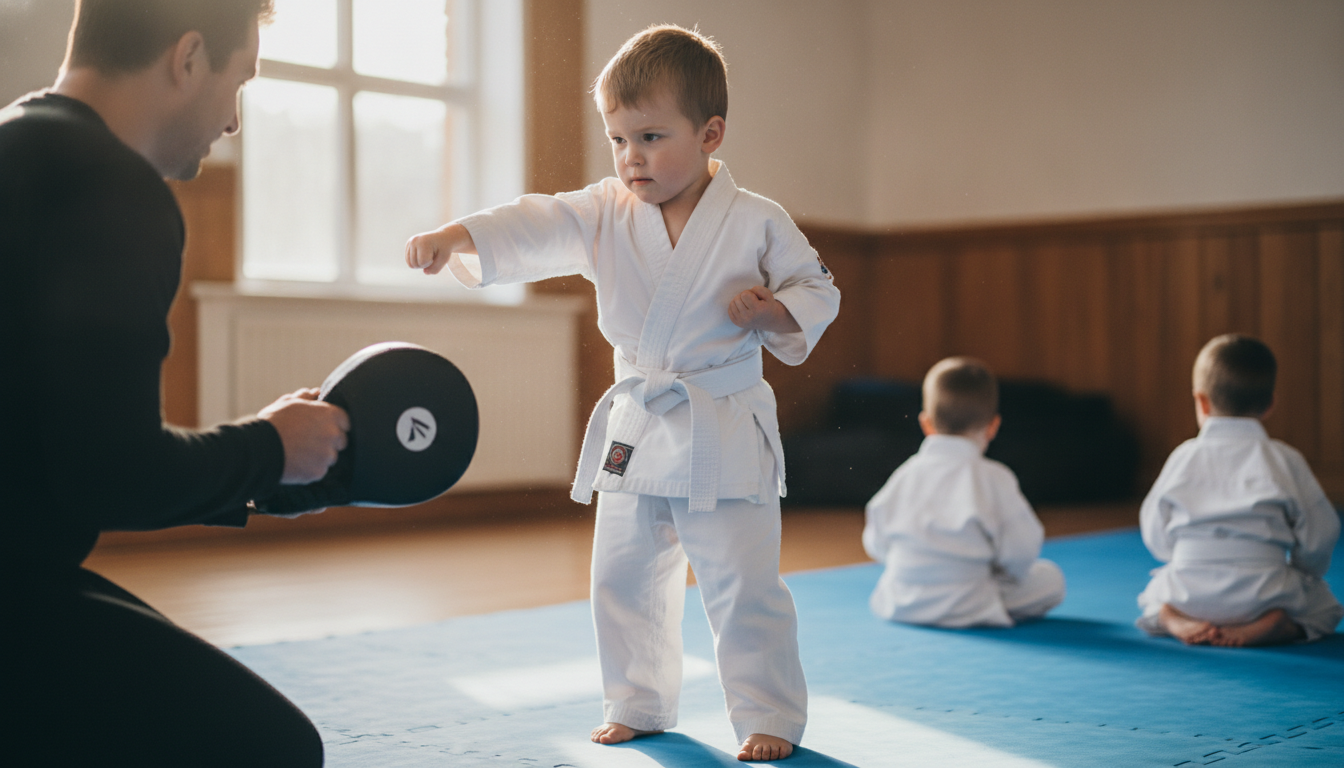
At this age, the plan teaches listening, balance, body control, and following instructions, with martial arts as the vehicle. Techniques stay simple and games do the teaching. Blocks last three to four minutes, and parents are often watching from the side, so the close matters as much as the content.
Objective: stand in a ready stance and throw a straight punch on command, then stop on the "freeze" signal.
Equipment: a hand pad with a sticker on it, 4-6 cones, one kick shield.
| Time | Activity | Coaching cue |
|---|---|---|
| 0-3 | Bow in, "focus eyes" check | "Eyes on me, hands on knees" |
| 3-7 | Animal walks: bear crawl, frog jump, crab walk | "Slow bear, bouncy frog" |
| 7-11 | Statues: freeze in ready stance when the instructor claps | "Feet wide, fists up, freeze" |
| 11-16 | Punch on the pad: both hands at the hip, punch, back to the hip | "Punch the sticker" |
| 16-20 | Obstacle line: step over a cone, jump a cone, punch the shield at the end | "Big step, big jump, strong punch" |
| 20-24 | "Instructor says" with stances and punches | "Only move when I say it" |
| 24-28 | Stretch in a circle, mat chat on listening | "What do our ears do in class?" |
| 28-30 | Sticker or stripe, bow out, high fives | "Show your parents your ready stance" |
Download the little ninjas plan as a printable PDF.
Use one-word cues and demonstrate everything, because three-year-olds copy what they see rather than what they hear. If the class is bigger than about eight children, bring in an assistant to run the obstacle line while you hold the pad. The freeze signal pays off far beyond this class: once they learn it, you can stop a room of 15 preschoolers in two seconds.
For more game ideas to rotate through this slot, see our martial arts drills for kids.
Sample plan 2: Kids beginners (ages 6-9, 45 minutes)
School-age beginners can handle a real technique breakdown, as long as each piece is short and the class keeps moving. This plan teaches one new kick and brings back a block from the previous two weeks.
Objective 1 (new): front kick with a chamber. Objective 2 (review): low block. Equipment: kick shields (one per pair), 4 cones.
| Time | Activity | Coaching cue | Common error |
|---|---|---|---|
| 0-3 | Bow in, line up by rank, focus check | "Feet together, eyes forward" | Chatting in line |
| 3-9 | Stance tag: tagged players freeze in horse stance until a teammate frees them | "Knees out, back tall" | Knees caving in |
| 9-15 | Basics in lines: low block, punches, knee raises | "Block starts at the opposite ear" | Short, arm-only block |
| 15-23 | Front kick in 3 parts: chamber, extend, re-chamber. Air first, then kick shield | "Knee up first, toes back" | Straight-leg swing from the hip |
| 23-24 | Water break | - | - |
| 24-31 | Call-out drill: holder calls "block" or "kick," partner responds | "Listen, then move" | Guessing before the call |
| 31-37 | Forms: first 8 moves of the first form (or the grading form for the rank) | "Look before you turn" | Turning without looking |
| 37-41 | Kick the shield relay: teams, only clean kicks count | "Chamber, then kick" | Rushing and skipping the chamber |
| 41-45 | Stretch, mat chat, stripes, bow out | "What does focus look like at school?" | - |
Download the kids beginners plan as a printable PDF.
The call-out drill at minute 24 is doing more than it looks like. It mixes the new kick with the old block, which is one of the simplest ways to build review into a class (more on why in the review section below). The relay rule, "only clean kicks count," turns a game into technique practice without anyone noticing.
Give the mat chat a monthly character theme, such as respect, focus, or perseverance, and return to it every week. Kids remember a theme they hear four times far better than four different themes, and parents notice when the word comes home with them. If you're making the case to families for why martial arts is worth the time, our post on the benefits of martial arts for kids covers the character side in more depth.
Sample plan 3: Tweens and teens (ages 10-14, 60 minutes)
This is the age where students want to know why a technique works, want more partner work and sparring, and want some ownership of the class. It's also where many drop out. Research from the Aspen Institute's Project Play and Utah State University found that the average child today spends less than three years playing a sport and quits by age 11. Longer partner blocks, controlled sparring, and letting older students lead parts of class are how you keep this group on the mat.
Objective 1 (new): counter a rear-hand punch with a block and roundhouse kick. Objective 2 (review): first half of the grading form at full speed. Equipment: focus mitts or kick pads (one per pair), a cone ladder, sparring gear.
| Time | Activity | Coaching cue | Common error |
|---|---|---|---|
| 0-8 | Student-led warm-up (a senior student runs it) | "Include hips and ankles" | Skipping mobility for push-ups only |
| 8-14 | Footwork: cone ladder, then partner mirror drill | "Stay on the balls of your feet" | Crossing the feet |
| 14-26 | Technique on pads: block the rear hand, then roundhouse to the body | "Pivot the base foot" | Flat base foot, knee takes the strain |
| 26-36 | One-step sparring: partner steps in with a punch, defender blocks and counters | "Block first, then counter" | Countering before the block lands |
| 36-46 | Forms in small groups, an older student leading each | "Full speed, full stances" | Stances shrinking at speed |
| 46-55 | Controlled sparring rounds: bonus point for the new counter | "Hands up after every kick" | Dropping the guard |
| 55-60 | Cool-down, one student recaps the objective in one line | "What did you use today?" | - |
Download the tweens and teens plan as a printable PDF.
The bonus-point rule in the sparring block is what ties the class together. Students who just drilled the counter now get a reason to try it against someone who is resisting, and the instructor gets a quick read on who can use it under pressure.
Grappling swap: in a BJJ or judo class, replace the one-step drill with a positional round from the day's position, such as escaping side control, with a reset after the escape or after 60 seconds. Replace the sparring block with specific rounds from that position, then a few minutes of free rolling.
Sample plan 4: Adults (60 minutes, all levels)
Adults come to class to understand what they're doing, to get a workout, and to not get hurt. Ask about injuries at bow-in, every class. Skip the mat chat and swap games for conditioning finishers or partner challenges. Adults can also hold a drill for 10 to 12 minutes, so the blocks run longer.
Objective: jab-cross-roundhouse combination with a defensive exit. Equipment: focus mitts and a kick pad per pair, gloves, a timer.
| Time | Activity | Coaching cue | Common error |
|---|---|---|---|
| 0-8 | Dynamic warm-up, then two rounds of shadowboxing | "Move your feet between strikes" | Standing flat and still |
| 8-20 | Technique breakdown: jab, cross, roundhouse, step out at an angle | "Cross turns the hips, kick follows" | Arm-only cross |
| 20-32 | Pad rounds, 3 x 2 minutes, holder gives feedback between rounds | "Exit, don't admire it" | Staying in range after the kick |
| 32-42 | Defensive drill: partner feeds a jab, student slips or parries, then fires the combo | "Defend first, then answer" | Firing back without defending |
| 42-52 | Situational or light sparring (or forms and self-defense for traditional styles) | "50% power, 100% technique" | Power creeping up |
| 52-56 | Conditioning finisher: partner kick-and-sprawl challenge | "Quality reps only" | Sloppy reps to beat the partner |
| 56-60 | Cool-down, recap, one line of homework | "Shadowbox the combo 3 x 2 min this week" | - |
Download the adults plan as a printable PDF.
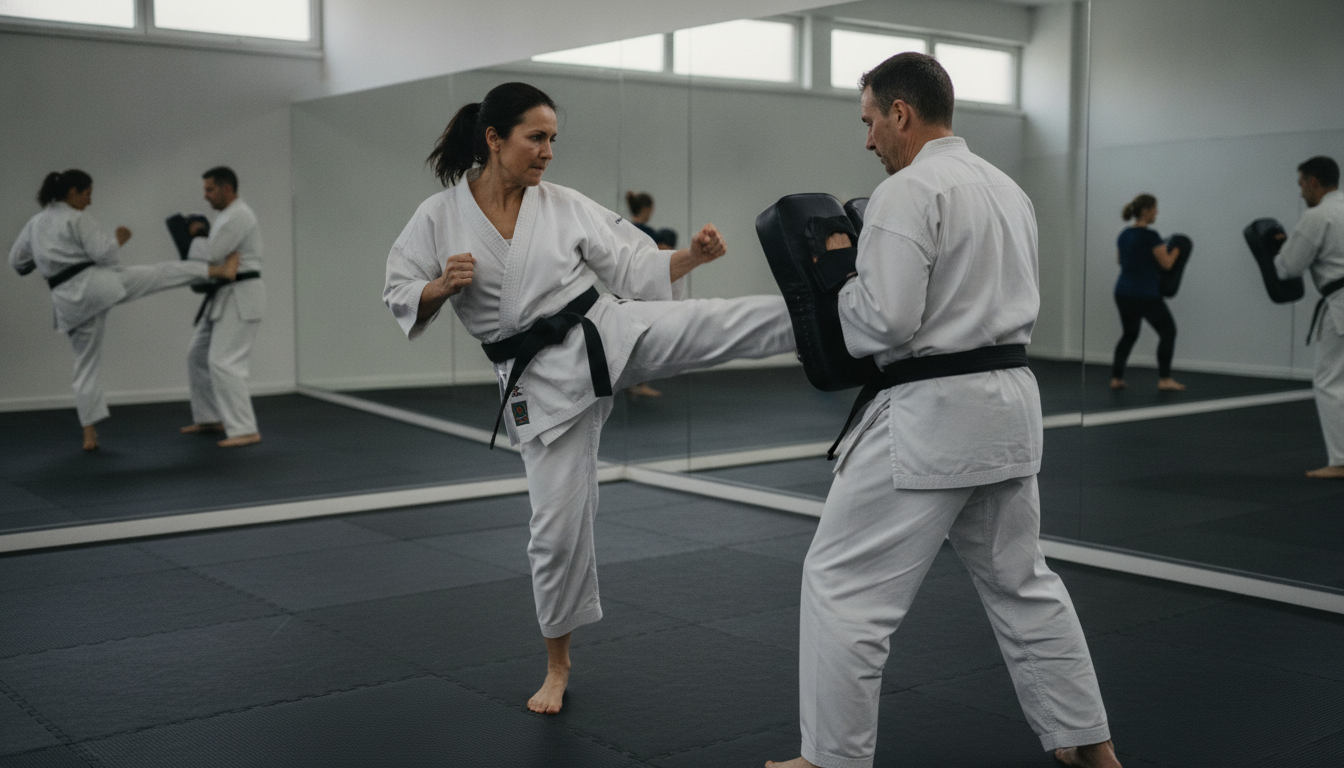
Scale impact for every adult who needs it. Offer a no-contact option on pad rounds and sparring, pair people by size and experience, and let a student with a bad shoulder swap strikes for kicks without making a fuss about it. The homework line at the end costs you ten seconds and gives the students who train at home something specific to do.
One plan, three belt levels: teaching a mixed-rank class
Most small schools can't split every rank into its own class, so one instructor ends up with white belts and brown belts on the same mat. The fix is not three separate lessons. It is one shared theme with three versions of each drill.
Four rules make it work:
- Same theme for everyone. "Defending a straight punch" works for a white belt and a brown belt. Different techniques for different ranks split your attention in three.
- Tier by difficulty, speed, resistance, and combination length. The drill stays the same; what changes is how fast the partner feeds, how much they resist, and how many strikes follow.
- Pair advanced students with beginners for one drill only. Teaching a technique sharpens it, but a brown belt who holds pads for a white belt all class stops improving.
- Pick material that's new to everyone when you can. A new self-defense scenario puts every rank at the start line together.
Here is how a "defending a straight punch" class tiers across three rank groups, with a fourth column for injuries or limited mobility.
| Drill | White-yellow | Green-blue | Brown-red | Injury or limited mobility |
|---|---|---|---|---|
| Block and counter | Static partner, one block + one punch | Partner feeds at half speed, block + two-strike counter | Unpredictable feeds, block + counter + takedown or exit | Knee injury: hands only, from a static stance |
| Kick drill | Front kick on a held shield | Front kick + roundhouse combination | Switch-kick combinations off footwork | Knee or hip injury: swap for hand pads |
| Forms | First form in sections of 4 moves | Grading form at full speed | Advanced form, explaining applications to a partner | Shorter stances, no jumps |
| Sparring | Tag-only target game | Controlled rounds, body only | Controlled rounds, full rules | Shoulder injury: kicks and footwork only |
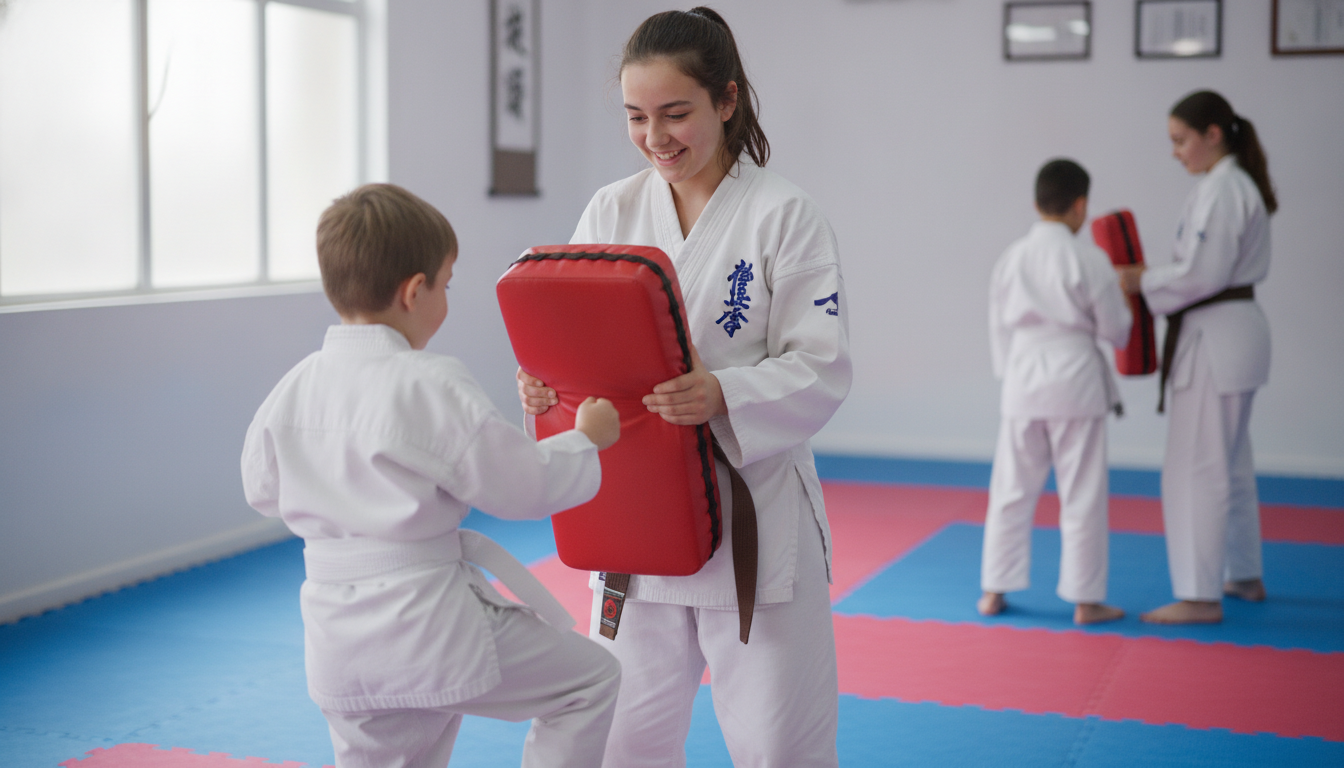
For the line-up, group by rank at stations and put a senior student or assistant in charge of one station. That lets you float between groups, correct technique, and move students up a tier the moment they're ready for it.
From weekly plans to a 12-week belt cycle
A string of good classes does not guarantee students who are ready to grade. A belt cycle does. It makes sure every required technique gets taught, reviewed, and tested before grading day. Many schools test color belts every three to four months, which lines up neatly with a 12-week cycle.
First, choose how your curriculum moves. There are three common models.
| Model | How it works | Suits | Watch out for |
|---|---|---|---|
| Linear | Each belt has its own syllabus, taught in its own rank group | Larger schools with separate classes by rank | Needs more instructors and more class slots |
| Rotating | Everyone works the same block of material for the cycle, with rank-specific requirements inside it | Small schools running mixed-rank classes | Students who join mid-cycle miss material before grading |
| Nested rotating | Grading content stays fixed per belt, supporting techniques rotate week to week | Kids programs and schools that want more variety | Takes more planning to keep the fixed and rotating parts balanced |
Most small schools with mixed-rank classes land on rotating or nested rotating, because it matches the tiered format from the section above. Whichever you pick, the cycle itself looks similar. Here is the shape of a 12-week cycle.
And here is the same cycle filled in for a mixed-rank striking class. Swap the themes for your own syllabus.
| Week | Phase | Theme | New material | Review | Notes |
|---|---|---|---|---|---|
| 1 | Foundation | Stances and footwork | Rank stances, stepping patterns | Bowing, ready stance | Welcome new students |
| 2 | Foundation | Blocking | Low, middle, high blocks by rank | Stances | - |
| 3 | Foundation | Striking basics | Punches and hand strikes by rank | Blocks | Check who has missed 2+ classes |
| 4 | Development | Kicking | Front, roundhouse, side kick by rank | Stances, punches | - |
| 5 | Development | Combinations | Hand-kick combos | Blocks, kicks | - |
| 6 | Development | Forms part 1 | First half of each grading form | Combinations | Midpoint check on grading candidates |
| 7 | Application | Forms part 2 | Second half of each grading form | Forms part 1 | - |
| 8 | Application | Self-defense | Grab releases, one-steps by rank | Blocks, strikes | - |
| 9 | Application | Sparring | Controlled sparring rules by rank | Combinations, footwork | Confirm grading list |
| 10 | Readiness | Mock grading 1 | - | Full syllabus run-through | Note gaps per student |
| 11 | Readiness | Form polish and mock grading 2 | - | Weakest items from week 10 | Send grading details to families |
| 12 | Grading | Grading and catch-up | - | - | Non-grading students catch up on missed weeks |
With the cycle mapped, planning a class becomes "fill in this week's row." The theme and new material from the table become Objective 1 in the template, and the review column becomes Objective 2.
New students who join mid-cycle follow along with the white-belt tier, and their first grading is the next cycle, not this one. Tell families this at sign-up so no one expects a belt after four classes. If you're still setting up your timetable and grading schedule, our guide on how to start a martial arts school covers the structure behind it.
Track readiness with data, not memory. Base grading eligibility on attendance plus technique checks. With our attendance tracker and class rosters, you can see who has attended enough classes this cycle before you plan the readiness weeks. If you still run on paper, a printable attendance sign-in sheet does the same job with more counting.
Build review into every class
Remember the call-out drill in sample plan 2, where the holder shouts "block" or "kick" at random? It's there because mixing techniques you've already practiced helps students keep them.
The classic evidence comes from a 1979 study by John Shea and Robyn Morgan in the Journal of Experimental Psychology: Human Learning and Memory. People who practiced three movement tasks in a random order performed worse during practice than those who practiced each task in a block, but they did better on later retention and transfer tests. Mixing felt harder and looked messier, and it stuck better.
How big that effect is in real sports practice is still debated. A 2023 meta-analysis of applied sports studies by Ammar and colleagues in Educational Research Review found only small, non-significant benefits for random practice, A 2024 meta-analysis by Czyż and colleagues in Scientific Reports, covering 54 studies, found that mixed practice had a medium-sized benefit for retention overall, but the benefit came mostly from lab studies and adult learners. In applied settings and with young participants, it was close to zero. The honest reading: mixing helps, especially with adults, but it isn't magic and it doesn't replace reps.
So the practical rule is:
- Block practice when a technique is brand new. Same technique, many reps, until students can do it roughly right.
- Mix once it's roughly right. Put it into drills and games alongside older techniques.
- Come back to it within two to three weeks. Every technique in the cycle should show up in the review column at least once after it's taught.
Easy ways to mix: call-out drills, form sections practiced out of order, and a two-minute review round at the start of the technique block.
Make the plan work for any instructor
Run every plan through the cover-instructor test: could an assistant teach it cold if you were off sick? If not, the plan is missing cues, timings, or equipment.
That's why every sample plan above has a cue and a common error for each block. They turn a list of drills into something another instructor can actually coach. Three examples:
- Front kick. Cue: "chamber the knee to belt height first." Error: kicking from the hip with a straight leg.
- Horse stance. Cue: "knees out over toes." Error: knees caving inward.
- Rear-hand punch. Cue: "turn the back foot, hips follow." Error: an arm-only punch.
A weekly routine keeps planning to about 15 minutes:
- Check this week's row in the cycle.
- Check attendance: who missed last week, and who is close to grading.
- Pick the two objectives.
- Choose the drills and write the three tiers.
- Add cues and common errors.
- Write plan B.
- After class, fill in the notes box.
In schools with more than one instructor, share one plan per cycle week. Students get the same syllabus whichever class they book into, and grading standards stay consistent. Review the curriculum itself every 6 to 12 months, using the after-class notes to spot which weeks keep running over or under. For assistants taking their first classes, our guide on how to become a martial arts instructor covers the path from helper to lead.
Plan B: small classes, big classes, and bad days
Every plan needs a fallback. Here is what to change for the four situations that break plans most often.
| Situation | What changes |
|---|---|
| 3-6 students | More partner rounds, instructor holds pads or partners in, extra one-on-one correction, longer sparring |
| 20-30+ students | Lines and stations, an assistant per station (roughly one adult per 8-10 young children is a sensible working ratio), shorter explanations, rotate every 6 minutes |
| Flat energy or a bad day | Switch to a review-games class and keep the objective |
| Smaller space (shared hall, community room) | Swap traveling drills for stationary ones, pads instead of bags |
The review-games class is worth writing once and keeping in your bag. Three games that cover most syllabuses:
- Technique bingo. Call a technique; students who do it cleanly cross it off their card.
- Sensei says, rank edition. Commands pulled from each rank's syllabus, so every belt has to listen for their own.
- Form relay. Teams complete a form one section per student, in order.
The plan handles what you teach. How you run the room on the day, from voice and discipline to transitions, is covered in our guide on how to run a martial arts class.
Turn your plans into a system you can reuse
After one cycle, you have 12 plans. Next cycle you don't start from scratch: you reuse them, and the notes boxes tell you what to change. Two or three cycles in, planning is mostly editing.
The admin around those plans is where time goes missing. We built Pembee so martial arts schools can take class bookings and trial classes online, track attendance, run waitlists, and send automated reminders, so the hours you'd spend chasing that go into planning and teaching instead. Our martial arts school software page shows how it fits together, and if you're comparing options, our roundup of the best martial arts software lays them out.
Pick the sample plan closest to your class, print it or copy it into the template, and teach it this week.
Key takeaways
- A martial arts lesson plan has four blocks: warm-up, technique, apply, and cool-down, with a time for each.
- Run 30 minutes for ages 3-5, 45 for school-age kids, and 60-90 for teens and adults. Rotate kids' activities every 5-7 minutes.
- Two objectives at most: one new, one review, each written as something you can see.
- In mixed-rank classes, keep one theme and tier each drill by speed, resistance, and combination length.
- Map a 12-week belt cycle, then fill in one row per week.
- Block practice for new techniques, then mix them with older ones and revisit within two to three weeks.
- Write cues, common errors, and a plan B so any instructor can teach the plan cold.
FAQs
How long should a martial arts class be?
About 30 minutes for ages 3-5, 45 minutes for school-age kids, and 60 to 90 minutes for teens and adults. Younger children lose focus fast, so shorter classes with 3-4 minute blocks work better. Adults can handle longer blocks and more conditioning.
What should a martial arts lesson plan include?
The four blocks (warm-up, technique, apply, cool-down) with times, one or two objectives tied to the belt syllabus, equipment, coaching cues, and a plan B. Add an after-class notes box for who struggled and who is close to grading.
How many techniques should I teach in one class?
One new technique and one review technique, two at most. Students need a lot of reps before a technique sticks, and splitting a class across five techniques gives each one only a few attempts.
How do I plan a martial arts class for mixed belt levels?
Keep one theme for the whole class and write three versions of each drill. Beginners work at a slower pace against a static partner, while advanced students get faster feeds, more resistance, and longer combinations. Stations led by senior students let you float between groups.
What is the difference between a martial arts curriculum and a lesson plan?
The curriculum is everything a student learns from white belt to black belt. A lesson plan is one class's slice of it, with timings, drills, and objectives. The belt cycle sits between them and decides which slice each week gets.
How often should students test for a new belt?
Many schools test color belts every three to four months, but it varies by style, age, and rank. Higher ranks usually wait longer between gradings. Base eligibility on attendance and technique checks, not just time since the last belt.
How do I keep kids interested in martial arts classes?
Change the activity every 5 to 7 minutes, use games that teach a technique rather than replace it, and make progress visible with stripes or stickers. A monthly character theme gives the mat chat something to build on each week.
How far ahead should I plan martial arts lessons?
Map the full 12-week cycle before it starts, then write each individual plan a week ahead. That way, the cycle guarantees coverage and the weekly plan can react to who showed up and what they struggled with.
How should I structure a martial arts class for adults?
Use the same four blocks with longer drills (10 to 12 minutes), a proper dynamic warm-up, and a conditioning finisher instead of games. Ask about injuries at the start of every class, and offer no-contact options for pad work and sparring.
How do I adapt a lesson plan for a BJJ or judo class?
Keep the four blocks and swap the striking drills for positional work. Replace one-step sparring with positional rounds from the day's position, and replace free sparring with specific rounds from that position followed by a few minutes of free rolling or randori.