
How to Start a Swim School: 10 Steps, Costs & Pool Options


Most swim schools don't start with a pool. They start with one instructor renting two lanes at a hotel or YMCA on weekday evenings, then adding hours as the waitlist grows. Owning water comes much later, if at all. Even one of the best-known franchise brands, British Swim School, runs on pool time leased from hotels, health clubs and community centers rather than its own buildings.
This guide shows you how to start a swim school the same way: low fixed costs, real demand, then growth. Here are the 10 steps:
- Get certified and decide what you'll teach
- Research your local market
- Choose your launch model
- Find and negotiate pool time
- Write a business plan and run the numbers
- Register the business and get insured
- Set your safety standards
- Hire and keep good instructors
- Set your pricing, levels and term calendar
- Set up online registration and payments
Budget-wise, mobile lessons in clients' pools can start for $1,000 to $5,000, and a rented-pool school typically launches for $5,000 to $25,000. Building your own facility runs from $500,000 into the millions. Plan on three to six months from decision to your first term.
Before you start: what owning a swim school actually involves
Teaching is about half of the job. The rest is booking pool hours, staffing a deck of part-time instructors (many of them high school and college students), re-enrolling families every term, and answering parent messages about make-ups, levels and closures. If you enjoy the teaching but dread the admin, plan for help or software from day one.
The demand side is strong and steady. According to the CDC, more children ages 1 to 4 die from drowning than from any other cause. A case-control study by Brenner et al. published in the Archives of Pediatrics & Adolescent Medicine in 2009 found that participation in formal swim lessons was associated with an 88% lower risk of drowning in children ages 1 to 4. Parents treat swim lessons as a safety skill, not a hobby, which is why good programs fill and keep families for years.
Expect seasonality. Enrollment spikes in spring and summer, and outdoor pools close in fall. If you want year-round income, you need access to indoor, heated water.
It isn't only a kids' business, either. Adult learn-to-swim classes, stroke clinics for triathletes, aquatic fitness and adaptive lessons are all real revenue lines, and they often fill the daytime and late-evening hours that kids' classes can't.
Step 1: Get certified and decide what you'll teach
Parents will ask about your qualifications before anything else, and pool hosts will ask for proof before they rent you a lane.
Certifications you need
The most widely recognized US credential is the American Red Cross Water Safety Instructor (WSI) certification. Per the Red Cross WSI course fact sheet, you must be at least 16 by the last day of the course and pass a precourse skills test: 25 yards each of front crawl, back crawl, breaststroke, elementary backstroke and sidestroke, 15 yards of butterfly, a one-minute back float and one minute of treading water. The certificate is valid for two years. The course mixes online learning with in-water sessions, and fees vary by local provider, so check a few training centers near you.
You'll also want:
- Lifeguard certification. Many host pools require a certified lifeguard on deck, and some will accept you in that role.
- CPR/AED and First Aid. Required for you and anyone you hire.
- A specialist certification if you plan to teach infant and toddler water-survival skills or adaptive lessons.
Other recognized programs exist, such as YMCA and Starfish Aquatics instructor courses. Pick one that parents in your area recognize and that matches the curriculum you plan to teach. If you're new to teaching, our guide on how to become a swimming teacher covers the route from first course to paid instructor.
Pick your niche and levels
You don't need to run every program on day one. Choose two or three you can staff and teach well, then add more once they fill.
| Program | Typical ages | Typical ratio | Lesson length | Price position |
|---|---|---|---|---|
| Parent and child | 6 months to 3 years | One adult per child in the water, one instructor per group | 30 minutes | Lower per head, high volume |
| Preschool | 3 to 5 | 1:3 to 1:4 | 30 minutes | Core product, steady demand |
| School-age group levels | 5 to 12 | 1:4 to 1:6 | 30 to 45 minutes | Core product, evening slots |
| Private and semi-private | All ages | 1:1 or 1:2 | 30 minutes | Premium |
| Adaptive lessons | All ages | 1:1 to 1:2 | 30 minutes | Premium, low competition |
| Adult learn-to-swim and stroke clinics | 16+ | 1:4 to 1:6 | 45 to 60 minutes | Mid to premium, off-peak hours |
Build four to six levels with clear pass criteria for each, such as "floats on back unassisted for 10 seconds" or "swims 15 yards of front crawl with side breathing." Parents re-enroll when they can see progress, and clear criteria make it obvious when a child is ready to move up. Our swim lesson plans guide maps out a level structure from water confidence through stroke development, with drills for each stage.

Step 2: Research your local market
Map every swim program within a 15 to 20 minute drive: YMCAs, city aquatic centers, franchise schools, private instructors advertising on Facebook and Nextdoor, and clubs running learn-to-swim alongside their teams. For each one, note:
- Price per lesson and per term
- Class sizes and ratios
- Time slots offered (weekday evenings, Saturday mornings, daytime)
- Whether they run waitlists or sell out
- Programs they don't offer, such as adult, adaptive or parent-and-child classes
Look for signs of unmet demand. City programs that sell out within hours of registration opening, long waitlists, no weekday evening slots and no adult or adaptive classes all point to families you could serve.
Public fee schedules give you a price benchmark. At the city-run Monterey Sports Center in California, a 30-minute private lesson costs $40 to $45 depending on the package size. Private schools commonly price above city programs when they offer smaller classes, warmer water and more convenient times.
Before you sign anything, test demand. Post an interest form in local parent groups listing your planned programs, locations and times, and see how many families add their names. Fifty names on a list before you've booked a pool tells you far more than a spreadsheet.
Step 3: Choose your launch model
This is the biggest decision you'll make, because it sets your startup costs, your fixed monthly bills and how much risk you carry. There are four common ways to start.
| Model | Typical startup cost | Fixed monthly costs | Capacity | Biggest risk | Best for |
|---|---|---|---|---|---|
| Mobile (clients' pools) | About $1,000 to $5,000 (our estimate) | Low: insurance, software, travel | Roughly 15 to 25 private lessons a week per instructor, limited by drive time | Seasonal, weather, local permit rules | Solo instructors testing demand |
| Rented pool time | About $5,000 to $25,000 (our estimate) | Pool rent per hour, payroll, insurance | Grows with the lanes and hours you can book | Losing your pool slot | Most new swim schools |
| Own facility | $500,000 to $2 million or more | Rent or mortgage, utilities, heating, chemicals, staff | High, year-round | Debt and fixed costs | Proven operators with a waitlist |
| Franchise | $122,700 to $176,050 (rented-pool brand) or $1.66 million to $3.75 million (built-facility brand) | Royalties of 6% to 10%, plus a 2% marketing fee and a monthly technology fee | Set by the franchise system | Royalties, territory rules | Owners who want a ready-made playbook |
The franchise figures come from Entrepreneur's franchise directory: British Swim School lists an initial investment of $122,700 to $176,050 with a 10% royalty, while Goldfish Swim School, which builds its own pools, lists $1,663,263 to $3,746,733 with a 6% royalty. Always read the current franchise disclosure document before you commit.
Mobile and in-home lessons
You drive to families and teach in their own pools. Startup costs are minimal, and private lessons command the highest per-lesson price. The ceiling is your calendar: drive time between houses eats into teaching hours, weather cancels lessons, and the season is short in most of the country.
The backyard pool trap
Many solo instructors want to teach groups in their own backyard pool. Check local rules before you advertise. In many US jurisdictions, a residential pool that's opened to paying members of the public stops being treated as private. Salt Lake County, for example, defines a pool as public if it is "open for use to anyone in the community (for a fee or not)," and public pools need a health department permit and inspections. Florida's public pool statute also defines public pools as those open for admission "with or without payment of a fee."
Insurance is the second trap. Homeowner policies commonly exclude business use, so a claim from a paid lesson may not be covered.
Teaching a family in their own pool is usually treated differently from running classes for other families in yours. Call your county environmental health department before you take bookings, and buy a business liability policy that covers off-premises lessons.
Rented pool time
This is the default for most new swim schools, and for good reason. You don't need capital for a building, and you grow by adding hours or a second pool. The trade-off is that you're a tenant. If the host changes its schedule or rents your slot to someone else, your classes go with it. Step 4 covers how to protect yourself.
Your own facility
Only consider building or leasing your own pool once you've filled every rented hour you can get and have a waitlist to prove it. Teaching pools are usually small, shallow and kept warmer than lap pools for young learners, and heating, water chemistry and HVAC make up a large share of running costs. Talk to an aquatic facility designer and your lender early, as permitting and construction can take a year or more.
Step 4: Find and negotiate pool time
Pool time is your most important supplier relationship. Treat it like a lease, not a favor.
Where to look
- Hotels. Indoor hotel pools often sit empty on weekday afternoons and evenings.
- Apartment and condo complexes. Some will trade pool time for lessons offered to residents.
- YMCAs and JCCs. Many rent lanes when their own programs aren't running.
- School district, college and private school pools. Good evening and weekend availability outside swim team season.
- City aquatic centers. Lane rentals are published and easy to book.
- Health clubs. Especially those without their own lesson program.
- Retirement communities and physical therapy clinics. Their pools are often small and warm, which suits young beginners.
What it costs
City fee schedules give you a baseline. The Monterey Sports Center charges $30 per lane per hour ($27 for residents). The Miami Springs Aquatic Center schedule of charges lists lane rentals at $15 an hour for residents and $30 for non-residents, with up to six swimmers per lane.
Hotels, clubs and private pools rarely publish rates. Expect a flat hourly fee or, sometimes, a revenue share. Ask what similar renters pay, and offer a longer commitment in exchange for a lower rate.
What hosts will ask you for
- A certificate of insurance naming them as an additional insured, often with limits around $1 million per occurrence and $2 million aggregate
- Proof of your instructors' certifications
- A certified lifeguard on deck (sometimes theirs, sometimes yours)
- Signed participant waivers
- A fixed schedule for the whole term
9 things to get in writing
- Guaranteed lanes and hours for the full term, not "subject to availability"
- The rate, and how long it's locked
- Notice periods for cancellations or schedule changes, and what happens when the pool closes for maintenance, chemical problems or a fecal incident
- The water temperature range
- Access to changing rooms, deck space for waiting parents and storage for equipment
- Who provides the lifeguard
- Insurance and additional insured requirements
- Exclusivity, meaning they won't rent the same slot to another swim school
- Renewal terms and first right of refusal on extra hours
Start small. One pool with two weekday evenings and a Saturday morning is enough for a first term. Add a second pool before you add a third day at the first one, so a single host closing doesn't shut you down.
Step 5: Write a business plan and run the numbers
Your business plan doesn't need to be long. It needs your programs and levels, your launch model and pool, your pricing, your marketing plan and a 12-month cash flow forecast. Our swim school business plan template covers pool access, pricing, staffing, startup costs and financial projections.
The section that matters most is the math on a single pool hour.
Worked example: one rented pool, one term
Here's an illustrative example for a rented-pool school. Swap in your own numbers.
Assumptions:
- 2 lanes at $30 per lane per hour = $60 an hour
- 30-minute group lessons, so two lesson slots per pool hour
- 1 instructor per lane, 4 swimmers per instructor
- 16 lesson spots per pool hour (2 slots × 2 lanes × 4 swimmers)
- 10 pool hours a week, so 160 spots a week
- 8-week term at $25 a lesson ($200 per swimmer per term)
- Instructors paid $20 an hour, 20 instructor-hours a week
- Card processing at about 3%
| Fill rate | Swimmers | Term revenue | Pool rent | Instructor pay | Card fees | Contribution per term |
|---|---|---|---|---|---|---|
| 40% | 64 | $12,800 | $4,800 | $3,200 | $384 | $4,416 |
| 55% | 88 | $17,600 | $4,800 | $3,200 | $528 | $9,072 |
| 70% | 112 | $22,400 | $4,800 | $3,200 | $672 | $13,728 |
| 85% | 136 | $27,200 | $4,800 | $3,200 | $816 | $18,384 |
Contribution is what's left before insurance, software, marketing, equipment and your own pay. The lesson is in the middle columns: pool rent and instructor pay don't change once you've booked the hour, so every extra swimmer is almost pure margin. In this example, you cover pool and staff costs at roughly 26% fill, about 41 swimmers. Going from 40% to 70% full triples your contribution without adding a single pool hour.
That's why fill rate, ratio and lesson length matter more than anything else in your plan. Fill the hours you have before you book more.
Startup costs for a rented-pool swim school
These are our estimates, built line by line, and your local prices will differ. For the kit line, our swim lesson equipment checklist lists what you need by level.
| Item | Estimated cost |
|---|---|
| LLC filing and local business license | $100 to $800 |
| Certifications (WSI, lifeguard, CPR/AED, First Aid) | $300 to $800 |
| Liability insurance, first year | $500 to $2,500 |
| Teaching equipment (kickboards, noodles, mats, toys, rings, rescue tube, first aid kit) | $500 to $2,000 |
| Pool deposit or first month's rent | $500 to $2,500 |
| Website, booking software and launch marketing | $500 to $3,000 |
| Hiring and paid training for instructors | $500 to $2,000 |
| Working capital (2 to 3 months of pool rent and payroll) | $2,000 to $11,000 |
| Total | About $5,000 to $25,000 |
You may see guides quoting $100,000 to $300,000 to start a swim school. Those figures assume a facility with a lease, renovations and pool equipment. They aren't what a rented-pool launch costs.
Ongoing monthly costs
Plan your monthly budget around pool rent, payroll, insurance, software and card fees, marketing, equipment replacement and staff recertification. Pool rent and payroll will be most of it.
Step 6: Register the business and get insured
Business setup
Most swim school owners form an LLC to separate personal and business liability. Filing fees vary by state. Then:
- Get a free Employer Identification Number from the IRS
- Apply for your city or county business license
- Open a business bank account
- Check your state's sales tax rules. Lessons are often not taxable, but merchandise such as swim caps and goggles usually is
Permits
If you operate your own pool, you'll need a health department pool permit, regular inspections and usually a Certified Pool Operator (CPO) or equivalent to manage water chemistry. If you rent pool time, the host holds the pool permit, but you still need your own business license. If you teach in a backyard pool, go back to Step 3 and check the rules first.
Insurance
A swim school policy usually combines several types of cover:
- General liability, for injuries and property damage
- Professional liability, for claims about your instruction
- Participant accident medical, which pays medical bills regardless of fault
- Abuse and molestation coverage, which is essential when you teach minors and is often excluded from standard policies
- Hired and non-owned auto, if you or your staff drive to clients' pools
- Workers' compensation, once you hire staff (rules vary by state)
Most hosts will want to be named as an additional insured. Ask an insurer that specializes in aquatics or youth activities, as general business insurers may exclude swimming. Our guide to swim school insurance goes through each type of cover and what it typically costs.
Waivers, health forms and consent
Collect everything at registration: emergency contacts, medical conditions and allergies, current swim ability, a liability waiver and photo consent. Our photo consent form examples and health disclaimer examples give you wording to adapt. In many states, a waiver signed by a parent on behalf of a minor won't hold up in court, so treat waivers as one layer of protection, not a replacement for insurance.
Step 7: Set your safety standards
Your safety standards protect swimmers, satisfy your pool host and your insurer, and give parents a concrete reason to choose you. A good baseline is the United States Swim School Association membership standards, which include:
- No more than a 1:6 ratio for beginner or intermediate lessons when a parent isn't in the water, with 1:4 or less recommended
- At least one CPR/First Aid certified person in the facility during operating hours
- Background checks on all staff over 18
- Lifesaving equipment and first aid supplies within easy reach, such as a rescue tube or ring buoy, a shepherd's crook or reaching pole, a spineboard, an AED, gloves and breathing masks
Build on that with your own rules:
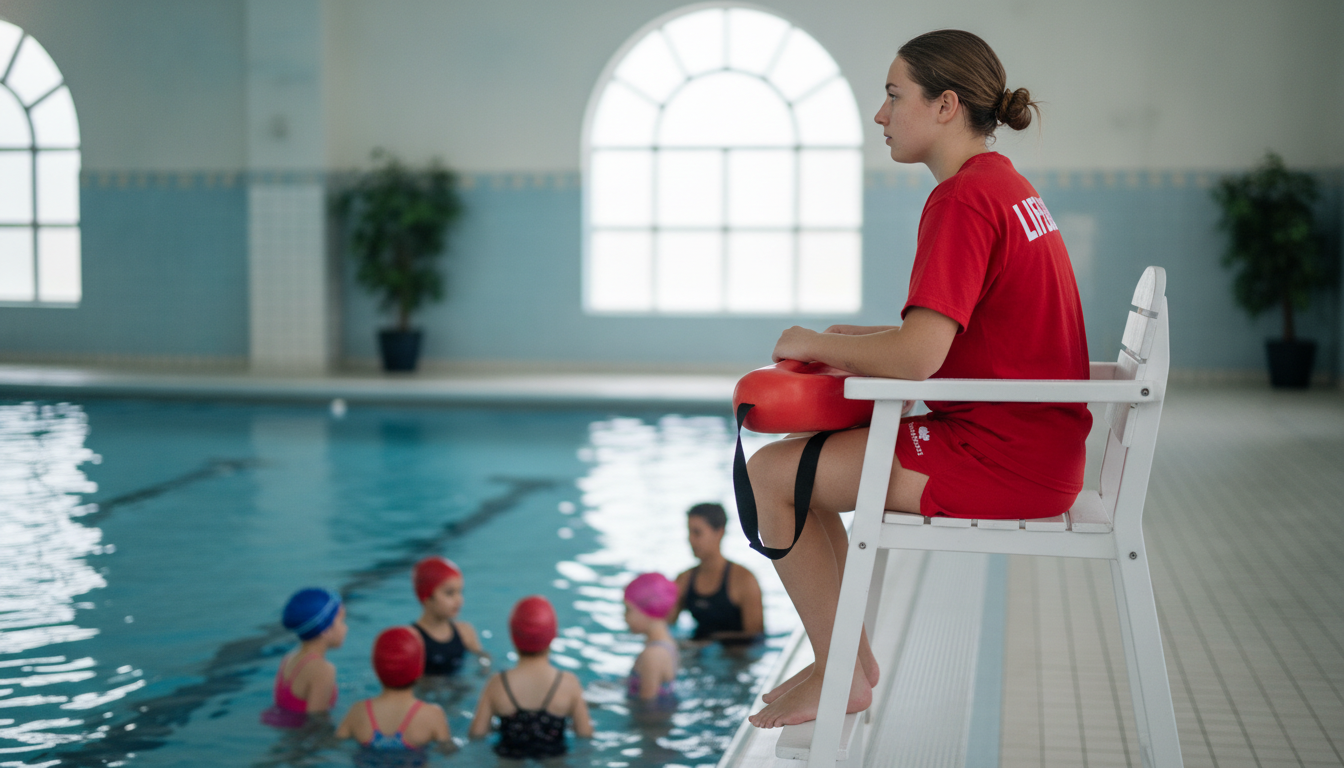
- A dedicated lifeguard for group classes, separate from your instructors. An instructor focused on four swimmers can't scan the whole pool.
- An emergency action plan that names who calls 911, who clears the pool and who meets emergency services at the door. Practice it with every new instructor and run a drill each term.
- One adult per child in the water for parent-and-child classes.
- Same-day incident reports for every injury or near miss, with your insurer notified as their policy requires.
Write it all into a short staff handbook and get each instructor to sign that they've read it.
Step 8: Hire and keep good instructors
Most swim instructors are lifeguards and former competitive swimmers in their late teens and early twenties, which suits evening and weekend classes. For daytime preschool and parent-and-child slots, you'll also need a few adults who are free during school hours, such as parents of older swimmers and retired teachers.
Good places to recruit:
- High school and college swim teams
- Lifeguard certification classes
- Local swim clubs
- Your own oldest swimmers, as junior aides you train up over time
On pay, ZipRecruiter puts the average US swim instructor wage at $19.33 an hour. Many schools pay group instructors somewhere around $18 to $25 an hour depending on local rates and experience. Pay for training and shadowing time too. It signals that you take the job seriously, and it's cheaper than turnover.
Train every new hire on your curriculum and level criteria, not just their certification. Have them shadow four to six lessons, then teach under supervision before running a class alone.
Turnover follows the school and college calendar, so plan for it:
- Offer consistent shifts that fit around classes and exams
- Build a pay ladder tied to the levels each instructor can teach
- Recognize good teaching publicly, in front of parents and other staff
- Recruit for summer in early spring, before other pools snap up the best lifeguards
Run background checks on all staff over 18, as the USSSA standards require, and put a written safeguarding policy in place. Where you can, avoid any situation where one adult is alone with one child out of view, including in changing areas.
Step 9: Set your pricing, levels and term calendar
This is where swim schools win or lose retention.
Pricing
Price group lessons per term (typically 8 to 10 weeks) rather than per lesson. Families commit up front, you know your numbers before the term starts, and you avoid chasing payments weekly. Sell privates as packages of four, eight or ten lessons. Offer a sibling discount, since many families enroll two or three children.
Use the local prices you gathered in Step 2 as your anchor. If you offer smaller ratios, warmer water and evening times that city programs don't, price above them with confidence. Our swim lesson pricing guide has typical rates for group, semi-private and private lessons, and how to structure terms, blocks and memberships.
Terms vs monthly membership
| Terms (8 to 10 weeks) | Monthly rolling membership | |
|---|---|---|
| Cash flow | Lumpy, paid up front each term | Smooth and predictable |
| Planning pool hours | Easy, fixed start and end dates match your pool agreement | Harder, numbers shift month to month |
| Retention | Every term end is a natural exit point | Families stay until they cancel |
| Admin | Busy re-enrollment weeks | More ongoing make-up and level-change requests |
Most new schools start with terms because they line up with pool agreements. Some move to monthly once they own or control their pool time.
Re-enrollment, waitlists and make-ups
Three policies will save you hours every term:
- Priority re-enrollment. Give existing families two to three weeks to rebook their spot before you open registration to the public. It rewards loyalty and gives you a clear view of how many spots are left.
- Waitlists by level and time slot. When the 4:30 pm preschool class fills, families should be able to join a waitlist for that exact class. When someone drops out, you offer the spot to the next family in line.
- A written make-up policy. For example: the school makes up any lesson canceled for a pool closure, and families get one make-up per term for a missed lesson with 24 hours' notice. Our cancellation and refund policy examples include wording you can adapt.
A sample first-term timetable
Here's one way to fill 10 pool hours a week in a single rented pool.
| Time | Monday and Wednesday | Saturday |
|---|---|---|
| 8:00 to 9:00 am | Parent and child | |
| 9:00 to 10:00 am | Preschool | |
| 10:00 to 11:00 am | School-age levels 1 to 2 | |
| 11:00 am to 12:00 pm | School-age levels 3 to 4 | |
| 4:00 to 4:30 pm | Preschool | |
| 4:30 to 6:30 pm | School-age levels 1 to 4 | |
| 6:30 to 7:00 pm | Adult learn-to-swim |
That's three hours on each weekday evening plus four on Saturday morning, for 10 hours in total.
We built Pembee to run exactly this kind of schedule. You can sell term enrollments, drop-ins and session passes side by side, let parents book several children into different classes in one checkout, and ask custom registration questions such as swim level and medical information. With a class waitlist, when a spot opens, the next family in line is notified automatically and gets a set time to claim it before it moves down the list. We don't have built-in skills progress tracking or report cards, so schools that use level checklists track those separately.
Step 10: Set up online registration and payments
Parents book swim lessons on their phones, usually in the evening after the kids are in bed. Popular summer classes can fill within hours of registration opening, so a manual process of emails and bank transfers will cost you families.
At a minimum, you need:
- Online booking by level, location and time slot
- Card and wallet payments taken at the point of booking
- Custom registration forms for swim ability, medical information, consent and waivers
- Automatic confirmations and reminders
- Class rosters your instructors can check on deck, with allergies and notes
- Attendance tracking so you know who missed lessons and who is due a make-up
In your first few weeks, a printed attendance sign-in sheet makes a handy backup at the pool. For a side-by-side look at the options, see our roundup of the best swim school software.

Marketing your swim school before and after opening
Start with your Google Business Profile. Most families find lessons by searching "swim lessons near me," and your profile is what shows up. Add photos, your pool locations as a service area, your hours and a direct link to your booking page. Ask your first families for reviews and reply to every one.
Then work your neighborhood:
- Local parent groups on Facebook and Nextdoor, where most swim lesson recommendations happen
- Partnerships with preschools, daycares and pediatricians, who see the families you want to reach
- Flyers and a banner at your host pool, if they allow it
- Free water safety talks or swim assessment days in spring, when parents start thinking about summer
For your first term, offer founding families something that costs you little but means a lot to them, such as priority re-enrollment for as long as they stay, rather than a deep discount that sets a low price anchor. Add a referral credit for families who bring a friend or a sibling.
When registration opens, email your interest list first and give them a head start before you announce publicly. Our guide on how to market a swim school goes deeper on local SEO, referrals, school partnerships and filling off-peak slots, and our email marketing for activity providers guide covers what to send. Get written photo consent from parents before you share any picture of a child.
Your 6-month pre-opening timeline
Here's how the steps fit together, counted back from a June summer launch. If you're opening with indoor, year-round water, you can start any month, but launching into the spring and summer demand peak makes the first term easier to fill.
| When | What to do |
|---|---|
| Month 6 (December) | Book or renew your certifications. Research your local market. Choose your launch model. |
| Month 5 (January) | Approach pools and compare rates. Write your business plan. Form your LLC and get an EIN. |
| Month 4 (February) | Sign your pool agreement. Get insurance quotes. Set your levels, pass criteria and curriculum. |
| Month 3 (March) | Recruit and train instructors. Build your website and online registration. Open your interest list. |
| Month 2 (April) | Bind your insurance and send the certificate to your host. Open registration to your interest list, then to the public. Push your local marketing. |
| Month 1 (May) | Run shadow sessions and an emergency drill in the pool. Send rosters to instructors and confirmations to families. |
| Launch (June) | Teach your first term. Collect feedback and open re-enrollment for fall in the final weeks. |
Mistakes that sink new swim schools
- Booking pool hours you can't fill. Fix: start with the hours your interest list supports, and add more only when classes have waitlists.
- Relying on a verbal pool agreement. Fix: get the nine items from Step 4 in writing before you sell a single spot.
- Teaching paid groups in a backyard pool without checking the rules. Fix: call your county health department and your insurer first.
- Pricing per lesson and chasing payments weekly. Fix: sell terms and packages, paid at booking.
- Ratios too high for children to make visible progress. Fix: stay at 1:4 for beginners, and use your level criteria to show parents what's changed.
- No make-up policy. Fix: publish one before the first term and apply it consistently.
- No plan for the fall and winter dip. Fix: secure indoor, heated pool time or build an off-season offer such as stroke clinics or adult classes.
- Hiring only teenagers. Fix: recruit a few adults for daytime preschool and parent-and-child slots.
Your pre-opening checklist
- WSI (or equivalent), lifeguard and CPR/First Aid certifications current
- Pool agreement signed, with guaranteed hours for the full term
- Insurance bound and certificate of insurance sent to your host
- LLC formed, EIN issued, business license in hand
- Registration form with waiver, medical questions and photo consent
- Emergency action plan written and practiced
- Instructors hired, background-checked and trained on your curriculum
- Levels, pricing, make-up policy and term calendar published
- Online registration and payments live
- Interest list emailed and local marketing launched
Key takeaways
- Start on rented pool time or with mobile lessons. A rented-pool school can launch for about $5,000 to $25,000, while your own facility costs $500,000 or more.
- Treat your pool agreement like a lease. Get guaranteed hours, notice periods, closures and exclusivity in writing.
- Fill rate drives profit. Pool rent and instructor pay are fixed once booked, so a full class earns several times what a half-empty one does.
- Use USSSA standards as your safety baseline: 1:6 maximum for beginners without a parent in the water, 1:4 recommended, and background checks for all staff over 18.
- Check health department rules before teaching paid classes in a backyard pool.
- Sell terms, run waitlists by class and give existing families priority re-enrollment.
- Move to your own pool only when demand forces you to.
FAQs
How much does it cost to start a swim school?
It depends on your model. By our estimates, mobile lessons in clients' pools start at about $1,000 to $5,000 and a rented-pool school at about $5,000 to $25,000. A British Swim School franchise lists $122,700 to $176,050, and building your own facility costs $500,000 to several million dollars.
Can I start a swim school without a pool?
Yes, and most new swim schools do. You can rent lanes or whole pools from hotels, YMCAs, schools, city aquatic centers and health clubs, or teach families in their own pools. Renting keeps your startup costs low while you build demand.
Do I need a license to teach swimming lessons?
There's no federal license to teach swimming in the US. You'll need a local business license, a recognized instructor certification such as the Red Cross WSI, and CPR/First Aid. If you operate your own pool, you'll also need a health department pool permit.
Is a swim school profitable?
It can be, and fill rate decides it. In our worked example, 10 rented pool hours a week at 70% full leave about $13,700 per 8-week term after pool rent, instructor pay and card fees. At 40% full, that drops to about $4,400, before insurance, marketing and your own pay.
Can I teach swim lessons in my backyard pool?
Check with your county environmental health department first. In many places, a residential pool opened to paying members of the public is treated as a public pool that needs a permit and inspections. Homeowner insurance also commonly excludes business use, so you'll need a business policy.
What ratio should swim lessons have?
The USSSA membership standards set a maximum of 1:6 for beginner and intermediate lessons without a parent in the water and recommend 1:4 or less. Parent-and-child classes should have one adult in the water per child. Privates and adaptive lessons run at 1:1 or 1:2.
How much do swim instructors get paid?
ZipRecruiter puts the average US swim instructor wage at $19.33 an hour. Many swim schools pay group instructors around $18 to $25 an hour, depending on local rates and experience. Private-lesson specialists can earn more.
How long does it take to open a swim school?
On rented pool time, you can go from decision to first term in about three to six months. Most of that time goes on certifications, securing a pool agreement and hiring instructors. Building your own facility typically takes 12 to 24 months because of design, permitting and construction.
What certifications do I need to start a swim school?
Most owners hold an American Red Cross Water Safety Instructor certification (or a recognized equivalent), lifeguard certification, and CPR/AED and First Aid. WSI candidates must be at least 16 and pass a swimming skills test, and the certificate is valid for two years.
When is the best time to open a swim school?
Spring is the best time to open registration, ready for a summer term. Parents start planning summer activities in March and April, so launching into that demand peak makes your first term easier to fill. If you have indoor heated water, you can start year-round lessons in any month.