


Finding activities is not what makes early years forest school hard. Any practitioner can list twenty things to do with sticks. The difficulty is running the same session every week through February drizzle, with the right adults on the right children and a written record that stands up to inspection. This post covers 24 activities banded by age and mapped to the EYFS, plus the session plan, ratios, risk assessment and kit budget underneath them.
Forest school activities for early years are short, child-led outdoor sessions using natural materials: mud kitchens, den building, minibeast hunts, transient art, bark rubbings and counting with sticks and stones. For under-5s they work best when they are simple, open-ended, repeated weekly, and matched to what each age group can physically do.
What forest school means in the early years
Forest school is not a synonym for outdoor play. The Forest School Association defines it against six principles, and the first and last are the ones that catch early years settings out.
- It is a long-term process of regular sessions, not one-off visits, with a cycle of planning, observation, adaptation and review running between them.
- It happens in a woodland or natural setting, building a lasting relationship between the learner and the natural world.
- It uses learner-centred processes to build a community for development and learning.
- It aims at development across the whole child, physical, social, emotional and cognitive, fostering resilient, confident, independent and creative learners.
- It gives learners supported risk-taking suited to the environment and to themselves.
- It is run by qualified forest school practitioners who keep developing their practice.
The practical distinction is easier than the theory. One afternoon in the woods is a trip. Twelve weekly sessions in the same spot, with the same adults, adapting each week from what you noticed the week before, is forest school. The last principle is the other sticking point: without a qualified leader you are running good outdoor learning, which is worth doing, but you should not call it forest school.
The model reached the UK in 1993, when nursery nurses from Bridgwater College in Somerset visited Denmark to look at its pre-school system and came back to run their own forest school with children in the college creche. Bridgwater developed a BTEC in 1995 and it spread from there.
You do not need a woodland
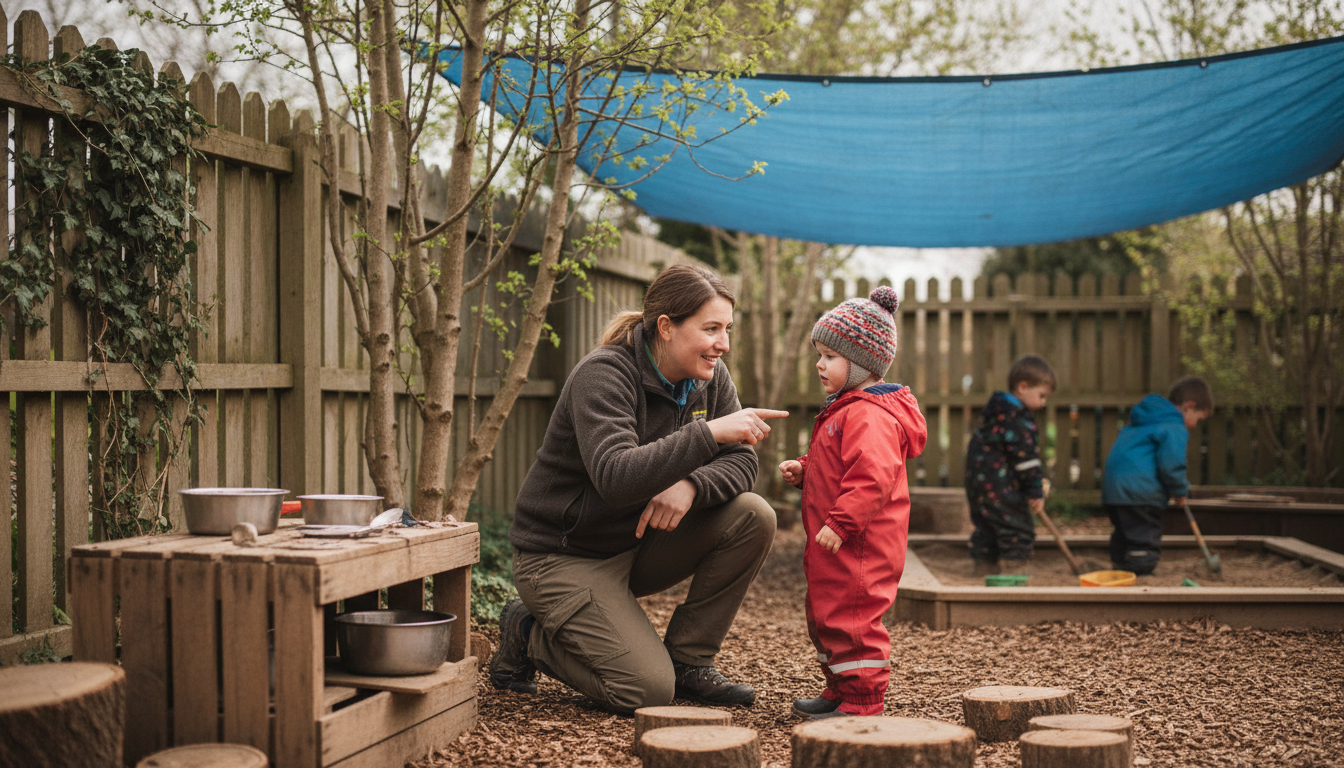
The commonest reason settings never start is that they think a woodland is the entry requirement. It is not. A car park verge with three trees, a raised bed and a tarpaulin will run 20 of the 24 activities below. What matters is a boundary the children can see and name, a base spot they return to every week, and permission from whoever owns the site to make a mess. Get those three and the rest is kit.
Why it works for under-5s
The most useful recent UK evidence is a 2024 ethnographic evaluation published in Wellcome Open Research, which followed 20 three-year-olds from two Bradford nurseries through 11 weekly forest school sessions, with 65 hours of participant observation. Before the programme the children's play had been almost entirely home, nursery and fixed park equipment, with little or no experience of natural space, and the session locations tell their own story: the first ran in the nursery yard, four in a local park, and only the final six in woodland reached by minibus.
Researchers recorded gains across the EYFS areas of learning, and were candid that physical development threw up less than they expected. The strongest results were in personal, social and emotional development (confidence, less anxiety, better peer relationships and emotional regulation), in communication and language, including English practice for children learning it as an additional language, and in mathematics, through counting, shape and relative size. Parents reported getting their own families outdoors more, and those who took the training offered alongside the programme arranged weekend trips to the woods. That fits the older baseline: the Forest Research and New Economics Foundation evaluations, now over twenty years old, found impact across six themes, including confidence, social skills, language and communication, and physical skills. Our guide to the benefits of forest school walks through the evidence in full.
Learning outdoors is still rarer than being outdoors. In Natural England's Children's People and Nature Survey (Wave 10, term time, 1,995 respondents), 80% of children said they spent time outside at school every day or most days, but only 35% had lessons or activities outside that often, excluding PE. The survey covers ages 8 to 15 rather than early years, so read it as context for outdoor learning generally. The gap it describes is the one forest school closes.
| EYFS area of learning | What it looks like in a forest school session |
|---|---|
| Communication and language | Naming what you found at the closing circle, retelling a walk from a journey stick |
| Physical development | Carrying a log round, climbing a slope, tying a knot, using a palm drill |
| Personal, social and emotional development | Waiting for a turn at the tool table, deciding when a den is finished |
| Literacy | Mark making in mud, bark rubbings, story stones round the fire circle |
| Mathematics | Counting sticks, sorting cones by size, number stones, sharing snack out |
| Understanding the world | Minibeast hunting, watching the same tree change across four terms |
| Expressive arts and design | Transient art mandalas, mud paint, nature paintbrushes, den design |
24 forest school activities for early years, by age
Most activity lists treat "EYFS" as one bucket. Statutory ratios split it into three bands, and practice splits it into four: a 14-month-old, a two-year-old, a nursery-age four-year-old and a Reception child need different activities and different supervision, and the first three need different adult numbers.
Babies and young toddlers, birth to 2
Ratio 1:3. Everything happens at floor level, everything is too big to swallow, and an adult stays within arm's reach. Sweep the site at crawling height first, because those hazards are not the ones you notice standing up.
1. Woodland treasure basket. A shallow basket of fir cones, large smooth pebbles, log slices, wooden rings and dried orange slices. Babies mouth, turn and drop; you narrate. Develops communication and language. Check every item for splits and size everything above the choke test.
2. Blanket under the canopy. A waterproof blanket and nothing else. Children lie back and watch branches move while you name what they are looking at. Develops communication and language. In summer, pick dappled shade rather than open sun.
3. Texture trail. Bark, moss, a sheepskin, log rounds and hessian laid in a line to crawl along. Develops physical development. For non-crawlers, lower them onto each surface in turn.
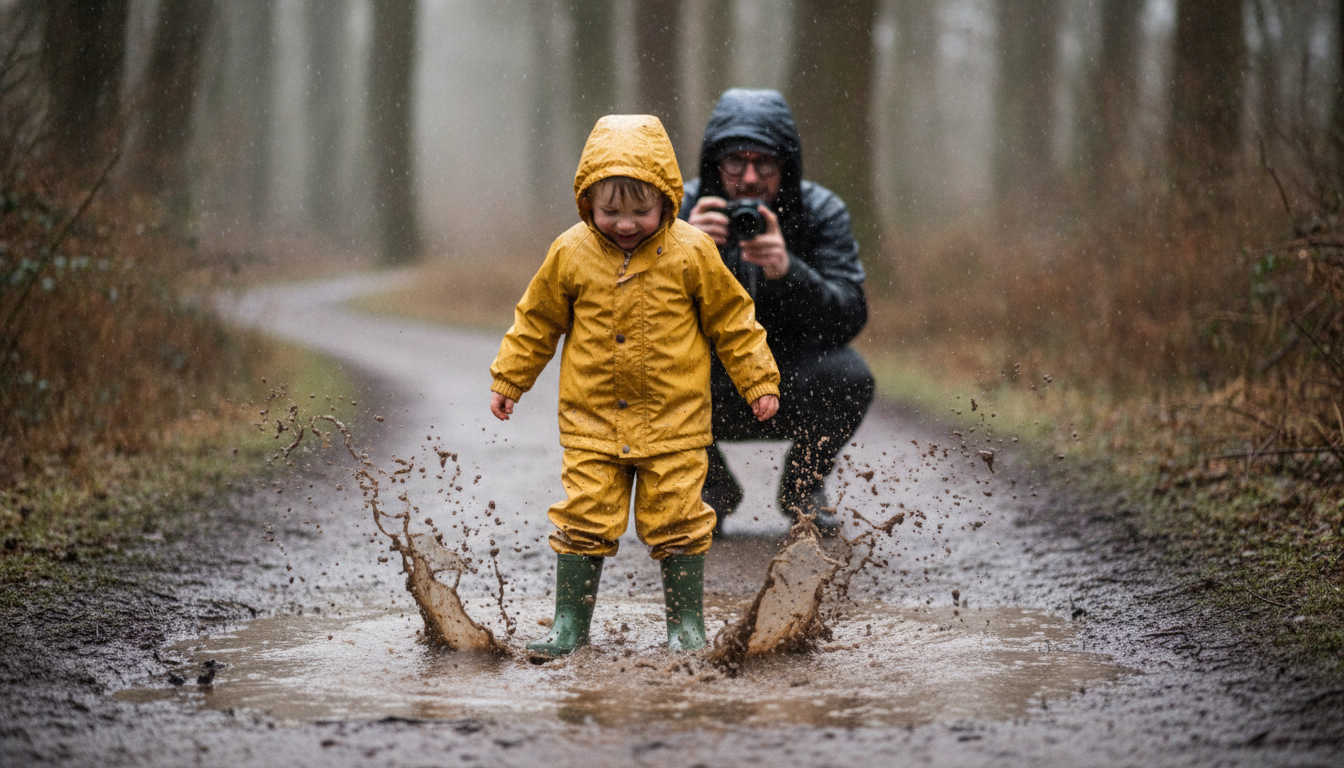
4. Puddle stamping and a splash tray. A shallow tray at floor height, jugs, and any puddle you can find. Develops physical development. Wellies, a full waterproof suit and a spare set are the whole risk control.
5. Posting natural objects. Leaves and grass posted into a length of guttering or through holes cut in an upturned crate. Develops physical development and feeds the posting schema that dominates this age. Keep objects leaf-sized, not berry-sized.
Two-year-olds
Ratio 1:5. Schema play drives everything at this age, so lean into transporting, trajectory and enveloping rather than fighting them.
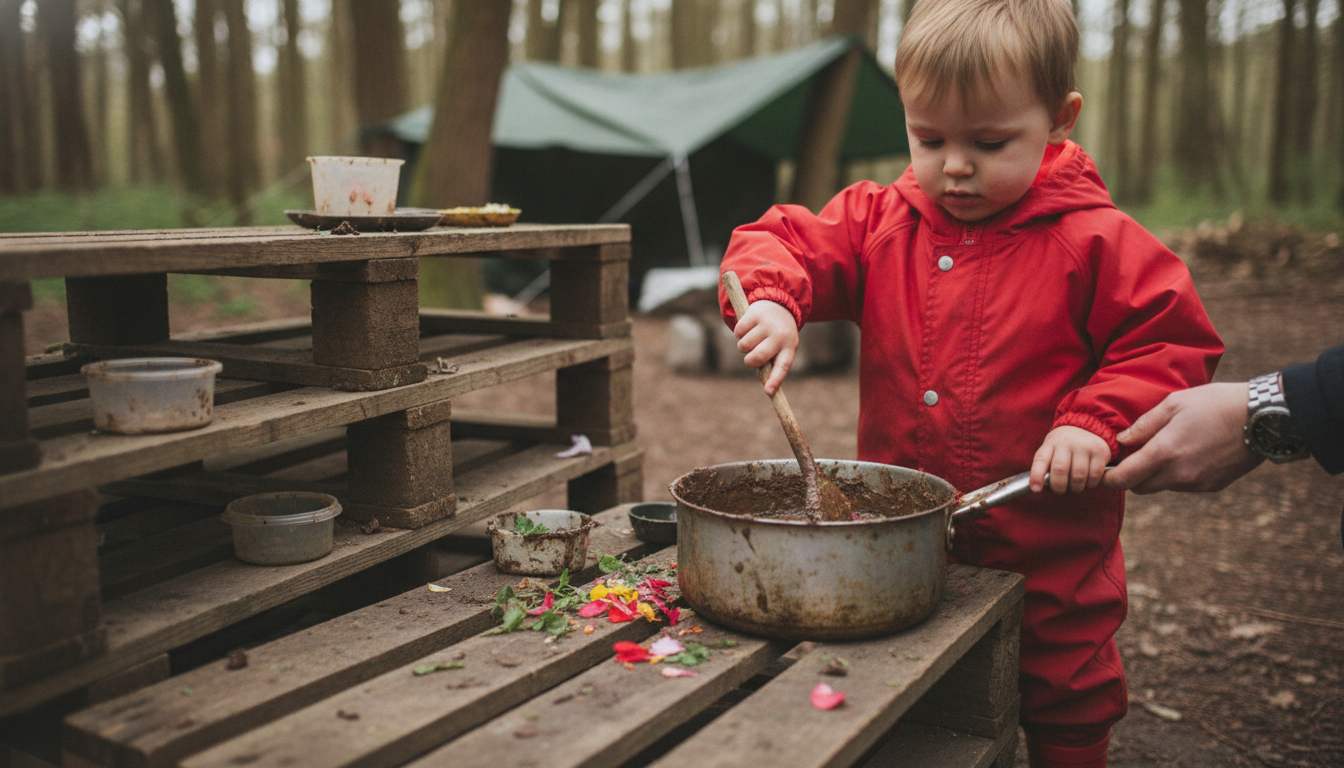
6. Mud kitchen potions. Mud, water, petals, leaves, old pans, a pestle and mortar. Develops expressive arts and design. Add a sieve and a funnel and the same set-up absorbs a whole session. Pack a water carrier for hand washing afterwards.
7. Water down the guttering. Guttering and tubes propped on a slope, with jugs and buckets at the top. Develops understanding the world through cause and effect. Where there is no slope, two crates of different heights work.
8. Colour matching hunt. Paint sample strips from any DIY shop, which are free, held against leaves, bark and stones. Develops understanding the world. For younger twos, cut the strips to two colours.
9. Transporting station. Buckets, a trolley, a small wheelbarrow and log rounds to move from one place to another. Develops physical development. There is no end point, and that is the point. Keep the rounds light enough to drop on a foot without harm.
10. Leaf piles and leaf showers. Rake a pile, jump in it, throw it in the air. Develops physical development. Check every pile for litter, glass and dog mess, and rake it fresh each week.
11. Bark rubbings with chunky crayons. Sugar paper held against a trunk, chunky crayons rubbed flat on their side. Develops literacy through early mark making. Tape the paper on so they only have one job.
Three and four-year-olds
Ratio 1:8, or 1:13 where a qualified teacher, Early Years Teacher or other suitably qualified level 6 practitioner works directly with the children. This is the band most people mean by early years forest school.
12. Mini den building. A small tarpaulin, tent pegs, a mallet and a few metres of rope, two children per den rather than six. Develops personal, social and emotional development. Tie the ropes yourself and hand over the pegging.
13. Minibeast hunt. Bug pots with magnifying lids, a spotter card and a rule everyone repeats: everything goes back where it was found. Develops understanding the world. Lift logs from the far edge, so they come up between child and minibeast.
14. Journey sticks. A stick, wool wound round it, and whatever gets collected on the walk tucked under the wool. Develops communication and language when it is retold at the closing circle.
15. Stick counting and number stones. Stones painted with numerals, sticks to count against them, and a challenge to find exactly five of something. Develops mathematics. Sorting cones by size before counting makes the maths visible.
16. Transient art mandalas. Petals, leaves, cones and stones arranged in a circle on a log round. No glue. Develops expressive arts and design. Photograph it, then dismantle it together, which is the part that teaches most.
17. Nature paintbrushes and mud paint. Twigs, feathers and grass bundles tied to sticks with string, used with thin mud on paper or bark. Develops expressive arts and design. Making the brushes is the longer half of it.
18. Story circle with story stones. Five or six stones with simple images, pulled from a bag one at a time to build a story at base camp. Develops literacy. Use images from the site, so the story stays about the place they are sitting in.
Reception, four to five
The statutory ratio is the same as for three-year-olds, and Reception classes in maintained schools sit under infant class size rules rather than these ratios at all. What changes in this band is that tools and fire enter, and practice runs far tighter than the statutory floor. Both need a qualified leader and a written risk-benefit assessment before they happen at all.
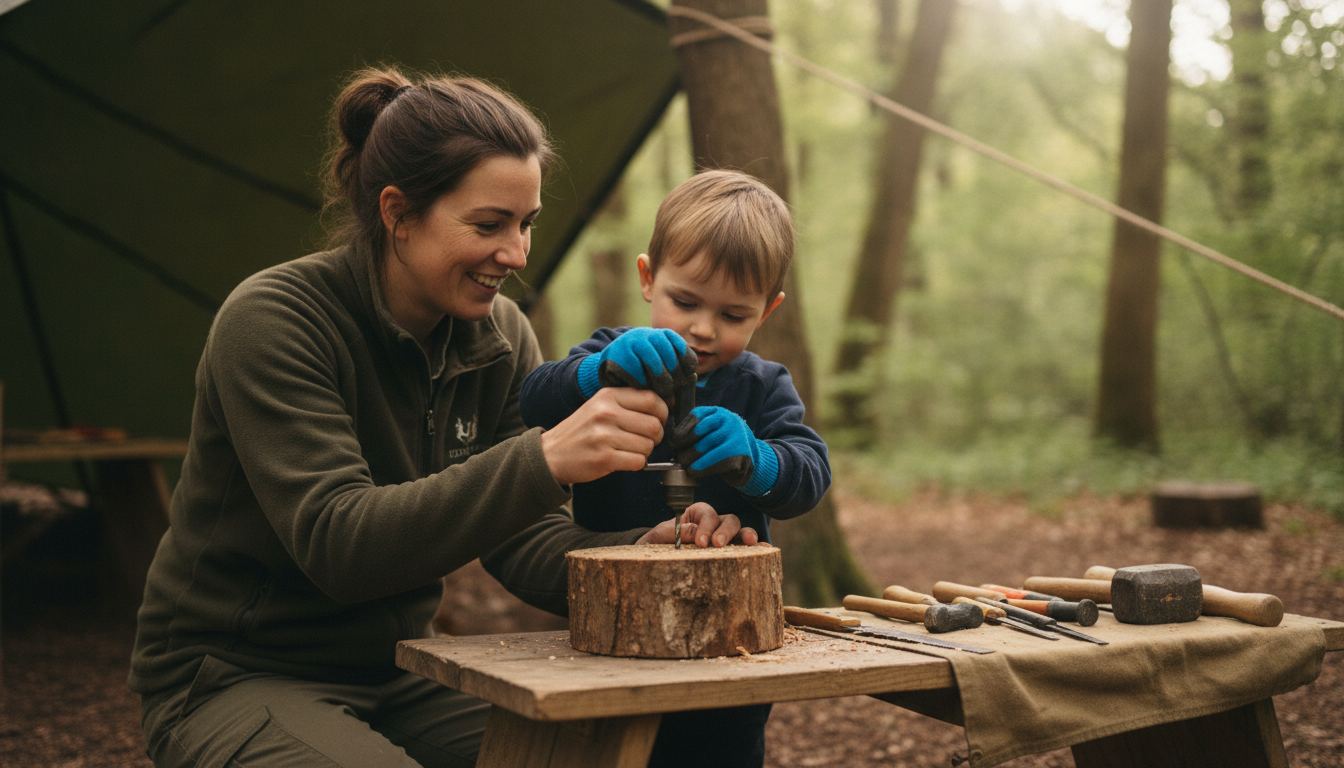
19. Tool table. Palm drills and vegetable peelers for whittling, at a defined table, children seated with a gloved non-tool hand. Develops physical development. Run 1:1 for first sessions and never more than 1:2 after that.
20. Fire circle and a hot drink. The leader lights and manages the fire; children learn the circle rules, the safe walk-past behind the seated ring, and that nobody steps over a fire. Develops personal, social and emotional development. A Kelly kettle and hot chocolate on a cold day is the ritual children remember longest.
21. Knot tying and a rope challenge. Sisal rope, a thumb knot, then a challenge like joining two ropes or lashing two sticks. Develops physical development. Keep loose rope off the ground and never near necks.
22. Bug hotel build. A pallet frame stuffed with canes, cones, straw, bark and broken pots, sited somewhere shady. Develops understanding the world. Build it in autumn and check it termly, so it becomes a fixture rather than a one-off craft.
23. Sit spot. One minute of quiet, each child in their own spot within the boundary, then one thing each of them heard. Develops communication and language. Start at 30 seconds; a minute is long when you are four.
24. Seed bombs and planting. Compost, clay powder and native wildflower seed rolled into balls, dried, then thrown into a scruffy corner of the site. Develops understanding the world. Come back to the patch in summer, which is where the learning lands.
A forest school session plan you can reuse every week
Practitioners usually search for activities because a session has gone flat, and the fix is a shape rather than a twenty-fifth idea. Use the same six stages every week and change only the invitation in the middle.
| Stage | Minutes | What happens |
|---|---|---|
| Kit check and walk down | 10 | Waterproofs on, headcount, same route every week |
| Opening circle | 10 | Same greeting, boundaries walked or pointed out, rules recapped in three phrases |
| Free play at base | 25 | Child-led. Adults observe and record rather than direct |
| Focused invitation | 20 | The week's activity from the list above, offered rather than imposed |
| Snack and story | 15 | Hand washing, snack, one story linked to what happened that session |
| Closing circle and walk back | 10 | One thing each child noticed, tidy, headcount, kit off |
For under-2s, cut the whole thing to 45 or 60 minutes and keep the same six stages. The repetition is what makes the middle work: children who know exactly what comes next stop asking and start playing, and that is when free play becomes genuinely child-led rather than a supervised queue. The planning, observation, adaptation and review cycle sits on top of this shape, and our guide to building a forest school curriculum covers it in detail.
What you actually need to buy
Prices below were checked at Muddy Faces on 2 August 2026 and include VAT. Kit prices move, so re-check before you order. Half the list is free anyway: sticks, leaves, mud, stones, water, cones and paint sample strips cost nothing, and a charity shop supplies the mud kitchen. What you are buying is shelter, safety and the things you cannot improvise.
| Start here, under £150 | Price inc VAT |
|---|---|
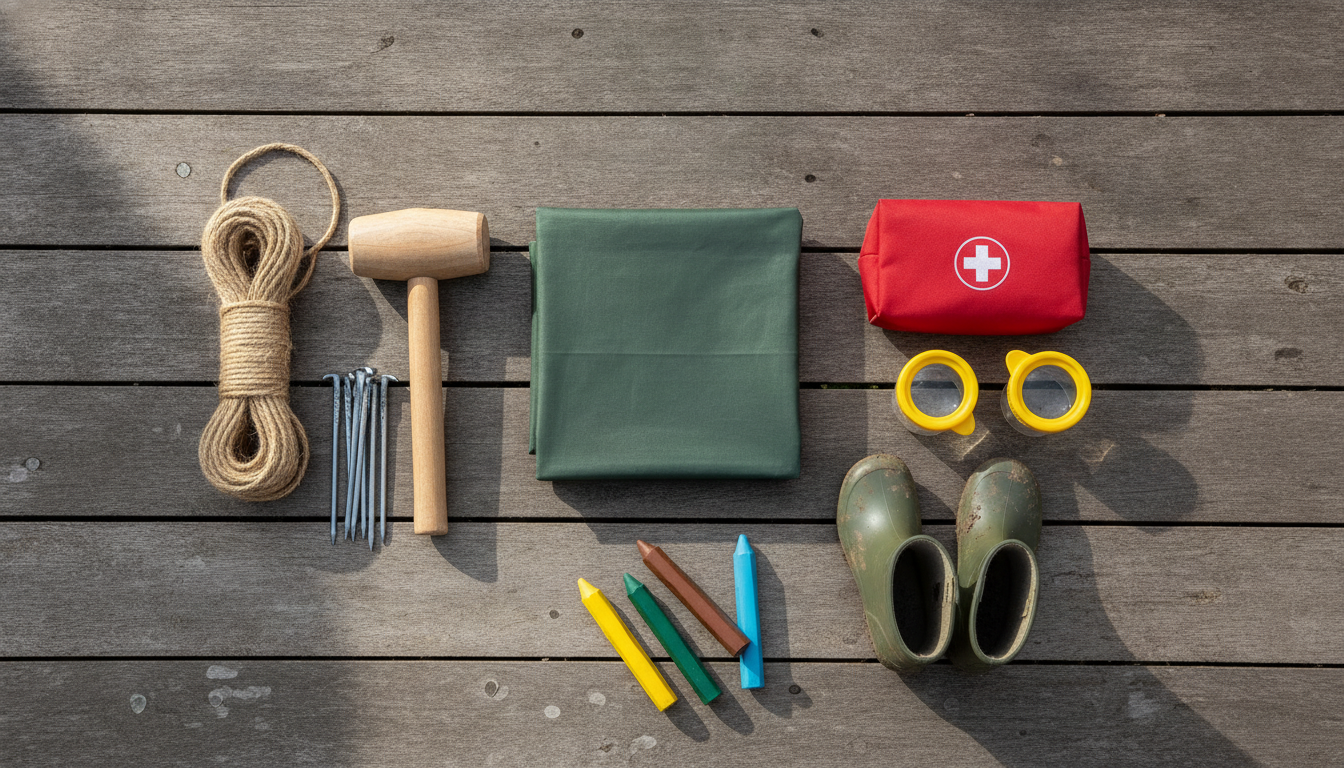
| Green mono tarpaulin, 4m x 5m | £27.59 |
| Hooked steel tent pegs, pack of 10 | £2.99 |
| Mallet with wooden handle, 300g | £4.79 |
| Sisal rope, 10m coil | from £5.27 |
| First aid kit in a waterproof pouch | £27.59 |
| Bug pot and magnifier kit | £12.50 |
| Two spare pairs of children's waterproof over-trousers | £21.48 |
| Water carrier, soap and towel for hand washing | around £20 |
| Mud kitchen pans, jugs and sieves from a charity shop | around £10 |
| Total | around £132 |
A full setup costs more, and most of it is training rather than equipment. A packaged Forest School Essentials Kit (companion knife, folding saw, bypass shears, 5mm palm drill, rigger gloves, lockable toolbox) is £107.99 including VAT, and a Forest School Activity Kit with rope, pulleys, carabiners, tarpaulins, camo netting and children's garden tools is £430.80. Add the starter list above and you are at roughly £670 in kit. Our guide to forest school resources breaks the full list down by what each stage of a programme actually needs.
Then the qualification. A Level 3 Forest School Leader course runs from about £897 to £1,320 across UK providers, with monthly plans from around £75. Check what the fee covers before you compare two of them, because some bundle the outdoor first aid certificate you need for insurance and others leave you to book it separately at £100 to £200. Our guide to forest school training compares the routes, levels and providers. Kit and training together land between £1,550 and £2,000 for a setting starting from nothing.
Ratios, risk and what to write down
Statutory staff-to-child ratios in England are set by the EYFS statutory framework and apply outdoors exactly as they do indoors.
| Age | Minimum ratio |
|---|---|
| Under 2 | 1:3 |
| Two-year-olds | 1:5 |
| Age 3 and over | 1:8, or 1:13 where a qualified teacher, Early Years Teacher or other suitably qualified level 6 practitioner works directly with the children |
New versions of the framework apply from 1 September 2026, but the changes are safeguarding and welfare ones: safer sleep, screen use guidance, banned dog breeds on the premises, allegations of harm rather than serious harm reported to Ofsted, enhanced criminal records checks for volunteers, and disclosure requirements around staff suitability. Nothing in the Department for Education's published summary of changes touches staff-to-child ratios, so the table above stands.
One piece of standing guidance matters more for forest school than any of that. Ofsted's early years blog is explicit that ratios apply to the whole provision rather than each room, and that it is up to you how you deploy your staff, provided you can explain your rationale. That is what lets you pull extra adults onto a session while keeping the setting compliant.
Ratios differ outside England: Scotland is regulated by the Care Inspectorate, Wales by the National Minimum Standards for Regulated Childcare, and Northern Ireland by its own minimum standards. Treat the figures as a floor either way. Forest school runs tighter than the law demands wherever tools, fire or water are involved, often 1:1 at the tool table.
For risk, use risk-benefit assessment rather than plain risk assessment. The Play Safety Forum's Managing Risk in Play Provision implementation guide, supported by the Health and Safety Executive, sets out the principle: weigh the risks of an activity against the benefits of challenging play, then apply precautions that are practicable and proportionate rather than trying to remove risk altogether. The forum publishes a blank form alongside a worked tree-swing example.
A worked fire circle assessment runs to five lines. Hazard: burns from flame, embers or hot water. Benefit: children learn to manage a genuine danger, and the circle builds the strongest group ritual in the programme. At risk: children aged 4 to 5, adults, visitors. Controls: qualified leader lights and manages, seated ring at one and a half metres, no stepping over, walk-past route behind the seats, water and a burns kit within reach, one adult whose only job is the fire. Judgement: proportionate, run weekly in winter. Keep it with the register and review it after each session.
If you are setting up from scratch, our guide on how to start a forest school covers site permissions, insurance and registration.
Weather, clothing and calling a session off
Cold and wet children are why sessions get cancelled and parents complain, and both are kit problems before they are weather problems. Send a written list before session one and repeat it before every block:
- A full waterproof suit, or a separate waterproof jacket and trousers
- Wellies, with a spare pair of socks in the bag
- Long sleeves and long trousers year-round, including summer, because of ticks, nettles and brambles
- Hat and gloves from October to March; sun hat and sun cream from May
- Everything named
Your spare-kit bag closes the gap when a child arrives in trainers: spare waterproofs in two sizes, spare socks, spare gloves, a towel and nappy sacks for wet kit going home. Keep it packed and check it weekly.
Cancelling is a different question from being uncomfortable. Rain, mud and 4°C are managed with clothing. The conditions that genuinely stop a session are high winds, where the standard call is to move away from trees or relocate; thunder and lightning; ice on the walk route; and extreme heat with no shade on site. Write those four into a weather policy with a named decision-maker and a cut-off time for messaging parents, so the call is not a judgement made alone at 7am and one leader does not cancel for conditions another would run in. If you charge for sessions, make sure your cancellation and refund policy says what happens to a weather-cancelled week.
Running forest school as a paid programme
Plenty of settings sell forest school rather than absorbing the cost: nurseries offering a paid add-on, independent leaders running weekend woodland clubs, holiday programmes in the school breaks. The operational side is where most of them lose money and time, and a written forest school business plan is the cheapest way to find out whether the numbers work before you commit.
Sell blocks, not drop-ins. The FSA's first principle is a long-term process, and a 12-week block matches both the pedagogy and the cash flow. It is also the only way the observation and adaptation cycle works, because it depends on the same children coming back.
Take consent once, before session one. Photo consent, medical and allergy information, emergency contacts and explicit permission for tool and fire activities, all collected at booking rather than chased at the gate. Our photo consent form templates cover the wording.
Take the register outdoors. Headcount at the gate, at the boundary, after free play and before the walk back. A register you can open on a phone beats a clipboard in the rain, and it puts the emergency contact for the child in front of you one tap away rather than back in the office.
Use kit reminders as a retention tool. An automated message two days before each session, listing what to wear, cuts the number of children who turn up in trainers to almost none. Parents who feel prepared rebook; parents whose child came home soaked do not.
Collect payment before the block starts. If you are Ofsted-registered and eligible, say so on the booking page, because Tax-Free Childcare makes a 12-week block noticeably cheaper for parents and is a real reason people pick one provider over another.
We built our forest school booking software around exactly this: block bookings with a waiting list, consent and medical questions captured at sign-up, registers that work on a phone at the edge of a field, and automated kit reminders before every session. If you would rather see it than read about it, book a live demo.
Rotating activities across the year
Returning to one site across four terms is the point rather than a scheduling problem. The same three trees give a different session in November than in May, and children who have watched that happen understand seasons in a way no display board delivers.
| Season | Activities to run |
|---|---|
| Autumn | Leaf piles and leaf showers, bark rubbings, conker and cone counting, journey sticks, build the bug hotel |
| Winter | Fire circle and hot drinks, frost and ice investigation, torch-lit story circle, bird feeders |
| Spring | Seed bombs and planting, minibeast hunt, mud kitchen potions, bud and tadpole watching |
| Summer | Water down the guttering, transient art mandalas, shade dens, sit spot, colour matching hunt |
If you also run sessions for older children, our list of forest school ideas for ages 5 to 11 picks up where this one stops.
Key takeaways
- Band activities by age. Birth to 2, twos, threes and fours, and Reception need different activities, supervision and statutory ratios.
- Use the same six-stage session shape every week and change only the focused invitation. Predictability is what makes free play child-led.
- You do not need a woodland. A visible boundary, a base spot and permission to make mess run 20 of the 24 activities above.
- A first term of kit costs around £132 including VAT. A full setup with tools and a Level 3 qualification runs £1,550 to £2,000.
- Statutory ratios are 1:3, 1:5 and 1:8, or 1:13 with a level 6 practitioner. Run tighter at the tool table and fire circle.
- Use risk-benefit assessment rather than plain risk assessment, and write it down.
- Sell sessions in blocks rather than drop-ins. It matches the pedagogy and fixes the cash flow.
FAQs
At what age can children start forest school?
From babies. What changes with age is supervision, not eligibility. Under-2s work at floor level with treasure baskets, texture trails and puddles, always within arm's reach at a 1:3 ratio. The Bradford study ran full 11-week programmes with three-year-olds who had almost no previous experience of natural space.
Do I need a woodland to run forest school activities?
No. You need a boundary the children can see and name, a base spot they return to weekly, and permission from the site owner to make a mess. A grass strip with three trees or a nursery yard runs most of the activities here. The Bradford study ran five of its 11 sessions outside any woodland.
How long should an early years forest school session be?
Around 90 minutes for three-year-olds and up, 45 to 60 minutes for under-2s. Keep the same six-stage shape at both lengths: walk down, opening circle, free play, focused invitation, snack and story, closing circle. Shorten the free play rather than dropping the circles, because the circles are what make the session feel the same every week.
Do I need a Level 3 qualification to run forest school in my nursery?
To call it forest school and meet the Forest School Association principles, yes. Courses run about £897 to £1,320 across UK providers, with monthly plans from around £75, and some bundle the outdoor first aid certificate while others leave you to book it at £100 to £200. You can run excellent nature-based outdoor learning without it, just do not label it forest school.
What should children wear to forest school?
A full waterproof suit or separate jacket and trousers, wellies, and long sleeves and trousers year-round because of ticks, nettles and brambles. Add a hat and gloves in winter, a sun hat and sun cream in summer, and spare socks every week. Name everything, and keep a spare-kit bag for children who arrive in trainers.
What staff-to-child ratio do I need for forest school?
The statutory EYFS minimums apply outdoors as indoors: 1:3 for under-2s, 1:5 for two-year-olds, and 1:8 for age 3 and over, or 1:13 with a suitably qualified level 6 practitioner working directly with the children. Treat those as a floor. Tool work and fire circles run 1:1 or 1:2.
How do I write a risk assessment for forest school?
Use a risk-benefit assessment. For each activity, record the hazard, the benefit to the children, who is at risk, the proportionate controls and your judgement on whether to run it. The Play Safety Forum publishes a blank form and a worked tree-swing example, and its approach is supported by the Health and Safety Executive.
Can two-year-olds use tools at forest school?
No. Tools and fire belong in the Reception band and above, under a qualified leader with a written risk-benefit assessment. Two-year-olds get the same physical development from transporting log rounds, mud kitchen work and pouring water down guttering, without a supervision load you cannot staff.
When should I cancel a forest school session for weather?
Cancel for high winds, thunder and lightning, ice on the walk route, or extreme heat with no shade on site. Rain, mud and cold are managed with clothing. Write those four into a weather policy with a named decision-maker and a cut-off time for messaging parents, so the call is consistent across leaders.
What is the difference between forest school and outdoor play?
Forest school is a long-term process of regular sessions in the same natural space, led by a qualified practitioner, with a cycle of planning, observation, adaptation and review between them. One afternoon in the woods is a trip; twelve weekly sessions in the same spot, adapting each week, is forest school.