


Search "forest school resources" and you land in a shopping basket or behind an email form. What you rarely get is an answer to the two questions every leader actually has: what do I need, and what will it cost?
Here is the short version. Forest school resources fall into five groups: kit and tools, planning and activity material, paperwork and policies, training and qualifications, and funding. A working kit costs between £215 and £1,500, and qualifying and insuring one leader adds roughly £1,250 to £1,500 on top of that in the first year.
Every price below comes from a named UK supplier and was correct at the time of writing. Where a free resource needs an email address or a login, we say so.
The five kinds of forest school resource
Most people arrive at this search looking for things to buy. That is one fifth of the answer.
| Resource type | What it covers | Typical cost |
|---|---|---|
| Kit and tools | Saws, knives, tarps, ropes, fire lighting, first aid | £215 to £1,500 |
| Planning and activity material | Session plans, prompt cards, scavenger hunts, seasonal packs | Free to around £60 a year |
| Paperwork and policies | Risk-benefit assessments, site survey, consent forms, tool and fire policies | Free, but costs you time |
| Training and qualification | Level 3 leader award, outdoor first aid, CPD | £1,050 to £1,300 |
| Funding | Grants, free tree packs, equipment awards | Free to apply |
The first row is the one people budget for. Rows three and four are the ones that stop first sessions from happening, because an insurer, an Ofsted inspector or a Level 3 assessor will ask for the paperwork long before anyone asks to see your bow saws.
Forest school kit: what you actually need
Kit falls into five groups. Buy in this order, because the first three make sessions possible and the last two make them better.
Cutting tools
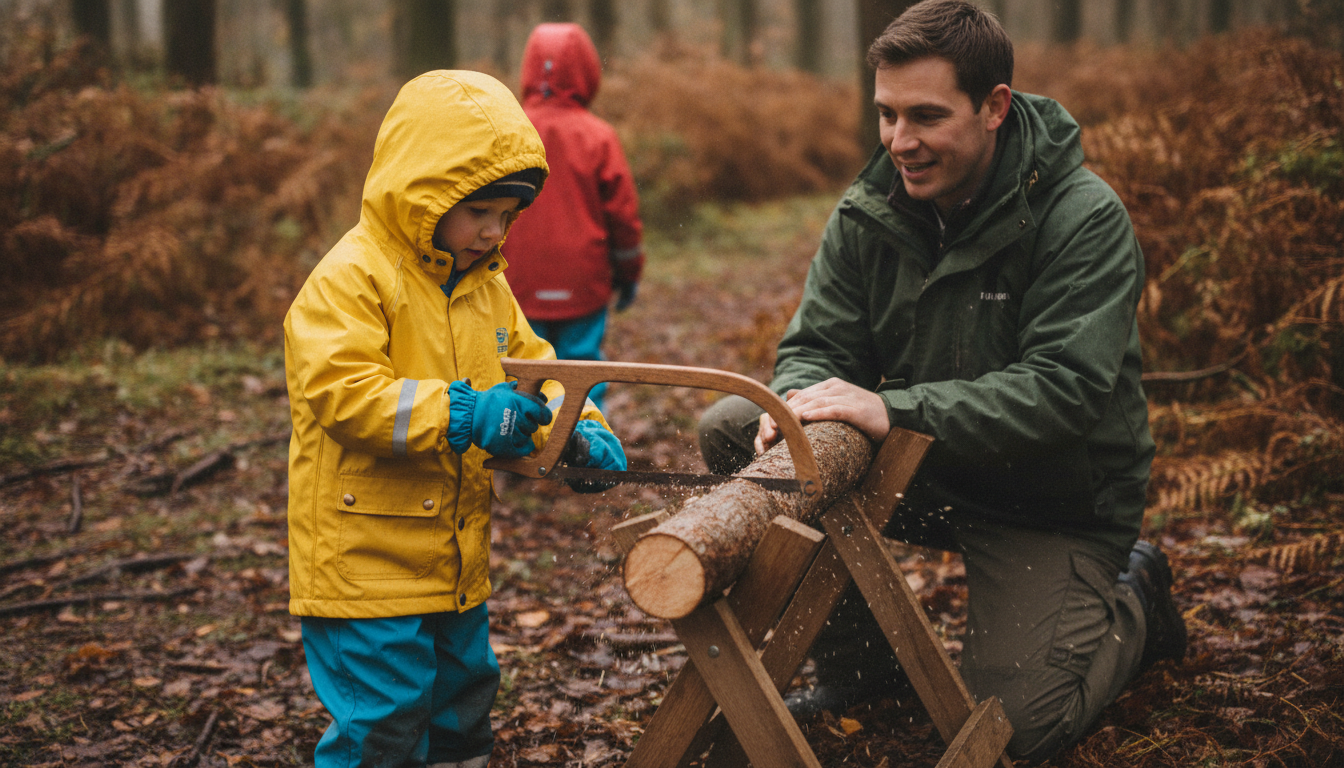
Bow saws are the backbone of the tool bag. Muddy Faces list a 30cm Draper Expert at £10.79 including VAT, a 53cm pointed model at £19.79 and a 53cm Bahco at £30.59, so two saws is a £20 to £60 decision. Start with two and split the blades by job, one for green wood and one for dry, which is how the practitioner lists on the Muddy Faces kit list hub and the Outdoor Learning Resources group kit are both set up.
Round it out with bypass loppers, geared secateurs, a palm drill and one or two safety sheath knives. Both Outdoor Learning Resources bundles use Hultafors craftsman's knives, because the sheath holds the blade securely between uses.
One point that saves money: you are not buying one tool per child. Tools come out for supervised small-group work in a marked safe working area while the rest of the group does something else. The Outdoor Learning Resources group kit, built for a full class, carries five saws in total.
Shelter, rope and ground cover
A 3x3m shelter sheet, a ground sheet of around 360x240cm, paracord, a couple of lengths of 7mm or 9mm general purpose rope and a ball of sisal twine. DD Hammocks tarps are what both Outdoor Learning Resources bundles ship with.
This group buys you all-weather sessions, which is what makes a 24-week programme viable. A tarp and a length of rope are the difference between a session going ahead in November and a session being cancelled.
Fire and cooking
Fire steels (Light My Fire Scout strikers are the common choice), a kelly kettle, heat-resistant gloves and a water container with a tap. Opinel peelers and a few gimlets cover simple whittling and craft work. Fire is also the part of your kit that needs a written policy and a competent adult before it comes out of the bag.
Safety and welfare
The emergency bag is not optional: a medium first aid kit, medical details and emergency contacts for every child, drinking water, and a copy of your emergency procedure.
Alongside it, build what practitioner kit lists call a nurture kit: spare hats, gloves, socks and fleeces, hand wipes and waste bags. This is what first-year leaders under-buy, and it is what keeps a cold child in the session instead of walking back to the building.
Loose parts and consumables
Sticks, stones, cones, log rounds, clay, hessian, cotton string. Close to free, and pound for pound the highest play value in the whole list.
What a forest school kit actually costs
Almost nobody publishes a costed kit list, which makes budgeting guesswork. Here are three real UK price points.
| Tier | Who it suits | Cost | What you get |
|---|---|---|---|
| Solo starter | One leader, small group, borrowed or shared site | £214.75 | Fiskars bypass loppers, geared secateurs, Hultafors sheath knife, 21in bow saw, rope-handled tool bag, 180x240cm ground sheet, DD small shelter sheet, 13 litre dry sack, LMF Scout fire striker, medium first aid kit, 5mm and 9mm rope |
| Group kit | A full class rotating through activities | £419.75 | 3 mini saws and spare blades, 12in and 15in bow saws, 3 sheath knives, 2 geared mini loppers, 2 palm drills, 10 litre water container with tap, DD 3x3m tarp, 360x240cm ground sheet, paracord, sisal twine, cotton string, 4 Opinel peelers, 3 fire steels, gimlets, tool box and bag |
| Fully resourced setting | Permanent site, multiple groups, year-round delivery | Around £1,500 | A whole-site set-up rather than a tool bag. Mark Stutt of FORESTed costs it at "everything you need to start a well resourced project for around £1500" on his itemised kit list published through Muddy Faces |
The two lower figures are the Forest School Starter Kit and Forest School Group Kit from Outdoor Learning Resources, both inclusive of VAT.
Four caveats worth building into your budget:
- These are kit only. They exclude training, insurance, site work, storage and consumables.
- Add roughly £100 to £150 a year for consumables: rope, twine, replacement blades, first aid restocks.
- Blades and rope are wear items, not one-off purchases. Budget them annually.
- A bundle saves you sourcing time. Buying item by item saves money if you already own half the list, which most schools do.
The free resources worth downloading
There are genuinely excellent free forest school resources in the UK, and a lot of "free" ones that want an email address or a membership first. Both are fine. You just need to know which is which before you plan a session around one.
| Resource | Provider | What is in it | Genuinely free? |
|---|---|---|---|
| Learning resources for forest visits | Forestry England | Over 20 curriculum-linked downloads mapped to EYFS, KS1, KS2, KS3 and KS4. Includes the Forest Code and the Forest Code for Minibeast Hunting, nature and wellbeing activity packs, Stick Man and Superworm education packs, landscape change lesson plans and a tree growth activity sheet | Yes, no sign-up |
| Free tree packs | Woodland Trust | Eight species mixes in packs of 15, 30, 105 or 420 saplings, for hedging, wildlife habitat, wild harvest or a small copse | Yes, application required |
| Forest School Lou resource packs | Shared via Muddy Faces | Seasonal and nature-connection packs, a forest school planning sheet, seasonal song sheets with videos, and a guide for forest school helpers | Yes, hosted on Buy Me a Coffee, no payment required |
| Free education resources | Woodland Classroom | Nature, autumn and winter scavenger hunts, a three-lesson-plan bundle, family campfire cooking book | Email sign-up required |
| Forest school printables | Little Owls Resources | Mud kitchen recipe and ingredient cards, weather calendars, woodland tree, bird and minibeast fact cards, life cycle visuals, minibeast hunt packs | Free tier needs registration, most items sit behind paid membership |
| Principles, criteria and provider directory | Forest School Association | The six core principles and full criteria for good practice, session and programme planning guidance, and the Recognised Provider directory | Yes, guidance is open |
If you only visit one, make it Forestry England's resource library: free without registration, and every download mapped to a key stage, which is what you need when a head teacher asks how a woodland session links to the curriculum. Go to Little Owls for EYFS prompt cards, and to Forest School Lou's packs for planning paperwork. If you work with the youngest age group, our forest school activities for early years covers what to do with the EYFS material once it is printed.
One practical warning: printed cards last about one damp session, and laminating a full set costs more than most people budget. Print only the cards you will use repeatedly and keep the rest on a phone. For the activities themselves, our forest school outdoor learning ideas covers the session-by-session side these downloads support.

The paperwork you need before your first session
This is the part no resource list covers and every insurer, Level 3 assessor and Ofsted inspector asks about. Work through it before you buy anything.
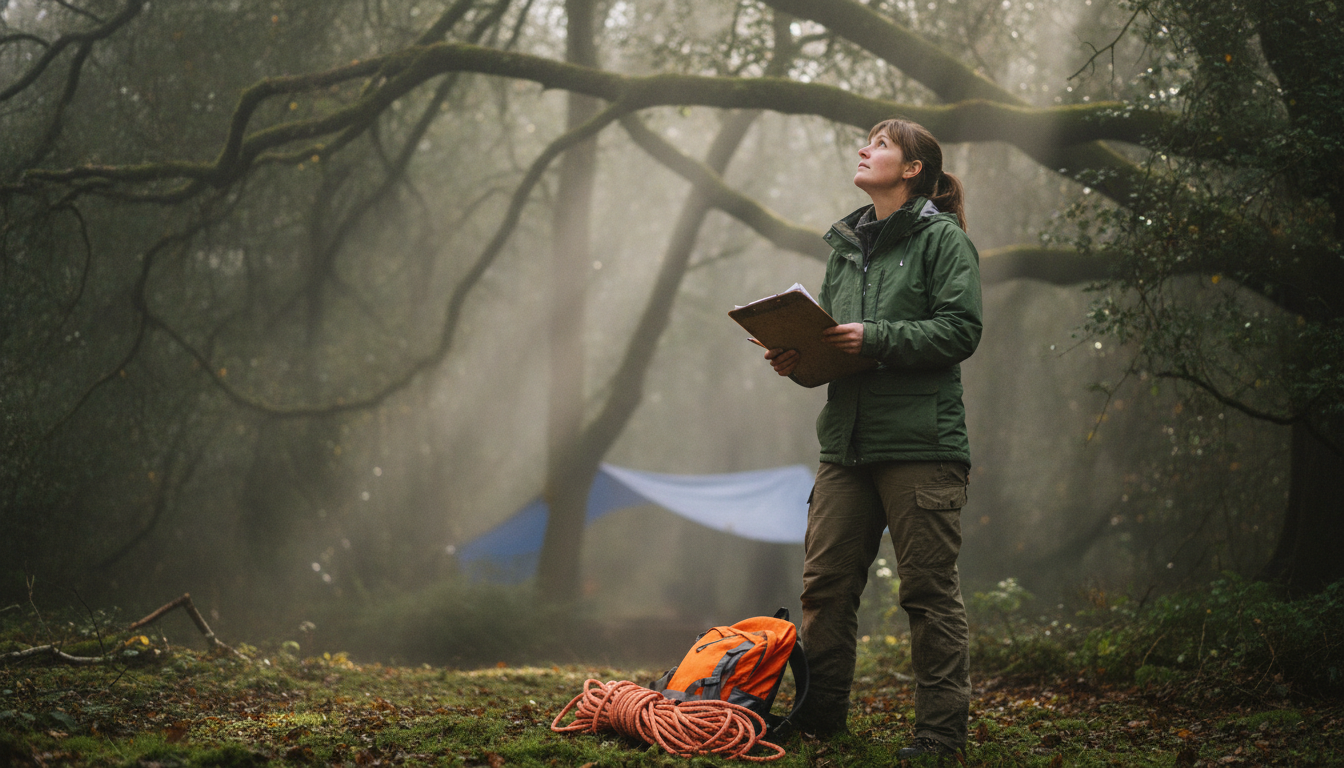
- Site survey and seasonal site risk assessment. Fallen limbs, water levels, nettles, ticks and ground conditions all change with the season, so this is a document you revisit rather than file once.
- Risk-benefit assessment for each activity, especially tool use, fire, tree climbing and water. The Forest School Association's Risk principle treats supported risk-taking as the point of the approach, so write these to manage risk, not to remove it.
- Tool use policy and fire policy. Who supervises, at what ratio, what the safe working area looks like, how tools are counted in and out, and who is competent to light a fire.
- Emergency procedures and an emergency bag contents list, including the site grid reference or what3words location and the nearest vehicle access point. An ambulance crew will ask for both.
- Parent and carer consent, covering medical information and photography. Our photo consent form templates and field trip permission slip both work as starting points for a woodland setting.
- A kit letter for parents. The most useful document nobody publishes. Set expectations on waterproofs, wellies, spare socks and layers and you will halve the number of children who cannot take part because they turned up in trainers.
- Attendance registers and medical or allergy records you can read on site, which usually means on a phone rather than on paper in the rain.
- Adult-to-child ratios. The FSA publishes no fixed number. Its criteria for good practice state that appropriate ratios are decided through a risk assessment approach, taking account of participants' needs and abilities, the site and the activities, and then adding one further adult on top, the FSA's "plus one".
Those same criteria drive the paperwork burden: sessions run for a minimum of two hours, a programme runs for 24 consecutive weeks in one year across at least two seasons, and sessions are led by someone holding at least an accredited Level 3 Forest School qualification. If you run sessions outside school hours, check whether you need to register with Ofsted before your first term, because the answer changes with the age of the children and the hours you run.
Training, qualification and insurance: the real annual bill
Training providers quote their own fee in isolation. Nobody totals the year, which is why the first-year cost catches people out. Here is the sum for one leader.
| Item | Cost | Notes |
|---|---|---|
| Level 3 Forest School Leader qualification | £900 to £1,100 | The Therapy Adventure lists £897 (£747.50 plus VAT), or 12 monthly instalments of £75. Kent Country Parks charges £995 for an eight-day course at Shorne Woods. Little Acorns is £1,100 and includes the outdoor and paediatric first aid qualification |
| Outdoor or forest school first aid (16 hours over 2 days) | £150 to £195 | ATNE lists £150, Inspired Forest School Training £185 and Kent Country Parks £195. Certificate valid for 3 years. Check it meets the paediatric requirement if you work with EYFS |
| Forest School Association membership | £40 a year | Individual membership, one year, non-recurring |
| Practitioner insurance, FSA member rate | £159 | The rate the FSA has negotiated with Birnbeck Insurance Services for individual practitioners. Organisation cover is quoted separately |
| First-year total, one leader | £1,250 to £1,500 | Kit is on top of this |
Three things to check before you compare training prices. Some fees include extras: Little Acorns' £1,100 covers the outdoor and paediatric first aid qualification other providers leave you to book separately, so the higher headline price is sometimes the cheaper deal. Check the face-to-face split, because the FSA will not accept a Level 3 delivered purely online for its Recognised Provider scheme, and requires at least 60% of guided learning hours to be delivered in person, rising to 80% for the revised FSA-endorsed RQF qualification. And look for a monthly plan: spreading £900 across twelve months means the qualification is funded by your first year of trading rather than out of savings. Our guide to forest school training compares the routes, providers and course formats in more depth.
If you are hiring a leader rather than training yourself, the Recognised Provider scheme applies to schools and organisations, not to individuals, and the FSA is explicit that it does not quality assure a provider's practice. A listing means the organisation has shown it delivers against the six principles. It does not tell you the person taking your sessions is qualified, so ask to see the Level 3 certificate and check the awarding body named on it.
Insurance is the item people leave until last, and it should be one of the first. Sort it before your opening session, and how to start a forest school walks through the order to do all of this in.
How to fund your forest school resources
Four figures of kit and training is a real barrier, and there is money available for most of it. These are current UK routes.
- Local School Nature Grant, Learning through Landscapes. £500 to spend from a catalogue of over 100 outdoor learning items, plus outdoor learning training for staff, a school grounds climate survey and a Climate Curriculum Kit worth £150. Open to schools and early years settings in England, Scotland and Wales. Applications open in January and close in mid-March, with decisions before the end of March. Early years settings need at least five staff and a dedicated building, and previous recipients cannot reapply. See the Learning through Landscapes grant page.
- Happy By Nature, from Learning through Landscapes and WWF. Ten state primary schools in England, Scotland and Wales receive £12,000 each plus expert guidance to develop nature-rich grounds. It runs in application rounds rather than continuously, so check whether one is open. Worth going for if you are building a permanent site rather than buying a tool bag.
- Woodland Trust free tree packs. Free saplings for schools, councils and not-for-profit community groups in England, Scotland and Wales, in packs of 15, 30, 105 or 420, delivered each March and November. You need landowner permission and a six-figure grid reference to apply, so pin the planting spot on OS Maps first. Apply through the Woodland Trust schools and communities pages.
- Local community and wellbeing funds. Forest school sits neatly inside mental and physical wellbeing funding criteria, which is the angle to write the application around, and the benefits of forest school summarises the evidence worth citing. Start with your county council's community grants page and your local community foundation.
- Parent-funded term blocks. Not a grant, but the most reliable route for an independent provider. Selling a 12-week block up front spreads the kit cost across a cohort instead of a single outlay before you have earned anything.
Plan around the pattern: grants buy equipment and site work, and almost never pay for staff time or training. Fund the kit from grants and the qualification from trading income. Our forest school business plan guide shows where both sit in your first-year numbers.
Building a resource library on a shoestring
Everything above assumes you are buying. You do not have to, and some of the best forest school resources cost nothing.
Loose parts outperform bought equipment for open-ended play, and they are free. Sticks, cones, stones, shells, log rounds and offcuts. Ask a local tree surgeon or sawmill, because they usually pay to dispose of them and will often drop a load off for nothing. Most of the sessions in our outdoor learning activities guide run on exactly this kind of material.
Borrow before you buy. Some council and community schemes run equipment libraries: Cambridge's Community Cupboard hires out kelly kettles, whittling knives, bow saws and fire starter kits for £10 a week. Worth ten minutes finding out whether your area has an equivalent before you spend £400.
Two rules. Buy safety items new and never second-hand: first aid kits, blades and fire equipment. And plan a replacement cycle, because blades and rope go annually, tarps every few seasons, and tools last years if you clean and oil them.
A realistic shoestring start is two bow saws, one tarp, a length of rope, a fire steel and a first aid kit. That lands under £100 and runs a genuine session while you build the rest.
Keeping the admin off your session time
The resource a forest school leader runs shortest of is not kit. It is the hour before and after every session spent chasing consent forms, texting parents about a cancelled week, and working out who has paid for half term.
That is the part we build for. Across a 24-week programme, our forest school booking software handles term-block and weekly bookings, waiting lists that open automatically when a session fills at your ratio, and registers with medical and allergy notes you can pull up on a phone in the woods. Consent and photo permissions are captured at sign-up rather than chased on paper, and when weather forces a cancellation, one message goes to every parent on the register.
None of that makes the sessions better on its own. It gives you the planning hours back, which is where session quality comes from.
Budget the year, not the shopping basket
The kit is the cheapest part of forest school and the easiest to solve. It is the paperwork, the qualification and the insurance that decide whether a first session actually happens, and those land in a different order and on a different budget line to a tool bag.
Once the resources are in place, the next job is turning them into a programme that builds across the seasons. Our guide to designing a forest school curriculum picks up from there.
Key takeaways
- Forest school resources come in five parts: kit, planning material, paperwork, training and funding. Budget for all five, not just the first.
- A solo starter kit runs £214.75 and a group kit £419.75 from Outdoor Learning Resources, a fully resourced site around £1,500, plus £100 to £150 a year for consumables.
- Qualifying and insuring one leader costs £1,250 to £1,500 in year one: Level 3 at £900 to £1,100, first aid at £150 to £195, FSA membership at £40 and insurance at £159.
- Forestry England's downloads are free with no sign-up. Woodland Classroom and Little Owls want an email or a membership first.
- Grants fund equipment, rarely staff time. Learning through Landscapes offers £500 plus training, and Woodland Trust tree packs are free.
- Sort the paperwork first: site and risk-benefit assessments, tool and fire policies, emergency procedures, consent, and a kit letter for parents.
FAQs
What equipment do you need for forest school?
Five groups: cutting tools (two bow saws, loppers, secateurs, a sheath knife), shelter and rope (a 3x3m tarp, ground sheet, paracord), fire kit (a fire steel, gloves, a kelly kettle), an emergency bag with a first aid kit and medical records, and loose parts. Starter bundles covering the first four begin at around £215 including VAT.
How much does it cost to set up a forest school?
Budget £215 to £1,500 for kit depending on group size and site, plus £1,250 to £1,500 for one leader's first-year qualification, first aid, membership and insurance, and £100 to £150 a year for consumables. A shoestring version with two saws, a tarp, rope, a fire steel and a first aid kit comes in under £100.
Are there free forest school resources?
Yes. Forestry England publishes over 20 curriculum-linked downloads mapped from EYFS to KS4 with no sign-up, and the Woodland Trust gives free tree packs to schools and community groups. Forest School Lou's planning sheets and seasonal packs are free too. Woodland Classroom and Little Owls Resources are free only after an email sign-up or registration.
Do you need a qualification to run forest school?
To run sessions as Forest School under the FSA principles, yes: the Leadership principle requires a minimum of an accredited Level 3 Forest School qualification. You can run outdoor learning or woodland activities without it, but you should not call them Forest School, and most insurers and schools will ask to see the certificate.
How long does a forest school programme have to run?
The FSA criteria set a minimum of two hours per session and a programme of 24 consecutive weeks in one year covering at least two seasons. Recognised alternatives are 12 consecutive weeks in each of two years, or fortnightly sessions across a full academic year for classes of more than 15.
What paperwork do you need to run a forest school session?
A site survey and seasonal site risk assessment, risk-benefit assessments for tool use, fire, climbing and water, a tool policy and fire policy, written emergency procedures with a grid reference or what3words location, parent consent covering medical and photography, attendance and allergy records, and a kit letter telling parents what children should wear.
What is the adult-to-child ratio for forest school?
There is no fixed national ratio. The FSA states that appropriate ratios are decided through a risk assessment approach, taking account of participants' needs and abilities, the site and the activities, then adding one further adult on top. In practice, start from your setting's normal ratio and add staff for tool use, fire and any child with additional needs.
Where can schools get free trees for a forest school site?
The Woodland Trust runs free tree packs for schools, councils and not-for-profit community groups in England, Scotland and Wales, in packs of 15, 30, 105 or 420 saplings across eight species mixes, delivered each March and November. You need permission from the legal landowner and a six-figure OS grid reference before applying.
Do you need insurance to run a forest school?
Yes. Public liability cover is the minimum, and employers' liability is a legal requirement the moment you take on staff. The FSA has negotiated a member rate with Birnbeck Insurance Services at £159 for individual practitioners. Check the policy names tool use and fire explicitly, because generic activity cover often excludes both.
Can you run forest school without buying a kit?
Partly. Loose parts, den building, shelter work and nature connection activities need almost nothing beyond string and imagination. Tool work and fire need bought equipment, and you should never buy blades, fire kit or first aid supplies second-hand. Some council schemes hire kit out, at £10 a week in one Cambridge example.